Quick Verdict: The Model Y Still Sets the Benchmark
The 2026 Tesla Model Y remains the best-selling electric vehicle in the United States for good reason: it pairs a usable 320-mile EPA range with access to the largest fast-charging network on the continent and a starting price that — after the federal tax credit — undercuts most electric SUV competitors. But "how much to charge a Tesla" isn't a single number. It depends entirely on whether you plug in at home on a utility off-peak rate or pull up to a 250 kW Supercharger on a road trip. This review dissects every cost layer, pairs them with real-world range data, and tells you exactly what ownership looks like in 2026.
| EPA Range | 320 miles |
| Battery (usable) | ~75 kWh, NMC chemistry |
| Max DC Fast Charge | 250 kW peak |
| 10–80% DCFC Time | ~25 minutes |
| Level 2 Home Charging | 11.5 kW (44 mi/hr) |
| 0–60 mph | 4.8 seconds |
| Horsepower | 384 hp (dual-motor AWD) |
| Efficiency | 122 MPGe combined / 27 kWh/100mi |
| Base MSRP | $44,990 (Long Range AWD) |
| Battery Warranty | 8 years / 120,000 miles |
How Much Does It Actually Cost to Charge a Tesla?
The search for "how much to charge a Tesla" usually comes from one of two places: prospective buyers comparing electricity costs to gasoline, or new owners surprised by their first Supercharger bill. The answer spans a wide range, from under $10 for a full home charge to over $30 at peak-rate public chargers. Here's the breakdown for the 2026 Model Y Long Range AWD with its ~75 kWh usable battery.
Home Level 2 Charging: The Cheapest Option
If you install a Tesla Wall Connector ($475 for the hardware) on a 60-amp circuit delivering 11.5 kW, a full 0–100% charge takes roughly 7.5 hours. The cost depends on your local electricity rate:
- National average residential rate (~$0.17/kWh): ~$12.75 for a full charge, or about $0.04 per mile.
- Off-peak utility rate (~$0.09/kWh): ~$6.75 for a full charge, or about $0.02 per mile.
- High-cost states (CA, HI at ~$0.30/kWh): ~$22.50 for a full charge, or about $0.07 per mile.
For context, a gasoline SUV averaging 25 MPG at $3.50/gallon costs $0.14 per mile. Even at California's steep residential rates, home-charging the Model Y costs roughly half what gasoline does per mile.
Tesla Supercharger Network: Road-Trip Pricing
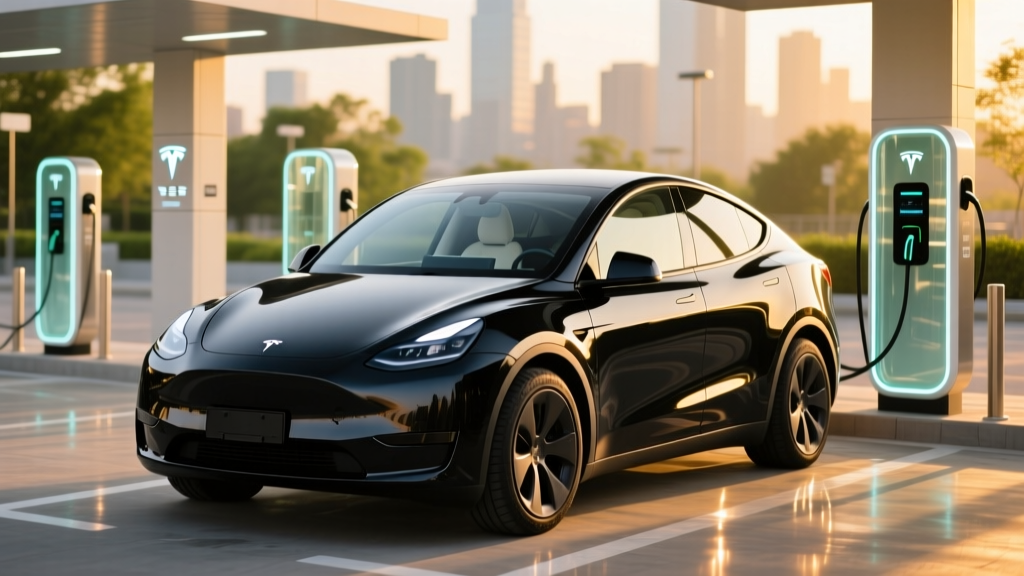
Tesla's Supercharger network now spans over 6,000 stations and 65,000+ individual stalls in North America. Pricing varies by location, time of day, and whether your vehicle qualifies for member pricing (Tesla owners typically save $0.05–$0.10/kWh vs. non-Tesla EVs using the network via NACS adapters).
- Average Supercharger rate (2026): $0.28–$0.36/kWh depending on region
- Typical 10–80% session (~52 kWh): $14.50–$18.75
- Full 0–100% equivalent: $21–$27
- Idle fees: $0.50–$1.00/minute if you remain plugged in after reaching your charge limit at a busy station
On a 600-mile road trip requiring two Supercharger stops, expect to spend roughly $30–$40 on charging — compared to $70–$90 in gasoline for a comparable ICE crossover.
Third-Party DC Fast Chargers (Electrify America, EVgo, ChargePoint)
Since the Model Y uses Tesla's NACS connector natively, you'll need an adapter (included with some vehicles, ~$150–$200 aftermarket) to use CCS1-equipped networks. Rates at third-party stations tend to be higher: $0.35–$0.55/kWh is common, pushing a 10–80% session to $18–$28. These stations remain useful for route flexibility, but the Supercharger network is almost always the cheaper and more reliable choice for Tesla owners.
| Method | Rate | Full Charge Cost | Cost/Mile |
|---|---|---|---|
| Home (off-peak) | $0.09/kWh | $6.75 | $0.02 |
| Home (avg. US) | $0.17/kWh | $12.75 | $0.04 |
| Home (CA/HI) | $0.30/kWh | $22.50 | $0.07 |
| Tesla Supercharger | $0.32/kWh avg | $24.00 | $0.08 |
| Third-party DCFC | $0.45/kWh avg | $33.75 | $0.11 |
| Gas SUV (25 MPG) | $3.50/gal | $44.80* | $0.14 |
*Gas SUV cost equivalent for 320 miles. Actual tank size varies.
Real-World Range: What the EPA Number Doesn't Tell You
EPA Estimated: 320 miles (Long Range AWD)
Real-World Highway (70 mph, mild weather): ~275–290 miles
Real-World City/Suburban (mixed regen): ~300–320 miles
Cold Weather (below 30°F, highway): ~220–255 miles (20–30% reduction)
Towing (light trailer, ~2,000 lbs): ~170–200 miles
The Model Y's efficiency of 27 kWh/100mi (per fueleconomy.gov) is among the best in the electric SUV segment. Regenerative braking recovers meaningful energy in stop-and-go driving, which is why city range often matches or exceeds the EPA sticker. Highway driving at sustained speeds is where all EVs lose range — and cold weather compounds this by increasing battery resistance and cabin-heating load.
Tesla's heat pump (standard on all 2026 Model Y trims) significantly reduces the cold-weather penalty compared to older EVs using resistive heaters, but physics is physics: expect a 20–30% range hit when temperatures drop below freezing, especially on highway trips where cabin heating runs continuously and the battery can't rely on regen to warm up.
Charging Speed: Supercharger, Level 2, and Level 1
The 2026 Model Y Long Range supports a peak DC fast-charge rate of 250 kW on V3 and V4 Superchargers. However, peak rate is not sustained rate — the charging curve tapers significantly above 60% state of charge to protect battery health.
| Level | Power | Miles Added/Hour | 10–80% Time |
|---|---|---|---|
| Level 1 (120V outlet) | ~1.4 kW | ~4–5 mi/hr | ~50+ hours |
| Level 2 (Wall Connector, 48A) | 11.5 kW | ~44 mi/hr | ~7.5 hours (full) |
| DC Fast (250 kW Supercharger) | 250 kW peak | ~1,000+ mi/hr (peak) | ~25 minutes |
| DC Fast (150 kW V2 Supercharger) | 150 kW peak | ~600 mi/hr (peak) | ~35 minutes |
Charging curve reality: The Model Y will pull close to 250 kW only between roughly 10–30% SoC. From 30–60%, expect 150–180 kW. Above 60%, the rate drops to 80–100 kW, and above 80% it falls below 50 kW. This is why Tesla's navigation system typically recommends charging to 80% on road trips — the time penalty for that last 20% is often longer than simply driving to the next station.
Preconditioning matters: If you navigate to a Supercharger using the car's built-in navigation, the Model Y will automatically warm the battery to optimal charging temperature before you arrive. Without preconditioning (e.g., arriving at a charger without using navigation), your initial charge rate can be 30–50% slower, especially in cold weather.
Performance, Interior, and Daily Livability
The 2026 Model Y Long Range AWD uses a dual-motor setup producing 384 horsepower and an estimated 376 lb-ft of torque. The 0–60 mph sprint takes 4.8 seconds — quick enough to merge onto any freeway with confidence, if not quite as thrilling as the discontinued Performance trim's 3.5-second run.
Cargo and Passenger Space
- Rear cargo (behind second row): 30.2 cu ft
- Cargo (second row folded): 72.1 cu ft
- Front trunk (frunk): 4.1 cu ft
- Rear legroom: 38.4 inches
- Front headroom: 41.0 inches
- Seating: 5 standard (optional 7-seat config available, third row best for children only)
The 7-seat option ($2,500) remains a compromise — the third row accommodates children or very short trips, but adults will find it cramped. For families regularly hauling more than five, a three-row electric SUV like the Kia EV9 or Rivian R1S is a better fit.
Tech and Driver Assistance
The 2026 Model Y continues with Tesla's minimalist interior anchored by a 15.4-inch center touchscreen. There is no instrument cluster — all information routes through the central display. Key tech features include:
- Autopilot (standard): Adaptive cruise control and lane centering on highways. This is an SAE Level 2 driver-assistance system — you must keep your hands on the wheel and eyes on the road at all times.
- Full Self-Driving Supervised ($8,000 option or $99/month): Adds automatic lane changes, traffic light/stop sign recognition, and assisted navigation on city streets. Despite the name, FSD is still SAE Level 2 and requires constant driver supervision. It is not autonomous driving.
- Over-the-air updates: Tesla regularly pushes software updates that add features, improve efficiency, and refine the UI.
- Sentry Mode: Cameras record surroundings when parked, providing security monitoring.
- Dashcam: Built-in multi-camera recording with USB export.
Tesla Autopilot and FSD (Supervised) are SAE Level 2 systems. They do NOT make the vehicle self-driving. The driver is legally and practically responsible for all vehicle operation at all times. NHTSA has issued multiple investigations into Autopilot-related incidents. Never use these systems as a substitute for attentive driving.
Notable Drawbacks
- No physical buttons: Climate, mirrors, and glovebox are all controlled through the touchscreen — a frustration for some drivers, especially in winter when gloves are involved.
- Ride quality: The Model Y's suspension, while improved in the 2025+ refresh, is still firmer than competitors like the Hyundai Ioniq 5 or Ford Mustang Mach-E. Road imperfections are noticeable on rough pavement.
- Visibility: The sloping roofline limits rear visibility; the digital rearview mirror helps but takes adjustment.
- Panel gaps and build consistency: Improved but still occasionally inconsistent compared to legacy automakers.
Pricing, Trims, and Federal Tax Credit Eligibility
The 2026 Tesla Model Y lineup starts at $44,990 for the Long Range AWD. Here's the full trim breakdown:
| Trim | MSRP | Est. §30D Credit | Effective Price |
|---|---|---|---|
| Long Range AWD | $44,990 | Up to $7,500 | ~$37,490 |
| Long Range AWD (7-seat) | $47,490 | Up to $7,500 | ~$39,990 |
| Performance AWD | $49,990 | Up to $7,500 | ~$42,490 |
Prices shown are base MSRP before destination fees ($1,390) and options. Tax credit amounts depend on individual eligibility — see checklist below.
Federal EV Tax Credit (§30D) Eligibility Checklist
The Model Y is assembled at Tesla's Fremont, California factory and Austin, Texas Gigafactory, and it has historically qualified for the full $7,500 federal tax credit under IRS §30D rules. However, eligibility is not automatic. You must meet ALL of the following:
- MSRP cap: Vehicle base price must be ≤ $80,000 for SUVs (all Model Y trims qualify).
- Buyer income cap: Modified AGI must not exceed $150,000 (single), $225,000 (head of household), or $300,000 (joint).
- Battery sourcing: A percentage of critical minerals and battery components must be sourced from the US or FTA-partner countries. Tesla has worked to localize supply chains, but specific credit amounts can shift as sourcing requirements tighten annually.
- Point-of-sale transfer: As of 2024+, you can transfer the credit to the dealer at purchase, reducing your out-of-pocket cost immediately rather than waiting for a tax refund.
- New vehicle: Must be purchased new; used Tesla purchases fall under a separate §25E credit (up to $4,000, different income caps).
Critical caveat: Battery-sourcing requirements tighten each year under the Inflation Reduction Act. A vehicle that qualifies for the full $7,500 in early 2026 may see partial credit reductions later in the year as new sourcing thresholds take effect. Always verify current eligibility on fueleconomy.gov before purchasing. Consult a tax professional for your specific situation.
How the Model Y Stacks Up Against Competitors
The electric midsize SUV segment has grown considerably. Here's how the Model Y compares to its three most cross-shopped rivals:
| Spec | Tesla Model Y LR | Hyundai Ioniq 5 LR | Ford Mach-E ER | Kia EV6 LR |
|---|---|---|---|---|
| EPA Range | 320 mi | 310 mi | 312 mi | 310 mi |
| Peak DCFC | 250 kW | 350 kW | 150 kW | 350 kW |
| 10–80% Time | ~25 min | ~18 min | ~37 min | ~18 min |
| Cargo (rear) | 30.2 cu ft | 27.2 cu ft | 29.7 cu ft | 24.4 cu ft |
| Base MSRP | $44,990 | $46,950 | $45,995 | $44,900 |
| Charging Network | Supercharger (native) | NACS adapter needed* | NACS adapter needed* | NACS adapter needed* |
*As of 2025+, Hyundai, Ford, and Kia EVs with NACS adapters can access Tesla Superchargers, though availability and pricing may differ from native Tesla vehicles.
- You want seamless access to the Supercharger network without adapters
- Cargo capacity is a priority (best-in-class 30.2 cu ft)
- You value OTA updates and the Tesla software ecosystem
- You want the lowest cost-per-mile at home
- You want the fastest possible DC charging (Ioniq 5/EV6 at 350 kW)
- You prefer physical buttons and a traditional instrument cluster
- You need genuine 7-passenger seating (consider the Kia EV9)
- Ride comfort is your top priority (Mach-E or Ioniq 5 are softer)
Ownership Costs: Warranty, Insurance, and Depreciation
Warranty: Tesla covers the Model Y's battery and drive unit for 8 years or 120,000 miles (whichever comes first), with a guarantee that the battery will retain at least 70% of its original capacity during that period. The limited vehicle warranty is 4 years / 50,000 miles. This is competitive with the segment, though Hyundai/Kia offer longer 10-year/100,000-mile battery warranties.
Insurance: Tesla vehicles tend to carry higher insurance premiums than comparable EVs due to repair costs and parts pricing. Expect annual premiums 15–30% higher than a similarly priced non-Tesla EV. Tesla offers its own insurance product in many states, which uses real-time driving data to set rates — safe drivers can save significantly, but aggressive drivers may pay more.
Depreciation: EV depreciation has been volatile. Tesla's aggressive price cuts in 2023–2024 hurt resale values across the board. The 2026 Model Y has stabilized somewhat, but plan for 45–55% depreciation over 5 years — higher than a comparable Toyota RAV4 Hybrid but in line with most EVs.
Maintenance: Minimal compared to ICE vehicles. No oil changes, no transmission fluid, no spark plugs. Budget for cabin air filter replacement (~$50–$100 every 2 years), tire rotation ($30–$50 every 6,000 miles), brake fluid checks, and wiper fluid. EVs eat tires faster due to instant torque and heavier weight — expect tire replacement every 30,000–40,000 miles at $200–$350 per tire.
Who Should Buy the 2026 Tesla Model Y?
The Model Y is the default recommendation for a reason: it does almost everything well enough to satisfy most buyers, and a few things (charging network access, cargo space, software) better than anyone else.
- Daily commuters with home charging: If you can install a Level 2 charger at home, the Model Y's ~$0.04/mile operating cost makes it one of the cheapest vehicles to drive daily, period.
- Families of 4–5: The cargo space handles strollers, groceries, and luggage easily. The optional third row works for young children on short trips.
- Frequent road trippers: The Supercharger network remains the most reliable and extensive DC fast-charging system in North America. Route planning through the Tesla nav system is seamless.
- Tech-forward buyers: OTA updates, the Tesla app, Sentry Mode, and the software ecosystem are genuinely best-in-class.
Who should skip it: Buyers who prioritize ride comfort, want the fastest DC charging times, prefer physical controls, or need genuine 7-seat capacity should test-drive the Ioniq 5, EV9, or Mach-E before committing.
Frequently Asked Questions
How much does it cost to charge a Tesla Model Y at home per month?
If you drive 1,000 miles per month and charge exclusively at home at the US average rate of $0.17/kWh, expect to spend roughly $38–$45 per month on electricity. That compares to $140+ in gasoline for a similar ICE SUV. With off-peak rates, the monthly cost can drop to $20–$25.
Is it cheaper to charge a Tesla at home or at a Supercharger?
Home charging is almost always cheaper. At the national average residential rate, home charging costs about $0.04/mile vs. $0.08/mile at a Supercharger. Over a year of 12,000 miles, that's a difference of roughly $480. Superchargers are best reserved for road trips.
Does the Tesla Model Y qualify for the $7,500 federal tax credit in 2026?
The Model Y has qualified for the full $7,500 credit under §30D, but eligibility depends on your income (must be under $150K single / $300K joint), the vehicle's battery sourcing compliance at time of purchase, and MSRP caps (all trims are under the $80K SUV cap). Always check fueleconomy.gov for the most current eligibility data and consult a tax professional.
How long does a Tesla Model Y battery last?
Tesla's battery warranty guarantees 70% capacity retention for 8 years or 120,000 miles. Real-world data from high-mileage Tesla owners suggests the NMC battery pack typically degrades 10–15% over the first 100,000 miles, with the rate of degradation slowing after the initial break-in period. Many Model Y batteries are expected to outlast 200,000 miles with usable capacity above 70%. Battery replacement, if ever needed, currently costs $12,000–$16,000 out of warranty.
Can I charge a Tesla Model Y on non-Tesla charging networks?
Yes, but you'll need a NACS-to-CCS adapter (available from Tesla and third parties for $150–$200) to use Electrify America, EVgo, and other CCS1-equipped networks. The experience is less seamless than Supercharging — you'll need separate apps and accounts, and reliability varies by network. For daily use, home Level 2 charging is the most convenient option regardless of network.
Is the Model Y better than the Hyundai Ioniq 5 or Kia EV6?
It depends on your priorities. The Ioniq 5 and EV6 charge faster (350 kW peak vs. 250 kW), offer more physical controls, and have slightly softer rides. The Model Y wins on cargo space (30.2 vs. 24–27 cu ft), native Supercharger access, and software features. For road-trippers who value charging reliability, the Model Y's Supercharger advantage is hard to overstate. For urban drivers who rarely road-trip, the Ioniq 5's faster charging and more comfortable interior may edge it out.