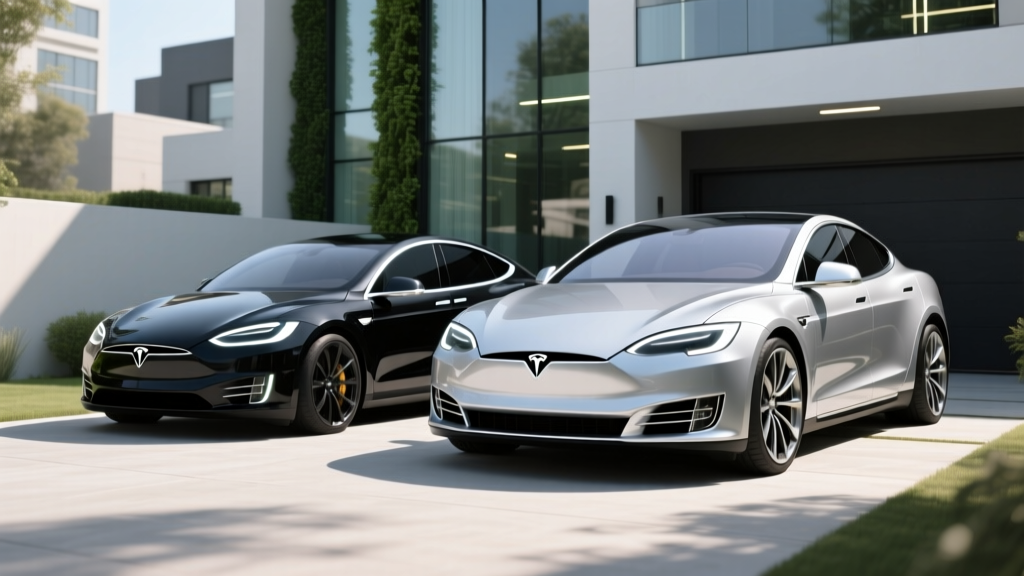
If you've searched "how much is a Tesla Plaid" and found conflicting numbers, you're not alone. Tesla's Plaid badge — its tri-motor, 1,020-horsepower performance tier — currently spans two vehicles: the Model S Plaid sedan and the Model X Plaid SUV. Both share the same powertrain architecture but differ meaningfully in range, price, cargo capacity, and real-world efficiency. This guide pins down exactly what each Plaid costs in 2026, what you actually get for the money, and whether the federal EV tax credit applies.
2026 Tesla Plaid Lineup at a Glance
| Spec | Model S Plaid | Model X Plaid |
|---|---|---|
| Base MSRP | $89,990 | $94,990 |
| EPA Range | 396 miles (19" wheels) | 320 miles (20" wheels) |
| Battery (usable) | ~95 kWh, NMC | ~95 kWh, NMC |
| Drivetrain | Tri-Motor AWD | Tri-Motor AWD |
| Horsepower | 1,020 hp | 1,020 hp |
| 0-60 mph | 1.99 sec | 2.5 sec |
| Top Speed | 200 mph | 163 mph |
| Peak DC Charge Rate | 250 kW | 250 kW |
| 10-80% DCFC Time | ~27 min | ~30 min |
| Level 2 Home Charge | 11.5 kW (~41 mi/hr) | 11.5 kW (~36 mi/hr) |
| MPGe (combined) | 120 MPGe | 101 MPGe |
| Battery Warranty | 8 yr / 150,000 mi | 8 yr / 150,000 mi |
| Cargo (rear + frunk) | 28 cu ft (rear) + 3.1 cu ft (frunk) | 88 cu ft (max) + 3.1 cu ft (frunk) |
Source: EPA / fueleconomy.gov and Tesla.com. Prices reflect base MSRP before destination fees, options, or incentives.
How Much Does a Tesla Plaid Actually Cost?
The headline number is the base MSRP, but real-world transaction prices climb quickly once you add paint, wheels, and software. Here's a realistic breakdown of what buyers actually pay at signing.
| Cost Item | Model S Plaid | Model X Plaid |
|---|---|---|
| Base MSRP | $89,990 | $94,990 |
| Destination Fee | $1,990 | $1,990 |
| 21" Arachnid Wheels (common upgrade) | $4,500 | $5,500 |
| Premium Paint (e.g., Ultra Red) | $2,500 | $2,500 |
| FSD (Supervised) — one-time purchase | $8,000 | $8,000 |
| Typical As-Tested Price | ~$106,980 | ~$112,980 |
| Federal §30D Tax Credit | $0 (exceeds MSRP cap) | $0 (exceeds MSRP cap) |
| Estimated Out-of-Pocket | ~$106,980 | ~$112,980 |
Does the Tesla Plaid Qualify for the Federal EV Tax Credit?
No. Under current IRS §30D rules, the federal EV tax credit (up to $7,500) has an MSRP cap: $55,000 for sedans and $80,000 for SUVs, vans, and trucks. Both the Model S Plaid ($89,990) and Model X Plaid ($94,990) exceed these thresholds. Additionally, buyer income caps apply ($300K joint / $225K head of household / $150K single for modified AGI). Even if the MSRP were under the limit, high-income buyers would be excluded. Always verify current rules at IRS.gov before making a purchase decision.
Real-World Range: What the EPA Sticker Doesn't Tell You
Model S Plaid: EPA 396 miles (19" wheels). Expect ~310-340 miles in mixed highway driving at 70-75 mph, and ~260-290 miles in sub-freezing winter conditions.
Model X Plaid: EPA 320 miles (20" wheels). Expect ~250-275 miles highway and ~210-235 miles in cold weather.
The Model S Plaid's 396-mile EPA figure is among the highest of any production EV, but real-world results depend heavily on three factors:
- Wheel size: The 396-mile rating applies to the standard 19" Tempest wheels. Opting for the 21" Arachnid wheels drops the EPA rating to roughly 359 miles due to higher rolling resistance and weight.
- Speed: At sustained 80 mph highway cruising, efficiency drops to roughly 300-320 Wh/mi (vs. the EPA-rated ~258 Wh/mi), cutting range by 15-20%.
- Temperature: In 20-30°F conditions, battery chemistry (NMC) loses roughly 20-30% of usable capacity without preconditioning. Tesla's heat pump mitigates cabin energy draw, but the battery itself still suffers reduced efficiency until it reaches operating temperature.
The tri-motor Plaid powertrain also consumes more energy than the dual-motor Long Range variants. If maximum range is your priority over 0-60 bragging rights, the Model S Long Range (402 miles EPA, ~$74,990) is the more efficient choice.
Charging Speed: DC Fast and Home Level 2
| Charging Method | Power | Model S Plaid | Model X Plaid |
|---|---|---|---|
| Level 1 (120V household) | ~1.4 kW | ~3-4 mi/hr | ~3 mi/hr |
| Level 2 (240V home, 48A) | 11.5 kW | ~41 mi/hr | ~36 mi/hr |
| DC Fast (Tesla Supercharger V3) | Peak 250 kW | 10-80% in ~27 min | 10-80% in ~30 min |
| DC Fast (CCS adapter, non-Tesla) | Peak ~150-170 kW* | 10-80% in ~35-40 min | 10-80% in ~38-42 min |
*CCS adapter speeds vary by station. Tesla's Magic Dock and third-party CCS chargers may not sustain peak rates as consistently as V3/V4 Superchargers.
Understanding the Charging Curve
The Plaid's 250 kW peak rate is only sustained between roughly 10-30% state of charge (SoC). Above 50%, the rate tapers to ~150 kW, and above 80%, it drops further to ~50-75 kW to protect the NMC battery. This is why Tesla (and every other manufacturer) quotes 10-80% times rather than 0-100%. Charging from 80-100% can add another 25-30 minutes — plan accordingly on road trips and aim to charge to 80% unless you need the full battery for the next leg.
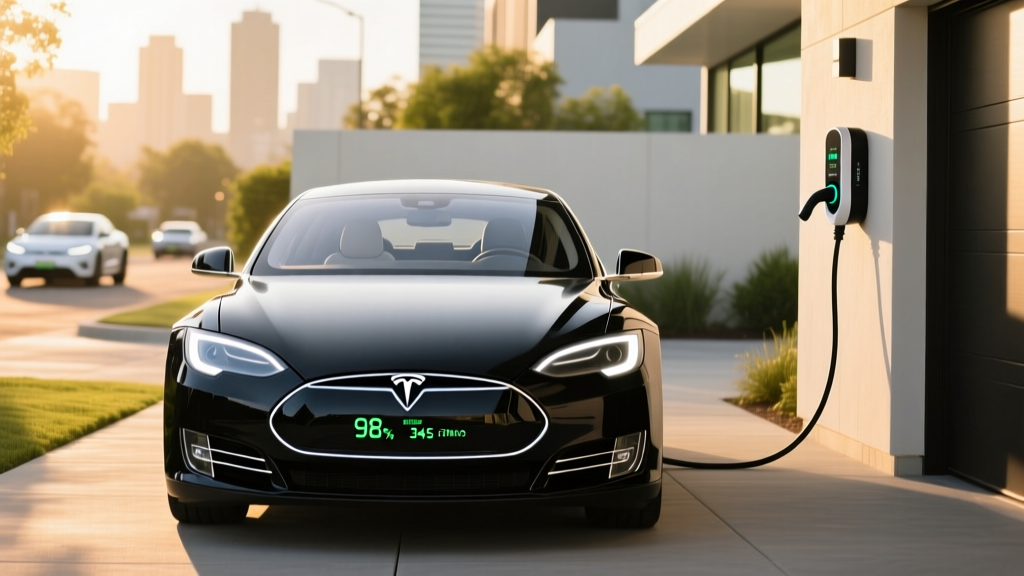
At home on a 48-amp Level 2 Wall Connector, both Plaid models recover a full overnight charge in roughly 8-9 hours. If your home has a 60-amp circuit available, Tesla's Wall Connector is a strong, integrated choice. Homes with older 100-amp electrical panels may need a panel upgrade ($1,500-$3,000) before installing a dedicated 60-amp EV circuit — budget for this when planning your charging setup.
Performance: 1,020 HP and What It Means on the Road
The Plaid's tri-motor layout uses one motor on the front axle and two on the rear, enabling torque vectoring across the rear wheels. The result is a claimed 1.99-second 0-60 mph for the Model S Plaid — but with a critical caveat: Tesla measures this with a 1-foot rollout subtracted (drag-strip convention). The actual 0-60 from a standstill is closer to 2.1-2.2 seconds, as verified by independent testing from outlets like MotorTrend and Car and Driver. Still, this makes the Model S Plaid one of the fastest production cars ever built, regardless of powertrain type.
Real-world performance notes:
- Track mode: The Model S Plaid includes a Track Mode that adjusts torque distribution, cooling, and suspension for circuit use. Sustained track sessions require the optional carbon-ceramic brake package ($8,000+) to avoid brake fade.
- Yoke steering: Both Plaid models come standard with the yoke (rectangular) steering wheel. A round wheel is available as a no-cost swap at order time, but not after delivery. Most daily drivers prefer the round wheel for low-speed maneuvers and parking.
- Launch consistency: To achieve peak 0-60 times, the battery must be at high SoC (>80%) and preconditioned. Cold batteries or low charge states reduce peak power output significantly.
Tech, Interior, and Daily Livability
The 2026 Model S and Model X share Tesla's current-generation interior architecture, including:
- 17" center touchscreen (landscape orientation, 2200 x 1300 resolution)
- 12.3" driver instrument cluster
- 8" rear-seat touchscreen for climate and entertainment
- 22-speaker audio system with active noise cancellation
- HEPA air filtration (Bioweapon Defense Mode)
- Ventilated front seats and heated rear seats
Autopilot and FSD (Supervised)
SAE Level 2 — Driver Assistance, NOT Self-Driving. Tesla's Autopilot (standard) and FSD Supervised ($8,000 one-time or $99/month) are Level 2 systems under SAE classification. This means the driver must remain fully attentive, keep hands on the wheel (or yoke), and be ready to take over at any moment. FSD Supervised can navigate highway interchanges, stop lights, and city streets, but it makes errors and requires constant supervision. It is not autonomous driving. Only Level 4 services like Waymo operate without a human driver in defined areas.
Cargo and Passenger Space
The Model S Plaid offers 28 cu ft of rear cargo space (hatchback-style liftback) plus a 3.1 cu ft frunk. Rear legroom is 40.9 inches, adequate for adults on longer trips.
The Model X Plaid is the family hauler: 88 cu ft of max cargo volume (with second and third rows folded) in the 5-seat configuration, or ~46 cu ft behind the second row in 6- or 7-seat layouts. The falcon-wing rear doors provide excellent access in tight parking spots, though they're slower to open/close than conventional doors and can be finicky in low-clearance garages.
Pros and Cons of the Tesla Plaid
Pros
- Class-leading acceleration — 1.99s 0-60 (Model S) is supercar territory
- Excellent EPA range (396 mi for S Plaid with 19" wheels)
- Access to Tesla Supercharger network — the most reliable DC fast-charging network in the US
- Over-the-air updates continuously add features
- Tri-motor torque vectoring provides exceptional all-weather traction
- Model X falcon-wing doors and available 7-seat layout offer unique family utility
Cons
- No federal tax credit — both models exceed §30D MSRP caps
- High starting price — realistically $100K+ after common options
- Yoke steering is polarizing and not ideal for daily low-speed use
- 250 kW peak DC charge rate lags behind Hyundai Ioniq 5 (350 kW) and Porsche Taycan (320 kW)
- Interior build quality has improved but still trails Mercedes EQS and Lucid Air in material quality
- FSD Supervised is expensive ($8K) and remains Level 2 — not autonomous
How Does the Tesla Plaid Compare to Key Competitors?
At this price point, the Plaid competes with a handful of high-performance EVs. Here's how it stacks up against its most direct rivals:
| Spec | Tesla Model S Plaid | Lucid Air Grand Touring | Porsche Taycan Turbo S | BMW i7 M70 |
|---|---|---|---|---|
| Price | $89,990 | $125,650 | $190,500 | $168,595 |
| EPA Range | 396 mi | 512 mi | 256 mi | 295 mi |
| 0-60 mph | 1.99 sec | 3.0 sec | 2.4 sec | 3.5 sec |
| HP | 1,020 | 819 | 750 | 650 |
| Peak DC Charge | 250 kW | 300 kW | 320 kW | 195 kW |
| Tax Credit | No | No | No | No |
Which Performance EV Should You Choose?
Choose the Tesla Model S Plaid if: You want the fastest acceleration under $100K, value the Supercharger network for road trips, and prefer a tech-forward, minimalist interior.
Choose the Lucid Air Grand Touring if: Maximum range (512 mi EPA) and rear-seat luxury are top priorities, and budget can stretch to $125K+.
Choose the Porsche Taycan Turbo S if: Driving dynamics, build quality, and brand prestige matter more than straight-line acceleration or range, and cost is secondary.
Choose the BMW i7 M70 if: You want a full-size luxury sedan with executive rear seating and don't need sub-3-second 0-60 times.
Who Is the Tesla Plaid Best Suited For?
The Plaid is a niche within a niche. Here's who benefits most from the investment:
- Tech-enthusiast commuters who want daily-driver practicality (396-mi range means charging once a week for most commutes) with supercar-level acceleration for on-ramps and passing.
- Families needing performance + space (Model X Plaid specifically) — the 7-seat layout, falcon-wing doors, and 1,020 hp make it uniquely capable as both a school-run hauler and a weekend canyon carver.
- Road-trippers who value Tesla's Supercharger network reliability. With 250 kW peak charging, a 20-25 minute stop adds ~180-200 miles of range — competitive for long-distance travel.
The Plaid is not ideal for budget-conscious buyers (no tax credit, $100K+ real-world cost), luxury traditionalists who want handcrafted interiors (look at Lucid or Porsche), or those who prioritize charging speed above all else (the 800V architectures in the Taycan and Ioniq 5 charge faster).
Frequently Asked Questions
How much is a Tesla Plaid in 2026?
The Model S Plaid starts at $89,990 and the Model X Plaid starts at $94,990. After destination fees and common options (wheels, paint, FSD), expect to pay $105,000-$115,000 out the door.
Does the Tesla Plaid qualify for the $7,500 federal EV tax credit?
No. Under current IRS §30D rules, sedans must have an MSRP under $55,000 and SUVs under $80,000 to qualify. Both Plaid models exceed these caps. Buyer income limits ($300K joint / $150K single) also apply. Verify current rules at IRS.gov.
What is the real-world range of the Model S Plaid?
The EPA rates the Model S Plaid at 396 miles (19" wheels). In real-world highway driving at 70-75 mph, expect 310-340 miles. In freezing temperatures, that drops to roughly 260-290 miles. Choosing 21" wheels reduces EPA range to ~359 miles.
How fast does the Tesla Plaid charge?
On a Tesla V3 Supercharger, both Plaid models peak at 250 kW and charge from 10-80% in approximately 27-30 minutes. On a 48-amp home Level 2 charger (11.5 kW), a full charge takes about 8-9 hours. The charge rate tapers significantly above 80% SoC.
Is the Tesla Plaid worth it vs. the Model S Long Range?
If straight-line acceleration (1.99s vs. 3.1s 0-60) and tri-motor torque vectoring matter to you, the Plaid justifies its ~$15,000 premium. If you primarily want range, daily comfort, and lower cost, the Long Range (402 mi EPA, ~$74,990) is the smarter buy. The Long Range also achieves slightly better real-world efficiency.
What's the battery warranty on a Tesla Plaid?
Tesla covers the Model S and Model X Plaid battery and drive unit for 8 years or 150,000 miles, whichever comes first, with a minimum 70% capacity retention guarantee. This is slightly better than the industry-standard 8yr/100,000mi, reflecting the premium positioning of these models.
Can I charge a Tesla Plaid at non-Tesla charging stations?
Yes. Tesla now includes a NACS (Tesla) charge port, and you can use the included CCS adapter to charge at Electrify America, EVgo, and other CCS-equipped networks. However, peak speeds on non-Tesla chargers may be limited to 150-170 kW depending on the station. The Supercharger network remains the fastest, most reliable option.
Safety data: Check current NHTSA ratings and IIHS crash-test results before purchasing, as ratings are updated periodically.