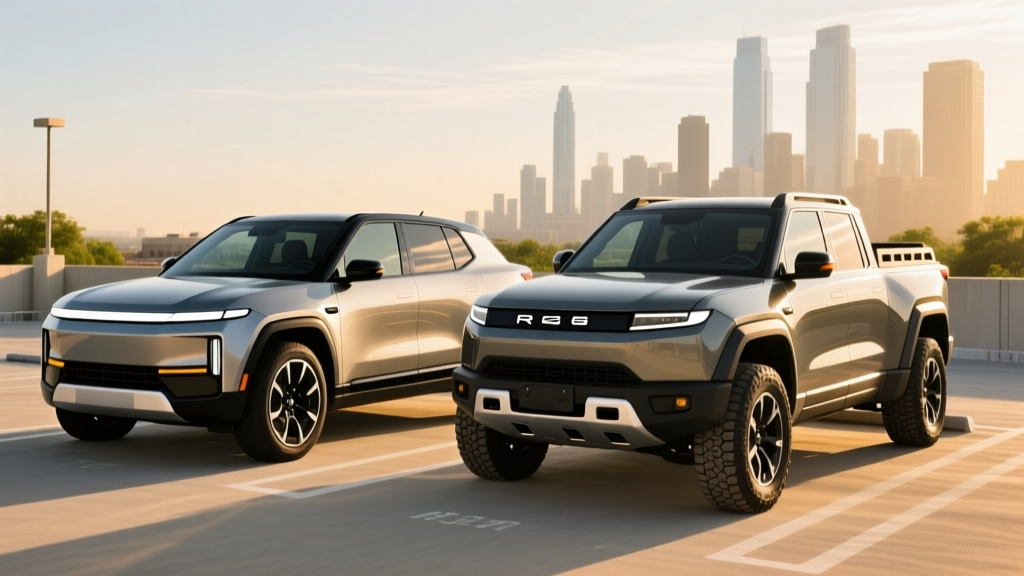
If you're researching how much is it to lease a Rivian, you've likely noticed that Rivian doesn't publish lease rates on its configurator the way legacy automakers do. Lease costs depend on trim level, battery pack choice, residual values, money factors, and whether you can capture the $7,500 federal EV tax credit through a point-of-sale transfer. This guide breaks down every number you need for the 2026 Rivian R1S (three-row SUV) and R1T (pickup) — including real-world range, charging speed, and total cost of ownership.
2026 Rivian R1S and R1T: Lease Pricing at a Glance
Rivian's current-generation R1 vehicles (the "Gen 2" platform introduced for 2025) carry MSRPs that place them firmly in the premium EV segment. Lease payments scale accordingly. Here's the starting-point pricing for the 2026 model year:
| Model | Trim | Battery | MSRP (before delivery) | Est. Monthly Lease (36 mo, 10k mi/yr) |
|---|---|---|---|---|
| R1S | Adventure | Standard (92.5 kWh usable) | $75,900 | $850 – $1,050 |
| R1S | Adventure | Max (141 kWh usable) | $85,900 | $1,050 – $1,250 |
| R1S | Ascend | Max | $95,000+ | $1,200 – $1,450 |
| R1T | Adventure | Standard | $69,900 | $750 – $950 |
| R1T | Adventure | Max | $79,900 | $950 – $1,150 |
| R1T | Ascend | Max | $89,000+ | $1,100 – $1,350 |
Why lease estimates vary so widely: Rivian uses a captive finance arm (Rivian Automotive Leasing) and third-party partner banks. Your actual payment depends on your credit tier, the negotiated capitalized cost, the residual percentage (typically 48–55% for 36 months), the money factor (lease interest rate equivalent), and any down payment. A $2,000 drive-off can lower the monthly payment by roughly $55–$65/month on a 36-month term.
Lease Cost After Federal Tax Credit
The IRS §30D New Clean Vehicle Credit offers up to $7,500 for eligible buyers. For leases, there's a critical distinction: the credit technically goes to the lessor (the finance company), not you. However, Rivian and most EV lessors pass this savings to the lessee as a capitalized cost reduction, effectively lowering your monthly payment by roughly $180–$210/month over 36 months.
- MSRP cap: SUVs (R1S) must be ≤ $80,000; trucks (R1T) must be ≤ $80,000. Higher-trim R1S models may exceed this.
- Income cap: AGI ≤ $150,000 (single), $225,000 (head of household), $300,000 (joint).
- Battery sourcing: Critical mineral and battery component thresholds apply and tighten annually. Confirm current-year compliance on the IRS eligible vehicles list.
- Point-of-sale transfer: You can elect to transfer the credit to the dealer/lessor at purchase, reducing your upfront cost.
EPA Range and Real-World Expectations
Range is the first spec EV buyers check — and the one where the sticker number diverges most from reality. Here's what the EPA says versus what you'll see on the road:
Rivian R1S Range: EPA vs. Real World
| Configuration | EPA Range | Real-World Highway (70–80 mph) | Cold Weather (below 30°F) |
|---|---|---|---|
| Dual-Motor, Standard Pack | 270 miles | ~220–240 miles | ~185–210 miles |
| Dual-Motor, Max Pack | 410 miles | ~330–360 miles | ~275–310 miles |
| Tri-Motor Performance, Max | 390 miles | ~310–340 miles | ~260–290 miles |
Real-world note: Rivian's boxy aerodynamics (drag coefficient ~0.30) hurt highway efficiency compared to sleeker crossovers. In our experience, 75-mph highway driving consistently yields 15–18% below EPA range. Cold weather compounds this — expect 25–35% range loss in sub-freezing temperatures due to battery heating demands and cabin climate load. The available heat pump on Gen 2 models mitigates this somewhat compared to resistive heating.
Rivian R1T Range: EPA vs. Real World
| Configuration | EPA Range | Real-World Highway | Cold Weather |
|---|---|---|---|
| Dual-Motor, Standard Pack | 270 miles | ~225–245 miles | ~190–210 miles |
| Dual-Motor, Max Pack | 420 miles | ~340–370 miles | ~285–320 miles |
| Tri-Motor Performance, Max | 400 miles | ~320–350 miles | ~270–300 miles |
For context, the EPA's fueleconomy.gov listings confirm these figures. The Max Pack's enormous 141 kWh usable battery is what makes 400+ mile EPA ratings possible — but it also adds significant weight (the R1S Max Pack tips the scales around 7,100 lbs), which impacts efficiency.
Battery, Chemistry, and Efficiency
| Spec | Standard Pack | Max Pack |
|---|---|---|
| Usable capacity | 92.5 kWh | 141 kWh |
| Chemistry | NMC (nickel manganese cobalt) | NMC (2170 cylindrical cells) |
| Cell format | 2170 cylindrical | 2170 cylindrical |
| Thermal management | Active liquid cooling + heat pump | Active liquid cooling + heat pump |
| EPA efficiency (R1S Dual-Motor) | ~2.0 kWh/mi (73 MPGe combined) | ~2.1 kWh/mi (70 MPGe combined) |
| kWh per 100 miles (R1S) | ~48–50 kWh/100mi | ~50–52 kWh/100mi |
Rivian uses NMC chemistry across both packs, unlike some competitors (notably Tesla's Standard Range models and Ford's LFP-equipped Mach-E) that have shifted to lithium iron phosphate (LFP) for cost and longevity. NMC offers higher energy density — essential for fitting 141 kWh into the Max Pack — but comes with faster calendar degradation and a lower cycle-life ceiling than LFP. In practical terms, Rivian's battery warranty (see below) protects you, and real-world degradation data on Gen 2 packs is still accumulating.
Charging Speed: DC Fast and Home Level 2
Charging speed is where Rivian owners spend or save the most time. Here's the full picture:
| Charging Level | Power / Rate | Time or Speed | Notes |
|---|---|---|---|
| Level 1 (120V household) | ~1.4 kW | ~3–4 miles per hour | Emergency/trickle only; impractical for Max Pack |
| Level 2 (240V home, 48A) | 11.5 kW | ~25–30 miles per hour; Standard Pack 0–100% in ~9 hrs | Requires NEMA 14-50 or hardwired Wall Connector; Rivian Wall Connector sold separately |
| Level 2 (240V, 60A circuit) | Up to 11.5 kW (onboard charger limited) | Same as above | Rivian's onboard AC charger caps at 11.5 kW — a 60A circuit won't charge faster |
| DC Fast Charge (Standard) | Peak 200 kW | 10–80% in ~28 minutes | Charge curve tapers significantly above 80% |
| DC Fast Charge (Max Pack) | Peak 220 kW | 10–80% in ~36 minutes | Larger battery absorbs more total energy; sustained rate matters more than peak |
Real-world charging insight: Rivian's peak DC charge rate is competitive but not class-leading. The Hyundai Ioniq 5 and Kia EV6 can peak at 350 kW on 800V architectures, achieving 10–80% in ~18 minutes. Rivian's 400V architecture means longer DC fast-charge sessions, particularly on the Max Pack where the sheer volume of kWh to replenish (roughly 100 kWh from 10–80%) takes time even at 220 kW. On a road trip, plan for 35–45 minute stops with a Max Pack vehicle.
Rivian now uses the NACS (Tesla) charge port as standard on all 2025+ Gen 2 vehicles, granting native access to the Tesla Supercharger network — currently the most reliable DC fast-charging infrastructure in the U.S. CCS adapters are no longer needed for non-Tesla networks, though an adapter for older CCS stations may still be useful in some areas.
Performance and Drivetrain
| Spec | R1S Dual-Motor | R1S Tri-Motor | R1T Dual-Motor | R1T Tri-Motor |
|---|---|---|---|---|
| Horsepower | 533 hp | 850 hp | 533 hp | 850 hp |
| Torque | 610 lb-ft | 1,100 lb-ft | 610 lb-ft | 1,100 lb-ft |
| 0–60 mph | 4.5 sec | 2.9 sec | 4.5 sec | 2.9 sec |
| Drivetrain | AWD (dual motor) | AWD (tri motor) | AWD (dual motor) | AWD (tri motor) |
| Towing capacity | 7,700 lbs | 7,700 lbs | 11,000 lbs | 11,000 lbs |
| Ground clearance | 8.7 in (up to 14.4 in max) | 8.7 in (up to 14.4 in max) | 8.7 in (up to 14.4 in max) | 8.7 in (up to 14.4 in max) |
| Wading depth | Up to 36 in | Up to 36 in | Up to 36 in | Up to 36 in |
The tri-motor Performance variants are brutally quick — a 7,100-lb SUV hitting 60 mph in under 3 seconds is genuinely startling. But the dual-motor with 533 hp is already faster than most buyers will ever need, and it preserves more range. Towing will cut range by 40–50% regardless of configuration; if you plan to tow frequently, the Max Pack is strongly recommended.
Cargo, Passenger Space, and Practicality
R1S (three-row SUV):
- Cargo behind 3rd row: ~11 cu ft
- Cargo behind 2nd row (3rd folded): ~46 cu ft
- Cargo behind 1st row (all rear folded): ~83 cu ft
- Front trunk (frunk): ~11 cu ft
- 3rd-row legroom: ~30 inches — tight for adults, fine for children
- 2nd-row legroom: ~37 inches
R1T (crew-cab pickup):
- Bed length: 4.5 feet (54 inches) — shorter than most full-size trucks
- Gear Tunnel: ~11 cu ft of enclosed, lockable cross-vehicle storage (unique to Rivian)
- Frunk: ~11 cu ft
- Bed payload: ~1,760 lbs
- Rear-seat legroom: ~38 inches
The R1T's Gear Tunnel is a standout feature — a full-width compartment accessible from either side of the truck, perfect for camping gear, charging cables, or muddy boots. No competitor offers anything equivalent.
Warranty Coverage
| Coverage | Term |
|---|---|
| Limited vehicle warranty | 5 years / 60,000 miles |
| Battery & powertrain | 8 years / 175,000 miles |
| Battery capacity retention | ≥70% over 8 yr / 175,000 mi |
| Roadside assistance | 5 years / 60,000 miles |
| Corrosion perforation | 5 years / unlimited miles |
Rivian's battery warranty threshold of 70% capacity retention is industry-standard, matching Tesla and Ford. The 175,000-mile cap is generous compared to the 100,000-mile limits some competitors use. For leaseholders on a typical 36-month / 30,000-mile lease, warranty coverage will far exceed your ownership period — any battery concern is Rivian's problem, not yours.
Technology, Driver Assistance, and Drawbacks
Standout tech:
- 15.6-inch center touchscreen with Rivian's custom OS — responsive, well-designed, with over-the-air update capability
- Driver+ (SAE Level 2 driver-assist): adaptive cruise, lane centering, automatic lane changes on highways. Competent but not class-leading compared to GM's Super Cruise or Ford's BlueCruise
- Highway Assist with hands-on-wheel requirement — no hands-free driving mode currently offered
- Camp Kitchen accessory (R1T): integrated slide-out electric kitchen with induction cooktop — a Rivian-exclusive lifestyle feature
- Vehicle-to-load (V2L): can power external devices and appliances via bed outlets and frunk
- Phone-as-key with automatic unlock and start
Driver Assistance Limitation
Rivian's Driver+ is an SAE Level 2 system. You must keep your hands on the steering wheel and remain fully engaged at all times. It is not self-driving. It does not handle construction zones, unmapped roads, or severe weather reliably. Always maintain situational awareness.
Notable drawbacks:
- No Apple CarPlay or Android Auto — Rivian uses its own infotainment exclusively. If you rely heavily on phone projection, this is a dealbreaker
- DC charging speed trails 800V competitors — Hyundai/Kia/Porsche platforms charge significantly faster
- Service center network still expanding — rural owners may face long travel distances for warranty repairs
- 3rd-row space (R1S) is cramped for adults on longer trips
- High insurance premiums — Rivian owners report rates 20–40% above comparable ICE SUVs/trucks
Pros
- Class-leading adventure capability (ground clearance, wading, AWD)
- 400+ mile EPA range with Max Pack
- Native NACS / Supercharger access
- Unique Gear Tunnel (R1T) and Camp Kitchen ecosystem
- Tri-motor performance is supercar-level in an SUV/truck
- Strong OTA update track record
- Generous 8-yr / 175,000-mi battery warranty
Cons
- No Apple CarPlay / Android Auto
- DC charging slower than 800V rivals
- Lease payments are premium-tier ($850–$1,450/mo)
- Real-world highway range drops 15–18% below EPA
- Service network gaps in rural areas
- High insurance costs
- Towing severely impacts range
Lease vs. Buy: Which Makes More Sense for a Rivian?
For many buyers, leasing a Rivian makes financial sense for three reasons:
- Depreciation protection. EVs have experienced volatile resale values. A lease transfers that risk to the lessor.
- Tax credit capture. Even if your income exceeds the §30D cap, a lease may allow the lessor to claim the commercial EV credit and pass savings to you (the "lease loophole" — technically a pass-through of the §45W commercial credit, though this provision has been under legislative review; confirm current status with your tax advisor).
- Technology refresh. Battery chemistry, charging speed, and ADAS features improve rapidly. A 36-month lease lets you upgrade to the next generation without selling.
However, buying makes sense if you plan to keep the vehicle 5+ years, drive under 10,000 miles annually, or want to customize (Rivian's accessory ecosystem is extensive). Lease mileage penalties (typically $0.25–$0.30/mile over the limit) add up fast for high-mileage drivers.
Who Should Lease a Rivian?
The R1S is ideal for: Active families who need three rows, tow boats or campers on weekends, and want a premium EV that handles both school runs and dirt roads. The Max Pack is worth the upcharge if you road-trip frequently.
The R1T is ideal for: Outdoor enthusiasts, light-duty truck users, and anyone who values the Gear Tunnel and frunk over bed length. It's not a work-site hauler — the 4.5-foot bed and $70K+ price make it a lifestyle truck, not a fleet vehicle.
Skip the Rivian if: You need CarPlay, you drive 20,000+ highway miles per year (consider a more efficient sedan like the Lucid Air or Tesla Model S), you need best-in-class DC charging speed, or your budget maxes out around $50,000 (look at the Hyundai Ioniq 5, Kia EV6, or Tesla Model Y instead).
Frequently Asked Questions
What is the cheapest way to lease a Rivian in 2026?
The R1T Adventure with the Standard Pack at $69,900 MSRP is the entry point. With the $7,500 federal credit applied as a cap cost reduction and a 36-month term, expect roughly $750–$850/month with $2,000–$3,000 due at signing. Your actual rate depends on credit score and regional incentives.
Does the Rivian R1S qualify for the $7,500 federal EV tax credit?
It depends on the trim and your income. The R1S Adventure Standard Pack at $75,900 MSRP falls under the $80,000 SUV cap. The R1S Ascend and Max Pack configurations may exceed it, which would disqualify a purchase from the §30D credit. However, leasing may bypass the MSRP cap through the commercial credit pass-through — verify current rules with IRS guidance and a tax professional.
How fast does a Rivian charge at home?
On a 240V Level 2 home charger at 48 amps, Rivian's 11.5 kW onboard charger adds roughly 25–30 miles of range per hour. A full Standard Pack charge takes about 9 hours; the Max Pack takes roughly 13 hours. Most owners charge overnight and wake up with a full battery. Home charger installation (NEMA 14-50 outlet or hardwired) typically costs $500–$2,000 depending on your electrical panel's capacity and distance to the parking spot.
Is it better to lease or buy a Rivian?
Leasing is advantageous if you want to avoid depreciation risk, potentially access the tax credit regardless of income (via the lease pass-through), and upgrade every 3 years. Buying is better for high-mileage drivers, long-term keepers, and those who want to modify the vehicle. Run the math with your specific income, mileage, and hold period.
How does Rivian compare to the Tesla Model X or Ford F-150 Lightning?
Against the Tesla Model X: Rivian offers superior off-road capability, a more rugged build, and native Supercharger access. The Model X offers faster charging, better efficiency, Autopilot/FSD, and falcon-wing doors. Against the F-150 Lightning: the R1T is more premium, more capable off-road, and has the Gear Tunnel, but the Lightning has a larger bed, lower starting price, and a more established dealer/service network. For a family SUV, the R1S competes more directly with the Kia EV9 and Tesla Model X.
What is Rivian's real-world range on a road trip?
For the Max Pack R1S (410 miles EPA), plan for roughly 330–360 miles at 70–75 mph in moderate weather, and 275–310 miles in cold conditions. The Standard Pack delivers roughly 220–240 highway miles. Always plan charging stops at 15–20% remaining SoC to avoid range stress and to take advantage of the faster portion of the charge curve (10–80% is much faster than 80–100%).