If you've been searching "how much is a Model S" you already know Tesla's flagship sedan occupies a strange space in the EV market: it's simultaneously the benchmark that launched the electric luxury segment and a vehicle whose price tag demands serious justification against newer rivals. For 2026, the Model S continues with dual-motor Long Range and tri-motor Plaid trims, incremental software and battery refinements, and a pricing structure that shifts more often than most automakers'. Here's the complete financial and technical picture before you configure one.
2026 Tesla Model S Pricing by Trim
Tesla adjusts pricing periodically throughout the year, so treat these figures as the current snapshot. Destination charges add approximately $1,390 to every configuration.
| Trim | Base MSRP | Drivetrain | EPA Range | 0-60 mph |
|---|---|---|---|---|
| Long Range (Dual Motor AWD) | $79,990 | Dual-Motor AWD | 402 mi | 3.1 sec |
| Plaid (Tri-Motor AWD) | $94,990 | Tri-Motor AWD | 396 mi | 1.99 sec |
Common options that push as-tested prices higher include 21-inch Arachnid wheels ($4,500, which reduces range to roughly 359 miles on Long Range), Full Self-Driving (Supervised) capability ($8,000 one-time or $99/month), and premium interior colors ($1,500–$2,500). A fully optioned Long Range can land near $92,000 before taxes; a loaded Plaid clears $110,000.
Federal Tax Credit Eligibility (§30D)
The Model S does not qualify for the $7,500 federal EV tax credit under current IRS §30D rules. The reason is straightforward: the statute caps eligible sedans at an MSRP of $55,000. Even the base Long Range at $79,990 exceeds that threshold by a wide margin. Buyer income caps ($150,000 single / $300,000 joint) and battery critical-mineral sourcing requirements are moot here — the MSRP cap alone disqualifies it.
If you're set on a Tesla and need the credit, the Model 3 (sedan cap applies) and Model Y (classified as an SUV, $80,000 cap) are the brand's eligible vehicles, subject to current-year sourcing and income rules that change frequently. Always verify on the IRS clean vehicle credit page before purchasing.
Range, Battery, and Real-World Efficiency
The Long Range Model S carries an EPA-estimated 402 miles of range — still among the highest of any production EV sold in the US. The Plaid sacrifices a handful of miles (396 EPA) for its third motor and performance tuning. Both trims use a ~100 kWh (usable) battery pack with NMC (nickel manganese cobalt) chemistry, which Tesla has favored in its long-range and performance vehicles for its higher energy density compared to LFP.
Real-World Range vs. EPA Sticker
EPA estimate: 402 mi (Long Range) / 396 mi (Plaid)
Real-world highway (70-75 mph, moderate temps): ~320-340 mi
Real-world city/mixed driving: ~360-380 mi
Cold weather (below 32°F, highway): ~260-300 mi
Like all EVs, the Model S loses range to high-speed driving where aerodynamic drag dominates, and to cold temperatures where battery resistance increases and cabin heating draws energy. Tesla's heat pump and battery preconditioning help mitigate cold-weather losses, but physics is physics — plan for a 20-30% reduction in freezing conditions on highway trips. The Model S's large battery means even with losses, you're still working with 260+ usable miles in most winter scenarios, which is more than most EVs manage on a good day.
Efficiency lands at approximately 124 MPGe combined (Long Range), which translates to roughly 27 kWh per 100 miles. That's respectable for a 4,500+ lb luxury sedan with this much power, though the lighter Lucid Air achieves better efficiency per mile thanks to its smaller, more optimized battery.
Charging Speed: DC Fast and Home Level 2
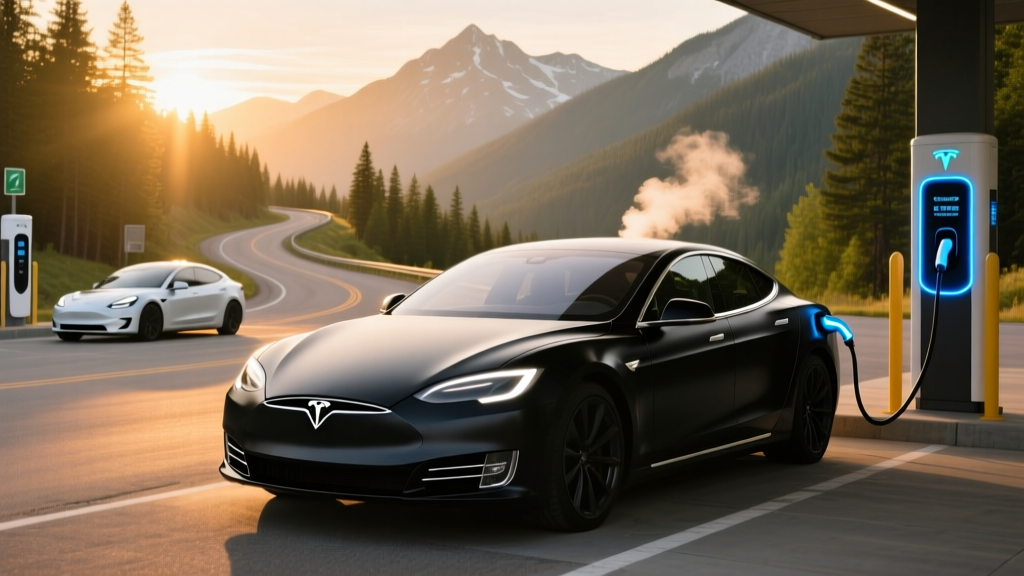
The Model S uses Tesla's NACS (North American Charging Standard) connector natively — no adapter needed for the Supercharger network, which remains the most reliable DC fast-charging ecosystem in North America.
| Charging Method | Max Power | Speed / Time | Notes |
|---|---|---|---|
| DC Fast Charge (Supercharger V4) | 250 kW peak | 10-80% in ~27 min; ~200 mi in 15 min | Peak rate sustained only at low SoC; tapers significantly above 60% |
| Level 2 Home (Tesla Wall Connector) | 11.5 kW (48A) | ~41 mi/hr added | Full charge in ~10 hours from near-empty |
| Level 2 Public (J1772 adapter included) | Up to 11.5 kW | Varies by station | NACS-to-J1772 adapter ships with vehicle |
| Level 1 (120V household) | ~1.4 kW | ~3-4 mi/hr | Emergency/trickle only; ~100+ hours for full charge |
A critical note on the DC fast-charging curve: the 250 kW peak is achieved only in the low state-of-charge window (roughly 5-30% SoC) and under ideal thermal conditions. Above 60%, charge rate drops substantially — often to 80-100 kW — meaning that 10-80% time of ~27 minutes doesn't mean 80-100% takes proportionally less. This is normal for NMC chemistry, but it matters for road-trip planning. Tesla's navigation-based battery preconditioning warms the pack en route to a Supercharger, which helps you hit peak rates upon arrival.
At home on a 48-amp Level 2 circuit (requiring a 60-amp breaker), the Model S adds roughly 41 miles of range per hour. Overnight charging from 20% to 80% takes about 6-7 hours, which is plenty for daily use. If your electrical panel supports only a 40-amp circuit (32A charging), expect ~30 mi/hr — still adequate for most drivers who charge nightly.
Performance and Drivetrain
| Spec | Long Range | Plaid |
|---|---|---|
| Horsepower | 670 hp | 1,020 hp |
| Torque | ~725 lb-ft | ~1,050 lb-ft |
| 0-60 mph | 3.1 sec | 1.99 sec |
| Top Speed | 155 mph | 200 mph |
| Drivetrain | Dual-Motor AWD | Tri-Motor AWD |
| Drag Coefficient | 0.208 Cd | 0.208 Cd |
The Long Range's 3.1-second 0-60 time already outpaces most sports cars. The Plaid's 1.99-second claim (with rollout subtracted, on prepped surfaces) makes it one of the quickest production cars ever built. Real-world street launches on regular asphalt typically yield 2.2-2.5 seconds — still ferocious. Both trims feature adaptive air suspension that adjusts ride height based on speed and road conditions, and both deliver a low center of gravity courtesy of the under-floor battery pack.
Interior, Cargo, and Technology
The Model S interior centers on a 17-inch touchscreen that controls virtually every vehicle function — climate, media, navigation, vehicle settings, and even the glovebox. A secondary 8-inch rear touchscreen gives back-seat passengers climate and media control. The yoke steering wheel is standard (a conventional round wheel is available as a no-cost option at order time).
Passenger and cargo dimensions:
- Front legroom: 42.7 in
- Rear legroom: 35.4 in
- Front headroom: 38.8 in
- Rear headroom: 38.1 in
- Trunk (rear): 26.3 cu ft
- Frunk (front trunk): 3.1 cu ft
- Total cargo: ~29.4 cu ft (rear seats up); ~64 cu ft (rear seats folded)
- Seating: 5 passengers
The rear seat is genuinely usable for adults on shorter trips, though the sloping roofline limits headroom for taller passengers compared to boxier sedans. The frunk is modest — useful for charging cables or a small bag — and the rear trunk opening is wide thanks to the liftback design. Compared to the Lucid Air (32 cu ft trunk) or Mercedes EQS (22 cu ft trunk but more rear legroom), the Model S splits the difference.
Standout tech features:
- Tesla's infotainment system with over-the-air updates, Netflix/YouTube streaming (while parked), and integrated trip planner with Supercharger routing
- Autopilot standard: adaptive cruise, lane centering, automatic emergency braking, blind-spot monitoring
- Full Self-Driving (Supervised) optional: adds automated lane changes, Navigate on Autopilot, traffic light/stop sign recognition, Smart Summon — this is SAE Level 2 driver assistance, not autonomous driving
- Sentry Mode: 360-degree camera recording when parked
- HEPA air filtration with Bioweapon Defense Mode
- Wireless phone charging, 22-speaker premium audio
Warranty and Ownership Costs
Tesla's warranty coverage for the Model S:
- Basic vehicle: 4 years / 50,000 miles
- Battery and drive units: 8 years / 150,000 miles (whichever comes first), with a guaranteed minimum 70% capacity retention over that period
The 150,000-mile battery warranty is generous and reflects Tesla's confidence in its NMC pack longevity. Real-world data from high-mileage Model S owners suggests degradation of roughly 10-15% over 100,000 miles, though individual results vary with charging habits, climate, and Supercharging frequency. Tesla does not publish a battery replacement cost for the Model S, but third-party estimates and past service invoices suggest $18,000-$25,000 out of warranty — a figure worth considering if you plan to own the car well past 150,000 miles.
Insurance premiums for the Model S run significantly higher than average, often $3,000-$5,000+ annually depending on your profile and state. Tesla's own insurance product (available in select states) uses real-time driving data and can be competitive, but get quotes before committing.
How It Compares: Model S vs. Key Competitors
| Spec | Tesla Model S LR | Lucid Air Pure | Mercedes EQS 580 | BMW i7 xDrive60 |
|---|---|---|---|---|
| Base MSRP | $79,990 | $69,900 | $105,550 | $106,695 |
| EPA Range | 402 mi | 419 mi | 371 mi | 318 mi |
| 0-60 mph | 3.1 sec | 5.0 sec | 4.1 sec | 4.5 sec |
| Peak DC Charge | 250 kW | 200+ kW | 200 kW | 195 kW |
| Federal Credit Eligible? | No (MSRP cap) | No (MSRP cap) | No (MSRP cap) | No (MSRP cap) |
| Rear Seat Comfort | Good | Excellent | Excellent | Excellent |
The Lucid Air Pure undercuts the Model S on price while offering slightly more EPA range, though it trades acceleration and Supercharger-network access for that advantage. The Mercedes EQS and BMW i7 are substantially more expensive and offer superior rear-seat luxury and build quality, but sacrifice range and performance. The Model S's unique combination of 400+ mile range, sub-3.5-second acceleration, and Supercharger infrastructure access remains unmatched in a single package — but the interior quality gap versus German competitors is real and worth experiencing in person.
Pros
- Class-leading 402-mile EPA range
- Access to Tesla Supercharger network (most reliable in the US)
- Blistering acceleration in both trims
- Continuous OTA updates add features over time
- Spacious liftback cargo area + frunk
- 8-year/150,000-mile battery warranty
- Lowest drag coefficient of any current production sedan (0.208)
Cons
- No federal tax credit eligibility (MSRP exceeds $55K sedan cap)
- Interior materials and build quality lag German rivals at this price
- Yoke steering is polarizing (round wheel available but must be specified)
- High insurance premiums ($3,000-$5,000+/year typical)
- Minimal physical buttons — everything routed through touchscreen
- Design aging — exterior/interior largely unchanged since 2021 refresh
- FSD (Supervised) remains Level 2 despite its name and price
Who Should Buy the Model S?
Choose the Model S Long Range if: You need maximum EV range for frequent road trips, value Supercharger network reliability, want a practical luxury sedan with serious acceleration, and plan to charge primarily at home with DC fast-charging for longer drives.
Choose the Model S Plaid if: Track-capable acceleration is a priority, you want the quickest sedan available, and the $15,000 premium over Long Range fits your budget.
Look elsewhere if: Rear-seat luxury and traditional build quality are paramount (consider the EQS or i7), you want the absolute longest range at a lower price (Lucid Air Pure), or you need the federal tax credit to justify an EV purchase (no luxury sedan over $55,000 qualifies).
Frequently Asked Questions
What is the real-world range of the Tesla Model S?
The EPA rates the Long Range at 402 miles and the Plaid at 396 miles. In real-world highway driving at 70-75 mph, expect 320-340 miles. In cold weather below freezing, plan for 260-300 miles on highway trips. City and mixed driving typically yields 360-380 miles thanks to regenerative braking recapturing energy in stop-and-go traffic.
How fast does the Model S charge?
On a Tesla V4 Supercharger, the Model S peaks at 250 kW and charges from 10-80% in approximately 27 minutes, adding about 200 miles in 15 minutes under ideal conditions. At home on a Level 2 Tesla Wall Connector (11.5 kW / 48A), it adds roughly 41 miles of range per hour, completing a near-full overnight charge in about 10 hours.
Does the Tesla Model S qualify for the federal EV tax credit?
No. Under IRS §30D rules, sedans must have an MSRP at or below $55,000 to qualify for the up-to-$7,500 credit. The Model S starts at $79,990, well above the cap. Income limits and battery sourcing rules are secondary disqualifiers — the price alone rules it out. State-level incentives may still apply; check your local DMV or energy office for details.
Is the Model S worth buying over the Lucid Air or Mercedes EQS?
It depends on your priorities. The Model S wins on the combination of range, performance, and Supercharger access. The Lucid Air Pure offers more range for less money but has a smaller charging network and slower acceleration. The Mercedes EQS and BMW i7 deliver superior interior luxury and rear-seat comfort at higher prices with less range. Test-drive all three — the interior-quality difference is something spec sheets can't capture.
How much does it cost to charge a Model S at home vs. Supercharging?
At the US average residential electricity rate of ~$0.17/kWh, a full 100 kWh charge costs roughly $17. Supercharger pricing varies by location and time of day but typically runs $0.25-$0.40/kWh, making a near-full charge $25-$40. Compared to a gas sedan getting 25 mpg at $3.50/gallon, the Model S costs roughly 60-70% less per mile when charging at home.
How long will the Model S battery last?
Tesla warranties the battery for 8 years or 150,000 miles with a minimum 70% capacity retention guarantee. Real-world data from high-mileage owners suggests 10-15% degradation at 100,000 miles under normal use. Minimizing frequent 100% charges (Tesla recommends 80-90% daily for NMC packs) and reducing Supercharger frequency can help preserve long-term battery health. Out-of-warranty replacement, if needed, is estimated at $18,000-$25,000.
Sources: fueleconomy.gov, IRS §30D Clean Vehicle Credits, Tesla Model S specifications. Pricing and incentive rules are subject to change; verify current figures before purchasing.