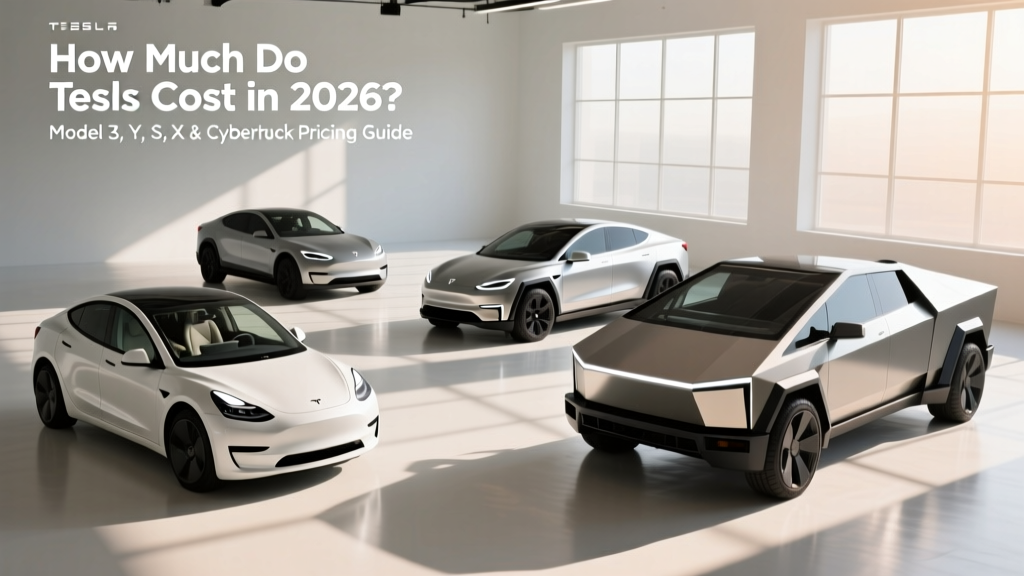
Tesla's lineup has matured into a five-model portfolio spanning a $38,000 commuter sedan to a $100,000+ electric pickup. But the sticker price is only the starting point. Between trim upgrades, destination fees, state incentives, and the shifting landscape of the federal §30D tax credit, the actual cost to put a Tesla in your driveway can swing by $10,000 or more depending on configuration and buyer eligibility.
This guide walks through every 2026 Tesla model — Model 3, Model Y, Model S, Model X, and Cybertruck — with exact MSRP figures, real-world range expectations, charging benchmarks, and a clear-eyed look at which models qualify for the federal EV tax credit under current IRS rules.
Tesla Model Lineup at a Glance: 2026 Pricing & Range
| Model | Trim | Base MSRP | EPA Range | Battery (kWh) | 0-60 mph | MPGe (Combined) |
|---|---|---|---|---|---|---|
| Model 3 | RWD | $38,990 | 272 mi | ~60 kWh (LFP) | 5.8s | 132 |
| Model 3 | Long Range AWD | $45,990 | 341 mi | ~79 kWh (NMC) | 4.2s | 132 |
| Model 3 | Performance | $52,990 | 315 mi | ~79 kWh (NMC) | 2.9s | 119 |
| Model Y | Long Range AWD | $44,990 | 320 mi | ~79 kWh (NMC) | 4.8s | 122 |
| Model Y | Performance | $51,490 | 298 mi | ~79 kWh (NMC) | 3.5s | 115 |
| Model S | Long Range | $74,990 | 402 mi | ~100 kWh (NMC) | 3.1s | 124 |
| Model S | Plaid | $89,990 | 359 mi | ~100 kWh (NMC) | 1.99s | 116 |
| Model X | Long Range | $79,990 | 348 mi | ~100 kWh (NMC) | 3.8s | 112 |
| Model X | Plaid | $94,990 | 326 mi | ~100 kWh (NMC) | 2.5s | 108 |
| Cybertruck | AWD | $79,990 | 340 mi | ~123 kWh (NMC) | 4.1s | 82 |
| Cybertruck | Cyberbeast | $99,990 | 320 mi | ~123 kWh (NMC) | 2.6s | 79 |
Source: Tesla.com, fueleconomy.gov. Prices exclude the $1,390 destination fee. Specs reflect 2026 model year as published.
Real-World Range: What the EPA Sticker Doesn't Tell You
The Model 3 Long Range carries an EPA estimate of 341 miles. In mixed highway driving at 70-75 mph, expect roughly 280-305 miles before needing a charge. In freezing temperatures (below 30°F), that range can drop to 220-260 miles due to battery resistance and cabin heating load. The LFP-equipped Model 3 RWD (272 mi EPA) is more range-stable across charge cycles but still loses ~15-20% in cold weather.
Tesla's efficiency engineering is among the best in the industry — the Model 3 RWD achieves roughly 25 kWh per 100 miles, which is excellent for its class. But EPA range is tested under controlled conditions that don't account for sustained highway speeds, elevation changes, or winter driving.
For the Model Y Long Range (320 mi EPA), plan for about 265-290 miles on a highway road trip in moderate weather. The Cybertruck, with its heavy stainless-steel exoskeleton and poor aerodynamics, sees the largest gap between sticker and reality: the 340-mile EPA figure can shrink to 250-280 miles at highway speeds, and further under towing load. If you're towing near the Cybertruck's 11,000-lb rated capacity, expect range to halve.
Charging Speed: Supercharger Network and Home Setup
Tesla's Supercharger network remains its strongest competitive advantage, with over 6,500 stations and 65,000+ connectors across North America. All 2026 Teslas use the NACS (North American Charging Standard) connector natively — the same plug now adopted by Ford, GM, Rivian, and most major automakers.
| Charging Level | Power | Model 3 / Y | Model S / X | Cybertruck | Miles Added per Hour |
|---|---|---|---|---|---|
| Level 1 (120V) | ~1.4 kW | ~3 mi/hr | ~3 mi/hr | ~3 mi/hr | 3-5 |
| Level 2 (240V, 48A) | 11.5 kW | ~44 mi/hr | ~40 mi/hr | ~40 mi/hr | 35-44 |
| DC Fast (V3 Supercharger) | 250 kW peak | 10-80% in ~25 min | 10-80% in ~30 min | 10-80% in ~28 min | ~1,000 mi/hr (peak) |
| DC Fast (V4 Supercharger) | Up to 325 kW | 10-80% in ~20 min | Supported | 10-80% in ~22 min | ~1,200 mi/hr (peak) |
A critical detail: peak kW is not sustained kW. A Model 3 Long Range may peak at 250 kW on a V3 Supercharger, but the charge curve tapers significantly above 50-60% state of charge. The 10-80% time is the practical benchmark — and Tesla's ~25-minute result is competitive but no longer class-leading. The Hyundai Ioniq 5 and Porsche Taycan can achieve 10-80% in 18 minutes or less on 350 kW chargers.
For home charging, Tesla's Wall Connector ($420) delivers up to 11.5 kW (48 amps) on a 60-amp circuit, adding roughly 44 miles of range per hour for the Model 3. Most owners charging overnight from 20% to 80% will wake up fully replenished. Installation cost for a dedicated 60-amp circuit typically runs $800-$2,000 depending on panel proximity and local permitting, though older homes may need a $2,000-$5,000 panel upgrade to support the additional 200-amp service requirement.
Federal Tax Credit Eligibility: The §30D Breakdown
The federal EV tax credit offers up to $7,500, but eligibility depends on three moving targets: buyer income caps, vehicle MSRP caps, and battery component/mineral sourcing requirements. As of 2026, credits can be transferred to the dealer at point of sale as an instant discount. Always verify current rules at IRS.gov.
| Model | MSRP Cap Met? | Income Cap (Single/Joint) | Est. Credit | Notes |
|---|---|---|---|---|
| Model 3 RWD | Yes (under $55K sedan cap) | $150K / $300K AGI | Up to $7,500 | LFP battery — sourcing rules may limit to $3,750 depending on critical-mineral compliance |
| Model 3 Long Range | Yes | $150K / $300K AGI | Up to $7,500 | NMC battery with North American assembly; sourcing varies by batch |
| Model 3 Performance | Yes | $150K / $300K AGI | Up to $7,500 | Same sourcing caveats as LR |
| Model Y (all trims) | Yes (under $80K SUV cap) | $150K / $300K AGI | Up to $7,500 | Most popular Tesla; generally qualifies but confirm sourcing at purchase |
| Model S / X | Exceeds $55K sedan / $80K SUV cap | N/A | $0 | MSRP exceeds the §30D cap — not eligible |
| Cybertruck (all trims) | Exceeds $80K truck cap | N/A | $0 | AWD trim is borderline at $79,990 + destination; Cyberbeast exceeds cap |
The critical nuance: even when MSRP and income qualify, the battery sourcing requirements — specifically the percentage of critical minerals sourced from the U.S. or free-trade-agreement partners — can reduce the credit from $7,500 to $3,750 or eliminate it entirely. Tesla sources battery cells from multiple suppliers (Panasonic, CATL, LG), and the exact credit amount can vary by production batch. The IRS publishes a list of qualifying vehicles that updates periodically — check it before signing a purchase agreement.
Cost After Credits: What You'll Actually Pay
| Model | Base MSRP | Destination | Max §30D Credit | Effective Price (Best Case) |
|---|---|---|---|---|
| Model 3 RWD | $38,990 | $1,390 | -$7,500 | $32,880 |
| Model 3 Long Range | $45,990 | $1,390 | -$7,500 | $39,880 |
| Model Y Long Range | $44,990 | $1,390 | -$7,500 | $38,880 |
| Model S Long Range | $74,990 | $1,390 | $0 | $76,380 |
| Model X Long Range | $79,990 | $1,390 | $0 | $81,380 |
| Cybertruck AWD | $79,990 | $1,390 | $0* | $81,380 |
*Cybertruck AWD at $79,990 sits at the $80K truck cap boundary; destination pushes it over. Confirm with your tax advisor.
For buyers who qualify for the full $7,500 credit on a Model 3 RWD, the effective price of ~$32,880 makes it one of the most affordable new EVs on the U.S. market — competitive with the Chevrolet Equinox EV and undercutting the Hyundai Ioniq 6 on price. The Model Y Long Range at ~$38,880 after credit is the value sweet spot for families needing crossover space.
Performance, Tech, and Ownership Experience
Every 2026 Tesla shares a common technology backbone: a 15.4-inch center touchscreen (Model 3/Y) or 17-inch (Model S/X) running Tesla's proprietary infotainment OS, over-the-air updates, and a camera-based vision system for driver assistance. Tesla does not include Apple CarPlay or Android Auto — a dealbreaker for some, a non-issue for Tesla loyalists who prefer the integrated navigation and media experience.
Autopilot and FSD (Supervised): Basic Autopilot (traffic-aware cruise control and lane centering) is standard. Full Self-Driving (Supervised) remains a $8,000 option or $99/month subscription. FSD is a SAE Level 2 driver-assistance system — it does not make the vehicle autonomous. The driver must remain attentive, hands on or near the wheel, and is legally responsible for all driving decisions. Despite the name, FSD cannot handle all driving scenarios without intervention, and NHTSA continues to scrutinize its safety record.
Tesla Autopilot and FSD (Supervised) are SAE Level 2 systems. The driver must remain fully engaged and ready to take over at any moment. These are not self-driving systems. Only SAE Level 4 robotaxi services like Waymo (available in select cities) operate without a human driver.
Cargo and Passenger Space: The Model 3 offers 23 cu ft of trunk space plus a small frunk — adequate for weekly groceries but tight for road-trip luggage. The Model Y provides 30 cu ft behind the second row (76 cu ft with seats folded), making it the practical choice for families. The Model X, with its available third row, accommodates up to seven passengers and offers 88 cu ft of max cargo volume. The Cybertruck's 6-foot bed and 121 cu ft total enclosed volume (bed + frunk + sail pillars) make it the most cargo-capable Tesla, though its 8,600-lb curb weight and 206-inch length complicate urban parking.
Warranty, Reliability, and Long-Term Costs
Tesla's warranty structure is straightforward:
- Basic Vehicle: 4 years / 50,000 miles (all models)
- Battery & Drive Unit: 8 years / 120,000 miles (Model 3 RWD with LFP); 8 years / 100,000 miles (Model 3 LR/Performance, Model Y); 8 years / 150,000 miles (Model S/X)
- Battery Capacity Guarantee: Tesla warrants a minimum 70% capacity retention during the warranty period
Real-world battery degradation data from Tesla's fleet indicates that most Model 3 and Model Y batteries retain approximately 85-90% capacity after 100,000 miles. LFP batteries in the RWD Model 3 tend to degrade more slowly and tolerate regular 100% charging — Tesla recommends charging LFP cells to 100% at least weekly for calibration. NMC batteries in Long Range and Performance models benefit from daily charging limits of 80-90% to maximize longevity.
Insurance costs remain a Tesla ownership pain point. Average annual premiums for a Model Y run $2,200-$3,000 depending on state and driver profile, roughly 20-35% higher than comparable gas crossovers. Tesla Insurance is available in select states and can be competitive, but availability varies.
Pros
- Supercharger network — 65,000+ connectors, highest reliability of any public network
- Industry-leading efficiency (kWh/100mi)
- Over-the-air updates continuously add features
- Strong resale value relative to EV market
- Model 3/Y eligible for up to $7,500 federal credit
- LFP battery option offers excellent longevity
Cons
- No Apple CarPlay or Android Auto
- Insurance premiums 20-35% above segment average
- Repair costs and wait times for body/collision damage remain high
- FSD ($8,000) is Level 2 — not autonomous despite the name
- Model S/X/Cybertruck ineligible for federal tax credit
- Minimalist interior not for everyone (no instrument cluster, stalkless steering)
Who Should Buy a Tesla — And Who Shouldn't
Choose the Model 3 RWD if: You want the lowest-cost entry into a Tesla with daily-commute range (272 mi EPA is plenty for a 40-mile round-trip commute), you can charge at home, and you qualify for the $7,500 credit — bringing your effective cost under $33K.
Choose the Model Y Long Range if: You need family-friendly cargo space (30 cu ft), all-wheel drive for snow/rain, and road-trip range (320 mi EPA, ~275 real-world highway). It's the best-selling Tesla for good reason.
Choose the Model S/X if: You want premium sedan/SUV space, 400+ mile range (Model S), and don't need the tax credit. Cross-shop against the Lucid Air, BMW i7, and Rivian R1S before committing.
Choose the Cybertruck if: You need a truck bed, value the stainless-steel durability, and accept that it's the least efficient Tesla (82 MPGe, ~250-280 real-world highway miles). Compare against the Ford F-150 Lightning and Rivian R1T for a more conventional truck experience.
Look elsewhere if: You absolutely need Apple CarPlay, prefer a traditional instrument cluster, want a dealership service network nearby, or live in an area with limited Supercharger coverage.
Frequently Asked Questions
What is the cheapest Tesla you can buy in 2026?
The Model 3 RWD at $38,990 MSRP plus $1,390 destination ($40,380 total). If you qualify for the full $7,500 federal tax credit and can apply it at point of sale, your effective price drops to approximately $32,880 — making it one of the cheapest new EVs available in the U.S.
Does the Tesla Model Y qualify for the $7,500 tax credit?
Yes, the Model Y qualifies for up to $7,500 under §30D, provided the buyer's adjusted gross income is below $150,000 (single) or $300,000 (joint), and the vehicle meets battery sourcing requirements. The exact credit amount ($3,750 or $7,500) depends on critical-mineral and battery-component sourcing at the time of manufacture. Verify on IRS.gov before purchasing.
How fast does a Tesla charge at a Supercharger?
On a V3 Supercharger (250 kW peak), a Model 3 Long Range charges from 10-80% in approximately 25 minutes. On newer V4 Superchargers (up to 325 kW), that drops to roughly 20 minutes. However, peak charging speed is not sustained — the rate tapers above 50-60% SoC, which is why the 10-80% benchmark matters more than peak kW.
How long do Tesla batteries last?
Tesla warranties its batteries for 8 years and 100,000-150,000 miles (depending on model) with a guaranteed minimum 70% capacity retention. Real-world fleet data shows most Tesla batteries retain 85-90% capacity at 100,000 miles. A full battery replacement outside of warranty costs approximately $12,000-$16,000 for a Model 3/Y and $18,000-$22,000 for a Model S/X, based on current service pricing.
Is Tesla's FSD worth the $8,000 cost?
For most buyers, no — at least not yet. FSD (Supervised) is an SAE Level 2 driver-assist system that still requires full driver attention. It handles highway lane changes, stoplights, and some city navigation, but performance is inconsistent and demands constant supervision. The $99/month subscription is a lower-risk way to try it. Basic Autopilot (included free) covers highway cruise and lane centering adequately for most commuters.
How much does home charging cost per month?
At the U.S. average residential electricity rate of ~$0.16/kWh, fully charging a Model 3 Long Range (79 kWh) costs about $12.64. Driving 1,000 miles per month would require roughly 250 kWh, costing ~$40/month. Compare that to a 25 MPG gas car at $3.50/gallon: the same 1,000 miles would cost ~$140 in fuel. Home charging saves most drivers $80-$120 per month.