The Real Cost to Charge a Tesla in 2026
If you've searched "how much do it cost to charge a Tesla" and found only vague answers, you're not alone. The truth is that Tesla charging costs vary dramatically depending on where and how you charge — from as little as $0.04 per mile at home on off-peak utility rates to over $0.14 per mile at peak Supercharger rates in expensive metro areas.
This guide breaks down the exact math for every Tesla model currently on sale in 2026, using real battery capacities in kWh (kilowatt-hours — the unit of energy stored), actual electricity rates, and real-world charging behavior. We'll also cover the full ownership picture: range, efficiency, and whether a Tesla still makes financial sense against rivals.
Tesla Charging Cost by Location: Home vs. Supercharger vs. Destination
The single biggest variable in Tesla ownership cost is your charging location. Here's the current landscape for 2026:
| Charging Location | Avg Cost per kWh | Cost to Fill 75 kWh Battery | Cost per Mile (Model Y LR) |
|---|---|---|---|
| Home Level 2 (national avg $0.17/kWh) | $0.17 | $12.75 | $0.04 |
| Home Level 2 (off-peak TOU rate) | $0.08–$0.12 | $6.00–$9.00 | $0.02–$0.03 |
| Tesla Supercharger V4 (avg $0.35/kWh) | $0.28–$0.48 | $21.00–$36.00 | $0.07–$0.11 |
| Third-Party DC Fast (Electrify America, EVgo) | $0.35–$0.55 | $26.25–$41.25 | $0.08–$0.13 |
| Tesla Destination Charger (hotels, restaurants) | Free–$0.30 | $0–$22.50 | $0.00–$0.07 |
Bottom line: A Tesla owner who charges 80% at home and 20% on Superchargers will pay roughly $0.05–$0.06 per mile. Compare that to a 25 MPG gas car at $3.40/gallon = $0.136 per mile. The savings are real, but they depend on home charging access.
2026 Tesla Lineup: Specs, Efficiency, and Charging Costs Per Model
To calculate exact charging costs, you need each model's usable battery capacity (in kWh) and efficiency (in kWh per 100 miles). Tesla does not officially publish usable kWh figures, but independent teardowns and fueleconomy.gov data give us reliable numbers.
| Spec | Model 3 LR AWD | Model Y LR AWD | Model S LR | Model X LR |
|---|---|---|---|---|
| EPA Range | 346 mi | 320 mi | 402 mi | 335 mi |
| Battery (usable, est.) | 75 kWh (NMC) | 75 kWh (NMC) | 95 kWh (NMC) | 95 kWh (NMC) |
| Efficiency (kWh/100 mi) | 24 | 27 | 26 | 31 |
| MPGe (combined) | 134 | 122 | 124 | 105 |
| Max DC Fast Charge | 250 kW | 250 kW | 250 kW | 250 kW |
| 10–80% DCFC Time | ~27 min | ~28 min | ~35 min | ~36 min |
| Level 2 Home (11.5 kW) | 44 mi/hr | 41 mi/hr | 41 mi/hr | 35 mi/hr |
| 0–60 mph | 4.2 sec | 4.8 sec | 3.1 sec | 3.8 sec |
| Horsepower | 346 hp | 384 hp | 670 hp | 670 hp |
| Drivetrain | Dual-Motor AWD | Dual-Motor AWD | Dual-Motor AWD | Dual-Motor AWD |
| Base MSRP | $47,740 | $48,630 | $79,990 | $84,990 |
| Battery Warranty | 8 yr / 120,000 mi | 8 yr / 120,000 mi | 8 yr / 150,000 mi | 8 yr / 150,000 mi |
Home Charging Setup: What It Actually Costs to Install
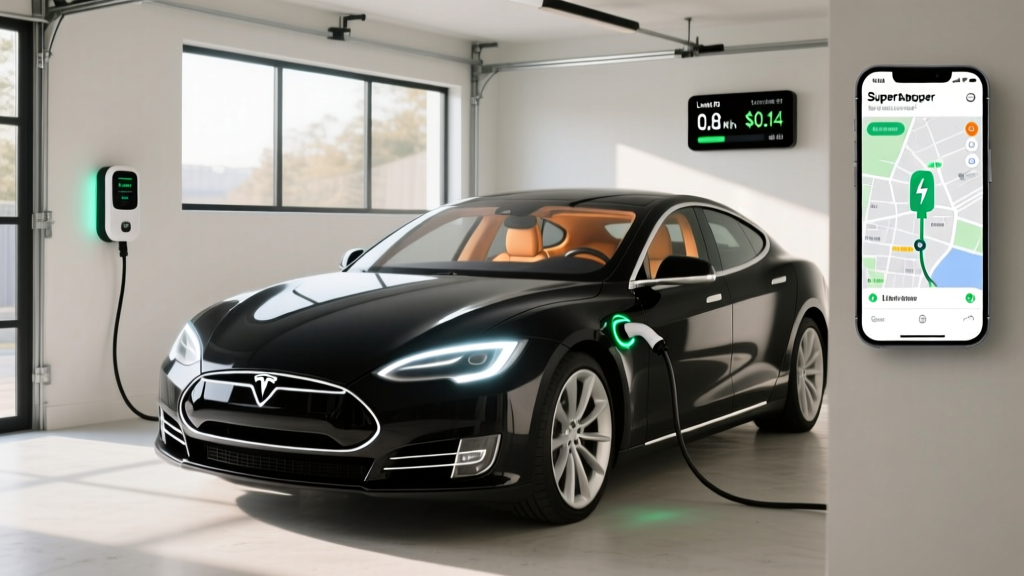
Most Tesla owners do 80–90% of their charging at home on a Level 2 (240V) circuit. Here's what that involves:
- Tesla Wall Connector: $475 (hardware). Delivers up to 11.5 kW (48A) on a 60A circuit.
- Electrician labor: $500–$2,000 depending on panel proximity, conduit run length, and local permit requirements.
- Electrical panel upgrade: If your home has a 100A panel, upgrading to 200A adds $1,500–$3,000. Many newer homes already have 200A panels.
- Permit: $50–$200 depending on jurisdiction.
Total home install cost: $1,025–$2,675 for a straightforward install; up to $5,500+ if a panel upgrade is needed. This is a one-time cost that pays for itself within 1–2 years of gas savings for most drivers.
Tesla also includes a Mobile Connector with every new vehicle, which can plug into a standard 120V outlet (Level 1) for ~3–4 miles of range per hour — adequate for low-mileage commuters who can charge overnight, but slow for most owners.
Supercharger Network: Speeds, Pricing, and the Charging Curve Reality
Tesla's Supercharger network remains its strongest competitive advantage. As of 2026, Tesla operates over 6,500 Supercharger stations and 60,000+ stalls globally, with V4 cabinets delivering up to 350 kW (though Tesla vehicles currently peak at 250 kW due to onboard architecture limits).
The charging curve matters: A Tesla Model 3 LR peaks at 250 kW only between roughly 10–30% State of Charge (SoC). From 30–60%, it sustains ~150–175 kW. From 60–80%, it tapers to ~75–100 kW. Above 80%, charging slows dramatically to protect battery longevity — often dropping below 40 kW. This is why Tesla (and all EV makers) quote 10–80% times rather than 0–100%.
Supercharger pricing varies by location, time of day, and whether your vehicle is a Tesla or a non-Tesla EV using the network via the Magic Dock adapter. Expect $0.28–$0.48/kWh in most US markets, with peak-hour pricing in cities like San Francisco and New York reaching $0.52–$0.58/kWh. Off-peak rates (typically 9 PM–6 AM) can drop to $0.22–$0.28/kWh at select stations.
For a 15,000-mile/year driver doing 80% home / 20% Supercharger charging, annual electricity cost runs approximately $750–$1,100, compared to $2,000–$2,400 for an equivalent gas vehicle.
2026 Federal EV Tax Credit: Does a Tesla Qualify?
Under IRS §30D rules, the federal EV tax credit offers up to $7,500 for qualifying new EVs — but eligibility depends on multiple factors that change periodically. As of early 2026:
- MSRP caps: Vans/SUVs/pickups must be under $80,000; sedans under $55,000. Model Y (classified as SUV) qualifies under the $80K cap. Model 3 (sedan) qualifies under the $55K cap on Long Range AWD. Model S and X exceed caps.
- Buyer income limits: Modified AGI must not exceed $150,000 (single), $225,000 (head of household), or $300,000 (joint filing).
- Battery sourcing requirements: Increasingly strict critical-minerals and battery-component sourcing rules apply. Tesla's US-built vehicles with LFP batteries (some Model 3 RWD) have faced sourcing challenges; NMC variants built at Fremont/Gigafactory Texas generally meet requirements. Check the latest IRS guidance before purchasing.
- Point-of-sale transfer: Since 2024, buyers can transfer the credit to the dealer at purchase, reducing the sale price directly rather than waiting for a tax refund.
| Model | Base MSRP | Est. After $7,500 Credit | Credit Eligible? |
|---|---|---|---|
| Model 3 LR AWD | $47,740 | ~$40,240 | Yes (if sourcing + income met) |
| Model Y LR AWD | $48,630 | ~$41,130 | Yes (if sourcing + income met) |
| Model S LR | $79,990 | $79,990 | No (exceeds $55K sedan cap) |
| Model X LR | $84,990 | $84,990 | No (exceeds $80K SUV cap) |
Always verify current eligibility at fueleconomy.gov and consult a tax professional. State and local incentives may stack on top — check your state's energy office for details.
Tech, Interior, and What It's Actually Like to Own One
Tesla's interior is minimalist by design — a single 15.4-inch center touchscreen handles navigation, media, climate, vehicle settings, and even the glovebox release. There is no traditional instrument cluster; speed and range info appear in the top corner of the screen. Some buyers love the simplicity; others find it distracting.
Driver assistance: Every Tesla ships with basic Autopilot (lane centering + adaptive cruise). Full Self-Driving (Supervised) costs an additional $8,000 or $99/month. Despite the name, FSD is SAE Level 2 — the driver must remain fully attentive with hands on the wheel at all times. It handles highway on-ramps, lane changes, and some city streets impressively, but it is not autonomous driving and can make unpredictable errors.
Cargo and space:
- Model 3: 23 cu ft trunk + rear frunk. Rear legroom: 35.3 in.
- Model Y: 34 cu ft behind second row (76 cu ft with seats folded) + frunk. Rear legroom: 41.6 in.
- Model S: 28 cu ft trunk + frunk. Rear legroom: 35.4 in.
- Model X: Up to 88 cu ft with seats folded (5/6/7-seat configs). Rear legroom: 37.1 in.
Pros, Cons, and Verdict: Is a Tesla Still Worth It?
Pros
- Supercharger network: 60,000+ stalls with plug-and-charge reliability unmatched by third-party networks
- Industry-leading efficiency: Model 3 achieves 134 MPGe combined, stretching every kWh further
- Over-the-air updates continuously add features without dealer visits
- Strong resale value relative to most EV competitors
- Home charging cost as low as $0.02–$0.03/mile on off-peak rates
Cons
- Build quality inconsistencies (panel gaps, paint) still reported vs. legacy automakers
- No Apple CarPlay or Android Auto — Tesla's proprietary system only
- FSD (Supervised) is expensive ($8K) and remains Level 2 despite the name
- Supercharger pricing has risen; peak-hour rates approach $0.50+/kWh in some cities
- Model S/X no longer qualify for federal tax credit due to MSRP caps
Tesla vs. Key Competitors: Where the Value Lands
The Tesla Model Y competes directly with the Hyundai Ioniq 5, Ford Mustang Mach-E, and Chevrolet Equinox EV. The Model 3 faces the BMW i4, Hyundai Ioniq 6, and Polestar 2. Here's the cost-to-charge comparison that matters:
At the national average residential rate of $0.17/kWh (EIA data):
- Tesla Model Y LR (27 kWh/100 mi): $0.046/mile
- Hyundai Ioniq 5 (30 kWh/100 mi): $0.051/mile
- Ford Mach-E ER (33 kWh/100 mi): $0.056/mile
- Gas Toyota RAV4 AWD (29 MPG, $3.40/gal): $0.117/mile
Tesla's efficiency advantage — squeezing more miles per kWh — means lower charging costs even when electricity rates are identical. Over 5 years and 75,000 miles, a Model Y owner charging at home saves roughly $5,400 vs. a RAV4 gas driver, and $300–$700 vs. rival EVs.
Choose a competitor if: You want Apple CarPlay, more traditional build quality, a physical instrument cluster, or need a lower entry price (the Chevy Equinox EV starts under $35K). The Ioniq 5 also offers 800V architecture for faster peak charging on non-Tesla networks.
Frequently Asked Questions
How much does it cost to charge a Tesla at home per month?
For a driver covering 1,250 miles/month in a Model Y LR (27 kWh/100 mi) at the national average rate of $0.17/kWh, monthly home charging costs approximately $57. On an off-peak time-of-use rate of $0.10/kWh, that drops to ~$34/month.
Is it cheaper to charge a Tesla at home or at a Supercharger?
Home charging is consistently cheaper. The national average home rate is ~$0.17/kWh; Superchargers average $0.35/kWh — roughly double. Over a year, exclusive Supercharger use could cost $1,200–$1,500 vs. $600–$800 for home charging.
Does charging a Tesla cost more than gas?
No, in nearly all US scenarios. A Model Y costs ~$0.05/mile on home charging vs. ~$0.12–$0.14/mile for a comparable gas SUV. Even at peak Supercharger rates ($0.10–$0.11/mile), Tesla charging costs less than gasoline per mile.
How long does a Tesla battery last, and what does replacement cost?
Tesla warranties its NMC batteries for 8 years / 120,000 miles (Model 3/Y) or 8 years / 150,000 miles (Model S/X), guaranteeing at least 70% capacity retention. Real-world data from Tesla's Impact Report shows average degradation of ~12% at 200,000 miles. Out-of-warranty replacement costs $12,000–$20,000 depending on the model.
Do Tesla vehicles qualify for the $7,500 federal tax credit in 2026?
Model 3 Long Range AWD and Model Y Long Range AWD generally qualify, subject to buyer income limits, battery-sourcing requirements, and MSRP caps. Model S and X do not qualify due to exceeding MSRP caps. Always verify at fueleconomy.gov and consult a tax professional before purchasing.
What is the real-world range of a Tesla Model Y?
The Model Y Long Range AWD is EPA-rated at 320 miles. In real-world highway driving at 70–75 mph in moderate weather, expect ~270–285 miles. In freezing winter conditions with cabin heat, expect ~220–250 miles. Preconditioning and using seat heaters instead of cabin heat can recover 10–15 miles of range.