The Real Cost to Fully Charge a Tesla Model Y
If you've been searching for a straight answer on how much does it cost to fully charge a Tesla, the Model Y is the best place to start—it's the best-selling EV in America, and its 75 kWh (usable) battery gives us a concrete baseline. The short answer: between $9 and $18 for a 0–100% fill, depending entirely on where and how you charge.
But that number hides a lot of nuance. Charging at home on a Level 2 circuit at the national average electricity rate of $0.17/kWh costs roughly $12.75. Hitting a Tesla Supercharger at $0.35/kWh pushes that to $26.25. And if you're lucky enough to have rooftop solar or a time-of-use plan with off-peak rates around $0.08/kWh, you're looking at under $6. Let's break down every scenario with real numbers, then move into the full 2026 Model Y profile so you know exactly what you're buying.
| Spec | Value |
|---|---|
| EPA Range | 320 miles |
| Battery (usable) | ~75 kWh, NMC (2170 cells) |
| Efficiency | 122 MPGe / 28 kWh/100 mi |
| Max DC Fast Charge | 250 kW peak |
| 10–80% DC Time | ~27 minutes |
| Level 2 Home Rate | 11.5 kW (44 mi/hr) |
| 0–60 mph | 4.8 seconds |
| Horsepower | 384 hp (dual motor) |
| Drivetrain | AWD, dual motor |
| Cargo (behind 2nd row) | 30.2 cu ft |
| Cargo (max, folded) | 72.0 cu ft |
| Base MSRP | $44,990 |
| Battery Warranty | 8 yr / 120,000 mi |
Charging Cost Breakdown: Home, Public, and Supercharger
The cost to charge an EV is a function of two things: battery capacity (kWh) and electricity rate ($/kWh). The 2026 Model Y Long Range AWD carries approximately 75 kWh of usable battery capacity. Multiply that by your local rate, and you have your fill-up cost.
| Method | Rate ($/kWh) | 0–100% Cost | Speed |
|---|---|---|---|
| Home Level 1 (120V) | $0.17 avg | $12.75 | ~3 mi/hr (very slow) |
| Home Level 2 (240V, 48A) | $0.17 avg | $12.75 | 44 mi/hr (~7 hr full) |
| Home L2 (off-peak TOU) | $0.08 | $6.00 | 44 mi/hr |
| Home L2 (solar) | ~$0.00 marginal | ~$0 | 44 mi/hr |
| Tesla Supercharger V3 | $0.30–$0.40 | $22.50–$30.00 | 250 kW peak, 27 min 10–80% |
| Electrify America / CCS (w/ adapter) | $0.35–$0.55 | $26.25–$41.25 | Up to 250 kW (varies) |
| Free destination / workplace L2 | $0.00 | $0 | ~25–44 mi/hr |
A few critical things to understand here. First, kW is power (how fast energy flows), and kWh is energy (how much the battery holds). A 250 kW Supercharger doesn't deliver 250 kW for the entire session—it peaks early and tapers as the battery fills, which is why a 10–80% session takes ~27 minutes instead of the ~18 minutes raw math would suggest. Second, home charging on a time-of-use plan is where EV economics shine. If your utility offers overnight rates below $0.10/kWh, you'll spend less than $8 to fill the Model Y and wake up to 320 miles of range every morning.
Compared to a gasoline compact SUV averaging 28 MPG at $3.40/gallon, the same 320 miles costs $38.86 in fuel. Even at Supercharger prices, the Model Y saves you money per mile. At home, the savings are dramatic: roughly $0.04/mile electric vs. $0.12/mile gas.
Range: EPA Sticker vs. Real-World Reality
EPA Estimated Range: 320 miles (Long Range AWD)
Real-World Expectation: Plan for 270–295 miles in mixed highway driving at 70–80 mph. In cold weather (below 32°F), expect a 15–30% reduction, bringing usable range to 220–260 miles depending on cabin heating demands and whether you precondition.
The EPA test cycle includes substantial low-speed city driving where regenerative braking recaptures energy—this inflates the sticker number relative to sustained highway travel. On a 75°F day at 65 mph with minimal climate load, you can approach or even slightly exceed 320 miles. But at 80 mph in 25°F weather with the heat on, 230 miles is a realistic planning number. According to fueleconomy.gov, the Model Y Long Range AWD achieves 122 MPGe combined, which translates to roughly 28 kWh consumed per 100 miles of driving.
The Model Y uses NMC (nickel manganese cobalt) lithium-ion cells in the 2170 cylindrical format. NMC offers higher energy density than LFP chemistry, which is why the Long Range variant achieves 320 miles from a ~75 kWh pack. The trade-off: NMC batteries prefer not to sit at 100% state of charge for extended periods. Tesla recommends daily charging to 80–90% and reserving 100% for road trips. This is different from the Standard Range RWD Model Y, which uses LFP (lithium iron phosphate) chemistry and can be charged to 100% daily without degradation concerns.
Charging Speed and Infrastructure
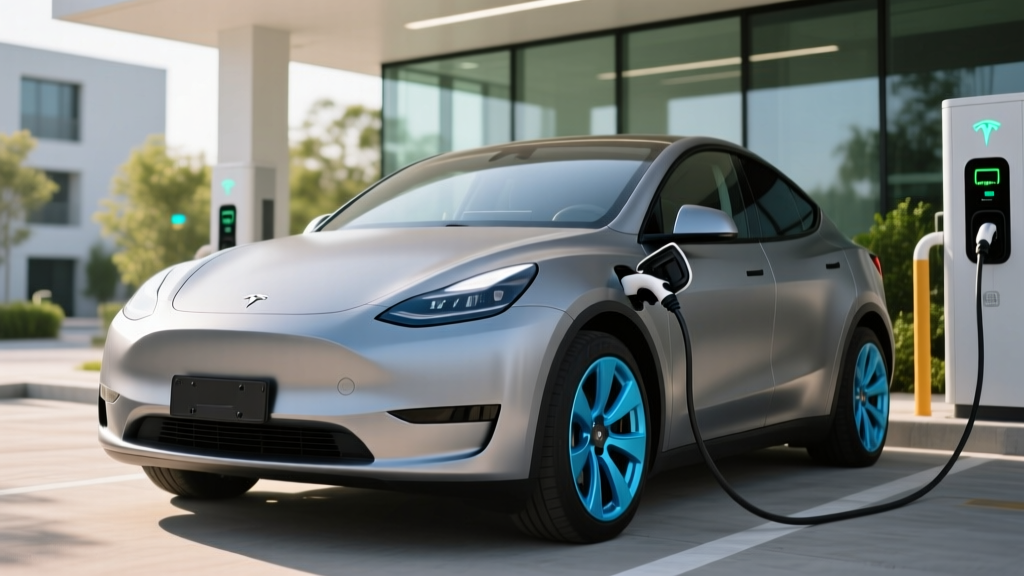
The 2026 Model Y supports a peak DC fast-charge rate of 250 kW on Tesla's V3 and V4 Superchargers using the native NACS connector. A 10–80% session takes approximately 27 minutes under ideal conditions (warm battery, low state of charge at plug-in). The charge curve is aggressive in the early phase—expect 150+ kW sustained through ~50% SoC—then a taper to 80 kW around 65%, and a slow crawl above 80%. This is why Tesla's navigation system will often suggest you unplug at 80% on road trips; the last 20% can take as long as the first 60%.
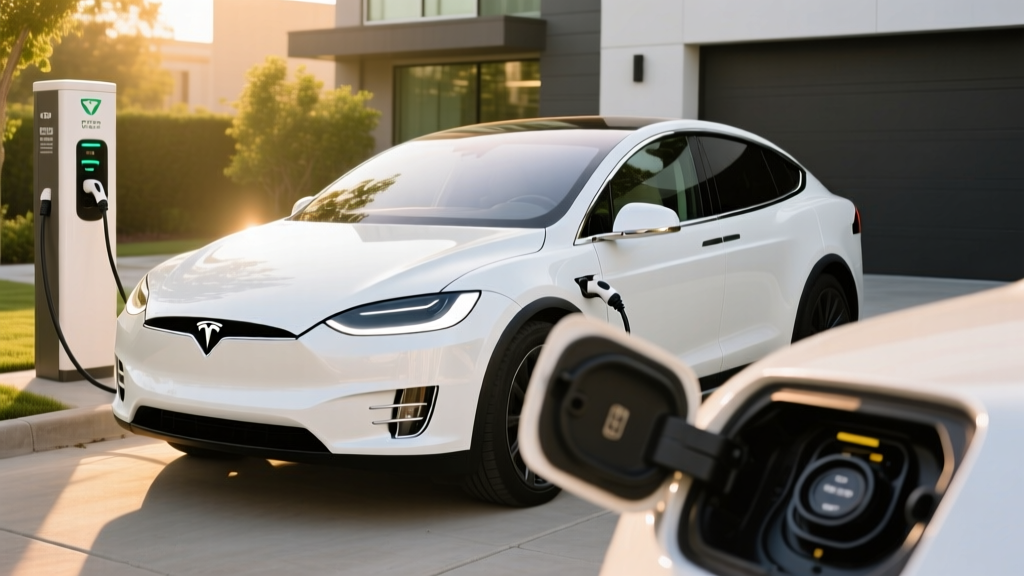
For home charging, the Model Y accepts up to 11.5 kW on Level 2 (48 amps on a 240V/60A circuit). This adds roughly 44 miles of range per hour, meaning a full charge from near-empty takes about 7 hours overnight. A Tesla Wall Connector costs ~$450, and professional installation of a 60A circuit typically runs $800–$2,000 depending on panel proximity and local permitting. If your home has a 200A electrical panel with spare capacity, you're in good shape. Older homes with 100A service may need a panel upgrade ($1,500–$3,000), which is the hidden cost many buyers overlook.
The Model Y ships with the NACS (North American Charging Standard) connector natively. Tesla's Supercharger network—over 25,000 stalls in North America—remains the most reliable DC fast-charging network available, with uptime consistently above 95% according to third-party monitoring. You can also use CCS1 chargers (Electrify America, EVgo) with an adapter, though peak speeds may be limited by the adapter's throughput.
Performance, Interior, and Tech
The Long Range AWD Model Y delivers 384 horsepower from its dual-motor setup, hitting 0–60 mph in 4.8 seconds. That's genuinely quick for a family crossover, and the instant torque makes highway merging effortless. The Performance trim drops the 0–60 to 3.5 seconds for buyers who prioritize acceleration, at a ~$4,000 premium.
Inside, the Model Y's cabin is minimalist by design. A 15.4-inch center touchscreen handles virtually all vehicle controls—there are no physical buttons for climate, mirrors, or glovebox. This is polarizing: some owners love the clean aesthetic, while others find it distracting to adjust fan speed through a touchscreen while driving. The 2026 model year continues to offer the refreshed interior introduced with the "Juniper" update, including ventilated front seats, ambient lighting, a rear-seat touchscreen, and improved noise insulation.
Cargo capacity stands at 30.2 cubic feet behind the second row and 72.0 cubic feet with the rear seats folded—competitive with the Toyota RAV4 and Honda CR-V. Rear legroom is 41.6 inches, adequate for adults on longer trips. The front trunk (frunk) adds 4.1 cubic feet for charging cables or a small bag.
On the tech front, Tesla's software remains the most advanced in the EV space. Over-the-air updates regularly add features, the navigation system integrates real-time Supercharger availability, and the Tesla app provides remote preconditioning, location tracking, and charging control. The available Full Self-Driving (Supervised) package is a SAE Level 2 driver-assistance system—it can handle highway lane changes, navigate on-ramps, and manage stoplights, but the driver must remain fully engaged and hands on the wheel at all times. This is not autonomous driving.
Pricing, Trims, and Federal Tax Credit Eligibility
| Trim | MSRP | Est. After §30D Credit* |
|---|---|---|
| Long Range AWD | $44,990 | ~$37,490 (if eligible) |
| Performance AWD | $48,990 | ~$41,490 (if eligible) |
*Federal §30D credit up to $7,500, subject to buyer income caps, battery critical-mineral sourcing, and MSRP limits. Point-of-sale transfer available. Verify current eligibility at IRS.gov before purchasing.
The Model Y Long Range AWD starts at $44,990 (including destination), placing it under the $55,000 MSRP cap for SUVs under IRS §30D rules. However, qualifying for the full $7,500 credit depends on three factors that change periodically:
- Buyer income: Modified AGI must not exceed $150,000 (single), $225,000 (head of household), or $300,000 (joint).
- Battery sourcing: A percentage of critical minerals and battery components must be sourced from the US or free-trade-agreement countries. Tesla has worked to localize its supply chain, but the exact qualifying amount shifts as Treasury issues new guidance.
- Point-of-sale transfer: As of 2024, you can transfer the credit to the dealer (Tesla) at purchase, reducing your out-of-pocket cost immediately rather than waiting for a tax refund.
Always confirm current eligibility on the IRS clean vehicle credit page and with a tax professional before relying on the credit in your purchase budget.
Ownership Costs and Warranty
Tesla covers the Model Y's battery and drive unit for 8 years or 120,000 miles (whichever comes first), with a guarantee that the battery will retain at least 70% of its original capacity during that period. The limited vehicle warranty is 4 years / 50,000 miles. In practice, NMC batteries in Tesla vehicles have shown degradation of roughly 5–8% over the first 100,000 miles based on fleet data, meaning most owners will never approach the warranty threshold.
Insurance costs are a real consideration. The Model Y's insurance premiums average 20–35% higher than a comparable gas-powered RAV4, driven by repair costs and Tesla's direct-body-shop network limitations. Get quotes before purchasing—this can add $400–$800/year depending on your state and driving record.
Maintenance is minimal: no oil changes, no transmission fluid, brake pad life is extended significantly by regenerative braking. Budget for cabin air filter replacement (~$50–$100 annually), tire rotation, and eventual tire replacement (EVs wear tires ~20% faster due to instant torque and heavier weight).
Pros, Cons, and Who Should Buy
Pros
- Best-in-class Supercharger network access
- Strong efficiency (122 MPGe / 28 kWh/100 mi)
- 320-mile EPA range covers most road trips comfortably
- Spacious cargo area (72 cu ft max) and practical crossover form factor
- Lowest home-charging cost in its class when using off-peak rates
- Over-the-air updates continually add features
Cons
- Touchscreen-only controls are distracting for some drivers
- Insurance premiums notably higher than gas equivalents
- Ride quality is firm; not as refined as Hyundai Ioniq 5 or BMW iX
- FSD (Supervised) costs extra and remains Level 2—driver must stay engaged
- NMC battery requires charge-limit discipline (80–90% daily)
- Home charger installation can require panel upgrade ($1,500–$3,000)
Best for: Daily commuters with home charging access, families needing cargo versatility, and road-trippers who value Supercharger reliability. The Model Y's combination of range, efficiency, and charging infrastructure makes it the default choice for buyers who want an EV that "just works" for both daily driving and long-distance travel.
Consider alternatives if: You prioritize ride comfort (Hyundai Ioniq 5), want LFP battery simplicity for daily 100% charging (Model Y RWD Standard Range), or need three-row seating (Kia EV9).
Frequently Asked Questions
How much does it cost to fully charge a Tesla Model Y at home?
At the US average electricity rate of $0.17/kWh, a full 0–100% charge of the Model Y's ~75 kWh battery costs approximately $12.75. On an off-peak time-of-use plan at $0.08/kWh, that drops to about $6.00.
How much does a Tesla Supercharger session cost?
Supercharger rates vary by location and time of day, typically $0.30–$0.40/kWh. A near-empty to 80% charge (about 60 kWh) costs roughly $18–$24. A full 0–100% fill would be $22.50–$30.00, though Tesla's navigation usually recommends stopping at 80% to save time due to charge-curve taper.
Does the 2026 Tesla Model Y qualify for the $7,500 federal tax credit?
The Model Y Long Range AWD is under the $55,000 SUV MSRP cap and may qualify for up to $7,500 under §30D. Eligibility depends on your income (AGI caps apply), and the battery must meet critical-mineral and component sourcing requirements that the Treasury updates periodically. Confirm at IRS.gov before purchasing.
Is it cheaper to charge a Tesla than to buy gas?
Yes, in almost all scenarios. At home on average electricity ($0.17/kWh), the Model Y costs about $0.04/mile. A comparable gas SUV at 28 MPG and $3.40/gallon costs $0.12/mile. Even at Supercharger rates, the per-mile cost is competitive with or below gasoline. The savings are largest when you charge at home on off-peak or solar rates.
How long does the Tesla Model Y battery last?
Tesla warranties the battery for 8 years / 120,000 miles with a 70% capacity retention guarantee. Real-world fleet data shows NMC Tesla batteries losing roughly 5–8% capacity over 100,000 miles. With proper care (daily charge limited to 80–90%, avoiding frequent 100% sessions), most batteries will outlast 200,000 miles with usable range above 250 miles.
What is the real-world range of the Tesla Model Y?
The EPA rates the Long Range AWD at 320 miles. In real-world highway driving at 70–80 mph in moderate temperatures, expect 270–295 miles. In cold weather (below freezing), plan for 220–260 miles due to battery heating demands and reduced regenerative braking efficiency. Preconditioning the battery while plugged in mitigates some cold-weather loss.