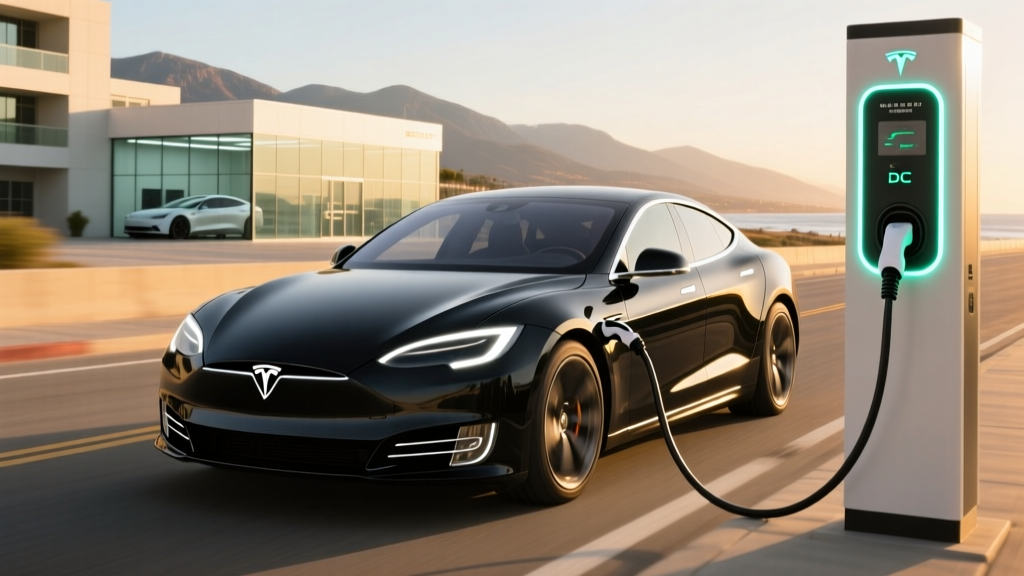
If you've ever typed "how many miles Tesla charge" into a search bar, you're not alone. The answer depends on which Tesla you drive, how you charge it, and the conditions you drive in. A Tesla Model 3 Rear-Wheel Drive plugged into a standard 120V wall outlet gains roughly 3 to 5 miles of range per hour — enough for a short commute top-up, but painfully slow for a full charge. Plug that same car into a 250 kW Supercharger, and you can recover up to 175 miles in about 15 minutes.
This guide breaks down exactly how many miles each current 2026 Tesla model delivers per charge session, per hour of charging, and on a full battery — with the real-world caveats the EPA sticker doesn't show you.
Full Tesla Lineup: Range, Battery, and Charging at a Glance
Before we get into the nuances of real-world range and charging curves, here's the raw data for every Tesla you can buy new in 2026. All figures reflect EPA estimates and manufacturer-published specs.
| Model / Trim | EPA Range | Battery (kWh usable) | Chemistry | Peak DC kW | 10–80% DC Time | Level 2 Rate | 0–60 mph | Base MSRP |
|---|---|---|---|---|---|---|---|---|
| Model 3 RWD | 363 mi | ~60 kWh | LFP | 170 kW | ~25 min | 11.5 kW (~44 mi/hr) | 5.8 s | $38,990 |
| Model 3 Long Range AWD | 363 mi | ~79 kWh | NMC | 250 kW | ~22 min | 11.5 kW (~44 mi/hr) | 4.2 s | $42,490 |
| Model 3 Performance | 315 mi | ~79 kWh | NMC | 250 kW | ~22 min | 11.5 kW (~44 mi/hr) | 2.9 s | $52,990 |
| Model Y Long Range AWD | 331 mi | ~79 kWh | NMC | 250 kW | ~22 min | 11.5 kW (~44 mi/hr) | 4.8 s | $44,990 |
| Model Y Performance | 298 mi | ~79 kWh | NMC | 250 kW | ~22 min | 11.5 kW (~44 mi/hr) | 3.5 s | $51,490 |
| Model S Long Range | 402 mi | ~100 kWh | NMC | 250 kW | ~27 min | 11.5 kW (~41 mi/hr) | 3.1 s | $79,990 |
| Model S Plaid | 359 mi | ~100 kWh | NMC | 250 kW | ~27 min | 11.5 kW (~41 mi/hr) | 1.99 s | $89,990 |
| Model X Long Range | 348 mi | ~100 kWh | NMC | 250 kW | ~28 min | 11.5 kW (~36 mi/hr) | 3.8 s | $79,990 |
| Model X Plaid | 320 mi | ~100 kWh | NMC | 250 kW | ~28 min | 11.5 kW (~36 mi/hr) | 2.5 s | $94,990 |
| Cybertruck AWD | 340 mi | ~123 kWh | NMC | 250 kW | ~30 min | 11.5 kW (~30 mi/hr) | 4.1 s | $79,990 |
| Cybertruck Cyberbeast | 320 mi | ~123 kWh | NMC | 250 kW | ~30 min | 11.5 kW (~30 mi/hr) | 2.6 s | $99,990 |
Sources: fueleconomy.gov, Tesla.com specifications. Real-world results will vary based on temperature, terrain, speed, and tire condition.
How Many Miles Per Hour of Charging: Level 1, Level 2, and DC Fast
The phrase "how many miles does a Tesla charge" really breaks down into two questions: how many miles do you get from a full charge, and how many miles do you add per unit of charging time. Here's what each charging level actually delivers in practice.
| Charging Level | Power (kW) | Miles Added / Hour | Time for Full Charge (0–100%) | Best Use Case |
|---|---|---|---|---|
| Level 1 (120V household) | ~1.2 kW | 3–5 mi/hr | ~22–26 hours | Emergency top-up, overnight for short commutes |
| Level 2 (240V, 32A Mobile Connector) | ~7.7 kW | ~30 mi/hr | ~10–12 hours | Overnight home charging (basic setup) |
| Level 2 (240V, 48A Wall Connector) | ~11.5 kW | ~44 mi/hr | ~7–8 hours | Optimal daily home charging |
| DC Fast (V3 Supercharger) | Up to 250 kW | ~1,000+ mi/hr (peak) | 10–80% in ~22 min | Road trips, rapid top-ups |
A critical distinction many new EV owners miss: kW (kilowatts) measures power — the rate of energy flow — while kWh (kilowatt-hours) measures energy capacity, the total amount stored in the battery. A 250 kW Supercharger delivers energy fast, but the battery's 79 kWh capacity determines how far that energy takes you.
On a V3 Supercharger, the charge curve matters enormously. Your Tesla will peak near 250 kW only between roughly 10% and 30% State of Charge (SoC). From 50% to 80%, the rate tapers significantly — often dropping below 75 kW. That's why Tesla (and every honest EV reviewer) quotes 10–80% time rather than 0–100%. Charging from 80% to 100% on DC fast charge can take as long as the 10–80% session itself, so it's rarely worth the wait on a road trip.
Real-World Range: What the EPA Sticker Doesn't Tell You
The EPA range figures above are achieved under controlled test cycles that mix city and highway driving at moderate temperatures. In actual ownership:
- Highway driving at 75 mph: Expect 85–90% of EPA range. A Model 3 Long Range rated at 363 miles will typically deliver ~310–325 miles on a flat interstate run at 70–75 mph.
- Cold weather (below 32°F): Expect 70–80% of EPA range. The same Model 3 LR may deliver 250–290 miles in winter conditions, due to battery resistance, cabin heating demand, and reduced regenerative braking efficiency.
- City / stop-and-go driving: You can match or slightly exceed EPA range. Regenerative braking recovers energy that would otherwise be lost to friction brakes, making Teslas extremely efficient in urban traffic.
- Extreme heat (above 95°F): Expect ~90–95% of EPA range, primarily from air conditioning load. Tesla's heat pump (standard on all current models) mitigates this better than resistive HVAC systems.
The Model 3 RWD's LFP (lithium iron phosphate) battery deserves a specific callout. LFP chemistry offers slower degradation over time and can be routinely charged to 100% without the longevity concerns of NMC batteries — Tesla actually recommends regular 100% charges for LFP-equipped vehicles to keep the battery management system calibrated. The tradeoff: LFP has lower energy density (hence the smaller ~60 kWh pack) and performs worse in extreme cold, where range loss can reach 35–40% without preconditioning.
Preconditioning — warming the battery before a fast-charge session or a cold-weather drive — is essential. Navigate to a Supercharger using the Tesla navigation system and the car will automatically precondition the battery, bringing it to optimal temperature for faster charging. Skipping this step in cold weather can cut your peak DC charge rate by 50% or more.
Efficiency Breakdown: MPGe and kWh per 100 Miles
Range is only half the story. Efficiency determines how much electricity (and money) you spend per mile. Here's how the current Tesla lineup compares, per fueleconomy.gov data:
| Model | Combined MPGe | kWh / 100 mi | Est. Cost per Mile* |
|---|---|---|---|
| Model 3 RWD | 132 MPGe | 25 kWh | $0.038 |
| Model 3 Long Range AWD | 134 MPGe | 25 kWh | $0.038 |
| Model 3 Performance | 113 MPGe | 30 kWh | $0.045 |
| Model Y Long Range AWD | 123 MPGe | 27 kWh | $0.041 |
| Model Y Performance | 111 MPGe | 30 kWh | $0.045 |
| Model S Long Range | 120 MPGe | 28 kWh | $0.042 |
| Model S Plaid | 116 MPGe | 29 kWh | $0.044 |
| Cybertruck AWD | 76 MPGe | 44 kWh | $0.066 |
*Cost per mile calculated at $0.15/kWh (U.S. residential average). Actual costs vary by utility rate, time-of-use pricing, and Supercharger fees ($0.25–$0.50+/kWh depending on location and time).
MPGe (miles per gallon equivalent) converts electricity consumption into a gasoline-familiar metric: 33.7 kWh of electricity equals one gallon of gas. The Model 3 Long Range at 134 MPGe combined is among the most efficient EVs sold in the U.S. — meaning you get more miles per dollar of electricity than nearly anything else on the road.
Pricing, Trims, and Federal Tax Credit Eligibility
Sticker price is only the starting point. The federal EV tax credit under IRS §30D can reduce your effective cost by up to $7,500, but eligibility is anything but automatic. Here's the current landscape for 2026 Tesla purchases:
| Model | Base MSRP | Under MSRP Cap? | Potential Credit | Est. Net Price* |
|---|---|---|---|---|
| Model 3 RWD | $38,990 | Yes (sedan cap: $55,000) | Up to $7,500 | ~$31,490 |
| Model 3 Long Range AWD | $42,490 | Yes | Up to $7,500 | ~$34,990 |
| Model 3 Performance | $52,990 | Yes | Up to $7,500 | ~$45,490 |
| Model Y Long Range AWD | $44,990 | Yes (SUV/truck cap: $80,000) | Up to $7,500 | ~$37,490 |
| Model Y Performance | $51,490 | Yes | Up to $7,500 | ~$43,990 |
| Model S Long Range | $79,990 | No (exceeds $55,000 sedan cap) | $0 | $79,990 |
| Model X Long Range | $79,990 | Yes (SUV cap: $80,000) | Up to $7,500 | ~$72,490 |
| Cybertruck AWD | $79,990 | Yes (truck cap: $80,000) | Up to $7,500 | ~$72,490 |
*Net price assumes full $7,500 credit. Your actual credit depends on meeting all §30D requirements. Consult a tax professional.
- Income caps: Modified AGI ≤ $150,000 (single), ≤ $225,000 (head of household), ≤ $300,000 (joint). If you exceed these in either the purchase year or prior year, you get $0.
- MSRP caps: Sedans/wagons ≤ $55,000; SUVs/trucks/vans ≤ $80,000. This eliminates the Model S from credit eligibility entirely.
- Battery sourcing: The $7,500 credit splits into two halves — $3,750 for critical minerals sourcing and $3,750 for battery component manufacturing. Tesla's U.S.-built vehicles with LFP batteries (Model 3 RWD) have faced partial credit reductions in past years due to China-sourced LFP cathode material. Verify current-year eligibility on IRS.gov before purchasing.
- Point-of-sale transfer: As of 2024, you can transfer the credit to the dealer at purchase, reducing your out-of-pocket cost immediately rather than waiting until tax filing. Tesla supports this at delivery.
- VIN registration: Tesla must report the vehicle's VIN to the IRS. This is standard for Tesla deliveries but confirm at signing.
Interior, Tech, and Daily Ownership Experience
Tesla's interior philosophy is minimalist to the point of polarizing. The Model 3 and Model Y center around a single 15.4-inch touchscreen that controls virtually everything — climate, mirrors, glovebox, and driving settings. There is no traditional instrument cluster; speed and navigation appear in the upper-left corner of the central display. The refreshed Model 3 (introduced for 2024) added ambient lighting, ventilated front seats, a rear passenger touchscreen, and significantly improved noise insulation — changes that carry into 2026.
Cargo and passenger space:
- Model 3: 23 cu ft trunk + 3.1 cu ft frunk; 42.2" front legroom, 35.3" rear legroom
- Model Y: 30.2 cu ft cargo (behind 2nd row) + 76.2 cu ft with seats folded + 4.1 cu ft frunk; 41.8" front, 37.3" rear legroom
- Model S: 28 cu ft cargo + 5.3 cu ft frunk; 42.4" front, 35.4" rear legroom
- Model X: Up to 88.1 cu ft (5-seat config, seats folded) + 6.6 cu ft frunk; 41.2" front, 37.1" rear legroom
- Cybertruck: ~67 cu ft bed (6' x 4') + lockable frunk; 41.3" front, 38.2" rear legroom
Driver assistance: Every Tesla ships with Basic Autopilot (traffic-aware cruise control and lane centering). Full Self-Driving (Supervised) remains a SAE Level 2 system — it does not make the car self-driving. You must keep your hands on the wheel (or demonstrate attentiveness via the cabin camera) and remain fully responsible for the vehicle at all times. FSD adds automatic lane changes, traffic light/stop sign response, and navigate-on-autopilot, but it requires constant supervision. True Level 4 autonomy (no driver needed) in consumer Teslas is not available.
Tesla's Autopilot and FSD (Supervised) are SAE Level 2 driver-assistance systems. They do NOT replace an attentive driver. They cannot handle all road conditions, construction zones, adverse weather, or unexpected obstacles without intervention. You are legally and physically responsible for the vehicle at all times. Do not use these systems while fatigued, distracted, or impaired.
Warranty Coverage and Battery Longevity
Tesla's warranty structure is straightforward but worth understanding before purchase:
| Coverage Type | Model 3 / Model Y | Model S / Model X | Cybertruck |
|---|---|---|---|
| Basic Vehicle | 4 yr / 50,000 mi | 4 yr / 50,000 mi | 4 yr / 50,000 mi |
| Battery & Drive Unit | 8 yr / 120,000 mi (LR/Perf) 8 yr / 100,000 mi (RWD) |
8 yr / 150,000 mi | 8 yr / 150,000 mi |
| Battery Capacity Retention | ≥70% over warranty period | ≥70% over warranty period | ≥70% over warranty period |
The 70% retention threshold means Tesla will repair or replace the battery if it degrades below 70% of original capacity within the warranty period. In practice, Tesla fleet data and third-party analyses (including long-term owner reports) show most NMC packs retain 85–90% capacity at 100,000 miles, with degradation flattening significantly after the initial 20,000–30,000 mile break-in period. LFP packs in the Model 3 RWD have shown even slower degradation curves, though with fewer ultra-high-mileage data points available so far.
Pros and Cons: The Honest Summary
Pros
- Class-leading Supercharger network — the most reliable and extensive DC fast-charging system in North America, now open to other brands via NACS adoption
- Outstanding efficiency: Model 3 LR at 134 MPGe combined is among the best EVs for cost-per-mile
- Over-the-air updates continuously add features, improve performance, and refine the UI post-purchase
- Strong resale value relative to many EV competitors
- LFP battery option (Model 3 RWD) allows routine 100% charging with minimal degradation concern
- Heat pump standard across the lineup for better cold-weather efficiency
Cons
- Minimalist interior not for everyone — no physical buttons for climate, volume, or glovebox
- Model S and Model 3 Performance lose federal tax credit eligibility (MSRP cap for sedans)
- Build quality, while improved, still shows occasional panel-gap inconsistency vs. legacy luxury brands
- FSD (Supervised) costs $8,000 extra (or $99/mo) and remains Level 2 — not autonomous driving
- Cybertruck's 76 MPGe efficiency makes it the most expensive Tesla per mile to operate
- Rear-seat comfort in Model 3 is tighter than competitors like the Hyundai Ioniq 6 or BMW i4
- LFP battery cold-weather performance is noticeably worse than NMC in sub-freezing temps
Who Should Buy Which Tesla?
- Choose the Model 3 RWD if: You want the most affordable entry point (~$31,490 after credit), commute under 60 miles daily, have reliable home charging, and don't need AWD. The LFP battery rewards simple daily charging habits.
- Choose the Model 3 Long Range AWD if: You need 363 miles of EPA range for regular road trips, want dual-motor AWD for snow/rain, and value the best efficiency-to-range ratio in the lineup.
- Choose the Model Y Long Range AWD if: You need crossover cargo space (76.2 cu ft max), carry rear-seat passengers regularly, and want an SUV that still qualifies for the full $7,500 federal credit.
- Choose the Model S Long Range if: You want 402 miles of range, a premium sedan experience, and budget is not your primary constraint. Just know the $79,990 MSRP disqualifies it from the federal credit.
- Choose the Cybertruck if: You need a truck bed, want stainless-steel durability for worksite use, and can accept the 76 MPGe efficiency penalty. It qualifies for the credit under the $80,000 truck cap.
Frequently Asked Questions
What is the real-world range of a Tesla on a full charge?
It depends on the model and conditions. The Model 3 Long Range AWD is EPA-rated at 363 miles, but expect ~310–325 miles on a sustained highway drive at 75 mph, and ~250–290 miles in freezing weather with cabin heat running. The Model S Long Range posts the highest EPA figure at 402 miles, with real-world highway results around 340–360 miles in moderate temperatures.
How fast does a Tesla charge at home and on the road?
At home on a 48A Tesla Wall Connector (Level 2, 11.5 kW), a Model 3 Long Range adds roughly 44 miles of range per hour — a full charge takes about 7–8 hours, ideal for overnight. On a V3 Supercharger (up to 250 kW DC), the same car charges from 10% to 80% in approximately 22 minutes. On a standard 120V outlet (Level 1), expect only 3–5 miles per hour — useful only for emergencies or very short commutes.
How much does a Tesla cost after the federal tax credit?
The Model 3 RWD starts at $38,990 and can drop to ~$31,490 with the full $7,500 §30D credit — if you meet income caps (≤$150K single / ≤$300K joint) and the battery sourcing requirements are satisfied that model year. The Model Y Long Range at $44,990 can reach ~$37,490 after credit. The Model S at $79,990 exceeds the $55,000 sedan MSRP cap and does not qualify. Always verify current eligibility on IRS.gov.
Is a Tesla worth buying compared to competitors?
Tesla's advantages are the Supercharger network, software/OTA update maturity, and efficiency. Against the Hyundai Ioniq 6 (361 mi, faster 800V charging at 350 kW), BMW i4 (more traditional luxury interior), or Ford Mustang Mach-E (competitive range, BlueCruise hands-free on mapped highways), Tesla still leads on charging infrastructure and over-the-air feature delivery. However, if you prioritize interior material quality, physical controls, or a more traditional dealership experience, the competitors deserve serious test drives.
Does every Tesla qualify for the $7,500 federal EV tax credit?
No. Eligibility requires meeting all three hurdles: buyer income within §30D caps, vehicle MSRP under the applicable limit ($55,000 for sedans, $80,000 for SUVs/trucks), and battery critical-mineral/component sourcing thresholds set by the IRS. The Model 3 RWD's LFP battery, historically sourced partly from China, has seen partial credit eligibility in some model years. Confirm the exact credit amount for your delivery month before signing — the rules are subject to change, and your tax professional should verify your personal eligibility.
How long does a Tesla battery last before needing replacement?
Tesla warranties the battery for 8 years / 100,000–150,000 miles (depending on model), guaranteeing at least 70% capacity retention. Real-world fleet data suggests most Tesla batteries retain 85–90% capacity at 100,000 miles. Full battery replacement outside of warranty currently costs between $12,000 and $20,000+ depending on the model, though this is rarely needed within normal ownership timeframes.