The Quick Answer: Tesla Charging kW by Model
If you're asking "how many kW does it take to charge a Tesla," the answer depends on whether you're talking about power (kW) — the rate at which energy flows into the battery — or energy (kWh) — the total capacity of the battery itself. These two units are the single most confused pair in EV ownership, so let's lock them down first:
- kW (kilowatts) = the speed of charging, like gallons-per-minute at a gas pump.
- kWh (kilowatt-hours) = the size of the battery tank, like gallons in a fuel tank.
A Tesla doesn't "take" a fixed number of kW. It accepts up to a maximum charge rate (in kW) that varies by model, battery chemistry, state of charge, and temperature. Here's the 2026 lineup at a glance:
| Model / Trim | Battery Capacity (usable kWh) | Chemistry | Max DC Fast-Charge kW | Max Level 2 kW (AC) |
|---|---|---|---|---|
| Model 3 RWD | ~57.5 kWh | LFP | 170 kW | 11.5 kW (48A) |
| Model 3 Long Range AWD | ~75 kWh | NMC | 250 kW | 11.5 kW (48A) |
| Model 3 Performance | ~75 kWh | NMC | 250 kW | 11.5 kW (48A) |
| Model Y Long Range AWD | ~75 kWh | NMC | 250 kW | 11.5 kW (48A) |
| Model Y Performance | ~75 kWh | NMC | 250 kW | 11.5 kW (48A) |
| Model S Long Range | ~95 kWh | NMC | 250 kW | 11.5 kW (48A) |
| Model S Plaid | ~95 kWh | NMC | 250 kW | 11.5 kW (48A) |
| Model X Long Range | ~95 kWh | NMC | 250 kW | 11.5 kW (48A) |
| Cybertruck AWD | ~123 kWh | NMC | 250 kW | 11.5 kW (48A) |
| Cybertruck Cyberbeast | ~123 kWh | NMC | 250 kW | 11.5 kW (48A) |
The critical takeaway: no current Tesla accepts more than 250 kW on DC fast charging, and the base Model 3 RWD with its LFP battery caps at 170 kW. The often-cited "V4 Supercharger" hardware is capable of higher output, but Tesla's vehicles themselves remain the bottleneck as of the 2026 model year.
Real-World Range vs. EPA Sticker: What You'll Actually Get
EPA vs. Reality Check: EPA range figures assume a mix of city and highway driving at moderate temperatures. In real-world highway use at 75 mph, expect 85–90% of the EPA sticker. In freezing weather (below 32°F / 0°C), plan for 20–30% range reduction due to battery resistance and cabin heating demands.
| Model | EPA Range (mi) | Real-World Highway (75 mph) | Cold-Weather Estimate (20°F) | MPGe (Combined) | kWh/100 mi |
|---|---|---|---|---|---|
| Model 3 RWD | 272 | ~235–245 | ~190–215 | 132 MPGe | 25 |
| Model 3 Long Range AWD | 363 | ~310–325 | ~255–290 | 132 MPGe | 25 |
| Model 3 Performance | 315 | ~270–285 | ~220–250 | 119 MPGe | 28 |
| Model Y Long Range AWD | 320 | ~275–290 | ~225–255 | 122 MPGe | 27 |
| Model Y Performance | 285 | ~245–260 | ~200–225 | 111 MPGe | 30 |
| Model S Long Range | 402 | ~345–365 | ~285–320 | 120 MPGe | 28 |
| Model S Plaid | 359 | ~305–325 | ~250–285 | 114 MPGe | 29 |
| Model X Long Range | 335 | ~285–300 | ~235–265 | 103 MPGe | 33 |
| Cybertruck AWD | 340 | ~280–300 | ~235–270 | 87 MPGe | 39 |
| Cybertruck Cyberbeast | 320 | ~265–285 | ~220–255 | 82 MPGe | 41 |
The Model 3 Long Range stands out for efficiency: 363 miles EPA on roughly 75 kWh of usable battery translates to about 4.8 miles per kWh — among the best in the industry. The Cybertruck's stainless-steel exoskeleton and 6,800+ lb curb weight push its consumption to nearly 41 kWh/100 mi, meaning you'll spend significantly more per mile on electricity compared to a Model 3. Data sourced from fueleconomy.gov.
Charging Speed Deep Dive: DC Fast, Level 2, and Level 1
Understanding how many kW a Tesla draws at each charging level is essential for trip planning and home setup. Here's what each tier delivers:
| Level | Power (kW) | Voltage / Amperage | Miles of Range per Hour | Typical Use Case |
|---|---|---|---|---|
| Level 1 (120V outlet) | ~1.0–1.4 kW | 120V / 12A | 3–5 mi/hr | Emergency / overnight trickle |
| Level 2 (240V home) | 7.7–11.5 kW | 240V / 32–48A | 25–44 mi/hr | Daily home charging |
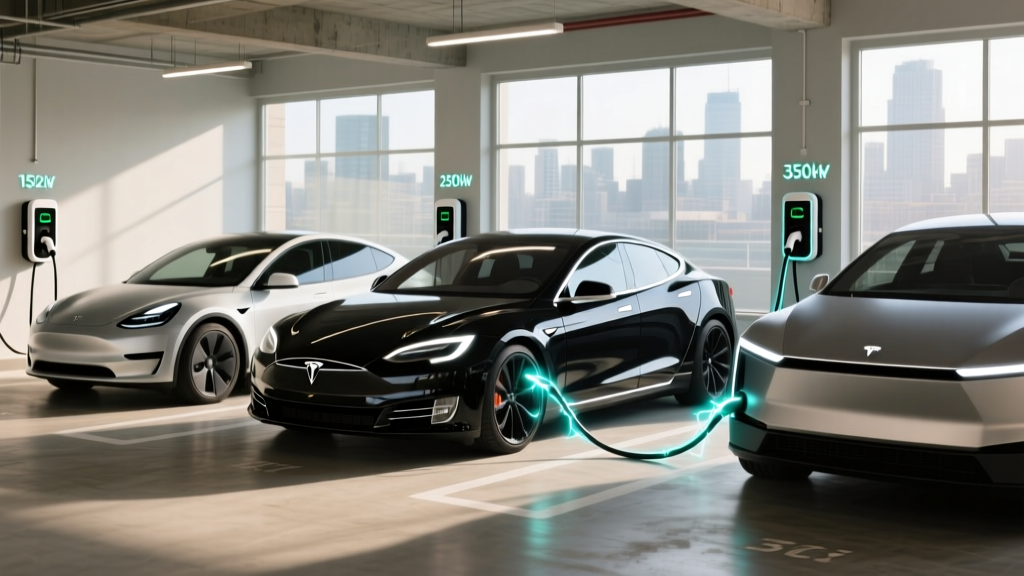
| DC Fast (Supercharger) | 170–250 kW | 400V architecture | Up to ~1,000 mi/hr (peak) | Road trips, rapid top-ups |
The Charging Curve Reality
Tesla's advertised "up to 250 kW" is a peak rate, not a sustained one. Like all EVs, Teslas follow a charging curve: the battery accepts maximum power at a low state of charge (SoC), then tapers as it fills. Here's a typical session on a V3 Supercharger for a Model 3 Long Range (NMC battery):
- 10–30% SoC: Peaks near 250 kW, averaging ~220 kW
- 30–50% SoC: Tapers to ~180–200 kW
- 50–80% SoC: Drops to ~100–130 kW
- 80–100% SoC: Slows sharply to ~30–50 kW (why you rarely charge past 80% on road trips)
10–80% DC fast-charge times by model:
- Model 3 RWD (LFP, 170 kW peak): ~25 minutes
- Model 3 Long Range / Performance (NMC, 250 kW peak): ~18–22 minutes
- Model Y Long Range / Performance (NMC, 250 kW peak): ~20–25 minutes
- Model S / Model X (NMC, 250 kW peak): ~25–30 minutes
- Cybertruck (NMC, 250 kW peak): ~35–40 minutes (larger battery)
Pro tip: Always use the Tesla navigation to route to a Supercharger. This triggers battery preconditioning — warming the pack to optimal temperature before you arrive — which can shave 5–10 minutes off your session, especially in cold weather. Without preconditioning, a cold battery may accept only 50–80 kW even at a 250 kW stall.
Home Level 2 Charging: How Many kW Do You Need?
For daily driving, Level 2 home charging is where 90%+ of Tesla charging happens. The Tesla Wall Connector delivers up to 11.5 kW (48 amps) on a 240V / 60A circuit. Here's what that means in practice:
- Model 3 RWD (~57.5 kWh battery): 0–100% in roughly 5.5 hours
- Model 3 Long Range (~75 kWh): 0–100% in roughly 7 hours
- Model S / X (~95 kWh): 0–100% in roughly 9 hours
- Cybertruck (~123 kWh): 0–100% in roughly 11.5 hours
Most owners charge from 20–80% overnight, which takes 3–5 hours for most models — easily handled while you sleep. A 40A circuit (9.6 kW) is the minimum practical setup; a 60A circuit (11.5 kW) is ideal and future-proofs for larger batteries. Always consult a licensed electrician for your specific panel capacity — older homes with 100A service may need a panel upgrade ($1,500–$3,000) before adding a 60A EV circuit.
Performance, Specs, and What It's Like to Drive
| Model | 0–60 mph (sec) | Horsepower | Drivetrain | Cargo (cu ft) | Rear Legroom (in) |
|---|---|---|---|---|---|
| Model 3 RWD | 5.8 | 271 hp | RWD (single motor) | 23 (trunk) + 3 (frunk) | 35.2 |
| Model 3 Long Range AWD | 4.2 | 346 hp | AWD (dual motor) | 23 + 3 | 35.2 |
| Model 3 Performance | 2.9 | 510 hp | AWD (dual motor) | 23 + 3 | 35.2 |
| Model Y Long Range AWD | 4.8 | 384 hp | AWD (dual motor) | 30 (behind 2nd row) + 4 (frunk) | 41.6 |
| Model Y Performance | 3.5 | 456 hp | AWD (dual motor) | 30 + 4 | 41.6 |
| Model S Long Range | 3.1 | 670 hp | AWD (dual motor) | 28 + 5 (frunk) | 35.4 |
| Model S Plaid | 1.99 | 1,020 hp | AWD (tri-motor) | 28 + 5 | 35.4 |
| Model X Long Range | 3.8 | 670 hp | AWD (dual motor) | 88 (max, seats folded) + 7 (frunk) | 41.1 |
| Cybertruck AWD | 3.9 | 600 hp | AWD (dual motor) | 121 (bed + vault) + 7 (frunk) | N/A (truck) |
| Cybertruck Cyberbeast | 2.6 | 845 hp | AWD (tri-motor) | 121 + 7 | N/A |
Tesla's dual-motor and tri-motor setups deliver exceptional traction and instantaneous torque. The Model 3 Performance's 2.9-second 0–60 time rivals six-figure supercars, while the Model S Plaid's 1.99-second claim (with rollout subtracted) remains one of the quickest production cars ever made.
Practically, the Model Y is the standout for families: 30 cu ft behind the second row (expanding to 72 with seats folded), available third-row micro-seats for small children, and a hatchback profile that swallows strollers and groceries with ease. The Model 3's sedan trunk is more limited at 23 cu ft but still competitive with midsize sedans like the Honda Accord.
Standout Tech Features
- 15.4" center touchscreen (Model 3/Y) or 17" touchscreen (Model S/X) handles all vehicle controls — no physical buttons for climate, mirrors, or glovebox
- Over-the-air (OTA) updates regularly add features; recent updates improved regenerative braking customization and added battery health metrics
- Tesla Vision camera-based Autopilot (no radar or ultrasonic sensors since 2022)
- Sentry Mode records surroundings when parked using the same camera array
- Tesla app integration: remote preconditioning, charge scheduling, location tracking, and Summon (low-speed remote parking)
Notable Drawbacks
- No Apple CarPlay or Android Auto — Tesla's proprietary infotainment is the only option
- Minimalist interior polarizes buyers; some find the lack of physical controls distracting while driving
- Vision-only Autopilot has drawn NHTSA scrutiny; phantom braking events are reported more frequently than with radar-equipped competitors
- Panel gaps and paint quality remain inconsistent, though improving at newer factories (Austin, Berlin)
- Ride firmness — especially on Performance trims with larger wheels and low-profile tires
Pricing, Trims, and Federal Tax Credit Eligibility
| Model / Trim | Base MSRP | Federal §30D Credit | Effective Price (after credit) | Notes |
|---|---|---|---|---|
| Model 3 RWD | $38,990 | Up to $7,500 | ~$31,490 | Subject to sourcing & income rules |
| Model 3 Long Range AWD | $45,240 | Up to $7,500 | ~$37,740 | Subject to sourcing & income rules |
| Model 3 Performance | $52,990 | Up to $7,500 | ~$45,490 | Subject to sourcing & income rules |
| Model Y Long Range AWD | $44,990 | Up to $7,500 | ~$37,490 | Subject to sourcing & income rules |
| Model Y Performance | $51,490 | Up to $7,500 | ~$43,990 | Subject to sourcing & income rules |
| Model S Long Range | $79,990 | $0 | $79,990 | Exceeds $55,000 sedan MSRP cap |
| Model S Plaid | $94,990 | $0 | $94,990 | Exceeds $55,000 sedan MSRP cap |
| Model X Long Range | $79,990 | $0 | $79,990 | Exceeds $80,000 SUV MSRP cap |
| Cybertruck AWD | $79,990 | $0 | $79,990 | Exceeds $80,000 truck MSRP cap |
| Cybertruck Cyberbeast | $99,990 | $0 | $99,990 | Exceeds $80,000 truck MSRP cap |
The federal EV tax credit under IRS §30D is not a blanket $7,500 for every buyer. Eligibility depends on several requirements that change frequently:
§30D Federal Tax Credit Requirements (2026):
- MSRP caps: Sedans ≤ $55,000; SUVs, vans, and trucks ≤ $80,000
- Buyer income caps (modified AGI): $150,000 single / $225,000 head of household / $300,000 joint
- Battery sourcing: Critical minerals and battery components must meet escalating domestic/free-trade-agreement percentages — this can reduce the credit to $3,750 or $0 depending on the build date and supply chain
- Point-of-sale transfer: As of 2024, buyers can transfer the credit to the dealer for an immediate price reduction at purchase (instead of waiting for tax filing)
- FEOC restriction: Vehicles with battery components from a "foreign entity of concern" (primarily Chinese suppliers) may be disqualified
As of early 2026, the Model 3 RWD and Long Range and Model Y Long Range have qualified for some or all of the $7,500 credit depending on the production batch and battery sourcing. The Model S, Model X, and Cybertruck all exceed their respective MSRP caps and are categorically ineligible. Always verify current eligibility on IRS.gov or fueleconomy.gov before purchasing — battery sourcing rules shift with supply chain changes.
Warranty, Battery Longevity, and Ownership Costs
Tesla's warranty structure is straightforward:
| Coverage | Duration |
|---|---|
| Basic Vehicle Limited Warranty | 4 years / 50,000 miles |
| Battery & Drive Unit (Model 3 RWD) | 8 years / 100,000 miles |
| Battery & Drive Unit (Model 3 LR/Perf, Model Y) | 8 years / 120,000 miles |
| Battery & Drive Unit (Model S/X) | 8 years / 150,000 miles |
| Battery & Drive Unit (Cybertruck) | 8 years / 120,000 miles |
The battery warranty guarantees a minimum of 70% capacity retention over the warranty period. If your battery degrades below 70% of its original capacity within the warranty window, Tesla will repair or replace it. In practice, Tesla's battery degradation data — reported by third-party fleet analyses — shows most packs retain 85–90% capacity after 100,000 miles. LFP batteries (Model 3 RWD) tend to degrade more slowly than NMC but start with less total capacity.
Battery replacement cost (out of warranty): $12,000–$22,000 depending on the model, based on current service center quotes. This is a worst-case scenario; most batteries outlast the vehicle itself.
Total Cost of Ownership Snapshot
Charging a Model 3 Long Range at home (national average electricity rate of $0.16/kWh) costs roughly $12 for a full 75 kWh charge, or about $0.033 per mile. Compare that to a gas-powered BMW 3 Series getting 30 MPG at $3.50/gallon: $0.117 per mile. Over 15,000 miles per year, that's a fuel savings of roughly $1,260 annually for the Tesla.
However, factor in potentially higher insurance premiums (Teslas average 15–25% more to insure than comparable gas sedans, per industry data) and faster tire wear from instant torque and heavy curb weight. Overall, the 5-year TCO for a Model 3 Long Range still undercuts most luxury gas sedans, but the gap is narrower than the fuel savings alone suggest.
Who Should Buy a Tesla — and Who Shouldn't
Choose a Tesla if:
- You want access to the Supercharger network — still the most reliable and widespread DC fast-charging ecosystem in North America with 6,000+ stalls in the US
- You value OTA software updates that add features post-purchase
- You prioritize efficiency and range per dollar (Model 3 LR is the class leader)
- You're comfortable with a touchscreen-first interior and no CarPlay
- You want a strong resale-value proposition (though Tesla price cuts have compressed this advantage recently)
Look elsewhere if:
- You need Apple CarPlay / Android Auto (consider Hyundai Ioniq 5, BMW i4)
- You want a traditional luxury interior with physical controls (BMW iX, Mercedes EQS)
- You need 800V architecture for faster peak charging (Hyundai Ioniq 5/6 and Kia EV6 accept up to 350 kW)
- You want a truck with proven towing durability and dealer service networks (Ford F-150 Lightning, Rivian R1T)
- You're concerned about Tesla's brand perception or Elon Musk's public controversies affecting resale
Pros
- Industry-leading efficiency (Model 3 LR: 4.8 mi/kWh)
- Supercharger network reliability — 99%+ uptime at V3 stalls
- Strong performance across all trims; even the base Model 3 RWD hits 60 in 5.8 sec
- Over-the-air updates continuously improve the vehicle
- Competitive pricing, especially Model 3 RWD at ~$31,490 after tax credit
- Extensive Sentry Mode and app-based remote features
Cons
- No Apple CarPlay or Android Auto
- Vision-only Autopilot draws safety scrutiny; phantom braking reported
- Build quality inconsistency (panel gaps, paint)
- 250 kW peak DC charge rate lags behind 800V competitors at 350 kW
- Model S, X, and Cybertruck ineligible for federal tax credit due to MSRP caps
- Insurance costs above segment average
Frequently Asked Questions
How many kW does it take to charge a Tesla at home?
A Tesla charges at up to 11.5 kW at home using a Tesla Wall Connector on a 240V / 60A circuit. On a standard 240V / 40A circuit (like a dryer outlet with a Mobile Connector), you'll get about 7.7 kW. A regular 120V household outlet delivers only ~1.2 kW (Level 1), adding roughly 3–5 miles of range per hour.
How many kWh does a full Tesla charge use?
It depends on the model's battery capacity. A Model 3 RWD uses about 57.5 kWh for a full charge; a Model 3 Long Range uses about 75 kWh; a Model S uses about 95 kWh; and a Cybertruck uses about 123 kWh. At the US average electricity rate of $0.16/kWh, a full Model 3 Long Range charge costs roughly $12.
Does Tesla charge faster than other EVs?
Tesla's 250 kW peak charge rate is competitive but no longer class-leading. Hyundai/Kia's E-GMP platform (Ioniq 5, EV6, Ioniq 6) uses 800V architecture and can accept up to 350 kW at compatible chargers, achieving 10–80% in approximately 18 minutes. Tesla's advantage is the Supercharger network's reliability and geographic coverage, not raw charge speed.
Can I charge a non-Tesla EV at a Supercharger?
Yes — Tesla has opened select Supercharger stations to non-Tesla EVs equipped with CCS or NACS connectors through the "Charge with NACS" and adapter programs. Availability varies by station; check the Tesla app for compatible locations. Non-Tesla vehicles may see slightly slower charge rates due to adapter overhead.
How long does a Tesla battery last before replacement?
Tesla's battery warranty covers 8 years / 100,000–150,000 miles (varies by model) with a 70% capacity retention guarantee. Real-world fleet data suggests most Tesla batteries retain 85–90% capacity after 100,000 miles. Full replacement is rarely needed; individual module repairs are more common and less expensive. LFP batteries in the Model 3 RWD are rated for 3,000+ charge cycles — roughly 1 million miles of equivalent driving — before significant degradation.
Does the Tesla Model 3 qualify for the $7,500 tax credit in 2026?
The Model 3 RWD and Long Range can qualify for up to $7,500 under IRS §30D, but eligibility depends on the buyer's income (≤$150K single / ≤$300K joint), battery critical-mineral sourcing, and FEOC compliance. The credit amount may be $3,750 or $7,500 depending on the production batch. Always check the latest eligibility list at fueleconomy.gov before purchasing. The Model 3 Performance at $52,990 MSRP is under the $55,000 sedan cap but still subject to sourcing rules.
What is the real-world range of a Tesla Model Y?
The 2026 Model Y Long Range AWD has an EPA rating of 320 miles. In real-world highway driving at 75 mph, expect approximately 275–290 miles. In cold weather (20°F / -7°C), plan for 225–255 miles due to battery resistance and cabin heating. Preconditioning the battery and using seat heaters instead of cabin heat can recover 10–15 miles of range in winter.
Editor's note: Pricing, tax credit eligibility, and specifications reflect 2026 model-year data available at time of publication. Tesla frequently adjusts pricing and trim configurations. Verify all figures with Tesla's configurator and IRS.gov before making a purchase decision. Safety ratings can be reviewed at NHTSA.gov and IIHS.org.