Tesla Model 3 Charging Times at a Glance
If you've ever typed "how long to charge Tesla 3" into a search bar at 11 p.m. while debating your next car purchase, you're not alone. Charging speed is the single most practical metric for EV ownership — more than 0-60 times, more than horsepower. It determines whether your morning routine adds five minutes or forty, and whether a road trip feels effortless or requires meticulous planning.
The 2026 Tesla Model 3 lineup spans three trims with distinctly different charging personalities, battery chemistries, and range profiles. Below is the essential data, followed by the real-world context that spec sheets omit.
| Trim | Battery (kWh usable) | Chemistry | EPA Range | Peak DC kW | 10–80% DC Time | Level 2 Rate |
|---|---|---|---|---|---|---|
| Model 3 RWD | ~57.5 | LFP | 272 mi | 170 kW | ~25 min | 11.5 kW (~44 mi/hr) |
| Model 3 Long Range AWD | ~75 | NMC | 341 mi | 250 kW | ~22 min | 11.5 kW (~44 mi/hr) |
| Model 3 Performance | ~75 | NMC | 315 mi | 250 kW | ~22 min | 11.5 kW (~44 mi/hr) |
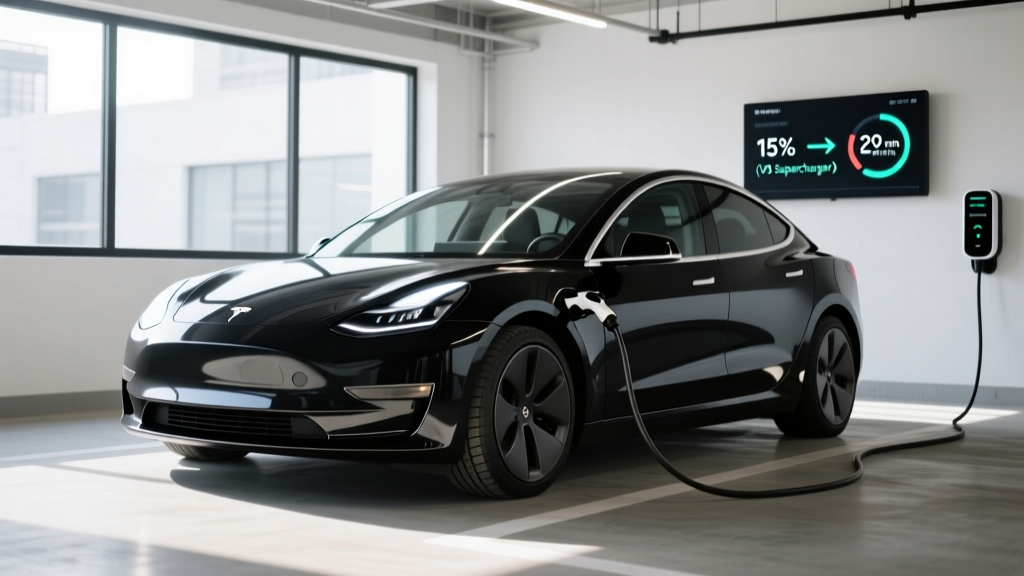
These DC fast-charge times assume you arrive at a V3 or V4 Tesla Supercharger (or an equivalently capable CCS/NACS station) with a preconditioned battery and a state of charge (SoC) near 10%. The charge curve is not linear — peak kW is sustained only through roughly 40–50% SoC, after which the rate tapers to protect the cells. By 80%, you're typically pulling under 60 kW. Charging from 80% to 100% on DC can take nearly as long as the 10–80% session, which is why road-trippers plan around the 80% mark.
Real-World Range vs. the EPA Sticker
EPA estimated range: 341 miles
Real-world highway (75 mph, mild weather): ~280–305 miles
Real-world mixed city/highway (spring/fall): ~310–330 miles
Cold-weather highway (30°F, heater on): ~230–260 miles
The EPA test cycle blends low-speed city driving with moderate highway speeds, which favors EVs thanks to regenerative braking in stop-and-go traffic. Sustained 75–80 mph highway driving is where range drops most noticeably — aerodynamic drag scales with the square of velocity, and the Model 3's efficiency falls from roughly 25 kWh/100mi in the city to 29–31 kWh/100mi on the interstate.
Cold weather compounds the loss. Lithium-ion batteries operate less efficiently below 40°F, and cabin heating (even with the Model 3's standard heat pump) draws 2–5 kW continuously. In sub-freezing conditions, plan for 20–30% range reduction versus the EPA number. The LFP battery in the RWD trim is slightly more resistant to cold-induced degradation over time, but it suffers similar immediate range loss in winter.
Home Charging: Level 1, Level 2, and Installation Reality
| Level | Voltage / Amps | Power (kW) | Miles of Range per Hour | Full 0–100% Time (LR AWD) |
|---|---|---|---|---|
| Level 1 (standard outlet) | 120V / 12A | ~1.4 kW | ~5 mi/hr | ~60+ hours |
| Level 2 (NEMA 14-50) | 240V / 40A | ~9.6 kW | ~37 mi/hr | ~9 hours |
| Level 2 (Tesla Wall Connector, 48A) | 240V / 48A | ~11.5 kW | ~44 mi/hr | ~7.5 hours |
For daily ownership, Level 2 is the baseline. A Tesla Wall Connector hardwired to a 60-amp circuit delivers the full 11.5 kW the Model 3's onboard charger can accept. That means plugging in at 6 p.m. with 20% SoC yields a full battery by 5 a.m. — more than enough for any daily commute.
Level 1 (a standard 120V household outlet) adds roughly 5 miles of range per hour. That's viable only if you drive under 30 miles daily and can leave the car plugged in for 10–12 hours overnight. For anyone with a longer commute or a Long Range battery to fill, Level 1 is a backup, not a strategy.
Installation cost for a Level 2 circuit varies enormously. A straightforward NEMA 14-50 outlet near the panel might cost $300–$600 with a licensed electrician. A hardwired Wall Connector on a 60-amp circuit, especially if the run is long or the panel needs upgrading from 100A to 200A service, can reach $1,500–$3,000. Always get a quote from a licensed electrician before purchasing equipment.
Performance, Efficiency, and Daily Livability
| Spec | RWD | Long Range AWD | Performance |
|---|---|---|---|
| 0–60 mph | 5.8 sec | 4.2 sec | 2.9 sec |
| Horsepower | ~271 hp | ~384 hp | ~510 hp |
| Drivetrain | Rear-wheel drive | Dual-motor AWD | Dual-motor AWD |
| MPGe (combined) | 132 MPGe | 125 MPGe | 118 MPGe |
| kWh/100 mi | 25 | 27 | 28 |
| Cargo (trunk + frunk) | 23 cu ft | 23 cu ft | 23 cu ft |
| Rear legroom | 35.3 in | 35.3 in | 35.3 in |
| Curb weight | ~3,862 lbs | ~4,034 lbs | ~4,065 lbs |
The Model 3 remains one of the most energy-efficient sedans in the EV market. The RWD trim's 132 MPGe combined translates to roughly 3.8 miles per kWh — meaning a full 57.5 kWh battery delivers its EPA-rated 272 miles with minimal waste. Even the Performance trim, with its stickier tires and more aggressive inverter mapping, stays above 118 MPGe.
Interior space is adequate for four adults but tight for three across the rear bench. The 23 cu ft of combined cargo space (trunk plus front trunk/frunk) handles groceries, carry-on luggage, and a stroller, but it doesn't rival a crossover. The cabin is minimalist by design — a single 15.4-inch touchscreen handles navigation, media, climate, and vehicle settings. There are no physical gauges, no stalks (turn signals are steering-wheel buttons on the refreshed Model 3), and no Apple CarPlay or Android Auto. Tesla's native infotainment is robust, but the lack of smartphone mirroring is a dealbreaker for some buyers.
Pricing, Trims, and Federal Tax Credit Eligibility
| Trim | Base MSRP | Est. As-Tested | §30D Credit Eligibility |
|---|---|---|---|
| RWD | $38,990 | $39,990–$42,490 | Likely eligible (verify sourcing) |
| Long Range AWD | $45,740 | $47,740–$52,240 | Likely eligible (under $55K sedan cap) |
| Performance | $52,990 | $54,990–$57,490 | Check MSRP with options vs. $55K cap |
The IRS §30D clean vehicle credit offers up to $7,500 for qualifying buyers, but eligibility hinges on three moving targets:
- MSRP cap: Sedans must be under $55,000. The RWD and Long Range trims clear this bar at base MSRP, but adding Full Self-Driving (Supervised), premium paint, or larger wheels can push the as-tested price above the threshold.
- Buyer income cap: Modified adjusted gross income must not exceed $150,000 (single), $225,000 (head of household), or $300,000 (joint).
- Battery sourcing: A percentage of critical minerals and battery components must be sourced from the U.S. or free-trade-agreement countries. These thresholds increase annually. Tesla has shifted some Model 3 battery production to U.S. plants using LFP and NMC cells, but exact compliance varies by build date and battery supplier.
The credit can now be transferred to the dealer at point of sale, reducing your purchase price directly rather than waiting for a tax return. Always verify current eligibility on the fueleconomy.gov credit lookup using the specific VIN before signing paperwork.
Tech, Driver Assistance, and What the Model 3 Does Best
Every Model 3 ships with Tesla's Basic Autopilot — a Level 2 driver-assistance system that handles adaptive cruise control and lane centering on highways. The optional Enhanced Autopilot ($6,000) adds auto lane change, autosteer on city streets, and smart summon. Full Self-Driving (Supervised) at $8,000 extends capability to traffic-light and stop-sign recognition with more aggressive city-street navigation.
All Tesla driver-assist features — including FSD (Supervised) — are SAE Level 2. The driver must remain fully engaged, hands on or near the wheel, eyes on the road, and ready to take over instantly. This is not autonomous driving. Level 4 driverless service (like Waymo) operates without a human driver in geofenced areas; the Model 3 does not offer this.
Standout tech includes over-the-air software updates that have materially improved acceleration, braking, and range efficiency post-purchase; the Tesla Supercharger network with over 6,000 U.S. stalls and near-flawless plug-and-charge authentication; and a cabin heat pump that reduces winter range loss compared to resistive heaters in older EVs. The Sentry Mode dashcam system, Dog Mode climate control, and theater-quality 17-speaker audio (Long Range/Performance) round out the feature set.
Notable drawbacks: the lack of a physical instrument cluster means glancing at speed requires looking at the center screen; rear visibility is compromised by the thick C-pillars and small rear window; and Tesla's build-quality consistency, while improved, still shows occasional panel-gap variation that legacy automakers typically avoid.
Who Should Buy the 2026 Model 3 — and Who Shouldn't
Choose the Model 3 RWD if: You commute under 60 miles daily, have reliable home Level 2 charging, want the lowest entry price, and prefer LFP chemistry for its longer cycle life and 100% SoC daily charging tolerance.
Choose the Model 3 Long Range AWD if: You road-trip regularly, live in a cold climate where AWD traction and extra range buffer matter, or need the most usable miles per charge session.
Choose the Model 3 Performance if: You value sub-3-second acceleration and track-capable handling, and you're willing to trade ~26 miles of EPA range for the performance delta.
Look elsewhere if: You need three rows of seating, over 30 cu ft of cargo, or you refuse to adapt to a screen-only interface. The Hyundai Ioniq 6 offers comparable range with more traditional controls; the BMW i4 provides a more luxurious cabin; and the Tesla Model Y gives crossover utility on the same platform.
Warranty and Long-Term Battery Outlook
Tesla covers the Model 3's battery and drive unit for 8 years or 100,000 miles (RWD) and 8 years or 120,000 miles (Long Range/Performance), whichever comes first, with a minimum 70% capacity retention threshold. The vehicle limited warranty is 4 years or 50,000 miles.
LFP batteries (RWD trim) demonstrate slower long-term degradation than NMC, with real-world fleet data showing 5–8% loss over 100,000 miles when charged to 100% regularly — which Tesla explicitly recommends for LFP. NMC packs in the Long Range and Performance trims degrade slightly faster (8–12% over similar mileage) and benefit from daily charge limits of 80%, reserving 100% for road trips.
Frequently Asked Questions
How long does it take to charge a Tesla Model 3 at home?
On a 240V Level 2 circuit at 11.5 kW (Tesla Wall Connector, 48A), the Long Range AWD charges from 0–100% in roughly 7.5 hours. The smaller RWD battery fills in about 5.5 hours. Most owners charge from 20–80% overnight, which takes 3–4 hours — well within a typical evening.
Can I charge a Tesla Model 3 on a regular household outlet?
Yes, using the Mobile Connector on a 120V outlet delivers about 1.4 kW, adding roughly 5 miles of range per hour. This works for very low-mileage drivers (under 30 miles/day) but is impractical as a primary charging method for most owners.
Does the Tesla Model 3 qualify for the $7,500 federal tax credit?
The RWD and Long Range trims likely qualify at base MSRP, provided the buyer meets income caps ($150K single / $300K joint) and the specific vehicle's battery meets critical-mineral and component-sourcing thresholds for the current tax year. The Performance trim's eligibility depends on whether options push the MSRP above the $55,000 sedan cap. Verify using the VIN on fueleconomy.gov before purchasing.
Is the Model 3 worth it over the Hyundai Ioniq 6 or BMW i4?
The Model 3 wins on Supercharger network access, energy efficiency (lowest kWh/100mi in its class), and OTA software improvements. The Ioniq 6 offers 800V architecture for faster DC charging curves and a more conventional interior. The BMW i4 delivers superior build quality and cabin materials. If Supercharger reliability and software are your priorities, the Model 3 remains the benchmark; if interior refinement or charging-protocol flexibility matters more, test-drive the competitors.
How does cold weather affect Model 3 range and charging?
In temperatures below 32°F, expect 20–30% range reduction due to battery resistance and cabin heating load. DC fast charging also slows — a cold-soaked battery may accept only 50–80 kW initially until it warms, even at a 250 kW Supercharger. Always use the Tesla app to precondition the battery (navigate to a Supercharger triggers automatic preconditioning) before arriving for the fastest charge.