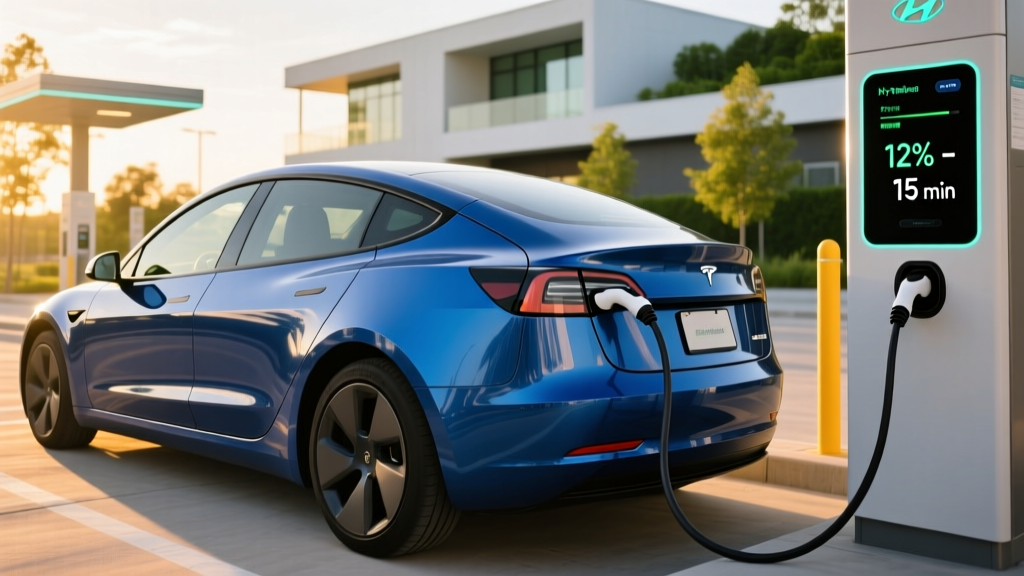
The honest answer to how long to charge an electric car depends entirely on which of three charging levels you're using and how large your battery is. A typical 75 kWh battery (like a Tesla Model Y Long Range) takes roughly 50–60 hours on a standard 120V wall outlet (Level 1), about 7–9 hours on a 240V home charger (Level 2), and approximately 20–25 minutes from 10% to 80% at a 250 kW DC fast charger. Those numbers shift based on battery size, charger power output, battery chemistry, and ambient temperature—but the hierarchy never changes: Level 1 is an emergency trickle, Level 2 is daily life, and DC fast charging is for road trips.
Quick Answer: Charge Times for a 75 kWh Battery
| Charging Level | Power Output | 0–100% Time | 10–80% Time | Miles Added per Hour |
|---|---|---|---|---|
| Level 1 (120V household) | 1.0–1.4 kW | 50–75 hours | N/A (impractical) | 3–5 mi/hr |
| Level 2 (240V home/public) | 7.2–11.5 kW | 7–11 hours | 5–8 hours | 25–44 mi/hr |
| DC Fast Charging | 50–350 kW | Not recommended to 100% | 18–45 min | 150–300+ mi (peak) |
Based on a ~75 kWh usable battery (e.g., Tesla Model Y, Hyundai Ioniq 5 AWD). Actual times vary by vehicle acceptance rate, state of charge, and temperature.
Understanding the Three Charging Levels
Before you can estimate how long to charge an electric car, you need to understand the fundamental difference between kW (kilowatts) and kWh (kilowatt-hours). Kilowatts measure the rate of power delivery—think of it as how wide the pipe is. Kilowatt-hours measure the total energy stored in your battery—think of it as the size of the tank. A 75 kWh battery charged at 7.5 kW takes roughly 10 hours. The math is that simple at Level 1 and Level 2.
DC fast charging is more complex because the charge rate isn't constant. Your vehicle's battery management system (BMS) tapers the charge speed as the battery fills, protecting cell longevity. A car that advertises "250 kW peak charging" will only sustain that rate for a narrow window—typically between 10% and 30% state of charge (SoC) under ideal thermal conditions. Above 80%, charging slows dramatically. This is why you'll see manufacturers advertise 10–80% charge times rather than 0–100%.
Level 1 Charging: The 120V Trickle
Every EV comes with a mobile charging cord that plugs into a standard 120V household outlet. This delivers between 1.0 and 1.4 kW of continuous power. For a vehicle like the 2026 Chevrolet Equinox EV (85 kWh usable battery, EPA range up to 319 miles), a full charge from empty would take roughly 60–85 hours. That's two to three full days.
Level 1 isn't useless—it's practical for plug-in hybrids with smaller batteries (the Toyota RAV4 Prime's 18.1 kWh battery charges in roughly 12 hours on 120V) and for EV owners who drive fewer than 30 miles per day and can top off overnight. But for a battery-electric vehicle with a 70+ kWh pack, Level 1 is a backup option, not a primary strategy.
Level 2 Home Charging: The Daily Workhorse
A 240V Level 2 home charger—hardwired or plugged into a NEMA 14-50 outlet—is where most EV owners do 90% or more of their charging. Common home units deliver between 7.2 kW (30-amp circuit) and 11.5 kW (50-amp circuit, 48-amp continuous). At 11.5 kW, a 75 kWh battery charges from 0–100% in roughly 7 hours. At 7.2 kW, expect closer to 10–11 hours.
Most EV owners charge from 20–80% overnight, which at 11.5 kW takes roughly 4–5 hours. If your vehicle supports scheduled charging and your utility offers time-of-use (TOU) rates, you can set the car to begin charging at 11 PM or midnight when electricity is cheapest—often $0.08–$0.12/kWh depending on your region.
Home Level 2 Installation Cost Breakdown
| Component | Cost Range | Notes |
|---|---|---|
| Level 2 charger (hardware) | $200–$700 | ChargePoint Home Flex, Emporia, Wallbox Pulsar Plus |
| Electrician labor | $500–$2,000 | Varies by run length, wall type, and local rates |
| Electrical panel upgrade (if needed) | $1,500–$3,500 | Required if panel is at capacity or is 100A or less |
| Permit and inspection | $50–$300 | Required in most jurisdictions |
| Total (no panel upgrade) | $750–$3,000 | Most common scenario for 200A panel homes |
| Total (with panel upgrade) | $2,250–$6,500 | Older homes or high-load households |
The IRS §30D credit does not cover home charger installation for most taxpayers in 2026. However, the separate §30C Alternative Fuel Vehicle Refueling Property Credit may cover up to 30% of home charging equipment and installation costs (up to $1,000) if you live in an eligible census tract. Consult a tax professional and verify your eligibility at irs.gov.
DC Fast Charging: Road-Trip Reality
DC fast chargers bypass the vehicle's onboard charger and deliver direct current straight to the battery at far higher power levels. In 2026, public DC fast chargers range from legacy 50 kW units to cutting-edge 350 kW and even 500 kW stations along major corridors.
But peak kW numbers are misleading. Here's what real-world DC fast charging actually looks like:
| Vehicle (2026) | Battery | Peak DC Rate | 10–80% Time | Sustained Average kW |
|---|---|---|---|---|
| Hyundai Ioniq 5 (Long Range AWD) | 77.4 kWh (NMC) | 240 kW | ~18 min | ~165 kW |
| Tesla Model Y Long Range | ~75 kWh (NMC) | 250 kW | ~25 min | ~140 kW |
| Chevrolet Equinox EV 3RS | 85 kWh (NMC) | 150 kW | ~35 min | ~105 kW |
| Ford F-150 Lightning (Extended) | 131 kWh (NMC) | 150 kW | ~41 min | ~115 kW |
| Rivian R1S (Max Pack) | 141 kWh (NMC) | 200+ kW | ~38 min | ~140 kW |
The sustained average kW matters far more than the peak number. The Hyundai Ioniq 5's 800V architecture allows it to sustain high charge rates longer, which is why its 10–80% time beats vehicles with a similar or even higher peak rate. Battery preconditioning—where the vehicle warms the battery while you navigate to a charger—is critical for achieving advertised charge speeds in cold weather. Tesla, Rivian, Hyundai/Kia, and most modern EV makers include automatic preconditioning; some older or budget models do not.
Charging Curve Reality Check
A DC fast charger rated at 350 kW will almost never deliver 350 kW to your car for more than a few minutes. Most vehicles peak between 150–250 kW and taper significantly above 50% SoC. Charging from 80% to 100% on DC fast charging can take as long as charging from 10% to 80%. For battery longevity, limit routine DC fast charging to 80% and save 100% fills for when you genuinely need the range.
How Long to Charge an Electric Car vs. Fueling a Gas Car
This is the comparison every prospective EV buyer wants to see. The framing matters: EV charging and gas fueling serve fundamentally different use cases.
| Metric | Electric Vehicle (Home Level 2) | Gasoline Vehicle |
|---|---|---|
| "Refuel" time (daily use) | 0 minutes (plug in at night, wake up full) | 5–10 minutes at gas station |
| Weekly time spent (30 mi/day avg) | ~0 minutes (overnight charging) | 15–25 minutes (1–2 gas station visits) |
| Road-trip refuel (300 miles) | 20–35 min (DC fast charge, 10–80%) | 5–8 min (gas station) |
| Annual "refueling" time | ~4–8 hours on road trips | ~15–30 hours at gas stations |
| Cost per mile (national avg) | $0.04–$0.06 (home), $0.12–$0.18 (DCFC) | $0.12–$0.16 (at $3.40/gal, 28 MPG) |
The data from fueleconomy.gov confirms that home-charging EV owners spend less total time "refueling" per year than gas car owners—they just do it while sleeping. The time penalty only appears on road trips, where a 300-mile journey in an EV might add 25–40 minutes of charging compared to a gas car.
The Real Cost of EV Charging in 2026
Electricity prices vary widely by state and utility. Here's a practical cost breakdown for a typical EV owner driving 12,000 miles per year in a vehicle averaging 3.0 miles per kWh (roughly 112 MPGe):
| Charging Scenario | Cost per kWh | Annual Fuel Cost (12k mi) | Cost per Mile |
|---|---|---|---|
| Home Level 2 (national avg electricity) | $0.16 | $640 | $0.053 |
| Home Level 2 (TOU off-peak rate) | $0.09 | $360 | $0.030 |
| Home Level 2 (California avg) | $0.28 | $1,120 | $0.093 |
| Public DC fast charging (avg) | $0.35–$0.48 | $1,400–$1,920 | $0.12–$0.16 |
| Gasoline car (28 MPG, $3.40/gal) | — | $1,457 | $0.121 |
If you charge at home on off-peak rates, an EV costs roughly 60–75% less per mile to fuel than a comparable gas car. If you rely exclusively on public DC fast charging in a high-cost state, your fuel savings shrink to near zero—or you may even pay more than a gas car. This is the single most important economic variable in EV ownership, and it hinges entirely on home charging access.
Total 5-Year Ownership: EV vs. Gas vs. Hybrid
| Cost Category (5 years, 60k mi) | EV (Home Charging) | Hybrid (HEV) | Gas Vehicle |
|---|---|---|---|
| Purchase price (avg midsize) | $42,000 | $35,000 | $32,000 |
| Federal tax credit (§30D, if eligible) | −$3,750 to −$7,500 | $0 | $0 |
| Fuel/energy (5 years) | $1,800–$3,200 | $4,200 | $7,300 |
| Maintenance (5 years) | $1,200–$1,800 | $3,000–$4,000 | $4,000–$5,500 |
| Insurance (5 years, avg) | $7,500–$9,000 | $6,000–$7,500 | $6,000–$7,500 |
| Depreciation (est. 5-yr) | $18,000–$22,000 | $14,000–$17,000 | $13,000–$16,000 |
| Estimated Total Cost | $47,000–$58,000 | $48,000–$53,000 | $49,000–$55,000 |
EV insurance premiums run 15–25% higher on average than equivalent gas vehicles, and depreciation on EVs has been steeper due to rapid price cuts and technology turnover. However, fuel and maintenance savings are substantial. The break-even point depends heavily on your local electricity rates, annual mileage, and whether you qualify for the federal tax credit under current IRS §30D rules.
Common Misconceptions About EV Charging Times
| Myth | Fact |
|---|---|
| "EVs take all day to charge." | On Level 2 at home, a nightly 6–8 hour session fully replenishes a day's driving. You spend zero waking minutes charging. |
| "You need a special electrical setup." | A NEMA 14-50 outlet (same as an electric dryer) supports 9.6 kW charging. Many homes already have 200A panels with capacity to spare. |
| "Cold weather makes charging impossibly slow." | Cold temperatures reduce charging speed by 20–40% unless the vehicle preconditioning system warms the battery. Preconditioning while plugged in mitigates most of this loss. |
| "I'll be stuck at charging stations for hours." | Modern 250+ kW chargers add 150–200 miles in 15–20 minutes. Plan meal or restroom breaks around charging stops on road trips. |
| "Charging to 100% every night is fine." | For NMC batteries, routine charging to 100% accelerates degradation. Set your charge limit to 80% for daily use. LFP batteries (Tesla Model 3 RWD, some BYD models) tolerate 100% and should be charged fully at least weekly per manufacturer guidance. |
| "Public chargers never work." | Reliability has improved significantly. Tesla Superchargers maintain 99%+ uptime. Networks like Electrify America and EVgo have improved but still trail Tesla. Always check PlugShare or your vehicle's built-in navigation for station status before relying on a single charger. |
What First-Time EV Buyers Must Know About Charging
If you're considering your first EV, here's a practical decision framework to determine whether charging will work for your lifestyle:
EV Charging Decision Framework
Choose a full EV (BEV) if:
- You have access to home charging (garage, driveway, or dedicated outlet) or reliable workplace Level 2 charging
- Your daily commute is under 80 miles round-trip
- You take road trips fewer than 6 times per year, and routes pass through areas with DC fast charging
- You want to minimize ongoing fuel and maintenance costs
Choose a plug-in hybrid (PHEV) if:
- You have home charging but frequently take long road trips
- Your daily driving is under 30–40 miles (covered by electric-only range)
- You live in an area with sparse DC fast charging infrastructure
- You want electric daily driving with zero range anxiety on trips
Choose a conventional hybrid (HEV) if:
- You cannot install home charging (apartment, street parking, no garage access)
- You rely entirely on public infrastructure and don't want to plan around chargers
- You want lower fuel costs without changing your refueling habits
Wait on going electric if:
- You live in an apartment without charging access, your workplace doesn't offer charging, and your area has limited public chargers
- Your driving pattern includes frequent 400+ mile trips through rural charging deserts
Real-World Ownership Considerations
Climate matters. In cold climates (sustained below 30°F), expect 20–35% range loss due to cabin heating and battery chemistry. Charging speeds also drop in cold weather unless your vehicle has a heat pump and preconditioning system. The Hyundai Ioniq 5, Tesla Model Y, and BMW iX all include heat pumps that mitigate this loss.
Apartment living is the biggest barrier. According to industry surveys, roughly 30% of US households lack access to dedicated home parking with electrical access. If you're in this group, your options are workplace charging, public Level 2 chargers near your routine (grocery stores, gyms), or DC fast charging—which is significantly more expensive and less convenient than home charging.
Battery degradation is real but manageable. Most modern EV batteries lose 5–10% capacity over the first 5 years and 60,000 miles. Federal law mandates that EV batteries carry a warranty of at least 8 years/100,000 miles (10 years/150,000 miles in CARB states), covering capacity loss below 70% of original. Avoid routine DC fast charging and routine 100% charges on NMC batteries to maximize longevity.
Frequently Asked Questions
Can I charge an EV from a regular wall outlet?
Yes, but slowly. A standard 120V outlet (Level 1) delivers about 1.0–1.4 kW, adding 3–5 miles of range per hour. This works for plug-in hybrids and for EV owners who drive fewer than 30 miles per day, but a full charge on a large battery can take 50–80 hours. Most EV owners install a 240V Level 2 charger for practical daily use.
How much does it cost to install a home EV charger?
A Level 2 home charger installation typically costs $750–$3,000 if your electrical panel has available capacity. If you need a panel upgrade (common in homes with 100A service or older wiring), total costs can reach $2,250–$6,500. The charger hardware itself runs $200–$700. Always get a quote from a licensed electrician before purchasing equipment.
Is DC fast charging bad for my EV battery?
Exclusive reliance on DC fast charging accelerates battery degradation compared to Level 2 charging. Studies show that vehicles charged primarily on DC fast chargers may lose 2–5% more capacity over 5 years compared to Level 2-only charging. Occasional DC fast charging on road trips has negligible impact. The bigger concern is heat—avoid fast charging in extreme heat without preconditioning.
Do I qualify for the federal EV tax credit?
The §30D Clean Vehicle Credit offers up to $7,500 for qualifying new EVs, but eligibility depends on multiple factors: your taxable income (capped at $150,000 single / $300,000 joint), the vehicle's MSRP (capped at $55,000 for cars, $80,000 for SUVs/trucks), and battery component and critical mineral sourcing requirements that tighten annually. As of 2026, fewer vehicles qualify for the full $7,500 due to sourcing rules. The credit can be transferred to the dealer as a point-of-sale discount. Verify current eligibility at irs.gov and consult a tax professional.
How long does a Tesla Supercharger stop actually take?
At a V3 or V4 Tesla Supercharger (250–350 kW), a Model Y Long Range typically charges from 10–80% in about 22–28 minutes. In practice, most Supercharger stops last 20–35 minutes including parking and walking time. The Tesla navigation system preconditions the battery en route, which is critical for achieving peak charge rates, especially in cold weather.
What happens if I can't charge at home?
Without home charging, EV ownership is significantly more expensive and less convenient. Public DC fast charging costs $0.35–$0.48/kWh in most markets—comparable to or exceeding gasoline on a per-mile basis. You'll also spend 1–3 hours per week at public chargers. If home charging isn't possible, a plug-in hybrid or conventional hybrid is often a more practical choice until charging access improves.