Quick Verdict: Tesla Charging Speeds at a Glance
If you're researching a Tesla and wondering how charging actually fits into daily life, the short answer is that DC fast-charging times vary significantly across the lineup — from roughly 15 minutes to over 30 minutes for a 10–80% session, depending on the model, battery chemistry, and Supercharger generation you're plugged into. Home Level 2 charging adds 30–44 miles of range per hour, meaning most owners wake up to a full battery every morning.
But peak kW numbers on a spec sheet don't tell the whole story. Charge curves, battery preconditioning, ambient temperature, and whether your Tesla uses an LFP or NMC pack all shape the real-world experience. Below, we break down every current 2026 Tesla model with exact figures, real-world caveats, and the ownership economics you need to decide.
2026 Tesla Lineup: Core Specs & Pricing
| Spec | Model 3 Long Range AWD | Model Y Long Range AWD | Model S Long Range | Model X Long Range | Cybertruck AWD |
|---|---|---|---|---|---|
| Base MSRP | $47,740 | $48,630 | $79,990 | $84,990 | $79,990 |
| EPA Range | 363 mi | 320 mi | 402 mi | 335 mi | 340 mi |
| Battery (usable) | ~75 kWh (NMC) | ~75 kWh (NMC) | ~95 kWh (NMC) | ~95 kWh (NMC) | ~123 kWh (NMC, 4680 cells) |
| Max DC Fast Charge | 250 kW | 250 kW | 250 kW | 250 kW | 250 kW (350 kW capable at V4) |
| 10–80% DCFC Time | ~25 min | ~25 min | ~30 min | ~30 min | ~28 min (350 kW stall) |
| Level 2 Home Rate | 11.5 kW (~44 mi/hr) | 11.5 kW (~44 mi/hr) | 11.5 kW (~41 mi/hr) | 11.5 kW (~38 mi/hr) | 11.5 kW (~37 mi/hr) |
| 0–60 mph | 4.2 sec | 4.8 sec | 3.1 sec | 3.8 sec | 3.9 sec |
| Horsepower | 346 hp | 384 hp | 670 hp | 670 hp | 600 hp |
| Drivetrain | Dual-Motor AWD | Dual-Motor AWD | Dual-Motor AWD | Dual-Motor AWD | Dual-Motor AWD |
| Efficiency (MPGe) | 131 MPGe | 122 MPGe | 124 MPGe | 111 MPGe | 76 MPGe |
| Battery Warranty | 8 yr / 120,000 mi | 8 yr / 120,000 mi | 8 yr / 150,000 mi | 8 yr / 150,000 mi | 8 yr / 120,000 mi |
Sources: fueleconomy.gov, Tesla.com official spec pages. Prices and specs reflect 2026 model year. RWD trims with LFP batteries have different charge profiles — see section below.
How Long Does It Take for a Tesla to Charge — The Real Numbers
The question "how long does it take for a Tesla to charge" doesn't have one answer. It depends on where you're charging (home vs. Supercharger), which model you own, and the state of charge (SoC) when you plug in. Here's the full picture.
DC Fast Charging at Tesla Superchargers
Tesla's V3 Superchargers deliver up to 250 kW. The newer V4 Supercharger cabinets, rolling out at select corridors, can deliver up to 350 kW — though only the Cybertruck (with its 4680-cell architecture and ~800V-capable system) can meaningfully take advantage of rates above 250 kW today.
Critical nuance: peak kW is not sustained kW. A Model 3 Long Range might hit 250 kW briefly around 10–15% SoC, but the charge curve tapers progressively. By 50% SoC, you're typically seeing 100–130 kW; by 80%, the rate drops to roughly 40–60 kW. This is why the 10–80% metric matters more than peak kW. Charging from 80–100% can add another 20–30 minutes on its own — Tesla's navigation system will typically recommend you unplug at 80% on road trips for this reason.
| Charging Method | Power (kW) | Approx. Miles Added per Hour | Typical Use Case |
|---|---|---|---|
| Level 1 (120V household) | ~1.4 kW | 3–5 mi/hr | Emergency top-up, overnight trickle |
| Level 2 (240V, Wall Connector) | 11.5 kW | 37–44 mi/hr | Daily home charging |
| Level 2 (240V, Mobile Connector) | ~7.2 kW (32A) | ~25–30 mi/hr | Portable / no Wall Connector |
| DC Fast (V3 Supercharger) | Up to 250 kW | ~1,000 mi/hr (peak) | Road trips, quick stops |
| DC Fast (V4 Supercharger) | Up to 350 kW | ~1,200+ mi/hr (peak, Cybertruck) | Next-gen corridor charging |
Home Level 2 Charging: The Daily Reality
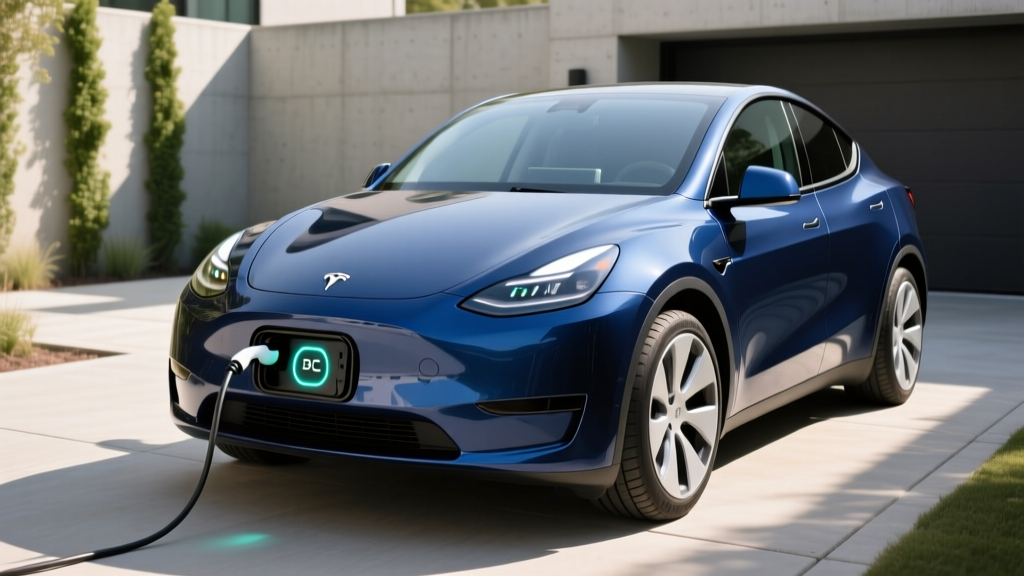
Most Tesla owners do 85–95% of their charging at home on a Level 2 Wall Connector. With a 60-amp circuit (48-amp continuous draw), the Tesla Wall Connector delivers up to 11.5 kW. For a Model 3 Long Range, that translates to roughly 44 miles of range per hour — meaning an overnight session of 8–10 hours easily replenishes a full battery from near-empty.
If your home electrical panel only supports a 40-amp circuit (32-amp continuous), you'll see about 7.7 kW, or roughly 30 miles per hour. Still sufficient for most daily commutes. A licensed electrician can assess whether your panel supports a 60-amp circuit or if an upgrade is needed — panel upgrades typically cost $1,500–$3,000 on top of the $500–$800 Wall Connector hardware and $500–$1,500 installation labor.
The LFP vs. NMC Difference in Charging
Tesla's Standard Range / RWD trims (available in the Model 3 and Model Y) use LFP (lithium iron phosphate) batteries, while Long Range and Performance trims use NMC (nickel manganese cobalt). This matters for charging:
- LFP packs have a slightly flatter charge curve and can tolerate regular 100% charging — Tesla actually recommends charging LFP vehicles to 100% at least once a week for accurate SoC calibration.
- NMC packs charge faster at low SoC (higher peak kW) but Tesla recommends a daily charge limit of 80–90% to preserve long-term battery health.
- DCFC speed: LFP packs generally peak at around 170–180 kW (Model 3 RWD), meaning a 10–80% session takes roughly 28–32 minutes — a few minutes longer than the NMC Long Range variants.
Real-World Range: What the EPA Sticker Doesn't Tell You
EPA estimates assume a mix of city and highway driving at moderate temperatures. In practice:
• Highway driving (75+ mph): Expect 85–90% of EPA range. A Model 3 LR rated at 363 mi will deliver roughly 310–325 mi at sustained freeway speeds.
• Cold weather (below 32°F / 0°C): Range drops 20–30% depending on severity. That same Model 3 LR may show 250–290 mi in sub-freezing conditions, even with Tesla's heat pump and battery preconditioning.
• City / stop-and-go: Regenerative braking helps you meet or slightly exceed EPA estimates, particularly in mild weather.
• Towing (Cybertruck / Model X): Towing near max capacity can cut range by 40–50%.
Tesla's onboard range estimator and trip planner are among the best in the industry — they account for elevation, temperature, and driving style in real time. On a 300-mile road trip in a Model Y Long Range, I've found the predicted arrival SoC to be accurate within 2–3 percentage points.
Efficiency, Cargo Space & Daily Livability
Efficiency separates Teslas from most competitors. The Model 3 Long Range achieves 131 MPGe combined (roughly 25 kWh/100 mi), making it one of the most energy-efficient EVs on the market. The Model Y Long Range comes in at 122 MPGe (~28 kWh/100 mi). For context, the average U.S. electricity cost of $0.17/kWh means fueling a Model 3 costs roughly $4.25 per 100 miles — compared to $12–$14 for a 30-MPG gas car at $3.80/gallon.
Cargo & Passenger Dimensions
| Model | Rear Legroom | Cargo (rear seats up) | Cargo (rear seats folded) | Frunk |
|---|---|---|---|---|
| Model 3 | 35.3 in | 23 cu ft (trunk) | — (sedan) | 3.1 cu ft |
| Model Y | 36.5 in | 30.2 cu ft | 72.1 cu ft | 4.1 cu ft |
| Model S | 35.4 in | 28 cu ft (liftback) | — | ~5.3 cu ft |
| Model X | 36.6 in (5-seat) | ~15 cu ft (behind 3rd row) | ~82 cu ft (2-row fold) | ~6.6 cu ft |
| Cybertruck | ~36 in (est.) | ~67 cu ft (bed, tonneau closed) | — | Front trunk ~7 cu ft |
The Model Y remains the practicality king for families — its hatchback design with 72 cu ft of folded cargo volume outclasses nearly every crossover in its price range. The Model 3's trunk is generous for a sedan but lacks the flexibility of a liftback.
Tax Credits, Pricing & What You'll Actually Pay
Federal EV tax credit eligibility under IRS §30D involves several requirements that change regularly. As of the 2026 tax year:
- MSRP caps: Vans, SUVs, and pickups must be under $80,000 MSRP; sedans under $55,000.
- Buyer income caps: AGI must not exceed $150,000 (single), $225,000 (head of household), or $300,000 (joint).
- Battery sourcing: Critical minerals and battery components must meet escalating domestic-content and free-trade-agreement thresholds each year. Tesla's U.S. manufacturing gives it an advantage, but specific trim eligibility can shift as sourcing requirements tighten.
- Point-of-sale transfer: Eligible buyers can apply the credit as an instant rebate at purchase rather than waiting for tax filing.
| Model / Trim | Base MSRP | MSRP Cap Eligible? | Est. Max Federal Credit | Est. After-Credit Price |
|---|---|---|---|---|
| Model 3 RWD (LFP) | $38,990 | Yes (sedan <$55k) | Up to $7,500* | ~$31,490* |
| Model 3 Long Range AWD | $47,740 | Yes (sedan <$55k) | Up to $7,500* | ~$40,240* |
| Model Y Long Range AWD | $48,630 | Yes (SUV <$80k) | Up to $7,500* | ~$41,130* |
| Model S Long Range | $79,990 | No (sedan >$55k) | $0 | $79,990 |
| Model X Long Range | $84,990 | No (SUV >$80k) | $0 | $84,990 |
| Cybertruck AWD | $79,990 | Yes (pickup <$80k) | Up to $7,500* | ~$72,490* |
*Credit eligibility depends on buyer income, battery sourcing compliance, and current-year IRS rules. Consult a tax professional and verify on IRS.gov before purchasing.
Tech, Driver Assists & Notable Drawbacks
Standout Technology
- Supercharger network: Over 20,000 V3/V4 stalls across North America, with 99%+ uptime. Non-Tesla EVs now access Superchargers via NACS adapters, but Tesla owners still get the most seamless plug-and-charge experience.
- Autopilot & FSD (Supervised): Tesla's Autopilot (standard) handles adaptive cruise and lane centering competently on highways. Full Self-Driving (Supervised) adds automated lane changes, traffic light/stop sign response, and city-street navigation — but remains a SAE Level 2 system requiring continuous driver attention.
- Over-the-air updates: Tesla pushes meaningful feature additions (not just bug fixes) regularly — new UI layouts, efficiency optimizations, and entertainment features arrive without dealer visits.
- Heat pump (all models): Tesla's octovalve heat pump system is among the most efficient in the industry, reducing cold-weather range loss compared to resistive heating.
- Sentry Mode & Dashcam: Built-in camera recording with cloud alerts provides passive security — a feature competitors are only beginning to match.
Tesla Autopilot and FSD (Supervised) are SAE Level 2 driver-assistance systems. The driver must remain fully engaged, hands on or near the wheel, and eyes on the road at all times. These are not self-driving systems. True driverless operation (Level 4) currently exists only in geofenced robotaxi services like Waymo.
Notable Drawbacks
- Minimalist interior: No physical stalks (turn signals are steering-wheel buttons on the refreshed Model 3/Y), no instrument cluster — everything routes through the 15.4" center screen. Some drivers adapt quickly; others find it distracting.
- Panel gaps and build consistency: While improved significantly from earlier years, minor panel-gap variance and trim-alignment issues still surface in delivery inspections more often than on legacy luxury brands.
- No Apple CarPlay / Android Auto: Tesla's proprietary infotainment is capable but closed. If you rely on CarPlay for navigation or music, you'll need to adapt to Tesla's native apps.
- Insurance costs: Teslas typically carry 15–30% higher insurance premiums than comparable gas vehicles due to repair costs and sensor density. Get a quote before committing.
- Cybertruck polarization: The angular stainless-steel design is a love-it-or-hate-it proposition, and its 6,600+ lb curb weight impacts tire wear and efficiency (76 MPGe is the lowest in the lineup).
Pros & Cons at a Glance
- Best-in-class Supercharger network reliability and coverage
- Industry-leading energy efficiency (Model 3: 131 MPGe)
- Fast home Level 2 charging (~44 mi/hr on Wall Connector)
- Continuous OTA updates add real features over time
- Strong resale value relative to most EV competitors
- Heat pump standard on all models (cold-weather efficiency)
- No CarPlay/Android Auto support
- Touchscreen-only controls (no physical buttons or stalks)
- Higher insurance premiums than gas equivalents
- FSD (Supervised) costs $8,000 extra and remains Level 2
- Model S/X ineligible for federal tax credit (MSRP cap)
- Cybertruck efficiency and weight are significant compromises
Who Should Buy a Tesla — And Which Model?
Choose the Model 3 if you're a commuter or solo driver prioritizing efficiency and value. At ~$31,500 after the federal credit (RWD), it's one of the cheapest ways into a 340+ mile EV with Supercharger access.
Choose the Model Y if you need family-friendly cargo space and versatility. It's the best-selling EV in America for a reason — 72 cu ft of cargo, comfortable rear seats, and eligible for the full tax credit.
Choose the Model S if you want flagship performance and luxury and don't need the tax credit. 402 miles of range and a 3.1-second 0–60 are remarkable, but the $80k price is steep with no federal offset.
Choose the Model X if you need three rows and falcon-wing doors justify the premium. Practical for families of 5–6, but efficiency and pricing are hard to recommend over a Model Y or competing 3-row EV.
Choose the Cybertruck if you need a truck bed, want V4 Supercharger speeds, and accept the efficiency trade-off. Towing capacity (11,000 lbs) and 4680-cell architecture are genuine differentiators, but range while towing drops sharply.
Frequently Asked Questions
How long does it take to charge a Tesla at a Supercharger?
For most 2026 Tesla models on a V3 Supercharger (250 kW), a 10–80% session takes 25–30 minutes. The Cybertruck on a V4 Supercharger (350 kW) can complete 10–80% in approximately 20–25 minutes thanks to its 4680-cell battery architecture. Charging from 80–100% adds another 20–30 minutes due to taper, which is why Tesla's trip planner typically recommends charging to 80% on road trips.
Can I charge a Tesla at home overnight?
Yes — and this is how most Tesla owners charge. A Tesla Wall Connector on a 60-amp circuit delivers 11.5 kW, adding 37–44 miles of range per hour. A full overnight charge (8–10 hours) will replenish any Tesla model from near-empty to full. Total home installation cost ranges from $1,000–$3,000 depending on your electrical panel and wiring distance.
Does a Tesla qualify for the $7,500 federal EV tax credit?
It depends on the model and your income. The Model 3, Model Y, and Cybertruck (all under their respective MSRP caps) can qualify for up to $7,500 under IRS §30D, provided the buyer meets income limits and the vehicle's battery sourcing meets current-year critical-mineral and component requirements. The Model S and Model X exceed MSRP caps and do not qualify. Always verify current eligibility on IRS.gov.
Is a Tesla worth buying vs. competitors in 2026?
Tesla's advantages remain the Supercharger network, efficiency, and software. Competitors like the Hyundai Ioniq 5, Ford Mustang Mach-E, and Chevrolet Blazer EV have closed the gap on range and charging speed, and some offer CarPlay and more traditional interiors. If seamless road-trip charging and OTA updates matter most, Tesla still leads. If you prefer physical controls, CarPlay, or dealer-service familiarity, competitors are compelling alternatives — especially with expanding NACS Supercharger access for non-Tesla EVs.
How long does a Tesla battery last?
Tesla warranties its batteries for 8 years and 120,000–150,000 miles (depending on model), guaranteeing at least 70% capacity retention over that period. Real-world data from high-mileage owners suggests NMC packs retain roughly 85–90% capacity at 100,000 miles with proper charging habits (avoiding frequent 100% charges and extreme heat). LFP packs show even slower degradation curves. Full battery replacement outside warranty currently costs $12,000–$20,000 depending on the model.
What is the real-world range of a Tesla?
Real-world range typically falls 10–15% below EPA estimates during sustained highway driving and 20–30% below in freezing temperatures. A Model 3 Long Range (EPA 363 mi) delivers roughly 310–325 mi on the highway in mild weather and 250–290 mi in winter. City driving with regenerative braking often matches or slightly exceeds the EPA figure. Tesla's trip planner is highly accurate at predicting real-world arrival SoC when you use onboard navigation.