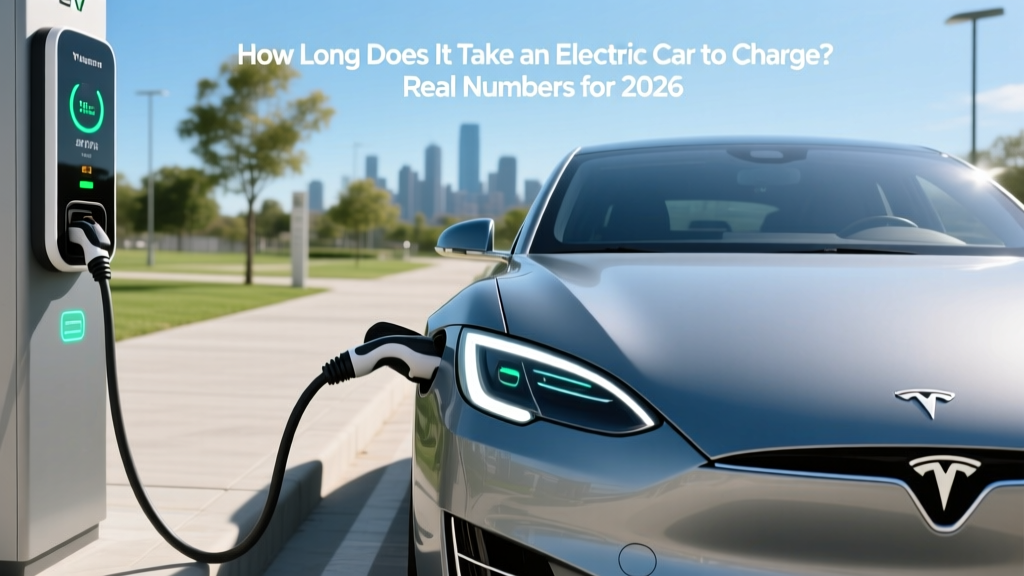
Quick Answer: How Long Does It Take an Electric Car to Charge?
It depends on the charger type and battery size. For a typical 2026 EV with a 75–85 kWh battery:
- Level 1 (120V household outlet): 40–60 hours for a full charge — adds ~3–5 miles of range per hour.
- Level 2 (240V home or public charger): 7–12 hours for a full charge — adds ~25–40 miles per hour.
- DC Fast Charging (150–350 kW): 10–80% in roughly 18–40 minutes depending on the vehicle's peak charge rate and battery preconditioning.
Most EV owners charge at home overnight on Level 2 and use DC fast charging only for road trips. You rarely charge from 0–100% in daily life — the practical question is how quickly you can add the range you need.
The Three Charging Levels Explained: kW, kWh, and Time
The single most important distinction in EV charging is the difference between kW (kilowatts) and kWh (kilowatt-hours). kW measures power — how fast energy flows into your car. kWh measures energy — the total capacity of your battery. Think of kW as the width of a hose and kWh as the size of the bucket you're filling.
A 75 kWh battery charged at 7.2 kW (a common Level 2 rate) takes roughly 10.4 hours from empty to full. That same battery on a 150 kW DC fast charger could theoretically fill in 30 minutes — but real-world charge curves prevent that. Here's a breakdown of each level:
| Charging Level | Voltage | Typical Power (kW) | Miles of Range Added/Hour | Best For |
|---|---|---|---|---|
| Level 1 | 120V AC | 1.0–1.4 kW | 3–5 mi/hr | Overnight top-ups, PHEVs, low-mileage drivers |
| Level 2 (Home/Public) | 240V AC | 3.3–19.2 kW | 12–65 mi/hr | Daily home charging, workplace, hotels |
| DC Fast Charging | 400–800V DC | 50–350 kW | 150–400+ mi/hr (at peak) | Road trips, highway corridors, quick top-ups |
Level 1 is included with every EV — just plug into a standard household outlet. It's painfully slow for a full battery electric vehicle (BEV), but perfectly adequate for a plug-in hybrid (PHEV) with a 15–20 kWh battery that needs only 4–6 hours to refill.
Level 2 is the backbone of practical EV ownership. A 48-amp (11.5 kW) home wall connector on a NEMA 14-50 or hardwired circuit can replenish most EVs overnight. According to fueleconomy.gov, the majority of EV charging happens at home on Level 2 equipment.
DC fast charging bypasses the car's onboard AC-to-DC converter and feeds DC power directly to the battery. Speeds vary enormously — a Hyundai Ioniq 5 with 800V architecture can peak at 240 kW and hit 10–80% in ~18 minutes, while an older Nissan Leaf tops out at ~50 kW and needs 40–50 minutes for the same session.
Real-World Charging Times for Popular 2026 EVs
Manufacturer specs quote peak charge rates, but the charge curve determines your actual session time. Lithium-ion batteries accept charge fastest between roughly 10–50% state of charge (SoC). Above 80%, the battery management system dramatically tapers power to protect cell health. This is why you'll see "10–80%" quoted rather than 0–100%.
| Vehicle (2026 MY) | Usable Battery (kWh) | Peak DC Rate (kW) | 10–80% DC Time | Level 2 (11.5 kW) Full Charge | EPA Range |
|---|---|---|---|---|---|
| Tesla Model Y Long Range | 75 kWh (NMC) | 250 kW | ~25 min | ~7 hours | 320 mi |
| Hyundai Ioniq 5 (Long Range AWD) | 77.4 kWh (NMC) | 240 kW | ~18 min | ~7 hours | 290 mi |
| Ford F-150 Lightning (Ext. Range) | 131 kWh (NMC) | 150 kW | ~41 min | ~11.5 hours | 320 mi |
| Chevrolet Equinox EV (3RS) | 85 kWh (NMC) | 150 kW | ~30 min | ~7.5 hours | |
| Toyota bZ4X (FWD) | 64 kWh (NMC) | 150 kW | ~30 min | ~5.5 hours | 252 mi |
| BMW i4 eDrive40 | 81.5 kWh (NMC) | 200 kW | ~31 min | ~7 hours | 301 mi |
| Toyota RAV4 Prime (PHEV) | 18.1 kWh (NMC) | N/A (no DCFC) | N/A | ~2.5 hours (Level 2 6.6 kW) | 42 mi EV / 94 MPGe |
Real-World Charging Caveat
Peak charge rates are only sustained for a narrow SoC window. A vehicle rated at 250 kW may average 150–180 kW across the full 10–80% session. Cold battery temperatures (below 50°F) can reduce charge rates by 30–50% unless the car has preconditioned the pack via navigation routing to a charger. Always plan for the taper.
EV Charging Cost vs. Gas: What You Actually Spend
The question "how long does it take to charge" is tightly linked to cost. A longer charge session at a cheaper rate may save you money versus a quick but expensive DC fast charge. Here's a realistic cost comparison for a midsize SUV driven 12,000 miles per year:
| Cost Factor | 2026 EV (Tesla Model Y LR) | 2026 Gas (Toyota RAV4 AWD) | Annual EV Savings |
|---|---|---|---|
| Energy/Fuel Cost | ~$540 (home L2 at $0.14/kWh) | ~$1,680 (30 MPG avg, $3.50/gal) | ~$1,140 |
| Public DCFC (road trips) | ~$240 (4 trips, 300 mi each) | Included above | — |
| Total Annual Fuel/Energy | ~$780 | ~$1,680 | ~$900 |
| Maintenance | ~$300 (cabin filter, wipers, tires) | ~$800 (oil, filters, brakes, spark plugs) | ~$500 |
| Insurance (avg) | ~$1,900 | ~$1,500 | –$400 |
| Net Annual Operating Cost | ~$2,980 | ~$3,980 | ~$1,000 |
Home charging is the economic sweet spot. At the U.S. residential average of roughly $0.14–$0.17/kWh in 2026 (per EIA data), filling an 80 kWh battery costs $11–$14. Public DC fast charging rates at networks like Electrify America or EVgo typically run $0.35–$0.55/kWh, making a comparable fill $28–$44 — still often cheaper than gas per mile, but the gap narrows significantly.
If your electricity provider offers time-of-use (TOU) rates, charging overnight at off-peak rates of $0.06–$0.09/kWh drops your annual fuel cost below $400. This is where EV ownership economics really shine.
What First-Time EV Buyers Should Know About Charging
Charging time is only part of the ownership equation. Here are the practical realities that spec sheets don't emphasize:
Home Charging Access Is the Biggest Variable
If you can install a Level 2 charger at home — in a garage, carport, or driveway — an EV integrates seamlessly into daily life. You plug in at night and wake up "full" every morning, which actually requires less time than weekly gas station visits. A typical home Level 2 installation (48-amp wall connector, 60-amp circuit) costs $800–$2,500 including equipment, electrician labor, and permits, depending on your panel's proximity to the charger location. Older homes with 100-amp electrical panels may need a $1,500–$3,000 panel upgrade to support a dedicated EV circuit.
If you cannot charge at home — apartment dwellers, street parkers, condo residents without HOA charger approval — EV ownership becomes substantially more inconvenient. You'll rely on public Level 2 and DC fast charging, which costs more per kWh, requires time detours, and introduces reliability concerns (broken chargers, occupied stalls, adapter compatibility).
Climate Affects Both Range and Charge Speed
Cold weather (below 32°F) reduces battery efficiency by 15–30% because energy is diverted to cabin heating and battery thermal management. A 320-mile EPA-rated Model Y may deliver 220–260 miles in sustained 20°F highway driving. Cold batteries also charge more slowly — a DC fast charge session that takes 25 minutes in summer could stretch to 35–40 minutes in winter unless you precondition the battery by navigating to the charger through the car's built-in navigation system.
Hot climates (above 95°F sustained) cause less range loss but accelerate long-term battery degradation. Vehicles with active liquid-cooled battery thermal management (Tesla, Hyundai E-GMP, GM Ultium) handle heat far better than passively cooled packs.
Connector Compatibility in 2026
The North American Charging Standard (NACS), originally developed by Tesla, has become the dominant connector for new 2025–2026 EVs. Ford, GM, Rivian, Volvo, Hyundai, and others now ship with native NACS ports. Older CCS1 vehicles can access Tesla Superchargers via adapter. CHAdeMO is effectively discontinued for new vehicles in the U.S. (the Nissan Ariya switched to CCS/NACS).
| Connector | Brands Using It (2026) | Network Access |
|---|---|---|
| NACS (native) | Tesla, Ford, GM, Rivian, Volvo, Polestar, Hyundai/Kia (2025+) | Tesla Supercharger, Electrify America (select), EVgo, ChargePoint |
| CCS1 (legacy) | VW ID.4 (pre-2026), BMW i4/iX, older Hyundai/Kia, Mercedes EQ | Electrify America, EVgo, ChargePoint, Tesla via adapter |
| CHAdeMO | Nissan Leaf (discontinued), Mitsubishi Outlander PHEV (legacy) | Limited — declining network support |
Common EV Charging Misconceptions: Myth vs. Fact
| Myth | Fact |
|---|---|
| "Charging an EV takes hours — I'll be stuck waiting." | At home on Level 2, you charge while sleeping. On road trips, 10–80% DC fast charging takes 18–40 minutes — roughly a meal or restroom break. Most drivers don't wait by their car; they eat, shop, or work. |
| "I need to charge to 100% every time." | For daily driving, charging to 80% is recommended for NMC batteries to extend longevity. Only charge to 100% before long road trips. LFP batteries (Tesla Model 3/Y Standard Range, some Rivian configs) can be charged to 100% daily without degradation concerns. |
| "Public charging is always unreliable." | Reliability varies widely. Tesla's Supercharger network consistently reports 99%+ uptime. Electrify America and EVgo have improved significantly since 2023 but still have occasional out-of-service stalls. Apps like PlugShare and A Better Routeplanner provide real-time status. |
| "Fast charging will destroy my battery." | Modern battery management systems limit charge rate, manage temperature, and maintain buffers. Data from Tesla's fleet shows ~12% average degradation at 150,000 miles. Manufacturer warranties guarantee 70% capacity retention at 8 years/100,000 miles (100,000–150,000 miles depending on brand). |
| "I can just use any extension cord for Level 1." | Level 1 charging draws 12 amps continuously for many hours. Use only a heavy-duty 12-gauge (or thicker) extension cord rated for outdoor use. Standard household extension cords can overheat and pose a fire risk. |
EV vs. Gas vs. Hybrid: Which Fits Your Driving Pattern?
Charging time only matters if it disrupts your life. For most drivers with home charging, it doesn't. But not everyone is an ideal EV candidate yet. Here's a practical decision framework:
| Factor | BEV (Battery Electric) | PHEV (Plug-in Hybrid) | HEV (Standard Hybrid) |
|---|---|---|---|
| Daily charging needed? | Yes (but overnight, passive) | Recommended for EV-mode savings | No — gas only |
| Home charging required? | Strongly recommended | Recommended | Not applicable |
| Road trip refuel time | 18–40 min per stop (DCFC) | 5 min (gas tank) + EV range first | 5 min (gas tank) |
| Best annual mileage for savings | 10,000–20,000+ mi/yr | 8,000–15,000 mi/yr (short commutes) | Any mileage |
| Cold-weather penalty | 15–30% range loss | Mild (gas engine provides heat) | Minimal |
| Upfront price premium (vs. gas) | $3,000–$10,000 | $3,000–$7,000 | $1,000–$3,000 |
| Federal tax credit (2026 §30D) | Up to $7,500 (eligibility varies) | Up to $7,500 (based on battery kWh) | None |
According to the IRS §30D guidelines, the federal clean vehicle credit has MSRP caps ($55,000 for sedans, $80,000 for SUVs/trucks/vans), buyer income limits ($150,000 single / $300,000 joint AGI), and strict battery component and critical mineral sourcing requirements. Not every EV qualifies for the full $7,500 — some qualify for $3,750 or nothing, depending on the model year and supply chain. The credit can now be transferred to the dealer at point of sale, reducing your purchase price directly. Always verify current eligibility on the IRS website or with a tax professional before committing.
Decision Framework: Which Electrified Vehicle Is Right for You?
- Choose a BEV if: You have reliable home or workplace Level 2 charging, drive under 300 miles/day, want the lowest operating costs, and are ready to plan road-trip charging stops.
- Choose a PHEV if: You have a short commute (under 40 miles) that fits within electric-only range, can charge at home, but need gas-engine flexibility for longer trips without charging stops. The Toyota RAV4 Prime (42 mi EV) and Jeep Wrangler 4xe (22 mi EV) are strong examples.
- Choose an HEV if: You cannot charge at home, live in a cold climate with limited charging infrastructure, or want fuel savings with zero behavioral change. The Toyota Prius (57 MPG combined) remains the benchmark.
- Wait if: You live in an apartment without charging access, drive 400+ miles regularly in rural areas, or your budget is under $30,000 (used EVs are an option, but selection is limited).
Frequently Asked Questions
Can I charge my EV from a regular household outlet?
Yes — this is Level 1 charging at 120V. It delivers roughly 1.0–1.4 kW, adding 3–5 miles of range per hour. For a 75 kWh battery, a full charge takes 40–60 hours. Level 1 is practical for PHEVs (small batteries) or BEVs driven fewer than 30 miles per day. For anything beyond that, Level 2 is strongly recommended.
Why does charging slow down after 80%?
Lithium-ion batteries accept charge fastest when they're partially empty. As cells approach full capacity, the battery management system (BMS) reduces current to prevent overvoltage and overheating. This "charge curve taper" means the last 20% can take as long as the first 60%. This is why DC fast charging times are quoted as 10–80% — charging to 100% on a road trip wastes time. Charge to 80%, drive, and top up at the next station if needed.
How much does a home Level 2 charger installation cost?
A typical installation runs $800–$2,500 for the equipment (Level 2 wall connector, $350–$700) plus electrician labor and permits ($450–$1,800). Costs rise to $2,500–$5,000+ if your electrical panel needs an upgrade from 100-amp to 200-amp service, or if the charger is far from the panel requiring long conduit runs. The IRS Energy Efficient Home Improvement Credit may cover up to 30% of home charging equipment and installation costs (up to $1,000) — check current eligibility.
Does fast charging damage my EV battery?
Occasional DC fast charging does not meaningfully accelerate degradation. Tesla's fleet data shows approximately 12% average battery degradation at 150,000 miles across vehicles that use a mix of Level 2 and Supercharging. The BMS actively manages cell temperature and voltage limits during every session. The bigger degradation factors are consistently charging to 100% and storing the vehicle at high SoC in hot weather. For daily use, set your charge limit to 80% (NMC) or 100% (LFP) and charge on Level 2 when possible.
How does cold weather affect charging time?
A cold battery (below 50°F) has higher internal resistance, which limits charge acceptance. Without preconditioning, a DC fast charge session that takes 25 minutes in warm weather can stretch to 35–45 minutes in freezing temperatures. Most modern EVs (Tesla, Hyundai E-GMP, GM Ultium, BMW) automatically precondition the battery when you navigate to a charger via the car's built-in navigation. Always use this feature in cold weather — it warms the pack to optimal charge temperature before you arrive.
What's the difference between kW and kWh?
kW (kilowatts) is a measure of power — how fast energy flows. kWh (kilowatt-hours) is a measure of energy — how much total energy is stored or consumed. A 75 kWh battery holds 75 kilowatt-hours of energy. Charging it at 7.5 kW takes 10 hours. Charging at 150 kW (DC fast charging) could theoretically fill it in 30 minutes, though real-world charge curves extend that. Confusing the two is the most common EV mistake — always check whether a spec refers to rate (kW) or capacity (kWh).
Charging an electric car is fundamentally different from refueling a gas car — and for most owners with home access, it's actually more convenient because it happens passively while you sleep or work. The 18–40 minute DC fast charge on road trips is the trade-off for never visiting a gas station during your daily routine. Understanding your driving patterns, charging access, and the real numbers behind each charging level is the key to choosing the right electrified vehicle.