The Quick Answer: Tesla Charging Times by the Numbers
If you're asking "how long does a Tesla charge take?" the answer depends on three things: which model you own, what charger you're plugged into, and how depleted your battery is. In 2026, Tesla's two highest-volume vehicles — the refreshed Model 3 (Highland) and the Model Y (Juniper) — support peak DC fast-charging rates between 170 kW and 250 kW, translating to a 10–80% charge in roughly 18 to 28 minutes depending on trim and battery chemistry.
But peak kW is a headline number, not the full story. Charging speed follows a curve: the battery accepts its maximum rate only in a narrow state-of-charge (SoC) window, then progressively tapers to protect cell health. Below, we map out exact charge times across Tesla's current lineup, explain the difference between kW (power — how fast energy flows into the car) and kWh (energy — how much the battery stores), and pair each figure with the real-world ownership context that spec sheets leave out.
| Model / Trim | Battery (kWh, usable) | Chemistry | EPA Range | Peak DC kW | 10–80% Time | Level 2 Rate |
|---|---|---|---|---|---|---|
| Model 3 RWD | 60 kWh | LFP | 272 mi | 170 kW | ~25 min | 11.5 kW (~44 mi/hr) |
| Model 3 Long Range AWD | 75 kWh | NMC | 341 mi | 250 kW | ~18 min | 11.5 kW (~44 mi/hr) |
| Model 3 Performance | 75 kWh | NMC | 315 mi | 250 kW | ~18 min | 11.5 kW (~44 mi/hr) |
| Model Y RWD | 60 kWh | LFP | 260 mi | 170 kW | ~28 min | 11.5 kW (~37 mi/hr) |
| Model Y Long Range AWD | 75 kWh | NMC | 320 mi | 250 kW | ~22 min | 11.5 kW (~37 mi/hr) |
| Model Y Performance | 75 kWh | NMC | 295 mi | 250 kW | ~22 min | 11.5 kW (~37 mi/hr) |
DC Fast Charging on the Road: What 10–80% Actually Looks Like
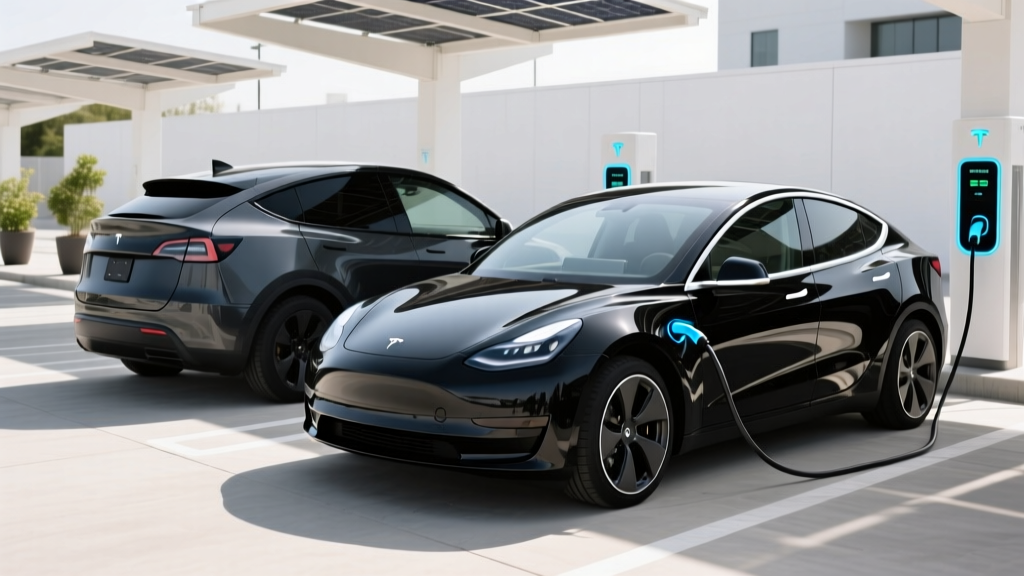
Tesla's Supercharger network — now exceeding 6,500 stations and 65,000 stalls globally — is the primary DC fast-charging option for Tesla owners, though the opening of the North American Charging Standard (NACS) to Ford, Rivian, GM, and others has increased stall competition at popular corridors.
At a V3 Supercharger (250 kW peak), a Model 3 Long Range AWD with its NMC battery will ramp quickly to approximately 240–250 kW between 10% and roughly 30% SoC. From there, the charge curve tapers: by 50% SoC, power drops to around 150 kW; by 70%, it's closer to 90 kW; and above 80%, it falls below 50 kW. This taper is why Tesla quotes 10–80% times rather than 0–100% — the last 20% of a DC fast charge can take as long as the first 60%.
The EPA range sticker assumes a mix of city and highway driving at moderate temperatures. In practice:
- Highway driving at 75 mph: Expect 85–90% of EPA range (e.g., a 341-mi Model 3 LR yields ~290–305 mi)
- Cold weather (below 32°F): Range drops 15–30% depending on severity and whether you precondition
- City / stop-and-go with regen: You may meet or slightly exceed EPA estimates
Always precondition your battery before a fast-charge stop — the car's navigation system does this automatically when a Supercharger is set as your destination.
The LFP-equipped RWD trims (Model 3 RWD, Model Y RWD) peak at a lower 170 kW. The smaller 60 kWh battery also means less total energy to add, so the 10–80% time difference versus the Long Range is narrower than the kW gap alone would suggest. LFP chemistry also tolerates regular 100% charging — Tesla recommends setting the daily limit to 100% on LFP vehicles, which partially offsets the smaller battery in daily use.
Home Level 2 Charging: Overnight Refills
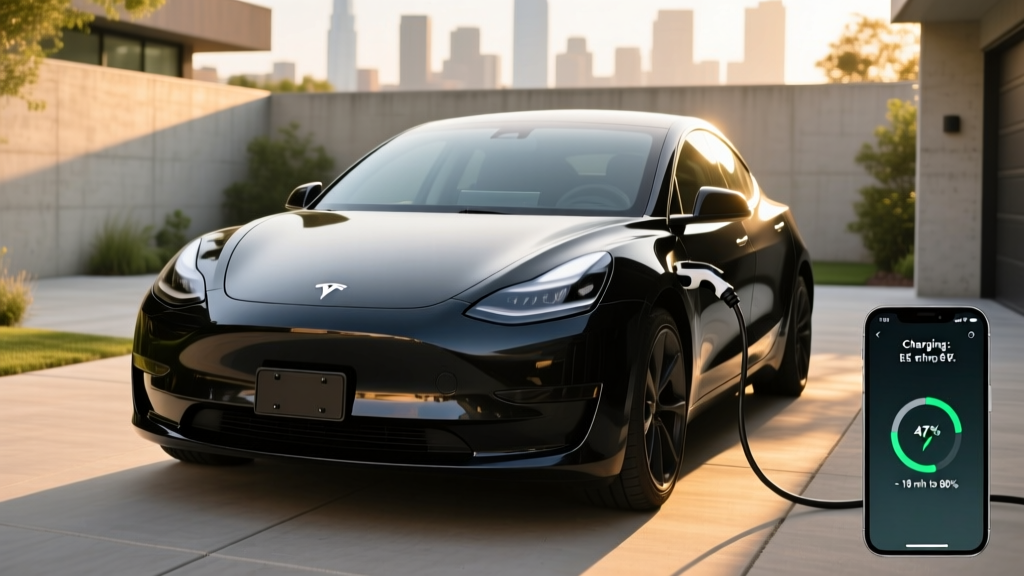
Most Tesla owners do the bulk of their charging at home on a Level 2 (240V) circuit. Tesla's Mobile Connector with a NEMA 14-50 adapter delivers up to 32 amps (7.7 kW), while the Tesla Wall Connector on a 60-amp circuit delivers up to 48 amps (11.5 kW).
| Setup | Amps / kW | Model 3 (mi/hr) | Model Y (mi/hr) | Full Charge Time (60 kWh) | Full Charge Time (75 kWh) |
|---|---|---|---|---|---|
| Mobile Connector (NEMA 14-50) | 32A / 7.7 kW | ~30 mi/hr | ~25 mi/hr | ~8 hrs | ~10 hrs |
| Wall Connector (60A circuit) | 48A / 11.5 kW | ~44 mi/hr | ~37 mi/hr | ~5.5 hrs | ~7 hrs |
| Standard 120V outlet (Level 1) | 12A / 1.4 kW | ~5 mi/hr | ~4 mi/hr | ~42 hrs | ~53 hrs |
For a typical commuter driving 30–40 miles per day, even the Mobile Connector on a 14-50 outlet fully replenishes overnight use in 1.5 to 2 hours. The Wall Connector is worth the upgrade if your daily mileage is higher, if you regularly precondition before departure (which draws from the wall, not the battery), or if you want maximum flexibility for road-trip preps.
Home charging installation costs vary widely. A straightforward Wall Connector install on an existing 200-amp panel with a short conduit run typically costs $500–$1,500 (electrician labor + permit). If your panel needs an upgrade to 200 amps, budget an additional $1,500–$3,500. Always consult a licensed electrician for your specific situation.
Battery Chemistry Matters: LFP vs. NMC in Teslas
Tesla uses two distinct battery chemistries across its 2026 lineup, and the choice directly affects your charging habits and long-term ownership experience.
LFP (Lithium Iron Phosphate) cells, sourced primarily from CATL, power the RWD trims. LFP batteries are heavier and less energy-dense than NMC, which is why RWD models carry a smaller 60 kWh pack with lower range. The payoff: LFP cells degrade more slowly over time, tolerate frequent 100% charging without accelerated wear, and contain no cobalt or nickel. Tesla recommends charging LFP vehicles to 100% at least once per week to keep the battery management system calibrated.
NMC (Nickel Manganese Cobalt) cells, supplied by Panasonic at the Nevada Gigafactory, equip Long Range and Performance trims. NMC offers higher energy density (hence the 75 kWh pack and longer range) and supports higher peak charge rates (250 kW vs. 170 kW). The trade-off is that NMC batteries degrade faster when routinely charged to 100% — Tesla recommends an 80% daily limit for NMC vehicles, reserving 100% for road trips.
| Factor | LFP (RWD trims) | NMC (LR / Performance trims) |
|---|---|---|
| Daily charge limit | 100% | 80% |
| Energy density | Lower | Higher |
| Peak DC charge rate | 170 kW | 250 kW |
| Long-term degradation | Slower | Moderate |
| Cold-weather performance | Slightly reduced | Better |
| Cobalt / nickel content | None | Yes |
2026 Pricing, Trims, and Federal Tax Credit Eligibility
Tesla's pricing has stabilized after years of volatility. Below is the current 2026 MSRP by trim, along with the federal tax credit landscape under IRS §30D.
| Model / Trim | Base MSRP | Est. §30D Credit | Effective Price |
|---|---|---|---|
| Model 3 RWD | $38,990 | Up to $7,500 (if sourcing rules met) | ~$31,490 |
| Model 3 Long Range AWD | $42,990 | Up to $7,500 | ~$35,490 |
| Model 3 Performance | $52,990 | Up to $7,500 | ~$45,490 |
| Model Y RWD | $44,990 | Up to $7,500 | ~$37,490 |
| Model Y Long Range AWD | $47,990 | Up to $7,500 | ~$40,490 |
| Model Y Performance | $52,490 | Up to $7,500 | ~$44,990 |
Critical tax credit caveats: The §30D credit is not automatic. Eligibility depends on multiple factors that can change with supply-chain shifts:
- MSRP caps: Sedans (Model 3) must be under $55,000; SUVs/trucks/vans (Model Y) under $80,000
- Buyer income caps: Modified AGI must not exceed $150,000 (single), $225,000 (head of household), or $300,000 (joint)
- Battery sourcing: The $7,500 credit splits into two halves — $3,750 for critical-minerals sourcing and $3,750 for battery-component manufacturing, each with escalating domestic-content thresholds. Vehicles meeting only one half qualify for $3,750
- Point-of-sale transfer: As of 2024, buyers can transfer the credit to the dealer at purchase, reducing the out-of-pocket price directly rather than waiting for a tax refund
Tesla's credit eligibility has fluctuated as battery-sourcing rules tighten. Always verify current status on fueleconomy.gov before purchasing.
Performance, Efficiency, and Daily-Use Specs
Beyond charging, here's what the numbers look like when you're driving rather than plugging in.
| Trim | 0–60 mph | Horsepower | Drivetrain | MPGe (combined) | kWh/100mi |
|---|---|---|---|---|---|
| Model 3 RWD | 5.8 sec | 271 hp | RWD | 132 MPGe | 25 kWh |
| Model 3 LR AWD | 4.2 sec | 346 hp | Dual-Motor AWD | 131 MPGe | 26 kWh |
| Model 3 Performance | 2.9 sec | 510 hp | Dual-Motor AWD | 115 MPGe | 29 kWh |
| Model Y RWD | 6.5 sec | 295 hp | RWD | 123 MPGe | 27 kWh |
| Model Y LR AWD | 4.8 sec | 384 hp | Dual-Motor AWD | 122 MPGe | 28 kWh |
| Model Y Performance | 3.5 sec | 456 hp | Dual-Motor AWD | 111 MPGe | 30 kWh |
Cargo and passenger space: The Model 3 offers 23 cu ft of trunk space (plus a small frunk), with rear legroom at 35.2 inches — adequate for adults but tighter than midsize sedans. The Model Y provides 30.2 cu ft behind the second row (76.2 cu ft with seats folded) and available third-row seating for occasional use, making it the more practical family hauler.
Warranty, Tech, and Notable Drawbacks
Warranty: Tesla covers the battery and drive unit for 8 years / 100,000 miles on RWD trims and 8 years / 120,000 miles on Long Range and Performance trims, with a guaranteed minimum 70% capacity retention over the warranty period. The basic vehicle warranty is 4 years / 50,000 miles. According to long-term fleet data, most Tesla batteries retain 85–90% capacity at 100,000 miles, well above the warranty floor.
Tech highlights: Tesla's 15.4-inch center touchscreen runs a proprietary OS with integrated navigation, streaming, and over-the-air updates. The 2026 Highland/Juniper refresh added ventilated front seats, ambient lighting, rear-seat touchscreen, and improved cabin insulation. Autopilot (standard) provides SAE Level 2 lane-centering and adaptive cruise; Full Self-Driving (Supervised) adds automated lane changes, traffic-light recognition, and city-street navigation for an additional $8,000 or $99/month — but requires continuous driver supervision and is not autonomous driving.
- Supercharger network remains the most reliable public DC fast-charging ecosystem in the U.S.
- Class-leading efficiency (kWh/100mi) means more range per kWh of electricity
- Over-the-air updates continuously add features and refine performance
- Strong resale value relative to most EV competitors
- LFP option offers slow degradation and 100% daily charging flexibility
- No Apple CarPlay or Android Auto — Tesla's proprietary infotainment only
- Minimalist interior lacks physical controls for climate, mirrors, and glovebox
- FSD (Supervised) is expensive and still requires full driver attention
- Service center wait times can be long in high-volume metro areas
- Increasing Supercharger congestion as non-Tesla EVs gain NACS access
Who Should Buy a Tesla in 2026?
Best for: Tech-forward commuters and road-trippers who value the Supercharger network, want strong efficiency, and prefer a minimal-control-cabin philosophy. The Model 3 Long Range is the sweet spot for range-conscious buyers; the Model Y Long Range suits families needing cargo space and optional third-row seating.
Consider alternatives if: You need Apple CarPlay, prefer physical buttons, want a luxury-brand badge, or live in an area where Tesla service centers are distant. The Hyundai Ioniq 5, Chevrolet Equinox EV, and Ford Mustang Mach-E offer compelling alternatives with CCS/NACS charging and more conventional interfaces.
Frequently Asked Questions
How long does a Tesla charge take at a Supercharger?
At a V3 Supercharger (250 kW), a Model 3 Long Range charges from 10% to 80% in approximately 18 minutes. RWD trims with LFP batteries peak at 170 kW and take roughly 25–28 minutes for the same 10–80% window.
Can I charge a Tesla at home overnight?
Yes. With a Tesla Wall Connector on a 60-amp circuit, you'll add roughly 44 miles of range per hour (Model 3) or 37 miles per hour (Model Y). A full charge from 10% takes about 5.5–7 hours depending on battery size — easily covered by an overnight session.
Does the Tesla Model 3 qualify for the $7,500 federal tax credit?
It can, but eligibility depends on current battery-sourcing rules, your income (AGI caps apply), and the vehicle's MSRP (under $55,000 for sedans). Check fueleconomy.gov and consult a tax professional for your specific situation. The credit can be transferred at point of sale to reduce your purchase price directly.
Is it better to get the LFP or NMC battery?
If your daily commute is under 60 miles and you want the longest possible battery lifespan with minimal degradation concern, LFP (RWD trims) is excellent. If you need maximum range for road trips or want the fastest DC charging, NMC (Long Range / Performance) is the better choice — just keep your daily charge limit at 80%.
How does cold weather affect Tesla charging speed?
Cold batteries accept charge more slowly. Without preconditioning, a battery at freezing temperatures may initially accept only 30–50 kW even at a 250 kW Supercharger. Tesla's navigation system automatically preconditions the battery when you route to a Supercharger, warming the cells to optimize charge speed by the time you arrive. Always use navigation routing in cold weather.
Is a Tesla worth buying vs. competitors in 2026?
Tesla's efficiency, Supercharger access, and software remain class-leading. However, competitors like the Hyundai Ioniq 5 (with 800V architecture enabling faster 10–80% charges), the Chevrolet Equinox EV (lower starting price), and the BMW i4 (more traditional luxury feel) are strong alternatives. Your priority weighting — charging network vs. interior quality vs. price — will determine the best fit.