Quick Answer: How Long Does It Take to Charge an EV Car?
The time to charge an EV depends entirely on the charger's power output (kW) and your battery's capacity (kWh). Here are the real-world benchmarks for a typical 75 kWh battery (like a Tesla Model Y or Hyundai Ioniq 5) going from 10% to 80% state of charge:
- Level 1 (120V household outlet, ~1.4 kW): 40–50 hours for a full charge. Adds roughly 3–5 miles of range per hour.
- Level 2 (240V home/public charger, 7–19 kW): 4–10 hours for a full charge. Adds 25–70 miles of range per hour.
- DC Fast Charging (50–350 kW): 18–45 minutes from 10–80%. Adds 150–300+ miles of range in 20 minutes on the fastest vehicles.
Peak kW ratings are misleading — charge speed tapers significantly above 80% state of charge to protect battery health. The 10–80% metric is the one that matters for road trips.
Understanding kW vs kWh: The Formula Behind Charge Times
The most common source of confusion for first-time EV buyers is mixing up kW (kilowatts) and kWh (kilowatt-hours). Here's the distinction:
- kW = power (charge rate). Think of it as the width of the pipe. A 150 kW charger delivers energy faster than a 50 kW charger.
- kWh = energy (battery capacity). Think of it as the size of the tank. A 84 kWh battery holds more energy than a 60 kWh battery.
The basic formula: Charge time (hours) = kWh needed ÷ kW delivered. To add 60 kWh to a battery using an 11.5 kW Level 2 charger: 60 ÷ 11.5 = ~5.2 hours. Simple math — but real-world factors complicate it.
Charging Levels Compared: Exact Speeds and Use Cases
| Level | Voltage | Power (kW) | Miles Added/Hour | 10–80% Time (75 kWh Battery) | Best For |
|---|---|---|---|---|---|
| Level 1 | 120V | 1.0–1.4 kW | 3–5 mi/hr | ~45+ hours | Overnight top-ups, PHEVs, emergencies |
| Level 2 (basic) | 240V | 3.3–7.2 kW | 12–25 mi/hr | ~10 hours | Home charging, workplaces |
| Level 2 (high-power) | 240V | 11.5–19.2 kW | 40–70 mi/hr | ~4–6 hours | Home with 48A+ charger, Tesla Wall Connector |
| DC Fast (50 kW) | 400V+ | 50 kW | ~150 mi/hr | ~55–65 min | Older DC stations, budget charging |
| DC Fast (150 kW) | 400V+ | 150 kW | ~400 mi/hr | ~28–35 min | Electrify America, EVgo highway stations |
| DC Fast (250–350 kW) | 800V | 250–350 kW | ~700+ mi/hr | ~18–22 min | Tesla V4 Supercharger, Ioniq 5 on 350 kW |
Real-world caveat: A 350 kW charger only delivers peak power when the battery is at a low state of charge (typically 10–30%) and at optimal temperature. As the battery fills, the charge rate tapers. A vehicle rated for "350 kW peak" may average closer to 150–180 kW over a full 10–80% session. This is why manufacturers publish 10–80% times rather than peak rates alone.
EV vs Gas: How Does Charging Time Compare to Refueling?
| Metric | Gas Car (2026 Toyota Camry) | EV (2026 Tesla Model Y LR) | EV (2026 Hyundai Ioniq 5) |
|---|---|---|---|
| "Refuel" time (full tank/battery) | ~3 minutes | ~8 hours (Level 2 home) | ~5.5 hours (Level 2 home) |
| Road-trip refill (10–80% / 1/4 to 3/4 tank) | ~3 minutes | ~25 min (250 kW Supercharger) | ~18 min (350 kW DC) |
| Range per fill/charge | ~450 mi (EPA) | ~320 mi (EPA; ~270 real-world highway) | ~310 mi (EPA; ~255 real-world highway) |
| Cost per fill/charge (full) | ~$50–$65 (13 gal × $4.20) | ~$12–$15 (home, $0.16/kWh avg) | ~$10–$13 (home, $0.16/kWh avg) |
| Cost per mile | ~$0.12/mi | ~$0.04/mi (home) / ~$0.11/mi (DC fast) | ~$0.04/mi (home) / ~$0.10/mi (DC fast) |
The honest truth: a gas car refuels faster than any EV charges on a road trip. But the comparison flips for daily use. Most EV owners charge at home overnight — plugging in takes 10 seconds, and you wake up to a full "tank" every morning. The average American drives 37 miles per day (FHWA data), which a Level 2 home charger replaces in under an hour. You're never visiting a gas station for daily commuting.
The road-trip gap is narrowing. Vehicles built on 800V architectures — the Hyundai Ioniq 5, Kia EV6, Porsche Taycan, and Genesis GV60 — can add 200+ miles of range in 15–18 minutes on a 350 kW charger. That's roughly the time it takes to use a rest stop, grab food, and stretch your legs.
What Determines Your Actual Charge Time? Five Key Variables
1. Battery Size (kWh)
A larger battery takes longer to fill at the same power level. The Ford F-150 Lightning Extended Range has a ~131 kWh usable battery — nearly double the Ioniq 5's 77.4 kWh. Even at 150 kW, the Lightning needs ~50 minutes for 10–80%, versus ~28 minutes for the Ioniq 5.
2. Vehicle Charge Acceptance Rate
Not every EV can use a 350 kW charger at full speed. The Chevy Equinox EV peaks around 150 kW on DC fast charging, so plugging into a 350 kW station won't save you time. Check your vehicle's maximum DC charge rate — it's the bottleneck.
3. State of Charge and the Charge Curve
Lithium-ion batteries charge fastest between roughly 10–50% state of charge. Above 80%, the battery management system (BMS) throttles power dramatically to protect cell health. Charging from 80–100% on a DC fast charger can take as long as 10–80%. This is why road-trip strategy favors shorter, more frequent stops (10–80%) over waiting for a full charge.
4. Battery Temperature and Preconditioning
Cold batteries charge slowly — sometimes painfully so. A battery at 32°F may accept only 30–50 kW even at a 250 kW charger. Most modern EVs offer battery preconditioning: the car warms the battery while you navigate to a charger, so you arrive at optimal temperature (roughly 77–95°F). Always use the vehicle's built-in navigation to a DC fast charger to trigger preconditioning. In Recurrent Auto's cold-weather testing, EVs lost 20–30% of range in sub-freezing conditions, and charging speeds dropped proportionally.
5. Charger Availability and Shared Power
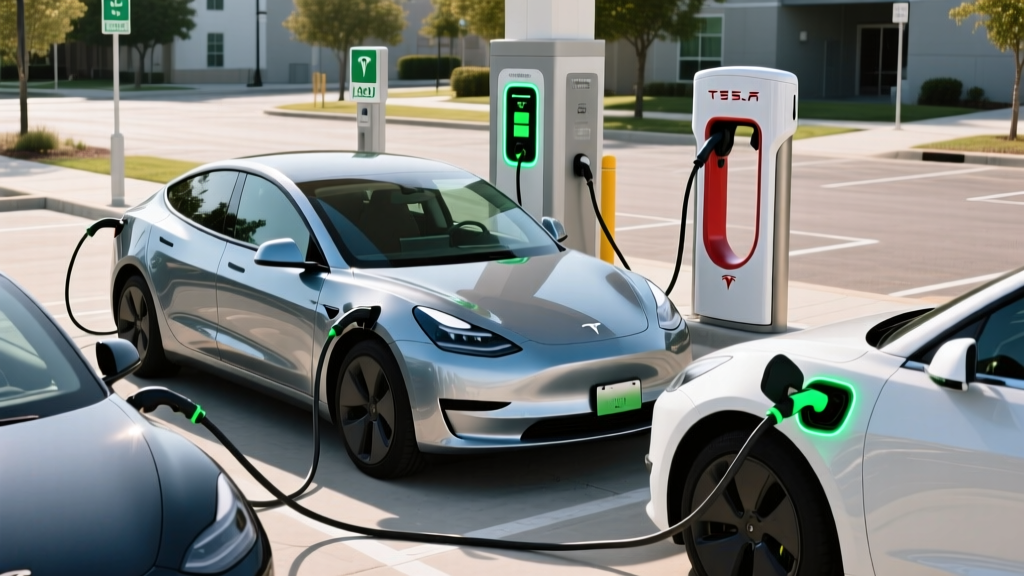
Some DC fast charging stations share power between two stalls. If both are occupied, each vehicle may receive half the rated power. Tesla Superchargers and newer Electrify America stations generally deliver dedicated power per stall, but older installations may not.
Real-World Ownership: Home Charging vs Public Charging
Home Charging: The Backbone of EV Ownership
Studies consistently show that 80–90% of EV charging happens at home. A Level 2 home charger (240V, 48 amps / 11.5 kW) fully replenishes most EVs overnight in 6–8 hours. Installation costs vary widely:
| Item | Cost Range | Notes |
|---|---|---|
| Level 2 charger (hardware) | $200–$700 | ChargePoint Home Flex, Tesla Wall Connector, Emporia |
| Electrician labor (240V outlet or hardwire) | $500–$2,000 | Depends on panel proximity, conduit run |
| Electrical panel upgrade (if needed) | $1,500–$4,000 | Required if panel is 100A or at capacity |
| Permit and inspection | $50–$300 | Varies by municipality |
| Total (typical install) | $800–$2,500 | Without panel upgrade |
| Total (with panel upgrade) | $2,500–$6,000 | Older homes, 100A service |
Important: Always hire a licensed electrician for 240V work. The final circuit specification (wire gauge, breaker amperage) must be determined by a professional based on your home's electrical panel and local code. The federal Residential Clean Energy Credit may cover 30% of home charging equipment and installation costs (up to $1,000) — consult IRS guidelines and a tax professional for your eligibility.
Apartment Living and Street Parking: The Real Barrier
If you lack access to home or workplace charging, EV ownership becomes significantly harder. Public DC fast charging costs $0.30–$0.50/kWh — roughly 3–5× more than home electricity — and repeated fast charging accelerates battery degradation slightly. Before buying an EV, honestly assess whether you can install a Level 2 charger or have reliable workplace charging. If neither is available, a plug-in hybrid (PHEV) like the Toyota RAV4 Prime (42 miles electric-only range, 38 MPG combined after depletion) may be a more practical electrified choice.
Cost Breakdown: What EV Charging Actually Costs
| Charging Method | Cost per kWh | Cost for 75 kWh (Full Charge) | Cost per Mile (3 mi/kWh avg) |
|---|---|---|---|
| Home Level 2 (US avg electricity) | $0.12–$0.20 | $9–$15 | $0.04–$0.07 |
| Home with solar / time-of-use off-peak | $0.05–$0.10 | $3.75–$7.50 | $0.02–$0.03 |
| Public Level 2 (ChargePoint, etc.) | $0.20–$0.40 | $15–$30 | $0.07–$0.13 |
| DC Fast Charging (EA, EVgo, Tesla) | $0.30–$0.55 | $22–$41 | $0.10–$0.18 |
| Gasoline (2026 avg, 30 MPG car) | — | ~$50–$65 per tank | $0.12–$0.15 |
Home-charged EVs cost roughly one-third to one-half as much per mile as gasoline. Even public DC fast charging is often comparable to or cheaper than gas on a per-mile basis, though the time cost is higher. Over 15,000 miles per year, a home-charged EV saves roughly $1,200–$1,800 annually in fuel costs versus a 25 MPG gas car.
Common EV Charging Myths vs Facts
| Myth | Fact |
|---|---|
| "EVs take hours to charge — that's impractical." | Home Level 2 charging happens while you sleep. Road-trip DC fast charging takes 18–35 minutes for 10–80% on modern vehicles — comparable to a rest stop. |
| "You need to charge to 100% every time." | Most EVs with NMC batteries recommend daily charging to 80% for longevity. LFP batteries (Tesla Model 3 RWD, some BYD models) can be charged to 100% daily without degradation concerns. |
| "Fast charging ruins the battery." | Modern BMS systems manage heat and taper rates to minimize degradation. Data from Recurrent Auto shows no statistically significant difference in long-term degradation between frequent and infrequent DC fast charg users. |
| "All EVs charge at the same speed." | Charge rates vary dramatically. A 2026 Ioniq 5 on a 350 kW charger hits 10–80% in ~18 min. A Nissan Leaf on a 50 kW CHAdeMO charger takes ~60 minutes for the same session. |
| "You can't charge in the rain or cold." | EV charging connectors are weather-sealed and safe in rain, snow, and extreme temperatures. Cold weather slows charge speed (preconditioning helps), but does not prevent charging. |
Decision Framework: Which Charging Setup Is Right for You?
Choose Your EV Charging Strategy
- If you have a garage or driveway with electrical access → Install a Level 2 home charger (48A, 11.5 kW). Budget $800–$2,500 for installation. This covers 90%+ of your charging needs and delivers the lowest cost per mile.
- If your electrical panel is older (100A service) → Get an electrician assessment first. A panel upgrade to 200A adds $1,500–$4,000 but unlocks full Level 2 charging and future-proofs for other electrification (heat pumps, solar).
- If you rent or lack dedicated parking → Check for workplace charging, nearby public Level 2 stations, or apartment complex chargers. If reliable daily charging isn't accessible, consider a PHEV instead of a full BEV.
- If you road-trip frequently (300+ miles) → Prioritize an EV with 800V architecture and 250+ kW DC fast charge acceptance (Ioniq 5, EV6, Taycan, Lucid Air). Plan routes around EPA-rated range with a 20–30% buffer for highway speeds and temperature.
- If you tow or haul heavy loads → Expect range to drop 30–50% under load. The F-150 Lightning or Rivian R1T offer the largest batteries (131 kWh / 128.9 kWh) to compensate, but charge times increase proportionally.
Frequently Asked Questions
Can I charge an EV from a regular household outlet?
Yes — a standard 120V outlet (Level 1) delivers about 1.0–1.4 kW, adding 3–5 miles of range per hour. For a driver covering 30–40 miles daily, overnight Level 1 charging (10–12 hours) can be sufficient. However, a full charge on a large battery (75–130 kWh) takes 40–90+ hours, making Level 1 impractical as a sole charging method for most BEV owners.
Why does charging slow down after 80%?
Lithium-ion cells experience increasing internal resistance as they approach full charge. To prevent overheating and lithium plating (which permanently damages cells), the battery management system reduces current. This is called the "charge curve taper." On a 250 kW Supercharger, a Tesla Model Y might pull 250 kW at 15% SoC but drop to 40 kW by 90%. This is why road-trippers charge to 80% and move on rather than waiting for 100%.
Does cold weather affect charging speed?
Significantly. At temperatures below 40°F, a cold battery may accept only 30–50% of its rated peak charge rate. Preconditioning — where the car warms the battery while navigating to a charger — can restore near-peak speeds. In extreme cold (below 10°F), expect charge times to increase 30–50% even with preconditioning, and expect 20–30% range loss from the EPA sticker, per III research.
How long do EV batteries last before needing replacement?
Federal law requires EV battery warranties of at least 8 years / 100,000 miles (10 years / 150,000 miles in CARB states). Most manufacturers warrant that the battery will retain 70% of original capacity during this period. Real-world degradation data shows most modern EV batteries lose 10–15% capacity over 150,000–200,000 miles. Full battery replacement costs $8,000–$22,000 depending on the vehicle, but is rarely needed within the vehicle's practical lifespan.
Is DC fast charging bad for my battery long-term?
The impact is smaller than commonly feared. Modern thermal management systems actively cool the battery during fast charging. Recurrent Auto's analysis of over 12,000 EVs found that vehicles using DC fast charging more than 90% of the time showed only marginally higher degradation (1–2% more over 100,000 miles) compared to vehicles that primarily used Level 2 charging. Occasional fast charging is a non-issue; daily fast charging may add slight long-term wear but is not catastrophic.