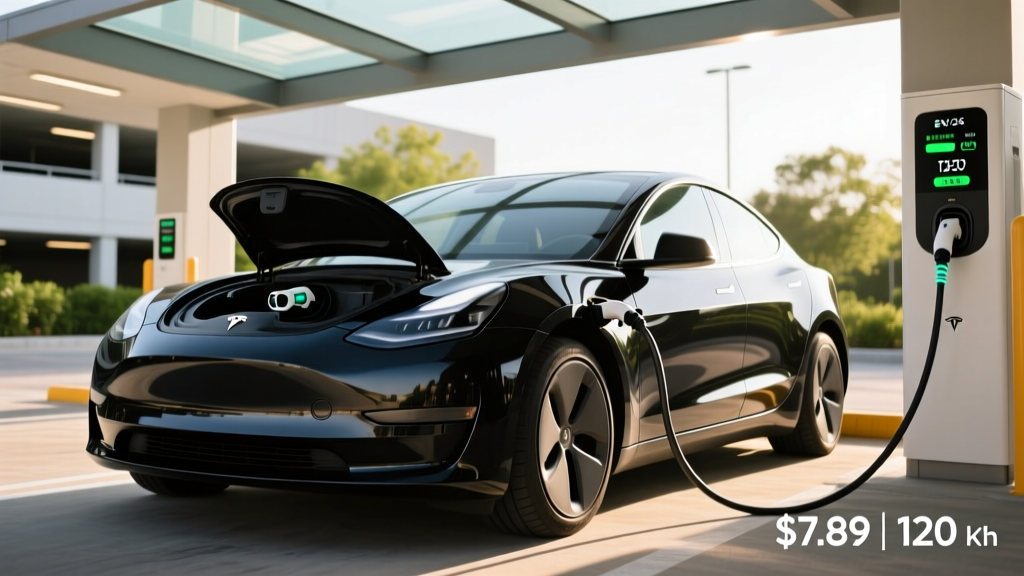
If you've searched "how long does it cost to charge a Tesla," you're likely conflating two separate questions: how much time does charging take, and how much money does it cost. The answer to both depends heavily on where and how you charge, which Tesla model you drive, and your local electricity rates. This 2026 Tesla Model 3 review breaks down the exact charging times, real-world costs, range expectations, and ownership economics so you can budget accurately before signing a purchase agreement.
The 2026 Tesla Model 3 remains the benchmark compact electric sedan. With the refreshed "Highland" platform now in its third model year, Tesla has refined efficiency, cabin quality, and charging speed. But the Model 3 lineup spans three distinct trims — each with different battery chemistries, range figures, and charging profiles. Understanding these differences is essential to answering both the time and cost questions.
2026 Tesla Model 3: Trim Lineup and Core Specifications
The 2026 Model 3 is available in three trims: the Standard Range RWD, the Long Range AWD, and the Performance AWD. Each uses a different battery pack and motor configuration, which directly affects charging time and cost.
| Spec | Standard Range RWD | Long Range AWD | Performance AWD |
|---|---|---|---|
| Base MSRP | $38,990 | $45,990 | $52,990 |
| Battery (usable) | ~57.5 kWh (LFP) | ~75 kWh (NMC) | ~75 kWh (NMC) |
| EPA Range | 272 mi | 363 mi | 315 mi |
| MPGe (combined) | 132 MPGe | 132 MPGe | 118 MPGe |
| kWh/100 mi | 25.4 | 25.4 | 28.5 |
| 0–60 mph | 5.8 sec | 4.2 sec | 2.9 sec |
| Horsepower | 271 hp | 346 hp | 510 hp |
| Drivetrain | RWD (single motor) | AWD (dual motor) | AWD (dual motor) |
| Max DC Fast Charge | 170 kW | 250 kW | 250 kW |
| 10–80% DC Time | ~25 min | ~27 min | ~27 min |
| Level 2 Home Rate | 11.5 kW (~44 mi/hr) | 11.5 kW (~44 mi/hr) | 11.5 kW (~44 mi/hr) |
| Battery Warranty | 8 yr / 100,000 mi | 8 yr / 120,000 mi | 8 yr / 120,000 mi |
How Long Does It Actually Take to Charge a Tesla Model 3?
Charging time is not a single number — it varies by charging level, battery chemistry, state of charge (SoC), and battery temperature. Here's the realistic breakdown for each method:
| Charging Level | Power (kW) | Miles Added per Hour | Typical Use Case | 0–100% Time (LR AWD) |
|---|---|---|---|---|
| Level 1 (120V household) | ~1.3 kW | ~3–5 mi/hr | Emergency / overnight trickle | ~60+ hours |
| Level 2 (240V home, 48A) | 11.5 kW | ~44 mi/hr | Daily home charging | ~7.5 hours |
| DC Fast (Tesla Supercharger V3) | Up to 250 kW (peak) | ~1,000+ mi/hr (peak) | Road trips | 10–80% in ~27 min |
| DC Fast (V4 Supercharger) | Up to 350 kW (peak)* | Varies | Newer Supercharger stations | Model 3 caps at 250 kW |
*The 2026 Model 3's onboard charging architecture limits DC intake to 250 kW. V4 Superchargers can deliver more to capable vehicles like the Cybertruck, but the Model 3 will not benefit from the higher peak.
Understanding the charge curve: Peak kW is not sustained kW. On a 250 kW Supercharger, the Long Range Model 3 will pull close to 250 kW between roughly 10–30% SoC, then taper to ~150 kW through 60%, and drop further to ~75 kW above 80%. This is why manufacturers quote 10–80% times rather than 0–100% — charging above 80% is dramatically slower and best reserved for destination charging or overnight Level 2 sessions.
Preconditioning matters. If you navigate to a Supercharger using the Tesla app or in-car navigation, the car will begin warming the battery pack 10–20 minutes before arrival. Without preconditioning — for example, plugging into a non-Tesla DC charger on a cold day — peak charge rates can drop by 30–50% until the battery reaches optimal temperature (roughly 95°F / 35°C).
How Much Does It Cost to Charge a Tesla? Home vs. Public
This is the "cost" half of the question, and the variance is enormous depending on your charging scenario.
Home Charging (Level 2, 240V)
Home charging is where the vast majority of Tesla owners do 85–95% of their charging. The cost depends entirely on your local electricity rate.
- National average electricity rate: ~$0.17/kWh (EIA, 2025 data)
- Long Range AWD battery (75 kWh usable): A full 0–100% charge costs approximately $12.75 at the national average.
- Cost per mile (Long Range): At 25.4 kWh/100 mi and $0.17/kWh, that's roughly $0.043 per mile.
- Monthly cost (1,000 miles/month): ~$43 — compared to ~$110–$130 for a 30 MPG gas car at $3.30/gallon.
If you have access to time-of-use (TOU) rates or overnight super-off-peak pricing (common in California, Texas, and the Northeast), your effective rate may drop to $0.08–$0.12/kWh, cutting your cost per mile to $0.02–$0.03. Some utilities offer EV-specific rate plans that make home charging nearly a third the cost of gasoline per mile.
Public DC Fast Charging (Superchargers and Third-Party)
Public charging is significantly more expensive than home charging, and rates have risen steadily since 2023.
- Tesla Supercharger average rate (2026): $0.32–$0.45/kWh depending on location and time of day
- Long Range full charge at $0.38/kWh average: ~$28.50
- Cost per mile (Supercharger): ~$0.097/mile — still cheaper than gas, but narrowing
- Third-party networks (Electrify America, EVgo): $0.40–$0.58/kWh; with NACS adapter access expanding, Tesla owners can use these but often at a premium
Idle fees: Tesla charges $0.50–$1.00/minute if your car remains plugged in after reaching its charge limit at a busy Supercharger station. Always monitor your session via the app.
Real-World Range: What the EPA Sticker Doesn't Tell You
EPA Estimated Range: 272 mi (RWD) / 363 mi (Long Range AWD) / 315 mi (Performance)
Real-World Highway (70–80 mph, moderate climate): Expect ~230–245 mi (RWD), ~305–325 mi (Long Range), ~265–285 mi (Performance)
Cold Weather (below 32°F, highway): Reduce EPA figures by 20–35%. The Long Range AWD may deliver ~240–270 mi in sustained freezing temperatures. LFP packs in the RWD model are more susceptible to cold range loss than NMC packs.
City/Mixed Driving: Real-world range often matches or slightly exceeds EPA in stop-and-go driving thanks to regenerative braking recapturing energy.
The EPA test cycle includes a mix of city and highway driving at moderate speeds with climate control at a mild setting. In practice, sustained highway driving at 75+ mph consumes significantly more energy due to aerodynamic drag, which increases with the square of velocity. Cold weather compounds this: the battery's internal resistance increases, cabin heating draws 2–5 kW continuously, and the available capacity shrinks due to the cold-induced buffer expansion.
The Long Range AWD's NMC battery has a slight cold-weather advantage over the Standard Range's LFP pack. LFP chemistry holds up better over thousands of charge cycles and can be charged to 100% daily without degradation concerns, but it loses more usable capacity in freezing temperatures. Tesla recommends LFP owners charge to 100% at least once per week for accurate SoC calibration.
Federal Tax Credit Eligibility: Does the Model 3 Qualify?
The IRS §30D Clean Vehicle Credit remains a major purchase factor, but eligibility is not guaranteed for every buyer or every trim.
- Maximum credit: $7,500 (split into $3,750 for critical minerals + $3,750 for battery component sourcing)
- MSRP cap (sedans): $55,000 — all 2026 Model 3 trims fall under this cap
- Buyer income caps (AGI): $150,000 single / $225,000 head of household / $300,000 joint
- Battery sourcing requirements: A percentage of critical minerals must be sourced from the US or FTA partners, and battery components must be manufactured or assembled in North America. These thresholds tighten annually.
- Point-of-sale transfer: As of 2024, buyers can transfer the credit to the dealer at purchase, reducing the sale price by up to $7,500 upfront rather than waiting for a tax refund.
For 2026, the Model 3 Long Range and Performance (with US-built NMC cells) have consistently qualified for the full $7,500 credit. The Standard Range RWD (with LFP cells historically sourced from CATL in China) has at times qualified for only $3,750 or $0 depending on the critical-minerals prong. Always verify current eligibility on fueleconomy.gov before purchasing, as sourcing requirements shift quarterly.
| Trim | Base MSRP | Est. §30D Credit | Effective Price* | Destination |
|---|---|---|---|---|
| Standard Range RWD | $38,990 | $3,750–$7,500 | $31,490–$35,240 | $1,390 |
| Long Range AWD | $45,990 | $7,500 | $38,490 | $1,390 |
| Performance AWD | $52,990 | $7,500 | $45,490 | $1,390 |
*Effective price does not include destination, state/local incentives, or optional equipment. Consult a tax professional to confirm personal eligibility. Credit is non-refundable; you must have sufficient tax liability to claim it if not using point-of-sale transfer.
Interior, Cargo, and Technology
The Highland-refreshed Model 3 interior is a significant step up from pre-2024 models. Material quality, NVH (noise/vibration/harshness), and seat comfort have all improved. However, Tesla's minimalist approach still polarizes.
- Front legroom: 42.2 inches
- Rear legroom: 35.3 inches
- Cargo (trunk): 23 cu ft
- Frunk (front trunk): 3.1 cu ft
- Total cargo: 26.1 cu ft
- Infotainment: 15.4-inch center touchscreen (no instrument cluster, no Apple CarPlay/Android Auto)
- Rear screen: 8-inch touchscreen for rear passengers (climate/media controls)
- Audio: 17-speaker premium system (Long Range/Performance)
Driver assistance: Basic Autopilot (lane centering + adaptive cruise) is standard. Full Self-Driving (Supervised) remains a $8,000 option or $99/month subscription. Despite the name, FSD is an SAE Level 2 system — you must keep your hands on the wheel and eyes on the road at all times. It is not autonomous driving. Tesla's camera-only "Tesla Vision" approach has drawn scrutiny; NHTSA continues to investigate certain Autopilot/FSD incidents.
Tesla Autopilot and FSD (Supervised) are SAE Level 2 driver-assistance systems. The driver must remain fully engaged, monitor the road, and be prepared to take over instantly. No consumer Tesla vehicle is self-driving. Level 4 (true driverless operation in defined areas) is currently only available through commercial robotaxi services like Waymo in select cities.
Pros, Cons, and Who Should Buy the Model 3
- Class-leading efficiency (25.4 kWh/100 mi)
- Access to Tesla Supercharger network (17,000+ stalls in North America)
- Over-the-air updates continuously add features
- Strong resale value relative to EV segment
- LFP option allows daily 100% charging without degradation worry
- Low cost per mile when charging at home
- No Apple CarPlay or Android Auto
- Rear visibility is limited; reliance on cameras
- FSD (Supervised) is expensive and still Level 2
- LFP battery loses more range in extreme cold
- Turn signals on steering wheel (no stalk) take adaptation
- Insurance premiums run 15–30% above segment average
Who the Model 3 Suits Best
- Daily commuters (30–80 miles round trip): The Standard Range RWD covers this easily with home charging, and the LFP battery's daily-100% tolerance means you wake up to a full "tank" every morning.
- Road-trip enthusiasts: The Long Range AWD's 363-mile EPA range and Supercharger network access make it the most practical EV for interstate travel in this price bracket.
- Performance seekers on a budget: The Performance trim's 2.9-second 0–60 time undercuts sports cars costing three times as much.
- NOT ideal for: Families needing third-row seating or significant cargo volume (consider the Model Y), or those who require Apple CarPlay integration.
Model 3 vs. Key Competitors: Is It Still Worth It?
The compact EV sedan segment has grown considerably. Here's how the Model 3 Long Range stacks up against its primary rivals:
| Metric | Tesla Model 3 LR | Hyundai Ioniq 6 SEL | BMW i4 eDrive40 |
|---|---|---|---|
| Base MSRP | $45,990 | $42,500 | $55,900 |
| EPA Range | 363 mi | 342 mi | 301 mi |
| Max DC Charge | 250 kW | 240 kW | 205 kW |
| 10–80% Time | ~27 min | ~18 min (800V) | ~31 min |
| MPGe (combined) | 132 | 140 | 109 |
| §30D Credit | $7,500 | $7,500 | $7,500 |
The Ioniq 6's 800V architecture gives it a faster 10–80% charge time despite a slightly lower peak kW, and its MPGe edges out the Model 3. The BMW i4 offers a more traditional luxury interior and driving dynamics but at a significant price premium. The Model 3's advantage remains the Supercharger network, software ecosystem, and overall value proposition after the tax credit.
Frequently Asked Questions
How long does it cost to charge a Tesla Model 3 at home overnight?
A full charge on a Level 2 home charger (11.5 kW) takes about 7.5 hours for the Long Range and roughly 6 hours for the Standard Range. At the national average electricity rate of $0.17/kWh, that costs approximately $12.75 (Long Range) or $9.78 (Standard Range). Most owners plug in nightly and rarely charge from 0% — a typical 50% top-up costs $5–$6.
How much does a Supercharger session cost on a road trip?
A 10–80% session on a Tesla Supercharger (adding ~250 miles to the Long Range) costs roughly $18–$25 depending on the station's per-kWh rate. In high-cost states like California, peak-rate sessions can exceed $30.
Does the 2026 Tesla Model 3 qualify for the $7,500 federal tax credit?
The Long Range AWD and Performance trims have consistently qualified for the full $7,500 under current §30D rules. The Standard Range RWD's LFP battery sourcing has made its eligibility variable. Confirm current status at fueleconomy.gov and consult a tax professional, as income caps and sourcing rules apply.
Is the Tesla Model 3 cheaper to own than a gas car?
Over five years and 60,000 miles, a Model 3 Long Range charged primarily at home saves approximately $4,000–$6,000 in fuel costs compared to a 30 MPG gas sedan. However, higher insurance premiums ($300–$600/year more) and potential tire costs (EVs are heavier and wear tires faster) partially offset savings. Total cost of ownership is generally favorable, especially after the tax credit.
How long will the Tesla Model 3 battery last?
Tesla warranties the Long Range/Performance battery for 8 years or 120,000 miles (whichever comes first) with a minimum 70% capacity retention threshold. Real-world data from Tesla's fleet reports indicate NMC packs retain approximately 85–90% capacity at 150,000 miles. LFP packs in the Standard Range model are warranted to 100,000 miles and generally show excellent cycle-life longevity, though with slightly higher cold-weather capacity loss.
Should I buy the Model 3 or the Model Y?
If cargo space, rear headroom, or a higher seating position are priorities, the Model Y (starting at ~$44,990, 310–330 mi EPA range) is the practical choice. If you prioritize driving dynamics, efficiency, and a lower purchase price, the Model 3 is the sharper car. The Model Y accounts for the majority of Tesla's US sales for a reason — most buyers prefer the crossover form factor.