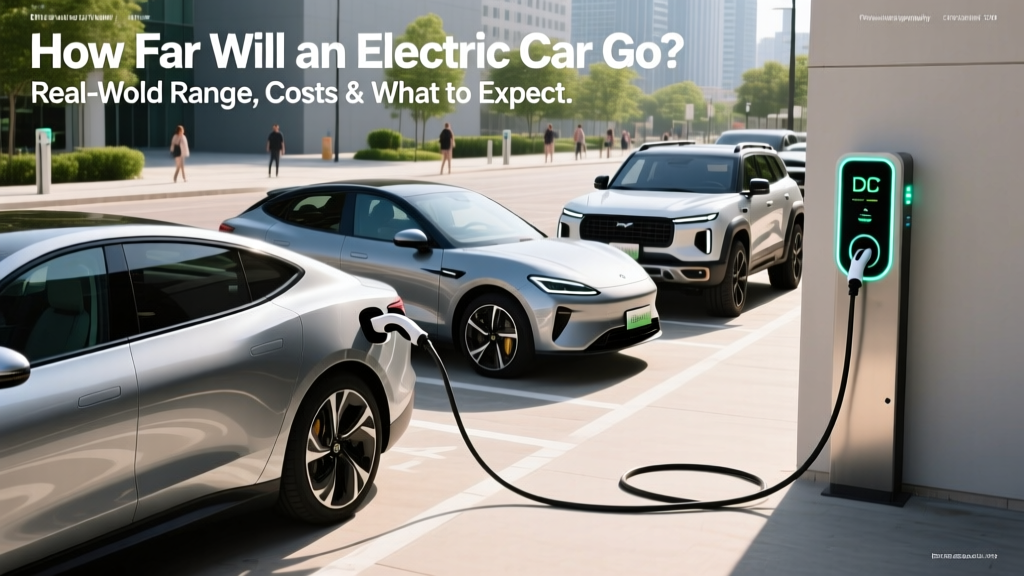
Quick Answer: How Far Will an Electric Car Go?
Most new electric vehicles sold in 2026 deliver between 220 and 350 miles of EPA-estimated range on a full charge. However, real-world results vary significantly: expect to lose 15–30% of that range at sustained highway speeds (70–80 mph) and up to 30–40% in freezing temperatures. For daily commuting under 60 miles round-trip, even a base-range EV will last several days between charges. The median EPA range for new 2026 EVs sits around 280 miles, with models like the Tesla Model 3 Long Range achieving 363 miles and the Chevrolet Equinox EV reaching 319 miles.
Understanding EPA Range vs. Real-World Driving
The EPA range sticker on a new EV is a useful baseline, but it's generated through a mix of city and highway driving cycles with climate control active. In practice, your results depend heavily on speed, terrain, temperature, and driving style.
Electric motors are extraordinarily efficient at low speeds — which is why EVs often exceed their EPA city estimates. But unlike gas cars, which become more efficient on the highway, EVs become less efficient as speed climbs. Aerodynamic drag increases with the square of velocity, and there's no multi-gear transmission to keep the motor in its sweet spot.
Real-World Range Translation Guide
| Driving Scenario | % of EPA Range to Expect | Example: 300-mi EPA Vehicle |
|---|---|---|
| City commuting (under 45 mph) | 95–110% | 285–330 miles |
| Mixed suburban/highway | 85–95% | 255–285 miles |
| Sustained highway (70–80 mph) | 70–85% | 210–255 miles |
| Highway in freezing weather (20°F) | 55–70% | 165–210 miles |
| Mountain driving with elevation gain | 60–80% | 180–240 miles |
Regenerative braking can recover significant energy on downhill mountain segments, partially offsetting uphill losses.
According to testing data published by fueleconomy.gov, EV energy consumption rises sharply above 65 mph. A vehicle rated at 25 kWh/100mi at 55 mph might consume 32–35 kWh/100mi at 75 mph — a 28–40% increase. Cold weather compounds this: battery internal resistance rises, and cabin heating draws 2–5 kW continuously in sub-freezing conditions. A heat pump (standard on most 2026 models including Hyundai, Tesla, and BMW) reduces heating energy draw by roughly 40–60% compared to resistive elements, but the range penalty remains real.
EV Range vs. Gas Car Range: The Honest Comparison
A common objection from first-time EV shoppers: "My gas car goes 400 miles on a tank." That's true, and the average gas car does carry a range advantage. But the comparison requires context about how each vehicle is actually used and refueled.
| Metric | Average Gas Car (2026) | Average EV (2026) |
|---|---|---|
| Total range (full tank / full charge) | 350–450 miles | 220–350 miles |
| "Refuel" time (typical stop) | 5–8 minutes | 18–35 min (DC fast, 10–80%) |
| Home "refuel" time (overnight) | N/A (not practical) | 6–10 hours (Level 2, 7–11 kW) |
| Cost per mile (fuel/energy) | $0.12–$0.16 | $0.03–$0.05 (home), $0.08–$0.14 (public DC) |
| Stops needed on 600-mile trip | 1 (fuel) | 2 (charging) |
| Time added to 600-mile trip | ~8 minutes | ~45–70 minutes |
The critical insight: 94% of daily driving trips in the US are under 40 miles (source: FHWA National Household Travel Survey). For this vast majority of driving, an EV owner with home charging starts every morning with a "full tank" and never visits a fueling station. The range disadvantage only materializes on road trips exceeding the vehicle's real-world range — typically 3–5 times per year for most drivers.
The Real Cost of EV Ownership: Purchase, Charging, and Maintenance
Range tells you how far an electric car will go. Cost tells you whether it makes financial sense. Here's a five-year ownership breakdown comparing a representative 2026 EV against a comparable gas vehicle.
| Cost Category (5 Years / 75,000 Miles) | 2026 Tesla Model 3 RWD | 2026 Toyota Camry LE (Gas) |
|---|---|---|
| Base MSRP | $38,990 | $29,495 |
| Federal §30D Tax Credit (if eligible) | −$7,500 (point-of-sale) | $0 |
| Effective Purchase Price | $31,490 | $29,495 |
| Fuel / Energy Cost (home charging at $0.14/kWh avg) | $2,940 | $7,500 (at $3.50/gal, 30 MPG) |
| Maintenance (oil, filters, brakes, fluids) | $800 | $3,200 |
| Insurance (avg premium differential) | $7,500 | $6,000 |
| Estimated Depreciation | $14,000 | $11,000 |
| Total 5-Year Cost | $56,730 | $57,195 |
Source: IRS §30D guidelines for credit eligibility. Actual credit depends on MSRP caps, buyer income limits, and battery component/critical mineral sourcing requirements. Consult a tax professional.
Key takeaways from this comparison:
- Energy savings are substantial: Home charging at national average electricity rates ($0.14–$0.17/kWh) costs roughly 60% less per mile than gasoline at $3.50/gallon. Over 75,000 miles, that's $4,500+ in savings.
- Maintenance is dramatically lower: EVs have no engine oil, transmission fluid, spark plugs, timing belts, or exhaust systems. Regenerative braking extends brake pad life to 100,000+ miles in typical use.
- Insurance costs more: EV insurance premiums run 15–25% higher on average due to higher repair costs and specialized parts. Budget an extra $200–$400/year.
- Depreciation is the wildcard: EV resale values have been volatile. Tesla price cuts in 2023–2024 hammered used values. As the market stabilizes in 2026, depreciation is normalizing but remains model-dependent.
Charging at Home: The Make-or-Break Factor
How far an electric car will go matters far less if you can conveniently recharge it. Home charging access is the single biggest determinant of EV satisfaction.
Level 1 (120V Standard Outlet)
Every EV ships with a mobile connector that plugs into a standard household outlet. This delivers roughly 1.0–1.4 kW, adding 3–5 miles of range per hour. For a 300-mile battery, a full charge takes 60–80 hours. This works only if your daily driving is under 25 miles and you can plug in for 10+ hours overnight.
Level 2 (240V — Recommended for Most Owners)
A dedicated Level 2 home charger delivers 7–11 kW, adding 25–44 miles of range per hour. A full charge of a 75 kWh battery takes 7–10 hours — perfect for overnight replenishment. Installation costs vary widely:
| Installation Component | Cost Range |
|---|---|
| Level 2 charger hardware (e.g., ChargePoint Home Flex, Emporia Vue) | $350–$700 |
| Electrician labor (standard install, panel nearby) | $500–$1,500 |
| Electrical panel upgrade (if 100A service needs 200A) | $1,500–$4,000 |
| Permits and inspection | $50–$300 |
| Total typical install (no panel upgrade) | $900–$2,500 |
| Total with panel upgrade | $2,500–$6,000 |
If you live in an apartment or lack dedicated parking with electrical access, public charging becomes your primary option — and that changes the economics and convenience calculus significantly. Public DC fast charging costs $0.30–$0.55/kWh in most markets, narrowing or eliminating the fuel-cost advantage over gasoline.
Common EV Range Myths vs. Facts
| Myth | Fact |
|---|---|
| "EV batteries degrade quickly and you'll lose half your range in a few years." | Modern NMC and LFP batteries lose approximately 5–10% capacity over the first 100,000 miles (roughly 5–7 years). Most degrade rapidly in the first year (~2–3%), then slow significantly. Federal warranty mandates require 8 years/100,000 miles coverage with at least 70% capacity retention. |
| "You can't take an EV on a road trip." | The DC fast-charging network has expanded to over 85,000 public ports in the US. A 300-mile-range EV needs one charging stop on a 500-mile trip. Plan for 20–30 minutes per stop at a 150+ kW charger. |
| "EVs are useless in cold weather." | Range drops 20–40% in sub-freezing temperatures — a real limitation. But with preconditioning (warming the battery while still plugged in), a heat pump, and seat/steering wheel heaters, EVs remain practical in cold climates. Norway, where EVs outsell gas cars, averages winter temperatures of 20°F. |
| "Charging takes too long." | Home Level 2 charging happens while you sleep — zero active time spent. On road trips, 2026 EVs with 800V architectures (Hyundai Ioniq 5/6, Kia EV6/EV9, Porsche Taycan) can charge from 10–80% in 18–22 minutes at a compatible 350 kW charger. |
| "The battery will cost $20,000 to replace." | Full battery replacement is rare — most degradation issues involve individual module or cell repairs. When full replacement is needed, costs in 2026 range from $8,000–$18,000 depending on the vehicle, and are trending downward. Most batteries outlast the vehicle's useful life. |
What First-Time EV Buyers Need to Know
Beyond range and cost, first-time EV buyers should evaluate these practical factors before purchasing:
Battery Chemistry Matters
Most 2026 EVs use one of two lithium-ion chemistries:
- NMC (Nickel Manganese Cobalt): Higher energy density = more range in a smaller, lighter pack. Best for long-range models. Typically recommend charging to 80% daily for longevity. Examples: Tesla Model 3 Long Range, Hyundai Ioniq 5, Ford Mustang Mach-E Extended Range.
- LFP (Lithium Iron Phosphate): Slightly lower energy density but longer cycle life, better thermal stability, and can be charged to 100% daily without accelerated degradation. Often found in standard-range/base trims. Examples: Tesla Model 3 RWD, Ford Mustang Mach-E Select (2025+). LFP is the chemistry to choose if you want maximum battery lifespan and don't need maximum range.
Charging Connectors: The NACS Shift
As of 2026, the North American Charging Standard (NACS), originally developed by Tesla, has become the dominant connector. Most major automakers — Ford, GM, Rivian, Hyundai, Kia, BMW, and others — have adopted NACS on new vehicles. CCS1 connectors still exist on some 2025 carryover models and the broader public charging infrastructure, but NACS provides access to Tesla's Supercharger network (now open to other brands via adapter or native port). Verify your vehicle's connector and plan adapter purchases accordingly.
The §30D Federal Tax Credit Is Not Guaranteed
The federal clean vehicle credit offers up to $7,500 — but eligibility depends on:
- Vehicle MSRP cap: $55,000 for sedans; $80,000 for SUVs, pickups, and vans
- Buyer income cap: $150,000 single / $300,000 married filing jointly (modified AGI)
- Battery sourcing requirements: Increasingly strict critical mineral and battery component rules that disqualify some models annually
- Point-of-sale transfer: As of 2024, the credit can be transferred to the dealer at purchase, reducing your out-of-pocket cost immediately — but you must still meet income requirements or repay the credit at tax time
Always verify current eligibility on the IRS clean vehicle credit page before committing to a purchase.
Decision Framework: Should You Buy an EV?
Choose an EV If:
- You have access to home or workplace Level 2 charging (or can install it)
- Your daily driving is under 80 miles round-trip (covers 95%+ of your needs without public charging)
- You want to reduce per-mile fuel costs by 50–70%
- You qualify for the §30D tax credit, narrowing the upfront price gap
- You take road trips fewer than 5–6 times per year and can plan charging stops
- You value instant torque, quiet operation, and one-pedal driving
Choose a Hybrid (HEV) or Plug-In Hybrid (PHEV) If:
- You lack reliable home or workplace charging access
- You frequently drive 300+ miles in a single day through areas with sparse charging infrastructure
- Your budget is under $30,000 and you want maximum range flexibility
- You live in an extreme cold climate (consistently below 0°F) and need guaranteed range regardless of temperature
- A PHEV with 30–45 miles of electric range covers your commute, and you want gas backup for longer trips (e.g., Toyota RAV4 Prime: 42 mi electric, 38 MPG gas)
Wait or Reconsider If:
- Your apartment or condo has no charging infrastructure and no plans to add it
- You tow heavy loads frequently (trailers over 3,000 lbs reduce EV range by 40–50%)
- You need a vehicle in a segment with limited EV options (e.g., heavy-duty trucks, certain commercial applications)
Frequently Asked Questions
How far will an electric car go on a single charge in 2026?
The EPA-rated range for new 2026 EVs spans from approximately 200 miles (base trims of compact models) to over 400 miles (Tesla Model S Long Range at 402 miles, Lucid Air Grand Touring at 516 miles). The typical new EV delivers 250–320 miles EPA. In real-world highway driving at 75 mph, expect 70–85% of that figure.
Do electric cars lose range over time?
Yes, but gradually. Data from fleet analyses show average battery degradation of roughly 2–3% in the first year, then approximately 0.5–1% per year thereafter. After 100,000 miles (5–7 years), most EVs retain 88–95% of original capacity. The federal battery warranty guarantees at least 70% retention at 8 years/100,000 miles.
Is it cheaper to charge an EV at home or buy gas?
Home charging is dramatically cheaper. At the US average electricity rate of $0.16/kWh and an EV efficiency of 3.0 miles/kWh, the cost is approximately $0.053 per mile. A gas car at 30 MPG with fuel at $3.50/gallon costs $0.117 per mile — more than double. Over 15,000 miles annually, that's a savings of roughly $960 per year with home charging.
Can I charge an EV with a regular household outlet?
Yes — this is Level 1 charging, delivering about 1.0–1.4 kW (3–5 miles of range per hour). It's adequate only if your daily driving is under 25 miles and the car is plugged in for 10+ hours. For most owners, a Level 2 (240V) installation is strongly recommended and costs $900–$2,500 installed without a panel upgrade.
What happens if my EV runs out of charge on the road?
Modern EVs provide extensive range warnings, navigation to the nearest charger, and aggressive power-reduction modes to extend your final miles. If you do run out, roadside assistance can tow you to the nearest charger. This scenario is rare with route-planning apps (A Better Routeplanner, built-in vehicle navigation) and the expanding DC fast-charging network.