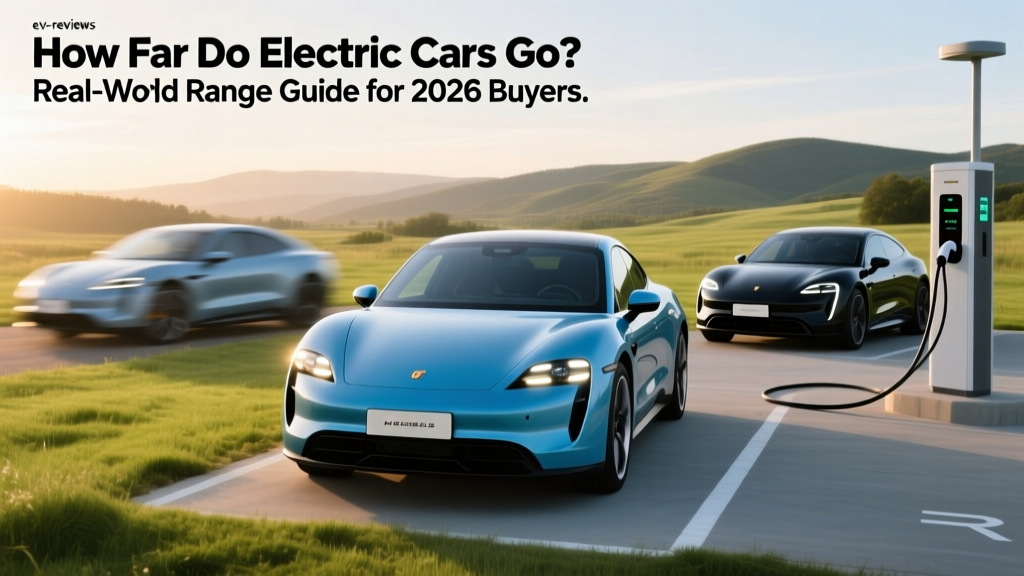
The Quick Answer: How Far Do Electric Cars Go?
In 2026, the average new electric vehicle (EV) delivers between 250 and 320 miles of EPA-estimated range on a full charge. However, real-world driving conditions typically reduce that figure by 10–30%. Expect 220–280 miles on the highway in moderate weather, and as little as 175–220 miles in freezing temperatures or at sustained speeds above 75 mph. Compact city-focused EVs may offer 150–230 miles, while premium long-range models from Tesla, Lucid, and Rivian push past 350–400 miles EPA.
Range remains the single most scrutinized spec among EV shoppers, and for good reason: it dictates road-trip feasibility, charging frequency, and daily usability. But the EPA sticker number is only a starting point. This guide breaks down what determines real-world range, how EVs compare to gas vehicles on practical distance, and the total ownership economics you need to evaluate before buying.
EPA Range vs. Real-World Miles: What You'll Actually Get
The EPA's range estimate uses a standardized lab cycle that blends city and highway driving at moderate temperatures. It's a useful baseline for comparing models, but it doesn't reflect how most people actually drive. Here's what changes the math:
- Highway speeds: Aerodynamic drag increases with the square of velocity. Sustained driving at 75–80 mph typically drops range 15–25% below the EPA combined figure. A car rated at 310 miles EPA may deliver only 240–260 miles on a flat interstate.
- Cold weather: Lithium-ion batteries lose efficiency below 40°F, and cabin heating draws heavily from the traction battery. Expect a 20–40% range reduction in sub-freezing conditions. Models equipped with a heat pump (standard on most 2026 Teslas, Hyundai/Kia E-GMP vehicles, and many others) mitigate this loss to roughly 15–25%.
- Elevation and terrain: Mountain passes consume energy on the ascent, though regenerative braking recovers some on the descent. Net loss on hilly routes typically runs 10–15%.
- Climate control and accessories: Running A/C in summer heat costs roughly 5–10% of range. Preconditioning the cabin while plugged in eliminates this penalty for the first leg of a trip.
- Battery age: Modern NMC and LFP batteries degrade approximately 1–2% per year under normal use. After five years, expect 90–95% of original capacity — meaning a 300-mile EV might deliver 270–285 miles when new-equivalent driving conditions are held constant.
Real-World Range Rule of Thumb: Take the EPA estimate and subtract 15% for mixed highway driving, 25–35% for cold-weather highway driving, and 5–10% for hot-weather city driving with A/C. These are averages — your results depend on driving style, terrain, and whether your EV has a heat pump.
2026 EV Range Leaders and Mainstream Models Compared
| Model (2026) | Battery (kWh usable) | Chemistry | EPA Range (mi) | Real-World Hwy Est. | MPGe (combined) | Base MSRP |
|---|---|---|---|---|---|---|
| Lucid Air Grand Touring | 112 | NMC | 516 | 410–440 | 131 | $125,600 |
| Tesla Model S Long Range | 95 | NMC | 402 | 320–350 | 124 | $79,990 |
| Hyundai Ioniq 6 SEL | 77.4 | NMC | 361 | 290–310 | 140 | $42,600 |
| Chevrolet Equinox EV 3LT | 85 | NMC | 319 | 255–280 | 115 | $43,400 |
| Tesla Model 3 Long Range | 75 | NMC | 341 | 275–300 | 132 | $47,740 |
| Ford Mustang Mach-E Extended Range | 91 | NMC | 320 | 255–280 | 103 | $48,995 |
| Nissan Leaf SV Plus | 60 | NMC | 212 | 170–190 | 111 | $36,190 |
| Hyundai Kona Electric SEL | 64.8 | NMC | 261 | 210–235 | 118 | $34,975 |
The spread is significant. If your daily commute is under 50 miles round-trip and you have home charging, even a 212-mile Leaf covers your needs with margin to spare. If you road-trip frequently or live in a cold climate, targeting 300+ EPA miles provides a real-world buffer that reduces charging stops and range stress.
EV vs. Gas Car: Range, Refueling, and Daily Practicality
A typical midsize gas sedan — say, a Toyota Camry — delivers roughly 450–500 miles per tank. That advantage in raw distance is real, but it's not the whole picture. Most EV owners charge at home overnight, starting every day with a "full tank." The average American drives 37 miles per day according to FHWA data, meaning even a 200-mile EV requires charging only every 4–5 days under normal commuting patterns.
| Factor | EV (300-mi range, 75 kWh battery) | Gas Car (30 MPG combined) |
|---|---|---|
| Fuel/Energy Cost Per Mile (home charging) | $0.04–$0.06 (at $0.13–$0.18/kWh) | $0.11–$0.13 (at $3.30–$3.80/gal) |
| Fuel/Energy Cost Per Mile (public DC fast charging) | $0.12–$0.18 (at $0.35–$0.55/kWh) | $0.11–$0.13 |
| Refueling Time (full tank / 10–80% charge) | 5 minutes (gas) / 18–30 minutes (DC fast) | 5 minutes |
| Annual Fuel/Energy Cost (12,000 mi, home charging) | $480–$720 | $1,320–$1,560 |
| Annual Maintenance | $300–$500 (tires, cabin filter, wipers, fluid top-offs) | $800–$1,200 (oil, filters, brakes, belts, spark plugs) |
| 5-Year Fuel + Maintenance Total | $3,900–$6,100 | $10,600–$13,800 |
The operational savings are substantial — typically $1,000–$1,800 per year when charging primarily at home. But these savings depend on access to affordable home electricity. If you rely exclusively on public DC fast chargers at $0.40–$0.55/kWh, the per-mile cost can equal or exceed gasoline. This is why home charging access is the single biggest determinant of EV ownership satisfaction.
Charging Speed: How Quickly Can You Get More Range?
Range is only half the equation — how fast you can replenish it matters just as much for road trips. Charging speed is measured in kW (kilowatts), which represents the rate of energy delivery, while battery capacity is measured in kWh (kilowatt-hours), the total energy stored.
| Charging Level | Power (kW) | Miles Added Per Hour | Typical Use Case |
|---|---|---|---|
| Level 1 (120V household outlet) | 1.0–1.4 kW | 3–5 miles | Overnight trickle; adequate for <40 mi/day drivers |
| Level 2 (240V home/public) | 7.2–19.2 kW | 25–65 miles | Daily home charging; full charge in 6–12 hours |
| DC Fast Charging | 50–350 kW | 150–1,000+ miles | Road trips; 10–80% in 15–40 minutes |
A critical concept: peak charge rate is not sustained charge rate. A vehicle that advertises "250 kW peak charging" may sustain that rate only between 10–30% State of Charge (SoC), then taper progressively. Real-world 10–80% charging times for popular 2026 models:
- Hyundai Ioniq 6 (800V architecture): Peak ~240 kW, 10–80% in approximately 18 minutes
- Tesla Model 3 Long Range: Peak ~250 kW, 10–80% in approximately 22 minutes
- Ford Mustang Mach-E: Peak ~150 kW, 10–80% in approximately 35 minutes
- Chevrolet Equinox EV: Peak ~150 kW, 10–80% in approximately 32 minutes
For road-trip planning, budget 20–35 minutes per charging stop and plan to charge to 80% rather than 100%. Charging from 80–100% can take as long as the 10–80% portion due to the taper curve, and it's rarely worth the wait unless you need every mile to reach your destination.
Total Cost of Ownership: The Full Financial Picture
The purchase price of an EV is typically higher than a comparable gas car, but the federal §30D tax credit can offset up to $7,500 — provided the vehicle and buyer meet specific requirements. As of 2026, eligibility depends on:
- MSRP caps: Vans, SUVs, and trucks must be under $80,000; sedans and other vehicles under $55,000
- Buyer income limits: Modified AGI must not exceed $150,000 (single), $225,000 (head of household), or $300,000 (joint)
- Battery sourcing: Critical minerals and battery components must meet escalating domestic/free-trade-partner sourcing thresholds, which tighten annually
- Point-of-sale transfer: Eligible buyers can apply the credit as an immediate dealer discount rather than waiting for tax filing
Consult a tax professional and verify current eligibility on IRS.gov before relying on the credit in your purchase math. Many models that qualified in prior years have lost eligibility as sourcing rules tighten.
| Cost Category | EV (e.g., Tesla Model 3 LR, ~$48K) | Gas Equivalent (e.g., Toyota Camry SE, ~$33K) |
|---|---|---|
| Purchase Price (after §30D credit) | $40,240 (if eligible) | $33,000 |
| Home Charger Install (Level 2) | $500–$2,000 | $0 |
| 5-Year Energy/Fuel | $2,400–$3,600 | $6,600–$7,800 |
| 5-Year Maintenance | $1,500–$2,500 | $4,000–$6,000 |
| 5-Year Insurance (avg) | $8,000–$10,500 | $6,000–$8,000 |
| Estimated 5-Year Depreciation | $18,000–$22,000 | $12,000–$15,000 |
| Estimated 5-Year Total Cost | $70,640–$80,840 | $61,600–$69,800 |
The EV's higher upfront price and steeper depreciation (though this has been narrowing) mean total cost parity depends heavily on how long you keep the vehicle, how much you drive, and whether you qualify for incentives. At 15,000+ miles per year with home charging, the energy and maintenance savings compound fast enough that many EVs reach cost parity with gas equivalents within 5–7 years.
Common EV Range Myths — Corrected With Data
| Myth | Fact |
|---|---|
| "EV batteries need replacement every few years." | Federal law mandates battery warranties of at least 8 years/100,000 miles. Real-world data shows most NMC and LFP packs retain 85–92% capacity at 150,000 miles. Full replacements are rare and typically covered under warranty within the coverage period. |
| "You'll be stranded with a dead battery." | EVs provide extensive range warnings, and navigation systems route through chargers. AAA's EV rescue calls remain a tiny fraction of their total roadside volume. The real risk is poor trip planning, not sudden failure. |
| "Cold weather makes EVs useless." | Range drops 20–40% in freezing temps, but preconditioning while plugged in and using seat/steering wheel heaters (which draw far less energy than cabin air heating) significantly mitigate the loss. Millions of EVs operate successfully in Norway, Canada, and northern US states. |
| "Public charging is always unreliable." | Network uptime varies significantly. Tesla's Supercharger network consistently reports 99%+ uptime. Electrify America and EVgo have improved but still experience occasional connector or payment issues. Check PlugShare for real-time station status before trips. |
| "I need 400+ miles of range." | If you charge at home daily, 250–300 EPA miles covers 95%+ of American driving patterns. Ultra-high range adds battery weight, cost, and resource consumption. The better solution for road trips is fast charging infrastructure, not a bigger battery. |
First-Time EV Buyer Decision Framework
Choose an EV with 250+ EPA miles if:
- You have access to Level 2 home or workplace charging
- Your daily driving is under 80 miles round-trip
- You take 2–4 road trips per year and can plan charging stops
- You live in a moderate climate or your EV has a heat pump
- You want the lowest per-mile operating cost and minimal maintenance
Choose a PHEV (plug-in hybrid) instead if:
- You lack reliable home or workplace charging access
- You frequently drive 300+ miles in a single day through charging-sparse regions
- You live in an extremely cold climate and want zero range-compromise flexibility
- Your budget is tighter and you want a lower purchase price with partial electrification (most PHEVs offer 25–45 miles of electric-only range)
Wait or choose a gas/hybrid vehicle if:
- You live in an apartment or condo without any charging option and public infrastructure is sparse in your area
- Your typical single-day drives exceed 400 miles with no tolerance for 20–30 minute stops
- You tow heavy trailers regularly (towing can cut EV range by 40–60%)
What to Know Before You Buy: Practical Ownership Realities
Home charging is the cornerstone. A Level 2 home charger (240V, 32–48 amps) adds 25–40 miles of range per hour of charging, fully replenishing most EVs overnight. Installation costs range from $500 for a simple outlet near your panel to $2,000+ if a panel upgrade or long conduit run is required. Hire a licensed electrician and check whether your utility offers rebates for charger installation.
Insurance is typically higher. EV insurance premiums run 15–30% above comparable gas vehicles due to higher repair costs and total-loss thresholds after battery damage. Shop quotes from multiple carriers before purchasing — the spread between insurers is often larger for EVs.
Tires wear faster. EVs are 10–20% heavier than gas equivalents and deliver instant torque, both of which accelerate tire wear. Budget for tire replacement every 25,000–40,000 miles rather than the 50,000+ miles typical for gas cars. EV-specific tire compounds (like Michelin's EV-optimized Pilot Sport lineup) can extend life and reduce road noise.
Depreciation is improving but remains a variable. Early EVs suffered steep depreciation due to rapid tech advancement and battery longevity concerns. Current-generation EVs from established brands hold value more competitively, though Tesla's frequent price adjustments and the rapid pace of new model introductions still create resale volatility. Leasing can hedge this risk if you're uncertain about long-term value retention.
How far do electric cars go on a single charge in 2026?
The current market spans from roughly 150 miles (compact city EVs like the base Nissan Leaf) to over 500 miles (Lucid Air Grand Touring). The mainstream average for popular models — Tesla Model 3, Hyundai Ioniq 6, Chevrolet Equinox EV — sits between 280 and 360 miles EPA. Real-world highway range is typically 15–25% lower than the EPA sticker.
Do electric cars lose range in winter?
Yes. Cold temperatures reduce battery efficiency and increase energy demand for cabin heating. Expect a 20–40% range reduction in sub-freezing conditions. Vehicles with heat pumps lose less range (typically 15–25%) than those using resistive heaters. Preconditioning the battery and cabin while plugged in before departure recovers significant range.
Is an EV cheaper to own than a gas car?
On a per-mile operating basis, yes — home-charged EVs cost $0.04–$0.06 per mile in energy versus $0.11–$0.13 for gasoline, and maintenance savings add another $500–$800 annually. However, higher purchase prices, insurance premiums, and depreciation mean total cost parity typically takes 5–7 years of ownership at average mileage. The math improves significantly with the §30D tax credit and high annual mileage.
What happens if I run out of charge?
Modern EVs provide progressive warnings, reduce power output, and route you to the nearest charger well before the battery depletes. Running completely out is rare and usually results from ignoring warnings or miscalculating distances. Roadside assistance services can provide a tow to the nearest charger — there is no equivalent of carrying a spare gallon of electricity.
How long do EV batteries last?
Federal law requires a minimum 8-year/100,000-mile battery warranty covering defects and excessive capacity loss (typically below 60–70% of original capacity). Real-world data from high-mileage Teslas, Nissan Leafs, and Chevrolet Bolts shows most modern batteries retain 85–92% of original capacity at 150,000 miles. Full pack replacement outside of warranty is uncommon but costs $5,000–$20,000 depending on the vehicle when needed.