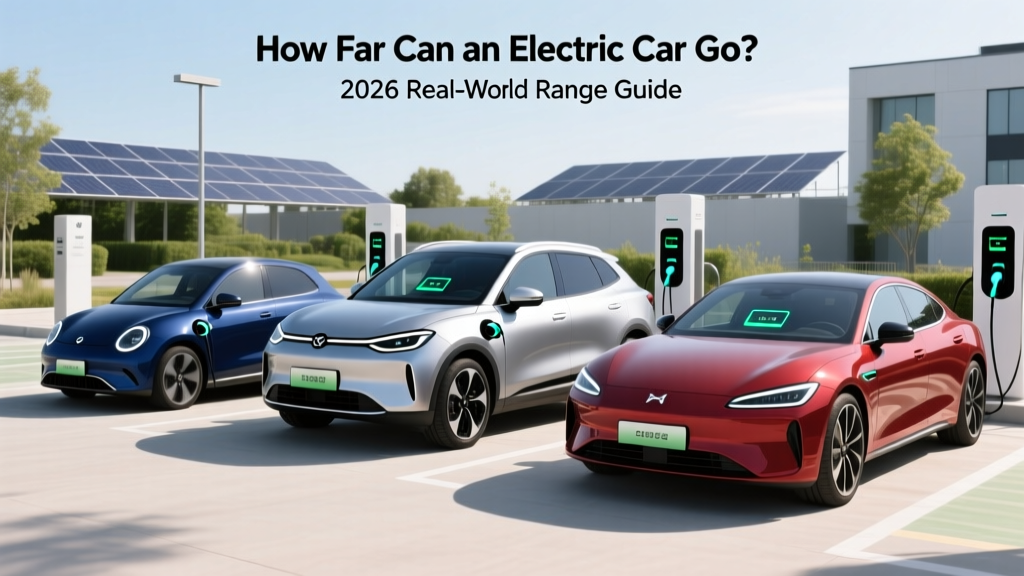
The Short Answer: 200–400+ Miles on a Charge
Most 2026 electric vehicles deliver an EPA-estimated range between 220 and 400 miles on a full charge, with the current class leader — the Lucid Air Grand Touring — rated at 516 miles. But the EPA sticker is a best-case laboratory number. In real-world highway driving at 70+ mph, expect to use 75–85% of that figure. In freezing winter conditions, plan on 60–75% of the EPA number. A 300-mile EPA-rated EV will typically deliver 225–255 miles on a highway road trip and as little as 180–210 miles in sub-30°F weather without preconditioning.
What the EPA Range Sticker Actually Means
The EPA tests EVs on a dynamometer using standardized city and highway drive cycles, then applies a 0.7 adjustment factor to approximate real-world conditions. The result is the combined MPGe and range figure you see on the window sticker and on fueleconomy.gov. It's useful for comparing vehicles against each other, but it does not replicate sustained highway speeds, extreme temperatures, mountain grades, or a fully loaded cabin.
Here's what the EPA numbers look like for popular 2026 models — alongside what you'll actually experience:
| Vehicle | Battery (kWh usable) | EPA Range (mi) | Real-World Highway (mi) | Cold Weather Est. (mi) | MSRP (base) |
|---|---|---|---|---|---|
| Tesla Model Y Long Range AWD | 75 kWh (NMC) | 320 | 260–280 | 200–230 | $47,990 |
| Hyundai Ioniq 5 Long Range AWD | 84 kWh (NMC) | 290 | 240–260 | 185–210 | $49,500 |
| Chevrolet Equinox EV RS | 85 kWh (NMC) | 319 | 260–280 | 200–225 | $43,400 |
| Ford F-150 Lightning Extended | 131 kWh (NMC) | 320 | 250–275 | 190–220 | $69,995 |
| BMW iX xDrive50 | 111.5 kWh (NMC) | 324 | 270–290 | 210–240 | $87,250 |
| Lucid Air Grand Touring | 112 kWh (NMC) | 516 | 410–450 | 320–370 | $125,600 |
| Tesla Model 3 RWD (LFP) | 60 kWh (LFP) | 272 | 220–240 | 170–195 | $38,990 |
The pattern is clear: heavier vehicles with larger frontal areas (trucks, large SUVs) lose more range at highway speeds than aerodynamic sedans. The Lucid Air's exceptional efficiency (4.5 mi/kWh) comes from its low drag coefficient (0.20 Cd) and lightweight design — not just a big battery.
What Drains an EV Battery Faster Than You'd Expect
Range is energy. Every watt-hour your battery spends on something other than moving the car forward is a watt-hour not spent on distance. Here are the biggest real-world range killers, ranked by impact:
- Cold temperatures (below 32°F): Battery chemistry slows, cabin heating draws 2–5 kW continuously, and regenerative braking is limited until the pack warms. Expect 20–40% range loss. A heat pump (standard on Tesla, Hyundai/Kia, BMW, and most 2026 EVs) reduces this penalty by roughly 10–15% compared to resistive heating.
- Highway speed (70–80 mph): Aerodynamic drag increases with the square of velocity. Driving 80 mph vs. 65 mph can cut range by 15–25%. This is the single biggest factor on road trips.
- Elevation gain: Climbing mountain passes consumes enormous energy. A 5,000-foot ascent can use the equivalent of 50–80 miles of flat-land range, though regenerative braking recovers roughly 30–50% on the descent.
- Towing: An F-150 Lightning towing a 5,000-lb trailer loses roughly 40–50% of its rated range. Ford's 320-mile EPA figure drops to approximately 160–180 miles while towing.
- Climate control at max: Running A/C in 100°F heat draws 1–3 kW; running the heater in 10°F cold draws 3–5 kW. Preconditioning while plugged in eliminates this penalty for the start of your trip.
EV Range vs. Gas Car Range: The Honest Comparison
A typical midsize gas sedan — say, a Toyota Camry — gets about 32 MPG combined with a 14.5-gallon tank, yielding roughly 460 miles per fill-up. That's more than most EVs deliver on a single charge. But raw range-per-tank isn't the whole picture.
| Factor | 2026 Tesla Model Y LR AWD | 2026 Toyota Camry LE (Gas) |
|---|---|---|
| EPA range / tank range | 320 mi | ~460 mi |
| Cost per "fill-up" (home charging / gas) | $9–$12 (at $0.13/kWh) | $48–$55 (at $3.50/gal) |
| Cost per mile (fuel) | $0.03–$0.04 | $0.10–$0.12 |
| Refuel/recharge time (full) | 6–10 hrs (Level 2 home) | 5 min (gas station) |
| Road-trip recharge (10–80%) | 15–25 min (DC fast) | 5 min |
| Annual fuel cost (12,000 mi) | $360–$480 | $1,200–$1,440 |
The critical insight: if you charge at home, you start every morning with a "full tank" and never visit a gas station for daily driving. The range advantage of gas cars only matters on long road trips — and even then, a 300-mile EV needs just one 20-minute DC fast-charge stop on a 500-mile drive.
Charging Speed: The Other Half of the Range Equation
How far an EV can go isn't just about battery size — it's about how quickly you can add range back. Understanding the difference between kW (kilowatts, the rate of charging) and kWh (kilowatt-hours, the battery's energy capacity) is essential. Think of kW as the flow rate of a hose and kWh as the size of the bucket.
| Level | Power (kW) | Range Added per Hour | Use Case |
|---|---|---|---|
| Level 1 (120V household) | 1.2–1.9 kW | 3–5 mi/hr | Overnight top-off, PHEVs |
| Level 2 (240V home/public) | 7.2–19.2 kW | 25–60 mi/hr | Daily home charging |
| DC Fast Charge (50–150 kW) | 50–150 kW | 150–400 mi/hr | Road trips, quick stops |
| DC Ultra-Fast (250–350 kW) | 250–350 kW | 500–900 mi/hr (peak) | 10–80% in 15–20 min |
A crucial reality about DC fast charging: peak kW is not sustained kW. A vehicle rated for 250 kW peak charging will only hit that rate at a low state of charge (typically 10–30%) and with a preconditioned battery. As the battery fills past 60–70%, the charge rate tapers significantly to protect cell health. This is called the charge curve. A "10–80% in 18 minutes" claim assumes ideal conditions — a warm battery and a charger that can actually deliver the peak rate.
For context, the Hyundai Ioniq 5 with its 800V architecture can peak at 240 kW and reach 10–80% in roughly 18 minutes on a 350 kW-capable charger. The Tesla Model Y peaks around 250 kW on V3 Superchargers, achieving 10–80% in approximately 22–25 minutes.
Total Cost of Ownership: What You Actually Spend
EVs typically carry a higher purchase price but lower operating costs. Here's a realistic 5-year breakdown comparing a Tesla Model Y Long Range against a comparably equipped gas crossover:
| Cost Category | Tesla Model Y LR AWD | Gas Crossover (e.g., Honda CR-V AWD) |
|---|---|---|
| MSRP (base) | $47,990 | $35,500 |
| Federal tax credit (§30D)* | −$3,750 to $7,500 | $0 |
| Effective purchase price | $40,490–$44,240 | $35,500 |
| Fuel / charging (5 years) | $1,800–$2,400 | $6,000–$7,200 |
| Maintenance (5 years) | $800–$1,200 | $2,500–$3,500 |
| Insurance (5 years) | $7,500–$10,000 | $5,500–$7,000 |
| Estimated depreciation (5 yr) | $18,000–$22,000 | $14,000–$17,000 |
| Total 5-year cost (approx.) | $68,590–$79,840 | $63,500–$70,200 |
*Federal EV tax credit under IRS §30D is subject to buyer income caps, MSRP limits, battery critical-mineral sourcing requirements, and vehicle eligibility. Check current rules at irs.gov. Some buyers may qualify for $3,750, the full $7,500, or $0 depending on sourcing compliance. Point-of-sale transfer is available through participating dealers.
The math shows that EVs break even or come out ahead over 5 years primarily when you can charge at home at residential electricity rates. Public DC fast charging at $0.35–$0.50/kWh erodes the fuel-cost advantage significantly — potentially doubling your per-mile energy cost compared to home Level 2 charging.
Common Range Myths vs. Reality
| Myth | Fact |
|---|---|
| "EV batteries die after a few years." | Most 2026 EV batteries carry an 8-year/100,000-mile warranty guaranteeing at least 70% capacity retention (fueleconomy.gov). Real-world data from Tesla and Hyundai show average degradation of 10–12% after 150,000 miles. LFP chemistry batteries (Tesla Model 3 RWD, some Chinese-market models) show even slower degradation. |
| "You'll get stranded with no warning." | Modern EVs provide highly accurate range predictions based on driving history, terrain, and temperature. The vehicle will progressively limit power and display urgent warnings well before the battery reaches 0%. Running out of charge is almost always a planning failure, not a surprise. |
| "Charging takes hours on road trips." | At a 250+ kW DC fast charger, a 10–80% charge takes 15–25 minutes for most 2026 EVs. Combined with a rest stop, food, and restroom break, the time penalty on a 500-mile trip is roughly 25–40 minutes total. |
| "EVs don't work in cold climates." | Norway — one of the world's coldest inhabited countries — has the highest per-capita EV adoption globally (over 80% of new car sales). Range drops 20–40% in extreme cold, but preconditioning, heat pumps, and seat/steering-wheel heaters make winter EV ownership practical. |
| "You need a 400-mile EV to be practical." | The average American drives 37 miles per day (FHWA data). A 250-mile EV charged overnight at home covers 95%+ of daily driving with range to spare. The 400+ mile benchmark only matters if you road-trip frequently without planning charging stops. |
Who Should Buy What: A Decision Framework
Choose a 250-mile EV (e.g., Tesla Model 3 RWD, Chevy Equinox EV) if:
- You have reliable home Level 2 charging (240V outlet or hardwired charger)
- Your daily commute is under 60 miles round-trip
- You road-trip fewer than 4 times per year
- Budget is a priority — these start at $30,000–$43,000
Choose a 300+ mile EV (e.g., Tesla Model Y LR, Hyundai Ioniq 5, BMW iX) if:
- You road-trip regularly (monthly or more)
- You live in a cold-weather climate where range drops 30%+
- You lack reliable home charging and rely on public DC fast chargers
- You tow or carry heavy loads frequently
Choose a PHEV (e.g., Toyota RAV4 Prime, Jeep Wrangler 4xe) if:
- You cannot install home charging and public charging is sparse
- You want electric-only commuting (25–42 miles) with gas-engine flexibility for long trips
- You live in an area with frequent extreme cold and limited charging infrastructure
Wait or reconsider if:
- You live in an apartment with no charging access and no workplace charging
- Your only parking option is street parking with no nearby public chargers
- You regularly tow heavy trailers over 300+ miles
First-Time EV Buyer Checklist
- Audit your charging access. Can you install a 240V Level 2 charger at home? A standard NEMA 14-50 outlet installation costs $500–$2,000 depending on panel capacity and run distance. If your electrical panel is at capacity (common in older homes), a 200-amp panel upgrade adds $1,500–$3,000. Hire a licensed electrician for a site assessment before buying the car.
- Map your typical drives. If 95% of your driving is under 50 miles daily, a 250-mile EV is more than sufficient. For regular 200+ mile trips, target 300+ miles EPA.
- Check your electrical panel. Most Level 2 chargers draw 32–48 amps and require a dedicated 40–60 amp circuit. If your panel is 100 amps and already near capacity, you may need an upgrade or a smart charger that load-balances with your home's existing circuits.
- Research tax credit eligibility. The §30D federal credit has MSRP caps ($80,000 for SUVs/trucks/vans, $55,000 for sedans), buyer income limits ($150K single / $300K joint for modified AGI), and battery sourcing requirements that change annually. Verify the specific vehicle's eligibility on the IRS clean vehicle credit page.
- Test-drive in conditions you'll actually use. If you commute on the highway, test at highway speeds. If you live in mountains, drive an elevation route. Regenerative braking behavior, one-pedal driving feel, and visibility all vary significantly between models.
- Factor in insurance. EV insurance premiums run 15–30% higher than comparable gas vehicles due to higher repair costs and battery replacement risk. Get quotes before committing.
Frequently Asked Questions
How far can an electric car go on a single charge in 2026?
The current range spans from about 150 miles (base Nissan Leaf) to 516 miles (Lucid Air Grand Touring) on the EPA cycle. The mainstream average sits around 270–320 miles for popular models like the Tesla Model Y, Hyundai Ioniq 5, and Chevrolet Equinox EV. Real-world highway range is typically 80–85% of the EPA figure.
Do EVs lose range over time as the battery degrades?
Yes, but slowly. Typical lithium-ion EV batteries lose 1–2% of capacity per year under normal use. After 5 years, expect roughly 88–92% of original capacity — meaning a 300-mile EV might deliver 265–275 miles when new-equivalent conditions are compared. LFP chemistry batteries degrade even more slowly, often retaining 95%+ after 5 years. All major manufacturers warrant the battery at 70% minimum capacity for 8 years or 100,000 miles.
Is a hybrid better than an EV if I'm worried about range?
A plug-in hybrid (PHEV) gives you 25–42 miles of electric-only range for daily commuting plus a gas engine for unlimited range on road trips. If you can charge at home and rarely drive more than 40 miles daily, a PHEV effectively operates as an EV most days while eliminating range anxiety entirely. The tradeoff: higher maintenance complexity (two powertrains), lower electric-only efficiency, and typically smaller federal tax credits ($3,750 for many PHEVs vs. up to $7,500 for BEVs).
How much does it cost to charge an EV at home vs. gas?
At the US average residential electricity rate of ~$0.16/kWh (EIA 2025 data), fully charging a 75 kWh battery (Tesla Model Y) costs about $12 for 300+ miles of range. The same distance in a 28 MPG gas car at $3.50/gallon costs roughly $37. Home charging delivers fuel savings of $600–$1,000 per year for a typical driver. Public DC fast charging at $0.35–$0.50/kWh narrows this gap substantially.
What happens if I run out of charge on the road?
Modern EVs provide multiple escalating warnings — typically at 10%, 5%, and 1% remaining — and will progressively limit speed and power to extend remaining range. If you do reach 0%, the vehicle will coast to a stop and require a flatbed tow to a charger (EVs should never be flat-towed or towed with drive wheels on the ground, as this can damage the motors). Roadside assistance services like AAA now offer mobile EV charging in many metro areas.