Quick Answer: How Does an Electric Motor Work?
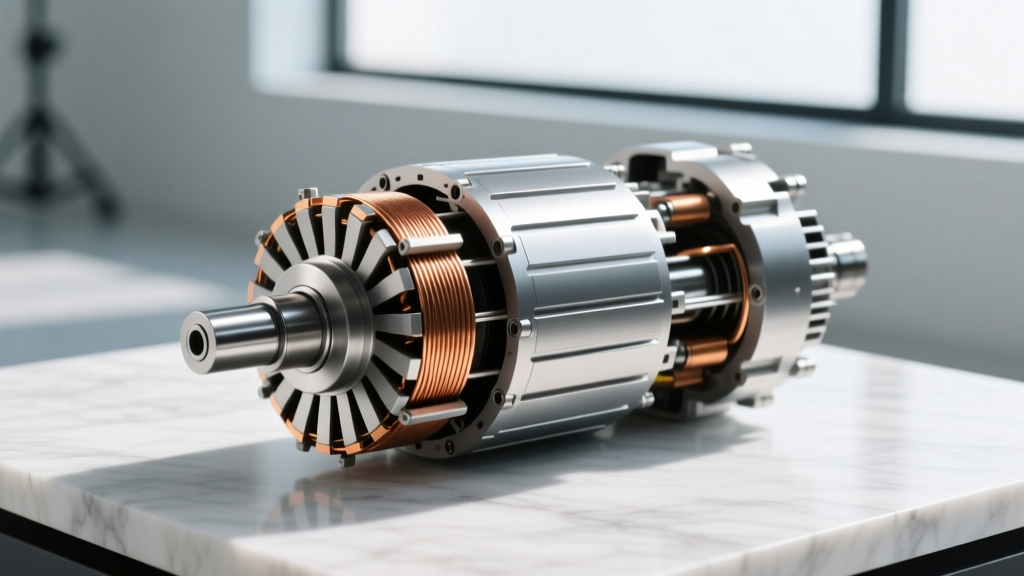
An electric motor converts electrical energy from the battery pack into rotational mechanical energy using electromagnetic force. When current flows through copper wire coils (the stator) surrounding a central rotor, it creates a rotating magnetic field. This field pushes permanent magnets or induced fields on the rotor, spinning it and turning the wheels. Unlike a gasoline engine, which relies on controlled explosions, pistons, and a multi-speed transmission, an EV motor delivers peak torque from 0 RPM with roughly 85–95% energy efficiency — compared to 20–35% for an internal combustion engine (ICE). Most modern EVs use either a permanent magnet synchronous motor (PMSM) or an AC induction motor, with some vehicles using both — one on each axle.
If you're shopping for an EV and wondering what's actually happening when you press the accelerator, understanding the electric motor is the single biggest factor in why EVs feel fundamentally different from gas cars. The motor is the reason for instant torque, silent acceleration, regenerative braking, and the efficiency numbers that make the ownership economics work. This guide breaks down the mechanics, the numbers, and what it all means for your purchase decision.
The Physics: Stator, Rotor, and Rotating Magnetic Fields
At its core, an EV traction motor has two main components:
- Stator: The stationary outer ring packed with copper wire coils arranged in phases (typically three-phase AC). When the inverter sends alternating current through these coils in a precise sequence, it generates a magnetic field that rotates around the stator's circumference.
- Rotor: The spinning inner shaft. In a permanent magnet synchronous motor (PMSM), the rotor carries rare-earth magnets (neodymium-iron-boron). In an AC induction motor, the rotor has aluminum or copper bars where current is induced by the stator's field, creating its own opposing magnetic field.
The inverter — a critical component sitting between the battery and motor — converts the battery's direct current (DC) into precisely timed alternating current (AC). It controls frequency (which determines motor speed) and amplitude (which controls torque). Modern silicon carbide (SiC) inverters switch at frequencies above 20 kHz, which is why you hear a faint whine rather than a buzz from some EV powertrains.
The result is a motor with essentially one moving part (the rotor on its bearings), no friction surfaces like piston rings, no valvetrain, no exhaust system, and no multi-gear transmission. Most EVs use a single-speed reduction gear with a ratio around 9:1 or 10:1, which multiplies motor torque to the wheels while allowing the motor to spin up to 15,000–20,000 RPM.
Motor Types Compared: PMSM vs. Induction vs. Reluctance
Not all EV motors are the same, and automakers choose motor chemistry and topology based on cost, performance, and supply chain constraints. Here's how the three main types compare:
| Motor Type | Efficiency | Torque Characteristic | Rare-Earth Dependency | Common Applications (2026) |
|---|---|---|---|---|
| Permanent Magnet Synchronous (PMSM) | 93–96% | High torque at low RPM, excellent low-speed efficiency | Yes (neodymium, dysprosium) | Tesla Model 3/Y (rear), Hyundai Ioniq 5, BMW iX, Rivian R1S/R1T |
| AC Induction Motor | 88–93% | Strong high-RPM power, can freewheel with zero drag | No | Tesla Model S/X (front), older Model 3 AWD (front), some commercial EVs |
| Synchronous Reluctance (SynRel) / IPM | 90–94% | Broad torque band, moderate low-speed torque | Low or none | BMW Gen5 eDrive, Tesla next-gen platforms, some European models |
The industry trend for 2025–2026 is toward interior permanent magnet (IPM) and reluctance-assisted designs that minimize or eliminate rare-earth materials. This is driven by both cost and geopolitical supply chain concerns — China controls roughly 85% of rare-earth refining capacity. Tesla's next-generation drive unit targets zero rare-earth content, and BMW's Gen5 eDrive already uses a current-excited synchronous motor with no permanent magnets.
EV Motor vs. Gasoline Engine: The Efficiency Gap
Understanding how an electric motor works matters most when you compare it to what it replaces. A gasoline engine converts roughly 20–35% of the chemical energy in fuel into forward motion. The rest is lost as heat through the exhaust, radiator, and friction. An electric motor converts 85–96% of electrical energy into mechanical rotation, with the inverter and single-speed gearbox accounting for most of the remaining losses.
| Metric | Electric Motor (EV) | Gasoline Engine (ICE) |
|---|---|---|
| Energy conversion efficiency | 85–96% (motor) / 77–89% (grid-to-wheel) | 20–35% (tank-to-wheel) |
| Moving parts in powertrain | ~2 (rotor, reduction gear) | Hundreds (pistons, valves, crankshaft, transmission) |
| Peak torque delivery | 0 RPM (instant) | 1,500–4,500 RPM (requires revving) |
| Transmission | Single-speed reduction gear | 6–10 speed automatic or CVT |
| Maintenance intervals | Coolant check, no oil/filters/plugs | Oil changes, spark plugs, filters, timing belt |
| Lifespan (typical) | 300,000+ miles (bearing wear is the limit) | 150,000–250,000 miles before major rebuild |
| Noise at idle | Silent | 35–50 dB |
This efficiency gap is why a 2026 Tesla Model 3 Long Range achieves an EPA-rated 132 MPGe combined on a 75 kWh battery, while a comparably quick Toyota Camry (2.5L, 203 HP) averages about 32 MPG combined. On fueleconomy.gov, the Department of Energy calculates that the average EV owner saves between $800 and $1,300 per year on fuel compared to a gasoline vehicle, depending on local electricity rates and driving patterns.
How the Motor Enables Regenerative Braking
One of the most practical advantages of the electric motor design is its reversibility. When you lift off the accelerator or press the brake pedal, the motor switches from consuming electricity to generating it. The vehicle's kinetic energy spins the rotor, inducing current back through the inverter and into the battery pack. This is regenerative braking, and it accomplishes two things simultaneously:
- Recovers energy: Typical regen systems recapture 60–70% of kinetic energy during deceleration, extending range by 10–30% in stop-and-go city driving compared to highway cruising.
- Reduces brake wear: Because the motor handles most routine deceleration (up to ~0.3g), the physical friction brakes engage only during hard stops or at very low speeds. It's common for EV owners to report original brake pads at 80,000–100,000+ miles.
One-pedal driving — where strong regen brings the vehicle to a complete stop without touching the brake pedal — is a direct result of this motor reversibility. Systems like Nissan's e-Pedal, Chevrolet's One-Pedal Driving, and Tesla's Hold mode all exploit the same electromagnetic principle.
Real-World Ownership: What Motor Efficiency Means for Your Wallet
The motor's efficiency advantage cascades through the entire ownership experience. Here's a 5-year cost comparison for a typical mid-size electric sedan versus a gasoline equivalent, based on 15,000 miles per year:
| Cost Category | 2026 EV Sedan (e.g., Tesla Model 3 RWD, ~$38,990 MSRP) | 2026 Gas Sedan (e.g., Toyota Camry LE, ~$29,995 MSRP) |
|---|---|---|
| Purchase price (before incentives) | $38,990 | $29,995 |
| Federal tax credit (§30D, if eligible) | -$3,750 to -$7,500 (depends on battery sourcing, income, MSRP caps — see IRS §30D rules) | $0 |
| 5-year fuel/energy cost | $3,000–$4,500 (home charging at $0.14/kWh avg) | $8,500–$10,500 (gas at $3.40/gal, 32 MPG) |
| 5-year maintenance | $900–$1,500 (cabin filter, tire rotation, brake fluid) | $3,500–$5,000 (oil changes, filters, spark plugs, brake pads) |
| 5-year insurance (avg) | $9,500–$12,000 (EV premiums run 15–25% higher) | $7,500–$9,500 |
| Estimated 5-year total cost | $45,000–$55,000 | $49,500–$55,000 |
The EV's motor-driven efficiency advantage shows up most clearly in fuel and maintenance savings — typically $5,000–$8,000 over five years. Higher insurance premiums and upfront price narrow the gap, but the federal tax credit (when eligible) and state incentives can tip the balance. Note: §30D credit eligibility depends on battery critical-mineral sourcing, buyer income caps ($150K single / $300K joint), vehicle MSRP caps ($55K sedans / $80K SUVs/trucks), and North American final assembly. Always verify current-year rules on irs.gov before relying on credit amounts.
Common Misconceptions About Electric Motors
| Myth | Fact |
|---|---|
| "EV motors wear out quickly and cost $10,000+ to replace." | EV traction motors have essentially one wearing component (bearings). Most are warrantied for 8 years/100,000 miles under federal mandate, and real-world failure rates are extremely low. Motor replacement, if needed, runs $3,000–$7,000 — but it rarely happens within the vehicle's life. |
| "Electric motors lose power over time like gas engines." | Motors themselves do not degrade meaningfully. What degrades is the battery pack (typically 10–15% capacity loss over 8 years for NMC chemistry, less for LFP). The motor at 150,000 miles produces the same torque curve as at mile one. |
| "More horsepower always means a better EV motor." | Motor efficiency across the driving range matters more than peak HP for daily ownership. A 200 HP PMSM running at 95% efficiency will deliver better real-world range and lower energy costs than a 400 HP motor running at 88% efficiency in typical commuting. Peak power matters for towing and passing, but sustained efficiency determines your charging bill. |
| "EVs need a multi-speed transmission like gas cars." | Because electric motors produce maximum torque from 0 RPM and rev to 15,000–20,000 RPM, a single-speed reduction gear covers the entire speed range from 0 to 120+ mph. Porsche's Taycan uses a 2-speed rear gearbox for optimized highway efficiency and launch acceleration, but this is the exception, not the rule. |
| "All EV motors use rare-earth magnets." | Induction motors (used on Tesla front axles, some commercial EVs) use zero rare-earth materials. BMW's Gen5 eDrive uses a current-excited synchronous design with no permanent magnets. The industry is actively shifting toward rare-earth-free designs. |
Decision Framework: What Motor Type Should You Care About?
Most buyers don't need to choose a motor type directly — you choose a vehicle. But understanding the motor helps you evaluate the spec sheet and match the car to your driving pattern:
- Choose a PMSM-equipped EV (e.g., Ioniq 5, Model 3 RWD, Equinox EV) if: You prioritize maximum efficiency and range per kWh. PMSM motors extract the most miles from the battery, which matters if you have a long commute (40+ miles/day) or limited home charging access and rely on public DC fast charging. The trade-off is rare-earth material sourcing — relevant if supply-chain ethics factor into your purchase.
- Choose a dual-motor AWD EV with mixed motor types (e.g., Model 3/Y Long Range AWD) if: You need all-weather traction and don't mind a 5–10% efficiency penalty. The front induction motor freewheels with zero magnetic drag during cruising, while the rear PMSM handles primary propulsion. This gives you AWD grip without the constant efficiency hit of a permanently engaged system.
- Choose a high-power dual-PMSM setup (e.g., Rivian R1T, BMW iX M60) if: You tow heavy loads (5,000–11,000 lbs) or want sports-car acceleration (0–60 under 3.5 seconds). Dual permanent-magnet motors deliver maximum torque to both axles, but expect range to drop 25–35% when towing at highway speeds. Motor efficiency at sustained high load is where the kWh really drain.
- Don't fixate on motor type if: You're choosing between vehicles in the same class with similar EPA ranges. The difference between a 93% and 95% efficient motor translates to roughly 5–8 miles of range on a 300-mile pack — far less impactful than battery size, vehicle weight, tire choice, and your local climate.
Real-World Considerations: Climate, Charging, and Motor Performance
The electric motor itself is nearly impervious to weather. It doesn't need to warm up, doesn't suffer from cold-start enrichment, and doesn't lose compression in freezing temperatures. But the battery that feeds it does, and this is where real-world ownership demands honesty:
- Cold weather (below 32°F): Expect 20–35% range reduction due to battery chemistry limitations, cabin heating load, and increased rolling resistance. The motor itself is unaffected — it's the energy supply and ancillary loads that suffer. A heat pump (standard on most 2025–2026 EVs, including Tesla, Hyundai, and BMW) recovers 2–3 kW of waste heat from the motor and power electronics to warm the cabin, reducing the cold-weather penalty to 15–25%.
- Hot weather (above 95°F): Battery thermal management systems use the motor's coolant loop to keep pack temperatures in the 25–40°C optimal range. Sustained high-speed driving in extreme heat can trigger power limiting to protect the battery — you'll see reduced acceleration, not motor damage.
- High-altitude driving: Electric motors are completely unaffected by altitude. There's no air intake, no oxygen-dependent combustion. An EV performs identically at sea level and at 10,000 feet, while a turbocharged gas engine loses roughly 3–4% power per 1,000 feet of elevation.
- Home charging access: The motor's efficiency only translates to savings if you can charge at home. A Level 2 home charger (7.2–11.5 kW, 240V) adds 25–44 miles of range per hour of charging and costs $500–$2,000 installed depending on panel capacity and run length. Without home charging, public DC fast charging at $0.35–$0.55/kWh erodes much of the fuel-cost advantage.
Frequently Asked Questions
Do electric motors require any regular maintenance?
No routine maintenance is required for the traction motor itself. The motor coolant should be checked at manufacturer-specified intervals (typically every 5 years or 60,000 miles), and the reduction gear fluid may be specified as "lifetime" or have a 100,000-mile service interval depending on the manufacturer. There are no oil changes, no spark plugs, no timing belts, no air filters, and no exhaust components. The federal mandate requires the motor and powertrain to be warrantied for at least 8 years or 100,000 miles — check your specific vehicle's warranty documentation for exact terms.
Why do EVs feel faster than gas cars with similar horsepower ratings?
Because an electric motor delivers maximum torque from 0 RPM, there is no lag waiting for the engine to build revs, no torque converter slip, and no transmission gear shifts. A 300 HP electric motor launches a car off the line with the immediacy of a 450+ HP gas engine. The 2026 Tesla Model 3 Performance (510 HP) hits 0–60 in 2.9 seconds — a time that required a $150,000 supercar with a gasoline engine just a decade ago. However, electric motors can lose some top-end power above their rated RPM range, which is why gas engines still dominate in sustained 150+ mph track driving.
Can an electric motor get wet or drive through floods?
EV traction motors are sealed units rated to IP67 or higher — meaning they can be submerged in 1 meter of water for 30 minutes without ingress. The motor itself is not the vulnerability in a flood. The high-voltage battery pack, electrical connections, and low-voltage electronics are the components at risk. Most manufacturers rate their EVs for wading depths of 20–30 cm (8–12 inches). Never drive any vehicle through water deeper than the lower door sill, regardless of powertrain type.
What happens if the electric motor fails while driving?
EV motor failures are rare, but if one occurs, the vehicle simply loses propulsion — there is no catastrophic mechanical event like a thrown rod or seized piston in a gas engine. The vehicle coasts to a stop, the 12V system remains operational (hazard lights, power steering, brakes), and you call for a tow. Under the 8-year/100,000-mile powertrain warranty, motor replacement is covered. Real-world data from fleet operators and consumer reports suggests motor failure rates well below 1% within the first 150,000 miles.
How does motor efficiency affect my actual electricity bill?
Motor efficiency is one of several factors determining your per-mile energy cost. A 2026 EV averaging 25 kWh/100 miles (a realistic combined figure for a mid-size crossover) charged at home at the US average of $0.14/kWh costs about $0.035 per mile — roughly $525 per year for 15,000 miles. A gasoline car at 30 MPG with gas at $3.40/gallon costs $0.113 per mile — about $1,700 per year. The motor's 90%+ efficiency is the primary reason for this 3:1 cost ratio. If you charge primarily on public DC fast chargers at $0.45/kWh, your cost rises to $0.113/mile, effectively matching gasoline — which is why home charging access remains the single most important factor in EV ownership economics.
Understanding how an electric motor works isn't an academic exercise — it's the foundation for evaluating every EV spec sheet, from EPA range to charging speed to towing capacity. The motor's simplicity, efficiency, and instant-torque delivery are why EVs have lower operating costs, fewer maintenance requirements, and fundamentally different driving dynamics than the gasoline vehicles they replace. Pair that knowledge with realistic expectations about battery degradation, cold-weather range, charging infrastructure, and tax-credit eligibility, and you have the framework to make a confident purchase decision.