How an Electric Engine Works — The Quick Answer
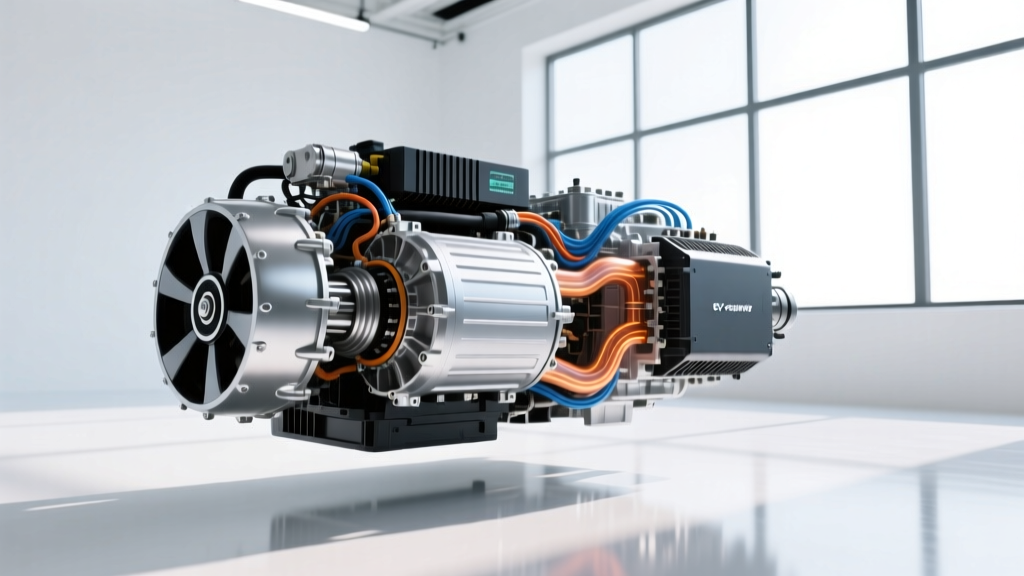
An electric vehicle replaces a gas engine with an electric motor powered by a large lithium-ion battery pack (typically 50–100+ kWh). Instead of burning fuel in cylinders, the battery sends electricity to the motor, which uses electromagnetic force to spin the wheels instantly — no gears, no spark plugs, no exhaust. A device called an inverter converts the battery's direct current (DC) into alternating current (AC) the motor needs, while an onboard charger handles converting AC from your wall or public charger back into DC to refill the battery. The result is smooth, instant torque, far fewer moving parts (around 20 versus 2,000+ in a gas powertrain), and energy efficiency of roughly 85–90% from battery to wheels — compared to about 20–30% for a gasoline engine.
The Core Components of an Electric Powertrain
Understanding how an electric engine works starts with four main components that replace everything under the hood of a conventional car:
- Traction battery pack (kWh): The energy reservoir. Most 2026 EVs use NMC (nickel-manganese-cobalt) or LFP (lithium iron phosphate) chemistry, ranging from ~50 kWh (compact cars) to 130+ kWh (large trucks like the Ford F-150 Lightning Extended Range). This is energy capacity — think of it as the "tank size."
- Electric motor(s): Convert electrical energy into rotational force. A single motor drives one axle; dual-motor setups power all four wheels. Output ranges from ~150 hp in affordable compacts to over 1,000 hp in performance models like the Tesla Model S Plaid.
- Inverter: Converts DC from the battery into AC for the motor and precisely controls motor speed and torque — essentially the "brain" of acceleration.
- Onboard charger: Converts incoming AC power (from a home Level 2 charger or public AC station) into DC to refill the battery. Typical onboard chargers handle 7.2 kW to 11.5 kW, dictating how fast Level 2 charging happens.
Unlike a gas engine that needs to rev through gears to build power, an electric motor delivers peak torque from 0 RPM. This is why even a modest 200-hp EV feels punchier off the line than a gas car with similar horsepower.
EV vs Gas vs Hybrid: Efficiency and Performance Compared
The fundamental physics of how an electric engine works explains why EVs dominate in efficiency. A gas engine wastes roughly 70–80% of fuel energy as heat, friction, and pumping losses. An electric motor wastes only about 10–15%.
| Metric | Battery EV (e.g., Hyundai Ioniq 6 SE) | Gas Sedan (e.g., Toyota Camry LE) | PHEV (e.g., Toyota Prius Prime) |
|---|---|---|---|
| Powertrain efficiency | ~85–90% | ~20–30% | ~40% (combined) |
| EPA combined | 140 MPGe | 32 MPG | 52 MPG + 127 MPGe (electric) |
| Energy cost per mile | ~$0.04–0.06 (home charging) | ~$0.12–0.15 (gas at $3.50/gal) | ~$0.06–0.10 |
| 0–60 mph | ~7.0 sec | ~7.6 sec | ~6.6 sec |
| Moving parts (powertrain) | ~20 | ~2,000+ | ~1,500+ |
| Regenerative braking | Yes — recovers kinetic energy | No — friction brakes only | Yes (limited) |
Sources: fueleconomy.gov, manufacturer specifications for 2025–2026 model years. MPGe (miles per gallon equivalent) converts electricity consumption into a gas-mileage equivalent for comparison.
Real-World Range: What the EPA Sticker Doesn't Tell You
EPA range estimates are measured under controlled conditions. In real-world driving, expect variation based on speed, temperature, and terrain:
- Highway driving at 70–80 mph: Expect 15–25% less than EPA range due to aerodynamic drag, which increases exponentially with speed.
- Cold weather (below 32°F): Battery chemistry slows, cabin heating draws power, and range can drop 20–40%. An EV rated at 300 miles EPA may deliver 200–240 miles in freezing conditions. Heat pumps (standard on many 2026 models like the Tesla Model Y and Hyundai Ioniq 5) mitigate this loss to roughly 15–25%.
- City driving with regen: This is where EVs shine — stop-and-go traffic lets regenerative braking recover energy, often exceeding EPA estimates.
Regenerative braking is a key part of how an electric engine works in practice: when you lift off the accelerator, the motor reverses direction, acting as a generator to slow the car and send energy back to the battery. This extends range and reduces brake wear dramatically — many EV owners go 100,000+ miles on original brake pads.
The Real Costs: Purchase, Charging, Maintenance, and Insurance
Understanding the economics of EV ownership requires looking beyond the sticker price. Here's a realistic 5-year cost breakdown comparing a typical EV to a comparable gas vehicle:
| Cost Category (5-Year) | EV (e.g., Tesla Model 3 RWD, ~$39,000 MSRP) | Gas Sedan (e.g., Toyota Camry SE, ~$30,000 MSRP) |
|---|---|---|
| Purchase price (after §30D credit) | ~$31,500 (if eligible for $7,500 credit) | $30,000 |
| Fuel/energy (75,000 miles) | ~$3,750 (home charging at $0.13/kWh) | ~$9,750 (gas at $3.50/gal, 32 MPG) |
| Maintenance | ~$1,500 (cabin filter, wipers, tire rotation) | ~$3,500 (oil changes, filters, belts, brakes) |
| Insurance (avg.) | ~$9,500 (EV premiums run 15–25% higher) | ~$7,500 |
| Tires (EVs wear tires ~20% faster) | ~$1,800 | ~$1,400 |
| Total 5-Year Cost | ~$48,050 | ~$52,150 |
Assumes 15,000 miles/year, home charging access, and §30D federal tax credit eligibility. Insurance averages based on industry data. Actual costs vary by state, driving profile, and electricity rate. See IRS §30D rules for current credit requirements including MSRP caps ($55,000 for sedans, $80,000 for SUVs/trucks), income limits ($150K single / $300K joint), and battery sourcing requirements.
Charging in Practice: Home, Public, and What You Need to Know
Because an electric motor draws from a battery rather than a fuel tank, "refueling" happens at three distinct levels:
| Charging Level | Power (kW) | Miles Added per Hour | Best For |
|---|---|---|---|
| Level 1 (120V household outlet) | 1.0–1.4 kW | 3–5 miles | Overnight top-ups, PHEVs |
| Level 2 (240V home/public) | 7.2–11.5 kW | 25–44 miles | Daily home charging, destination charging |
| DC Fast Charging | 50–350 kW | 150–1,000+ miles/hr (peak) | Road trips, rapid top-ups |
Home charging is the backbone of EV ownership. A Level 2 home charger installation typically costs $1,200–$3,500 total (equipment + electrician + permit), depending on your electrical panel. Homes with 200-amp panels usually accommodate a 48-amp (11.5 kW) charger with minimal upgrades. Older homes with 100-amp service may need a panel upgrade ($1,500–$3,000+).
DC fast charging reality check: Peak kW ratings are not sustained rates. A vehicle advertising "250 kW peak" typically holds that rate only between roughly 10–40% state of charge, then tapers to protect battery health. Expect a 10–80% charge in 18–35 minutes for most 2026 EVs at a capable station. Charging above 80% slows dramatically — plan to charge to 80% on road trips and move on.
If you lack home charging: EV ownership is still possible but significantly less convenient and more expensive. Public DC fast charging costs roughly $0.30–$0.50/kWh (versus ~$0.13/kWh at home), and you'll spend 30–45 minutes per session, 2–3 times per week. This is a real limitation worth evaluating honestly before purchasing.
Common Misconceptions — Myth vs. Fact
| Myth | Fact |
|---|---|
| "EV batteries need replacing every few years." | Federal law mandates battery warranties of at least 8 years/100,000 miles. Most 2026 EV batteries are engineered for 200,000+ miles with less than 10–15% degradation. Replacement costs $5,000–$20,000 but is rarely needed within the vehicle's life. |
| "Electric motors are slow." | Electric motors deliver instant torque from 0 RPM. Even affordable EVs like the Chevrolet Equinox EV (~$33,000) hit 0–60 in under 8 seconds; performance models do it in under 3 seconds. |
| "EVs are worse for the environment due to battery mining." | Lifecycle analyses from Argonne National Laboratory and others consistently show EVs produce fewer total emissions than gas cars over their lifetime — even accounting for battery manufacturing. The grid is getting cleaner every year, widening this advantage. |
| "You can't drive an EV in cold weather." | You absolutely can, but plan for 20–30% range loss. Preconditioning the battery (warming it while plugged in before departure) mitigates this significantly and is standard on most 2026 models. |
| "All EVs qualify for the $7,500 tax credit." | Under current §30D rules, eligibility depends on MSRP caps, buyer income, and battery mineral/component sourcing. Many popular EVs qualify for only $3,750 or nothing at all. Always check IRS guidance and consult a tax professional. |
Battery Chemistry: LFP vs NMC and Why It Matters
The battery is the most expensive component in an EV, and its chemistry affects range, longevity, charging behavior, and cost:
| Attribute | LFP (Lithium Iron Phosphate) | NMC (Nickel Manganese Cobalt) |
|---|---|---|
| Energy density | Lower — heavier for same kWh | Higher — lighter, more range per kg |
| Cycle life | 3,000–5,000+ cycles | 1,000–2,000 cycles |
| Can charge to 100% daily? | Yes — recommended for accuracy | No — 80% daily, 100% for trips only |
| Cold-weather performance | Weaker — more range loss | Better in freezing temps |
| Cost | Lower — no cobalt or nickel | Higher — commodity-sensitive |
| Common in (2026) | Tesla Model 3 RWD, Ford Mustang Mach-E Select | Hyundai Ioniq 5, BMW i4, most long-range models |
If you prioritize longevity and plan to keep your EV 10+ years, LFP is compelling. If maximum range and cold-weather driving matter most, NMC is the better fit.
Decision Framework: Is an EV Right for You?
Choose a Battery EV if:
- You have access to home or workplace Level 2 charging
- Your daily commute is under 80 miles round-trip (covers 90%+ of US drivers)
- You want the lowest per-mile fuel cost and minimal maintenance
- You qualify for federal/state incentives that narrow the upfront price gap
- You're willing to plan charging stops on road trips (15–30 min every 200–250 miles)
Choose a PHEV (Plug-in Hybrid) if:
- You lack reliable home charging but can charge occasionally
- You frequently drive 300+ miles without stopping
- You want electric-only commuting (25–50 miles) with gas backup for long trips
- You live in an area with limited DC fast-charging infrastructure
Stick with a Gas or HEV (Standard Hybrid) if:
- You have zero charging access at home or work
- You regularly tow heavy loads in extreme cold
- Upfront budget is tight and no incentives apply to your situation
- You live in a rural area far from public charging networks
Frequently Asked Questions
Do electric motors have horsepower like gas engines?
Yes, but they deliver it differently. Electric motors produce peak torque instantly at 0 RPM, while gas engines need to rev to a specific RPM to hit peak torque. This means a 250-hp EV often accelerates faster than a 250-hp gas car in real-world driving. Horsepower ratings for EVs are measured at the motor output, and dual-motor configurations simply add front and rear motor output together.
How long do EV batteries actually last?
Most 2026 EV batteries are warrantied for 8 years/100,000 miles (10 years/150,000 miles in California and states adopting CARB standards) with a capacity-retention threshold of 70%. Real-world data from fleet operators and sources like Recurrent Auto show average degradation of 5–10% over the first 100,000 miles, with most packs lasting well beyond 200,000 miles before dropping below 80% capacity.
What happens when I lift off the accelerator in an EV?
That's regenerative braking — the motor reverses function and becomes a generator, slowing the vehicle while sending energy back into the battery. Many EVs offer adjustable regen levels, and the strongest settings enable "one-pedal driving," where you rarely need the friction brake pedal in normal traffic. This recovers energy that gas cars waste entirely as brake heat.
Does an EV motor require maintenance?
Virtually none. Electric motors have one moving part (the rotor) and no fluids to change. There are no oil changes, spark plugs, timing belts, or transmission fluid services. The main maintenance items on an EV are tires (which wear faster due to instant torque and vehicle weight), cabin air filters, brake fluid checks, and windshield washer fluid. Expect annual maintenance costs of $200–$400 versus $800–$1,500 for a gas vehicle.
Can I charge an EV from a regular wall outlet?
Yes, but slowly. A standard 120V household outlet (Level 1) delivers roughly 1.0–1.4 kW, adding about 3–5 miles of range per hour. For a 75 kWh battery, a full charge from empty would take 50–75 hours. This works for PHEVs with smaller batteries (10–18 kWh) or as a backup for BEVs driven fewer than 30 miles daily, but a 240V Level 2 home charger is strongly recommended for full EV ownership.
What's the difference between kW and kWh?
This is the most common point of confusion for new EV buyers. kW (kilowatts) measures power — the rate of energy flow, like the speed of water through a hose. It determines charging speed and motor output. kWh (kilowatt-hours) measures energy — the total amount stored or consumed, like the volume of water in a tank. A 75 kWh battery stores 75 kilowatt-hours of energy. Charging at 75 kW for one hour would (in theory) add 75 kWh. Think of kW as "how fast" and kWh as "how much."