Quick Answer: How Do Electric Heaters Work in EVs?
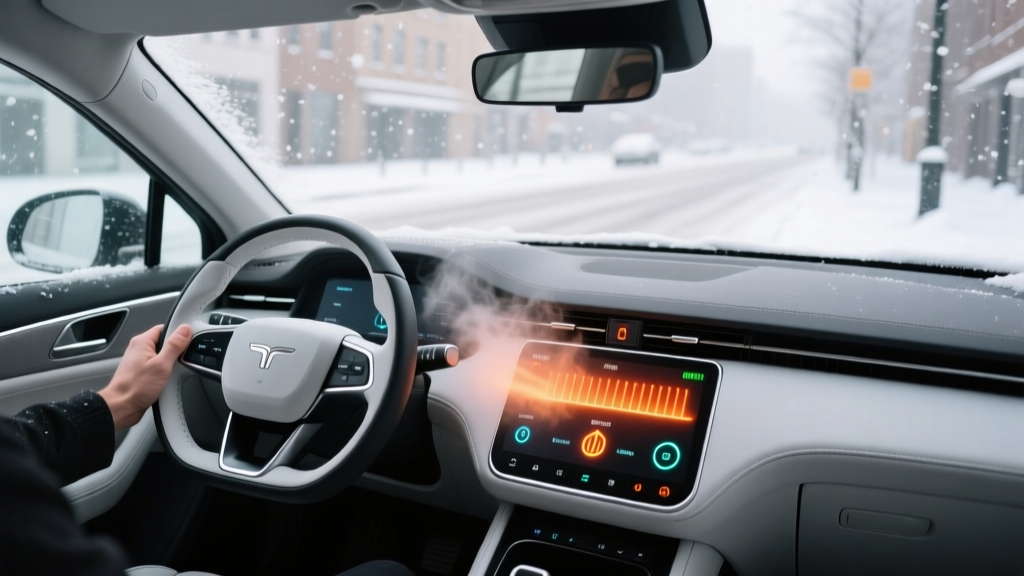
Unlike gas cars that recycle waste engine heat, EVs must generate cabin warmth from scratch using electricity drawn from the traction battery. There are two primary methods: resistive heaters (PTC heaters), which pass current through a resistive element to produce heat — similar to a space heater — and heat pumps, which use a refrigerant cycle to extract ambient heat from outside air and concentrate it inside the cabin. A resistive heater typically draws 3–6 kW of continuous power, while a modern heat pump draws only 1–3 kW for equivalent warmth, making it 2–3× more efficient. Because every kilowatt-hour spent on heating is a kilowatt-hour not spent on propulsion, EV heating systems directly impact driving range — especially in cold climates where range losses of 20–40% are common.
Resistive Heaters vs. Heat Pumps: The Two Ways EVs Make Heat
Understanding how do electric heaters work starts with the two competing technologies automakers deploy. Each has distinct trade-offs in efficiency, cost, and cold-weather performance.
PTC (Positive Temperature Coefficient) Resistive Heaters
A PTC heater works on a simple principle: electricity flows through a ceramic resistive element, which heats up as current passes through it. The element's resistance increases as it gets hotter (the "positive temperature coefficient"), creating a self-regulating effect that prevents overheating. Most PTC systems in current EVs draw between 3 kW and 6 kW at full output. That's a significant load — running a 5 kW heater for one hour consumes 5 kWh of battery energy, which on a typical EV consuming 3.5–4.0 miles per kWh, translates to roughly 17–20 miles of lost range per hour of continuous heating.
Vehicles like the base-trim Chevrolet Bolt EV and earlier Nissan Leaf models have historically relied on PTC heaters. They're inexpensive to manufacture (adding roughly $200–$400 to vehicle cost), extremely reliable with no moving parts, and produce heat instantly regardless of outside temperature. The downside is raw energy consumption.
Heat Pump Systems
A heat pump operates on the same thermodynamic principle as your home HVAC system or refrigerator — but in reverse. It uses a compressor to circulate refrigerant (typically R-1234yf or CO₂/R-744 in newer systems) through an outdoor heat exchanger that absorbs thermal energy from ambient air, even at temperatures well below freezing. The compressed, heated refrigerant then passes through an indoor condenser that releases warmth into the cabin.
The key metric is Coefficient of Performance (COP). A COP of 3.0 means the heat pump delivers 3 kW of heat for every 1 kW of electrical energy consumed. In moderate cold (32–45°F / 0–7°C), modern automotive heat pumps achieve COPs of 2.5–4.0. Even at 14°F (−10°C), advanced systems like Hyundai's multi-heat-pump architecture or Tesla's octovalve-integrated system maintain COPs above 1.5–2.0, still outperforming resistive heating's fixed COP of 1.0.
As of 2026, heat pumps are standard or available on most mainstream EVs including the Tesla Model Y, Hyundai Ioniq 5/6, Kia EV6/EV9, Ford Mustang Mach-E, BMW iX, and Volkswagen ID.4. They typically add $500–$1,200 to the vehicle's build cost compared to PTC-only systems.
| Feature | PTC Resistive Heater | Heat Pump System |
|---|---|---|
| Power draw (full heat) | 3–6 kW | 1–3 kW |
| Coefficient of Performance | 1.0 (fixed) | 1.5–4.0 (varies by temp) |
| Range impact (30°F, 1-hr drive) | ~15–25% loss | ~8–15% loss |
| Heat-up speed | Instant (10–30 sec) | Slightly slower (30–90 sec) |
| Added vehicle cost | $200–$400 | $500–$1,200 |
| Cold-climate efficiency (below 0°F) | Unchanged (COP 1.0) | Reduced (COP drops toward 1.0–1.5) |
| Example 2026 vehicles | Chevrolet Bolt EV (base), Nissan Leaf S | Tesla Model Y, Hyundai Ioniq 5, Kia EV6, VW ID.4 |
Real-World Range Loss: What Cold Weather Actually Costs You
The most practical consequence of how electric heaters work is range reduction. Every kilowatt-hour diverted to cabin heating reduces the energy available for propulsion. Here's what that looks like with real numbers.
Consider a 2026 Hyundai Ioniq 5 SEL AWD with its 77.4 kWh usable battery and EPA-rated 290-mile range. In mild 65°F conditions, it averages roughly 3.7 mi/kWh, yielding approximately 286 real-world miles. But in 25°F (−4°C) weather:
- Heat pump running at ~2 kW average: Over a 2-hour, 140-mile highway drive, the heat pump consumes ~4 kWh. Combined with the battery's increased internal resistance and reduced regenerative braking efficiency, expect a total range reduction of approximately 20–25%. Real-world range drops to roughly 215–230 miles.
- Hypothetical PTC heater at ~4.5 kW average: The same drive would consume ~9 kWh for heating alone, contributing to a 30–40% total range reduction. Real-world range drops to roughly 175–200 miles.
Cold-weather range reality: EPA range figures are measured in controlled laboratory conditions at roughly 68–77°F. In sustained sub-freezing temperatures, expect 20–30% range loss with a heat pump and 30–40% with a PTC resistive heater. At extreme cold (below 0°F / −18°C), losses can exceed 40% regardless of heating technology. Data from fueleconomy.gov and independent testing by organizations like AAA confirm these ranges consistently across multiple model years.
Several compounding factors amplify cold-weather range loss beyond just the heater:
- Battery chemistry slowdown: Lithium-ion cells have higher internal resistance below freezing, reducing usable capacity by 5–15% until the pack warms up.
- Reduced regenerative braking: Cold batteries can't accept charge as quickly, so regen is limited or disabled until the pack reaches operating temperature — typically 5–15 minutes of driving.
- Denser air and winter tires: Cold air increases aerodynamic drag slightly, and winter tire rolling resistance adds roughly 2–5% consumption.
- Accessory loads: Heated seats (50–100W each), heated steering wheel (~50W), defroster, and headlights all draw additional power, though these are minor compared to cabin heating.
EV vs. Gas Car Heating: Why Gas Cars Have an Advantage Here
One of the most common questions from prospective EV buyers is why gas cars seem unaffected by cold weather while EVs lose significant range. The answer lies in thermodynamic waste.
An internal combustion engine is roughly 20–35% efficient — meaning 65–80% of the energy in gasoline is wasted as heat. In winter, the climate control system simply redirects some of that waste heat into the cabin. You're not using any additional fuel for warmth; the heat is a free byproduct of the engine's inefficiency.
An electric motor, by contrast, is 85–95% efficient. There's very little waste heat to capture. The EV must therefore generate heat intentionally, consuming battery energy that would otherwise go to propulsion. This fundamental physics difference is why cold weather disproportionately affects EVs.
| Metric | EV (Heat Pump) | EV (PTC Heater) | Gas Car (Waste Heat) |
|---|---|---|---|
| Heating energy consumed | ~2 kWh | ~5 kWh | ~0 additional fuel |
| Range/efficiency impact | 8–15% range loss | 15–25% range loss | Negligible |
| Heating cost (at $0.15/kWh) | $0.30 | $0.75 | $0.00 |
| Annual heating cost (150 cold days, 1 hr/day) | $45 | $112 | $0 |
However, context matters. Gas cars still lose fuel economy in cold weather — the U.S. Department of Energy notes that short-trip fuel economy can drop 12–22% at 20°F versus 77°F due to cold-engine enrichment, increased friction, and winter fuel blends. The gas car just doesn't lose range from heating specifically, because the tank holds surplus energy relative to the trip.
Smart Strategies: Minimizing Heating-Related Range Loss
Experienced EV owners in cold climates deploy several strategies to reduce the heating tax on their range:
Preconditioning While Plugged In
This is the single most impactful cold-weather habit. By scheduling cabin and battery preconditioning while the EV is still connected to a Level 2 home charger (typically 7–11 kW), the heating energy comes from the grid rather than the battery. You start your drive with a warm cabin and a warm battery pack — both of which improve efficiency from the first mile. Most 2026 EVs support app-based or scheduled preconditioning: Tesla, Hyundai/Kia, Ford, BMW, and VW all include this feature.
Heated Seats and Steering Wheel Over Cabin Air
Heated seats draw roughly 50–100 watts each — about 1/30th to 1/50th the power of a cabin air heater. Heated steering wheels consume around 50 watts. By using these contact heaters to warm your body directly, you can lower the cabin air temperature by 5–10°F and still feel comfortable, reducing overall heating energy by 30–50%.
Garage Parking
Starting from a 40°F garage versus a 15°F driveway reduces the initial heating load substantially. The cabin reaches comfort temperature faster, and the battery pack starts closer to its optimal operating range (roughly 68–95°F), restoring regenerative braking sooner.
Seat Heater–Only Mode for Short Solo Trips
For quick errands under 20 minutes with just the driver, running seat heaters and a heated steering wheel while keeping cabin air heating off or minimal can save 2–4 kWh per trip — roughly 8–15 miles of preserved range.
Myths vs. Facts About EV Heating
| Myth | Fact |
|---|---|
| "EVs can't heat the cabin in extreme cold" | Both PTC heaters and heat pumps function well below 0°F. Heat pumps lose efficiency but modern systems with CO₂ refrigerant (like some European-market models) maintain COPs above 1.5 even at −15°F (−26°C). The cabin will reach 70°F — it just takes more energy. |
| "Running the heater will leave you stranded" | Even with a 30% range loss, a 300-mile EPA EV still delivers ~210 real-world winter miles — more than sufficient for the average American's 37-mile daily commute. Plan for the reduction; it won't strand you on normal drives. |
| "All EVs have heat pumps now" | Not all. Budget-oriented models and some base trims still use PTC heaters to control cost. Always check the specific trim's spec sheet — don't assume heat pump inclusion based on the model name alone. |
| "EV heaters are a fire risk" | Automotive PTC heaters and heat pumps undergo rigorous safety certification (FMVSS, UN ECE R100). PTC elements are inherently self-limiting — they cannot overheat by design. There is no meaningful fire risk difference versus a gas car's heater core. |
| "You can't use the heater while DC fast charging" | You can. The vehicle's thermal management system coordinates cabin heating and battery conditioning simultaneously during a DC fast charge. The charger supplies enough power (often 50–250+ kW) to cover both loads easily. |
What First-Time EV Buyers in Cold Climates Should Know
If you're considering an EV and live where winters routinely drop below freezing, heating efficiency should be a primary factor in your purchase decision — not an afterthought. Here's a practical framework:
Cold-Climate EV Decision Framework
- Choose a heat pump–equipped EV if: You regularly drive more than 40 miles round-trip in sub-40°F weather, you don't have a heated garage, or you want to minimize DC fast-charge stops on winter road trips. The $500–$1,200 premium pays for itself in preserved range and comfort.
- A PTC heater is acceptable if: Your daily commute is under 30 miles round-trip, you have reliable Level 2 home charging for preconditioning, you live in a moderate climate (rarely below 25°F), or you're buying a budget-oriented EV where the heat pump option isn't available.
- Prioritize a larger battery (75+ kWh usable) if: You live in extreme cold (frequent sub-zero temps) and need 200+ miles of real-world winter range. The buffer matters more than the heating technology alone.
- Install a Level 2 home charger (240V, 32–48A) before winter: Preconditioning while plugged in is the single most effective cold-weather strategy. A basic 32A Level 2 installation typically costs $800–$2,000 including equipment and electrician labor, per U.S. Department of Energy guidance.
Also factor in the federal §30D clean vehicle tax credit, which provides up to $7,500 for eligible new EVs purchased in 2026 — subject to MSRP caps ($55,000 for sedans, $80,000 for SUVs/trucks), buyer income limits ($150K single / $300K joint), and battery critical-mineral and component sourcing requirements. Point-of-sale transfer is available, reducing your dealer price directly. Eligibility rules are specific and change periodically, so verify current requirements with your tax professional and the IRS.
Frequently Asked Questions
Do electric car heaters drain the battery quickly?
At full output, a PTC resistive heater draws 3–6 kW, consuming 3–6 kWh per hour. A heat pump draws 1–3 kW for equivalent warmth. On a 75 kWh battery, running a heat pump for an hour uses roughly 2–4% of total capacity — noticeable on long winter drives but not catastrophic. Preconditioning while plugged in eliminates this drain entirely at the start of your trip.
Can I retrofit a heat pump into an EV that came with a PTC heater?
No. Heat pump systems require dedicated refrigerant lines, compressors, heat exchangers, and control software integrated into the vehicle's thermal management architecture. Retrofitting is not practical or cost-effective. If heating efficiency is a priority, select a heat-pump-equipped trim at purchase.
Does using heated seats save more energy than cabin heating?
Yes, substantially. Heated seats draw 50–100 watts each versus 2,000–5,000 watts for cabin air heating. Using seat heaters as your primary warmth source and reducing the cabin thermostat by 5–10°F can cut heating energy consumption by 30–60%, directly preserving driving range.
Why does my EV's range estimate drop suddenly when I turn on the heater?
The vehicle's range estimator (often called the "guess-o-meter") recalculates projected range based on current energy consumption. Activating a 3–5 kW heater instantly increases the consumption rate, and the estimator projects that rate forward. The displayed range will partially recover once the cabin reaches the set temperature and the heater cycles to a lower power level — especially with heat pump systems that maintain temperature efficiently.
Are heat pumps reliable long-term?
Automotive heat pumps use well-established refrigeration technology with few wear components — primarily the compressor, which is designed for the vehicle's lifespan. Failures are uncommon within typical ownership periods. The system is covered under the vehicle's standard warranty (typically 3 years/36,000 miles bumper-to-bumper) and in some cases under the powertrain or EV-specific warranty (8 years/100,000 miles). Refrigerant recharge, if ever needed, costs $150–$300 at a dealership.