The Short Answer: How Do Electric Cars Work?
An electric car replaces a gasoline engine and fuel tank with an electric motor and a rechargeable battery pack (measured in kilowatt-hours, or kWh). Electricity from the grid charges the battery; an inverter converts that stored DC energy into AC power for the motor, which drives the wheels directly — no multi-speed transmission needed. Regenerative braking captures kinetic energy during deceleration and feeds it back into the battery. The result is instant torque, fewer moving parts, and zero tailpipe emissions.
If you're researching whether an EV fits your life, understanding the mechanics is only the starting point. What really matters is how those mechanics translate into range, charging logistics, and total cost of ownership. This guide walks through the engineering basics and then gets into the numbers that determine whether going electric makes financial and practical sense for you.
The Core Components Under the Hood (and Floor)
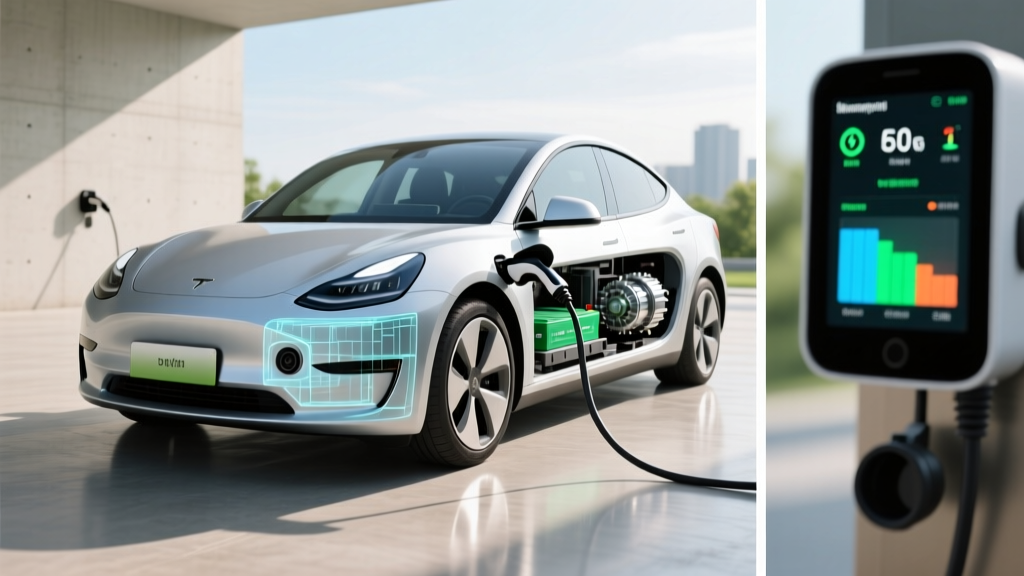
Strip away the body panels of any modern battery-electric vehicle (BEV) and you'll find a relatively simple architecture compared to a gas car:
- Battery pack: Mounted low in the chassis for a low center of gravity. Most 2025–2026 EVs use either NMC (nickel manganese cobalt) chemistry for higher energy density or LFP (lithium iron phosphate) for lower cost and longer cycle life. Usable capacities range from roughly 50 kWh in compact models to over 130 kWh in large trucks.
- Electric motor(s): Permanent-magnet synchronous or induction motors produce peak torque from 0 RPM. Single-motor setups are common for efficiency; dual- and tri-motor configurations add all-wheel drive and performance.
- Inverter: Converts DC battery power to AC for the motor and manages power delivery. This is the EV equivalent of a fuel-injection and engine-management system.
- Onboard charger: Converts AC power from a Level 1 or Level 2 source into DC to charge the battery. Typical onboard chargers handle 7.2 kW to 11.5 kW.
- Thermal management system: Liquid cooling and heating loops keep the battery in its optimal temperature range (roughly 60–95°F), which is critical for longevity, charging speed, and range.
- Single-speed reduction gear: Replaces the multi-speed transmission. Electric motors are efficient across a wide RPM range, so one gear ratio handles everything from launch to highway speed.
The simplicity here is the point. A gasoline powertrain has hundreds of moving parts in the engine and transmission alone. An EV motor has essentially one. That difference drives much of the maintenance-cost advantage we'll quantify below.
Energy Flow: From Grid to Wheels
Understanding kW versus kWh is the single most important concept for any EV buyer:
- kWh (kilowatt-hour) measures energy capacity — the size of your "fuel tank." A 75 kWh battery stores 75 kilowatt-hours of energy.
- kW (kilowatt) measures power — how fast energy flows. A 150 kW DC fast charger can deliver energy much faster than a 7.2 kW Level 2 home charger.
Here's how a typical energy cycle works in practice:
- You plug into a Level 2 home charger (say, 11.5 kW). Over ~8 hours, roughly 80 kWh flows into the battery.
- The battery management system (BMS) balances cells, monitors temperature, and manages the usable buffer — you never actually access 100% of the raw capacity, which protects longevity.
- When you drive, the inverter draws DC from the battery and converts it to AC for the motor. Efficiency in modern EVs typically runs 3–4 miles per kWh, which translates to roughly 85–120 MPGe combined depending on the model.
- Lift off the accelerator, and the motor reverses role — it becomes a generator, slowing the car and pushing energy back into the pack. This regenerative braking can recover 15–30% of energy in stop-and-go driving.
EV vs. Gas vs. Hybrid: The Numbers Side by Side
The engineering differences matter less than what they cost you over five years. Below is a comparison using representative 2025–2026 models: a Tesla Model 3 Long Range (BEV), a Toyota Camry Hybrid (HEV), and a Honda Accord 1.5T (gas-only) — all midsize sedans in the $30,000–$45,000 range.
| Metric | Tesla Model 3 LR (BEV) | Toyota Camry Hybrid (HEV) | Honda Accord 1.5T (Gas) |
|---|---|---|---|
| Base MSRP | $42,380 | $30,495 | $29,290 |
| EPA Efficiency | 132 MPGe (25 kWh/100mi) | 51 MPG combined | 32 MPG combined |
| EPA Range / Tank Range | 363 miles | ~570 miles | ~460 miles |
| "Fuel" Cost per Mile* | $0.043 (home charging) | $0.065 | $0.104 |
| Annual Fuel/Energy (12k mi) | $516 | $780 | $1,248 |
| Estimated Annual Maintenance | ~$200 | ~$550 | ~$600 |
| Fed. Tax Credit Eligibility (§30D) | Up to $7,500 (verify sourcing) | $0 | $0 |
| 0–60 mph | 4.2 seconds | 7.2 seconds | 7.0 seconds |
*Fuel costs assume $3.33/gal regular, $0.16/kWh national average electricity. Your actual rate varies by utility and state. Source: fueleconomy.gov
The BEV's higher sticker price narrows significantly after the §30D federal tax credit — if you qualify. The credit now has MSRP caps ($55,000 for sedans, $80,000 for SUVs/trucks/vans), buyer income limits ($150k single / $300k joint), and critical-mineral/battery-sourcing requirements that change annually. Always verify current-year eligibility on the IRS site or with a tax professional before assuming the full $7,500.
Real-World Range: What the EPA Sticker Doesn't Tell You
EPA range estimates are standardized laboratory tests — useful for comparison, but not a guarantee. Here's what actually affects the miles you'll see:
- Highway driving: EVs are less efficient at sustained high speeds (no regenerative braking to help). Expect 10–15% below EPA on a 75 mph interstate run.
- Cold weather: Below freezing, battery chemistry slows and cabin heating draws significant energy. Range loss of 20–35% is common in sub-30°F conditions. Models with heat pumps (standard on most 2025+ EVs) mitigate this by 5–10 percentage points.
- Charging curve taper: Peak DC fast-charge rates (e.g., 250 kW) only hold from roughly 10–50% state of charge. Above 80%, charging slows dramatically to protect the battery. A "10–80% in 18 minutes" spec is the number that matters for road trips, not the peak kW figure alone.
- Terrain and towing: Mountain grades and trailer loads can cut range 25–40% versus flat, unloaded driving.
Rule of thumb: If an EV shows 320 miles EPA, plan for ~260 miles on a highway road trip in moderate weather, ~220 miles in freezing conditions, and charge to 80% at stops (not 100%) to keep charging speed high. This means practical between-stop legs of roughly 180–210 miles in real-world touring.
Ownership Costs: The 5-Year Breakdown
Purchase price is just the entry fee. Here's a realistic 5-year / 60,000-mile cost comparison for the same three vehicles, assuming 12,000 miles/year, $0.16/kWh home electricity, $3.33/gallon gas, and typical insurance premiums:
| Cost Category | Tesla Model 3 LR (BEV) | Camry Hybrid (HEV) | Accord 1.5T (Gas) |
|---|---|---|---|
| Purchase Price (after credit) | $34,880* | $30,495 | $29,290 |
| 5-Year Energy/Fuel | $2,580 | $3,900 | $6,240 |
| 5-Year Maintenance | $1,000 | $2,750 | $3,000 |
| 5-Year Insurance (est.) | $8,500 | $6,200 | $6,400 |
| Estimated Depreciation | $18,000 | $13,500 | $14,000 |
| 5-Year Total Cost | $64,960 | $56,845 | $58,930 |
| Cost per Mile | $1.08 | $0.95 | $0.98 |
*Assumes full $7,500 §30D credit applied at point of sale. Insurance is typically 20–40% higher for EVs due to repair costs and parts pricing. Depreciation figures are estimates based on current market trends and vary by model and region.
The BEV's energy and maintenance savings are real — roughly $5,400 less than the gas car over five years. But higher insurance and steeper depreciation (a known issue as the used-EV market adjusts) eat into those gains. The hybrid splits the difference: lower upfront cost, no charging dependency, meaningful fuel savings, and strong resale value.
Charging Logistics: The Make-or-Break Factor
How you charge determines whether an EV is a joy or a burden. Here are the three tiers:
| Level | Power | Miles Added per Hour | Use Case |
|---|---|---|---|
| Level 1 (120V outlet) | 1.0–1.4 kW | 3–5 miles | Overnight top-up, PHEVs, emergencies |
| Level 2 (240V home/public) | 7.2–11.5 kW | 25–44 miles | Daily home charging, workplace, shopping |
| DC Fast Charging | 50–350 kW | 150–1,000+ miles/hr | Road trips; 10–80% in 15–35 minutes |
Home charging is the foundation. Most EV owners do 85–95% of their charging at home. A Level 2 home charger installation runs $800–$2,500 total (equipment plus electrician labor and permits) if your electrical panel has capacity. A panel upgrade from 100A to 200A can add $1,500–$3,500.
If you cannot charge at home — apartment living, street parking, no garage access — an EV becomes significantly less convenient. Public DC fast charging costs roughly 2–3× more per kWh than home electricity, and relying on it exclusively adds 30–60 minutes per week of charging time for an average driver. In this scenario, a hybrid (HEV or PHEV) may be the more practical electrified choice.
The U.S. public charging network continues to expand, with Tesla's Supercharger network now accessible to most non-Tesla EVs via NACS adapters, and Electrify America, EVgo, and ChargePoint covering major corridors. But reliability at public chargers remains inconsistent — J.D. Power's 2024 charging study found owner satisfaction with public charging still lagging behind home charging by a wide margin.
Common Misconceptions, Corrected
| Myth | Fact |
|---|---|
| "EV batteries need replacing every few years and cost $20,000." | Federal law mandates battery warranties of at least 8 years / 100,000 miles. Real-world degradation data shows most packs retain 85–92% capacity after 100k miles. Full replacements are rare and typically covered under warranty during that period. |
| "EVs are worse for the environment because of electricity generation." | Even on coal-heavy grids, EVs produce fewer lifetime emissions than gas cars. On the increasingly renewable U.S. grid, the advantage is 50–70% fewer lifecycle emissions per EPA analysis. The gap widens as grids decarbonize. |
| "You can't drive an EV in cold weather." | You can, but expect 20–35% range loss below freezing. Preconditioning the battery while plugged in and using seat/steering-wheel heaters (instead of cabin air heating) recovers significant range. EVs start reliably in extreme cold — better than gas cars in some cases. |
| "Charging takes too long for road trips." | A modern EV charging from 10–80% at a 250 kW station takes 15–25 minutes. Plan stops around meals and rest breaks. For most drivers on trips under 400 miles, total added time is 20–40 minutes versus a gas trip. |
| "The power grid can't handle millions of EVs." | Most charging happens overnight during off-peak hours when grid capacity is underutilized. Smart charging and time-of-use rates manage demand. Local transformer upgrades are needed in some neighborhoods, but grid-level collapse is not supported by utility data. |
Decision Framework: Should You Buy an EV, Hybrid, or Stick with Gas?
Choose a BEV (full electric) if:
- You have reliable home or workplace Level 2 charging access
- Your daily driving is under 250 miles (covers 95%+ of U.S. drivers)
- You want the lowest per-mile energy cost and minimal maintenance
- You qualify for the §30D tax credit (income, MSRP, and sourcing requirements met)
- You're willing to plan charging stops on road trips 2–4 times per year
Choose a PHEV (plug-in hybrid) if:
- You have home charging but frequently take trips exceeding electric-only range (25–50 miles on most PHEVs)
- You want electric commuting without any range-anxiety on longer drives
- Your household has one car that must serve both daily commuting and road-trip duty
Choose an HEV (standard hybrid) if:
- You have no home charging access (apartment, street parking)
- You want better fuel economy without changing any habits or installing equipment
- Your budget is tighter and you want proven, low-risk technology with strong resale
Stick with gas (for now) if:
- You regularly tow heavy loads in extreme cold (though electric trucks like the F-150 Lightning handle moderate towing)
- You drive in remote areas far from any charging infrastructure
- Your annual mileage is very low (<5,000 miles), making fuel savings negligible against higher purchase price
Frequently Asked Questions
Do electric cars need oil changes?
No. EVs have no engine oil, no transmission fluid (in the traditional sense), no spark plugs, no timing belts, and no exhaust system. Routine maintenance is limited to tire rotations, cabin air filter replacement, brake fluid checks, and windshield washer fluid. This is why EV maintenance costs average $0.06–$0.08 per mile versus $0.10–$0.12 for gas vehicles.
How long do EV batteries actually last?
Based on fleet data from Tesla, Hyundai, and independent analyses, modern lithium-ion EV batteries typically retain 85–92% of original capacity after 100,000 miles and 80–88% after 150,000 miles. LFP chemistry packs (used in base-model Tesla Model 3/Y, Ford Mustang Mach-E Select, and others) often show even slower degradation. Federal warranty requirements mandate at least 8 years / 100,000 miles of coverage with a minimum 70% capacity retention threshold.
Can I charge an EV from a regular household outlet?
Yes, but slowly. A standard 120V Level 1 outlet adds roughly 3–5 miles of range per hour of charging. That's 36–60 miles overnight — sufficient for some PHEVs and low-mileage commuters, but inadequate as a primary charging method for most BEV owners with 250+ mile commutes or daily needs above 40 miles.
Are EVs more expensive to insure?
Typically yes. EV insurance premiums run 20–40% higher than comparable gas vehicles, driven by higher repair costs (specialized parts, battery-safe repair procedures) and higher vehicle values. Shop quotes from multiple insurers — Tesla Insurance, Progressive, GEICO, and State Farm all price EVs differently, and the gap varies significantly by model and state.
What happens if I run out of charge on the road?
The same thing that happens if you run out of gas: you need a tow to the nearest charger. EV navigation systems (Tesla, Rivian, Hyundai, Ford) route you through charging stops with estimated arrival state-of-charge, making this scenario rare if you follow the car's guidance. Most EVs also have a "turtle mode" that limits power and speed when the battery is critically low, giving you a few extra miles to reach safety.
Do EVs lose range over time?
Yes, gradually. This is called degradation, and it's most pronounced in the first year or two (typically 2–5% loss) before leveling off. Avoiding frequent 100% charges, minimizing DC fast-charging in extreme heat, and using preconditioning features all slow degradation. For NMC batteries, daily charging to 80% is recommended; LFP batteries can be charged to 100% regularly without significant harm.