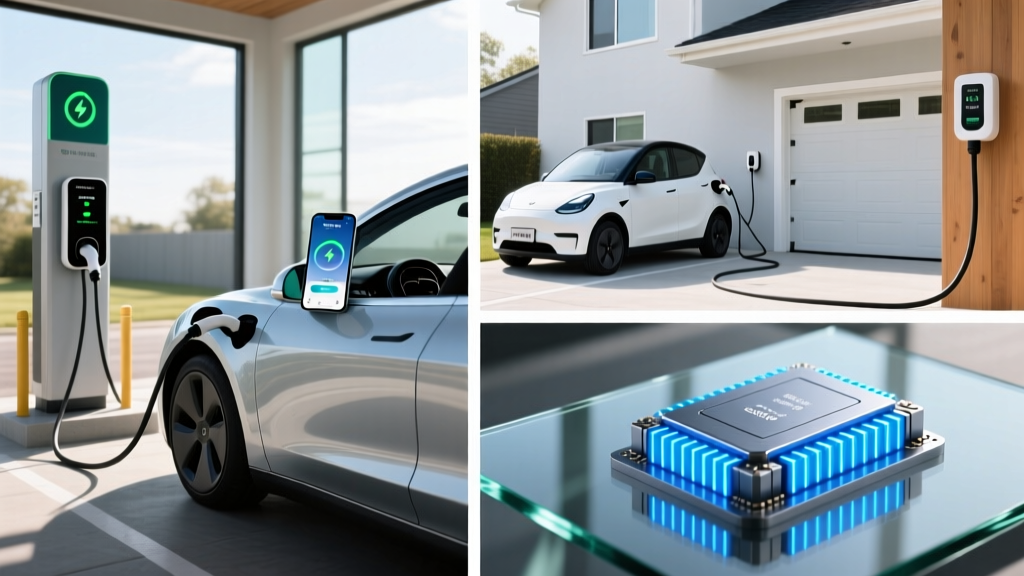
If you're asking how are electric cars charged, here's the direct answer: EVs charge by plugging into an electrical source that sends current to an onboard battery pack. There are three charging speeds — Level 1 (standard 120V outlet, adding ~3–5 miles of range per hour), Level 2 (240V home or public station, adding ~20–40 miles per hour), and DC Fast Charging (public stations delivering 50–350 kW, adding 100–250+ miles in 20–30 minutes). Most EV owners do 80% or more of their charging at home on Level 2, using public DC fast chargers for road trips.
Quick Answer: The Three Ways to Charge an EV
- Level 1 (120V): ~1.4 kW — adds 3–5 miles/hour. Good for overnight top-ups on low-mileage days.
- Level 2 (240V): 7–19 kW — adds 20–40 miles/hour. The standard for daily home charging.
- DC Fast Charging: 50–350 kW — adds 100–250+ miles in 20–30 min. For road trips and quick top-ups.
Understanding kW vs kWh: The Numbers That Matter
Before going further, clear up the single most common EV confusion: kW (kilowatts) measures power — how fast energy flows into your car. kWh (kilowatt-hours) measures energy — how much the battery holds. Think of kW as the width of a hose and kWh as the size of the bucket.
A typical 2026 EV battery holds between 60 and 100 kWh of usable energy. A car like the Hyundai Ioniq 5 has a 77.4 kWh battery and a peak DC fast-charge rate of 240 kW. That peak rate only sustains for a portion of the session — charging slows significantly above 80% State of Charge (SoC) to protect battery health. That's why manufacturers quote "10–80%" charge times rather than 0–100%.
Charging Levels Explained: Speed, Cost, and Setup
| Level | Voltage | Power (kW) | Miles Added/Hour | Typical Use Case | 10–80% Time (80 kWh battery) |
|---|---|---|---|---|---|
| Level 1 | 120V AC | 1.0–1.4 kW | 3–5 mi | Overnight trickle, PHEVs | 40+ hours (not practical) |
| Level 2 | 240V AC | 7.2–19.2 kW | 20–40 mi | Daily home/work charging | 4–8 hours |
| DC Fast | 400–800V DC | 50–350 kW | 150–250+ mi in 20 min | Road trips, quick top-ups | 18–35 minutes |
Level 1: The Emergency Trickle
Every EV comes with a cord that plugs into a standard household 120V outlet. It delivers roughly 1.4 kW, which means a full charge of an 80 kWh battery would take over 55 hours. Level 1 works fine for plug-in hybrids with small batteries (like the Toyota RAV4 Prime's 18.1 kWh pack) or EV owners who drive under 30 miles daily and can top up overnight. For full battery EVs, it's a backup — not a primary strategy.
Level 2: The Home Charging Standard
A Level 2 charger requires a 240V circuit — the same kind your electric dryer uses. Most home installations use a 40-amp or 48-amp circuit, delivering 7.7 to 11.5 kW. At 11.5 kW, you add roughly 30–35 miles of range per hour of charging, meaning an 80 kWh battery refills from 10–80% in about 5–6 hours — perfectly suited for overnight charging.
Home Level 2 installation costs vary significantly:
| Item | Typical Cost Range |
|---|---|
| Level 2 charger hardware (e.g., ChargePoint Home Flex, Wallbox Pulsar Plus) | $350–$700 |
| Electrician labor (run 240V line, mount charger) | $500–$2,000 |
| Electrical panel upgrade (if needed, 100A → 200A) | $1,500–$4,000 |
| Permits and inspection | $50–$300 |
| Total (no panel upgrade) | $900–$3,000 |
| Total (with panel upgrade) | $2,400–$7,000 |
If your home already has a 200-amp panel with spare capacity, expect to pay $900–$2,500 for a straightforward install. Older homes with 100-amp service may need a panel upgrade, which pushes costs higher. Always get a quote from a licensed electrician — panel capacity is not a DIY assessment.
DC Fast Charging: Road-Trip Refueling
DC fast chargers bypass the car's onboard charger and send direct current straight to the battery at much higher power levels. Networks like Tesla Supercharger, Electrify America, EVgo, and ChargePoint operate stations ranging from 50 kW to 350 kW.
Real-world charging speed depends on several factors:
- Battery chemistry and architecture: 800V architectures (Hyundai Ioniq 5, Kia EV6, Porsche Taycan) sustain higher charge rates longer than 400V systems.
- State of charge: Peak kW only happens between roughly 10–50% SoC. Above 80%, charging slows dramatically — sometimes to Level 2 speeds — to prevent battery damage.
- Battery temperature: Cold batteries charge much slower. Most EVs precondition the battery (warm it up) when you navigate to a charger, which is critical in winter.
- Station sharing: Some older stations split power between two stalls; plugging in next to another charging car can cut your speed in half.
According to fueleconomy.gov, the average 2026 EV achieves 3–4 miles per kWh, which helps you estimate charging needs: a 200-mile road-trip leg requires roughly 50–65 kWh, achievable in one 20–25 minute DC fast-charge stop at a 150+ kW station.
EV Charging Cost vs Gas: The Real Math
The cost advantage of charging over fueling is one of the strongest ownership arguments — but the savings depend heavily on where and when you charge.
| Fueling Method | Cost per kWh/Gallon | Cost per Mile (2026 average) | Annual Cost (12,000 mi) |
|---|---|---|---|
| Home Level 2 (national avg electricity ~$0.17/kWh) | $0.17/kWh | $0.05–$0.06 | $600–$720 |
| Home with time-of-use rate (off-peak ~$0.09/kWh) | $0.09/kWh | $0.03 | $360 |
| Public DC Fast Charging (~$0.35–$0.50/kWh) | $0.42/kWh (avg) | $0.12–$0.15 | $1,440–$1,800 |
| Gasoline car (28 MPG avg, $3.40/gallon) | $3.40/gal | $0.12 | $1,440 |
| Hybrid (50 MPG combined, $3.40/gallon) | $3.40/gal | $0.07 | $816 |
The takeaway: home-charged EVs cost roughly half as much per mile as a gas car and are competitive with or cheaper than hybrids. But if you rely entirely on public DC fast charging, your per-mile cost equals or exceeds gasoline. This is why home charging access is the single biggest factor in EV satisfaction.
Real-World Ownership: What First-Time Buyers Need to Know
Home Charging Access Is the Make-or-Break Factor
If you can install a Level 2 charger at home — whether in a garage, carport, or driveway — EV ownership is seamless. You wake up every morning with a "full tank." If you live in an apartment, condo, or street-parking situation without charging access, EV ownership becomes significantly more challenging. You'll rely on public chargers, workplace charging, or a combination, which adds time and cost.
Before buying, check:
- Does your electrical panel have spare capacity (typically 40–50 amps for a Level 2 circuit)?
- Does your HOA or landlord allow charger installation? Some states have "right to charge" laws that override HOA restrictions.
- Is your parking spot within 20–25 feet of where the charger would be mounted? Longer wire runs increase install cost.
Cold Weather Cuts Range — Plan for It
EV batteries lose efficiency in cold temperatures. At 20°F, expect a 20–30% range reduction compared to the EPA sticker. A car rated at 300 miles EPA may deliver 210–240 miles in freezing highway driving. Cold also slows DC fast charging — preconditioning the battery (a feature in most modern EVs) mitigates this but doesn't eliminate it.
If you live in northern climates, buy for your worst-case range day, not your best. An EPA rating of 300+ miles gives a comfortable buffer for winter driving.
Driving Patterns Determine Which EV Fits
Your daily mileage and road-trip frequency should drive your EV choice:
- Under 40 miles/day, rare road trips: Any modern EV works. Even a smaller-battery model like the Chevy Equinox EV (EPA 319 mi, ~$33,000 base) is more than sufficient.
- 40–80 miles/day, occasional road trips: Target 300+ miles EPA range. Models like the Tesla Model Y (EPA 320 mi, ~$44,990), Hyundai Ioniq 5 (EPA 318 mi, ~$42,600), or Ford Mustang Mach-E (EPA 320 mi, ~$42,995) fit well.
- 100+ miles/day or frequent long road trips: Consider whether a PHEV (like the Toyota RAV4 Prime, 42 mi electric-only + 38 MPG gas) might better serve you, or invest in an EV with 350+ mile range and 200+ kW DC fast charging.
Common EV Charging Myths — Fact-Checked
| Myth | Fact |
|---|---|
| "EV batteries need full replacement every few years" | Federal law mandates battery warranties of at least 8 years/100,000 miles. Real-world data shows most EV batteries lose 5–10% capacity over 100,000 miles and remain functional well beyond 150,000 miles. LFP chemistry batteries (Tesla Model 3 RWD, some Ford models) degrade even slower. |
| "You can't charge an EV in the rain" | EV chargers and ports are weather-sealed (IP65+ rated). Charging in rain, snow, or humidity is safe and normal. |
| "Public charging is always broken" | Reliability has improved substantially. Tesla Superchargers consistently report 98%+ uptime per NHTSA-adjacent studies. Electrify America and EVgo have made major infrastructure upgrades since 2023. However, older CCS stations in rural areas can still be unreliable — plan road trips with apps like PlugShare or A Better Routeplanner. |
| "EVs cost more to own overall" | Higher purchase price is offset by lower fuel and maintenance costs (no oil changes, fewer brake replacements due to regenerative braking). A federal tax credit of up to $7,500 under §30D can narrow the gap further — though eligibility depends on MSRP caps, buyer income limits, and battery sourcing requirements. |
| "Charging takes too long" | Home charging happens while you sleep — zero active time. Road-trip DC fast charging adds 20–30 minutes every 200–250 miles, which aligns with a rest stop. Most EV owners report spending less total time "fueling" than they did with gas cars. |
The §30D Federal Tax Credit: What It Actually Takes to Qualify
The federal clean vehicle credit under IRS §30D can reduce your effective purchase price by up to $7,500, and as of 2024, it can be transferred to the dealer as a point-of-sale discount. But qualification is not automatic. Here's the 2026 checklist:
- MSRP cap: Vans, SUVs, and pickups must be under $80,000 MSRP. Sedans and other vehicles must be under $55,000.
- Buyer income cap: Modified adjusted gross income must not exceed $300,000 (joint), $225,000 (head of household), or $150,000 (individual).
- Battery sourcing: Increasing percentages of battery critical minerals and components must be sourced from the U.S. or free-trade-agreement countries. This requirement tightens annually and eliminates some models mid-year.
- Final assembly: Vehicle must undergo final assembly in North America (check your VIN at fueleconomy.gov).
- One credit per VIN: The credit applies once per vehicle and once per taxpayer per year.
Always verify eligibility on the official IRS clean vehicle page before purchasing. Tax rules change, and a model that qualifies in January may not qualify by June if sourcing thresholds shift.
EV vs Gas vs Hybrid: Which Should You Choose?
Decision Framework: Pick the Right Powertrain
Choose a full EV if:
- You have reliable home Level 2 charging access
- Your daily driving is under 80 miles with occasional road trips
- You want the lowest per-mile fuel cost and minimal maintenance
- You qualify for the §30D tax credit or state incentives
Choose a PHEV if:
- You want electric-only commuting (25–45 miles) but need gas flexibility for long trips
- You have limited or inconsistent charging access
- You live in a cold climate and worry about winter range loss
- You're not ready to commit to full electric but want to reduce emissions and fuel cost
Choose a conventional hybrid if:
- You have no home charging access
- You drive high daily miles but want better fuel economy (45–55 MPG)
- You want the lowest upfront cost with no charging behavior change
Stick with gas (for now) if:
- You regularly tow heavy loads over long distances (EV towing range drops 40–50%)
- You live in a charging desert with no reliable public infrastructure
- Your budget is strictly under $25,000 and you need a new vehicle (used EVs are an option here)
Frequently Asked Questions
Can I charge an EV with a regular household outlet?
Yes, but slowly. A standard 120V outlet provides Level 1 charging at about 1.4 kW, adding 3–5 miles of range per hour. It works for plug-in hybrids with small batteries or as a backup for full EVs, but most BEV owners install a 240V Level 2 charger for daily use.
How long does it take to charge an EV at a public fast charger?
At a 150–250 kW DC fast charger, most modern EVs charge from 10–80% in 18–30 minutes. Cars with 800V architectures (Hyundai Ioniq 5, Kia EV6, Porsche Taycan) can hit 10–80% in as little as 18 minutes under optimal conditions. Charging above 80% slows significantly, so most drivers unplug at 80% and continue driving.
Is it bad to charge an EV to 100% every day?
For NMC/NCA battery chemistries, daily charging to 100% accelerates degradation slightly — most manufacturers recommend setting a daily charge limit of 80% and charging to 100% only for road trips. LFP (lithium iron phosphate) batteries, found in the Tesla Model 3 RWD and some other models, tolerate daily 100% charges better and actually benefit from periodic full charges for battery calibration.
How much does it cost to install a home EV charger?
A typical Level 2 home installation costs $900–$3,000 if your electrical panel has spare capacity. If you need a panel upgrade (common in older homes with 100-amp service), total costs can reach $2,400–$7,000. Some utilities and states offer rebates of $200–$1,000 for charger installation — check with your local provider.
Do EVs really save money compared to gas cars?
On fuel alone, home-charged EVs save $700–$1,000+ annually versus a gas car at 2026 fuel and electricity prices. Maintenance savings add another $300–$500 per year (no oil changes, fewer brake jobs). However, EVs often cost more to insure (10–25% higher premiums on average) and have higher upfront purchase prices. The total cost of ownership typically tips in the EV's favor within 3–5 years, especially with the §30D tax credit applied.
What happens if I run out of charge on the road?
Running an EV to 0% is rare with modern range estimation and route-planning apps, but if it happens, the car will need to be towed to a charger — you can't bring a spare can of electrons. Most EV roadside assistance programs (including Tesla, Ford, and Hyundai) offer limited tow-to-charger service. Keeping a 10–15% buffer on road trips eliminates this risk entirely.
Understanding how electric cars are charged — and more importantly, how you will charge yours — is the single most important factor in EV satisfaction. Confirm your home charging setup before signing a purchase agreement, buy for your worst-case range day, and the transition to electric will be remarkably smooth.