Hong Kong's EV Incentives at a Glance: What You Save in 2026
Direct answer: Hong Kong does not offer a flat cash rebate on EV purchases like the US §30D credit. Instead, the city's primary electric vehicle subsidy policy centers on a First Registration Tax (FRT) waiver for new electric private cars, currently capped at HK$287,500 for vehicles with a retail price up to HK$300,000, with a tapered waiver for higher-priced models up to HK$600,000. Additionally, the EV-charging at Home Subsidy Scheme (EHSS) provides up to HK$30,000 per parking space (capped at HK$15 million per development) to cover Level 2 charger installation in residential carparks. Combined, these policies can reduce upfront acquisition costs by tens of thousands of US dollars equivalent and lower home-charging setup barriers — but they do not eliminate the premium EVs carry over comparable gas cars in Hong Kong's already expensive auto market.
Hong Kong is one of the most EV-dense cities on Earth. As of late 2025, battery-electric vehicles accounted for over 70% of new private car registrations, driven almost entirely by the FRT waiver structure rather than a per-vehicle cash handout. If you're evaluating an EV purchase in Hong Kong — or comparing the city's approach to incentives in the US, Europe, or mainland China — understanding the mechanics of this policy is essential to calculating your real cost of ownership.
This guide breaks down the exact figures, compares EV vs gas ownership costs in Hong Kong, addresses common misconceptions, and provides a decision framework for first-time buyers navigating the market in 2026.
How the First Registration Tax Waiver Works
Hong Kong levies a First Registration Tax on all newly registered vehicles, calculated on a sliding scale based on the car's retail price. For internal combustion engine (ICE) vehicles, FRT rates range from 40% on the first HK$150,000 of taxable value up to 115% on the portion exceeding HK$300,000. On a HK$500,000 gas car, that tax alone can exceed HK$300,000.
The EV FRT waiver, extended through March 31, 2026 under the current policy framework, changes the equation:
| Vehicle Retail Price (HK$) | FRT Waiver Amount | Effective Tax Saved |
|---|---|---|
| Up to $300,000 | Full waiver, capped at $287,500 | ~$117,500 – $287,500 |
| $300,001 – $600,000 | 50% of applicable FRT, capped at $287,500 | Variable by price band |
| Above $600,000 | No waiver | $0 |
The practical implication: a Tesla Model 3 RWD (base price approximately HK$359,900 in early 2026) qualifies for a partial waiver, saving the buyer roughly HK$140,000–$160,000 in registration tax compared to registering an equivalently priced gas sedan. A BYD Atto 3 (approximately HK$279,900) qualifies for the full waiver, eliminating up to HK$112,500 in FRT. Meanwhile, a Porsche Taycan or Mercedes EQS priced above HK$600,000 receives no waiver at all and is taxed like any other luxury vehicle.
This structure deliberately steers buyers toward mass-market EVs and away from luxury electric models — a policy design that differs sharply from the US §30D credit, which applies a flat dollar amount (up to US$7,500) subject to MSRP caps (US$55,000 for sedans, US$80,000 for SUVs/trucks) and buyer income limits.
EV vs Gas: Real Ownership Costs in Hong Kong
The FRT waiver narrows the upfront price gap, but total cost of ownership (TCO) over five years tells the fuller story. Below is a comparison using a BYD Atto 3 (BEV, ~60 kWh LFP battery, WLTP range 420 km) versus a Toyota Corolla 1.8L (ICE, Hong Kong's perennial best-selling gas sedan) as representative models.
| Cost Factor (5-Year) | BYD Atto 3 (EV) | Toyota Corolla 1.8 (Gas) |
|---|---|---|
| Purchase Price (incl. FRT) | ~HK$280,000 | ~HK$410,000 |
| Annual License Fee | HK$3,970/yr (EV rate) | HK$3,970/yr (same cc class) |
| Energy Cost (12,000 km/yr) | ~HK$4,800/yr (home charging at HK$1.0/kWh) | ~HK$16,800/yr (petrol at ~HK$28/L, 14 km/L) |
| 5-Year Fuel/Energy Total | ~HK$24,000 | ~HK$84,000 |
| Maintenance (5-Year) | ~HK$12,000 (no oil, fewer fluids) | ~HK$30,000 (oil, filters, belts) |
| Insurance (avg. annual) | ~HK$8,500/yr | ~HK$6,500/yr |
| 5-Year Insurance Total | ~HK$42,500 | ~HK$32,500 |
| 5-Year TCO Estimate | ~HK$378,500 | ~HK$560,500 |
The EV saves roughly HK$180,000 over five years in this scenario, driven primarily by the FRT waiver reducing the purchase price and the per-kilometer energy cost running at approximately one-third of petrol. Insurance premiums for EVs in Hong Kong remain 20–30% higher on average, reflecting elevated repair-cost assessments for battery packs and specialized bodywork — a real cost that partially offsets the savings.
Real-world caveat on range: The Atto 3's 420 km WLTP figure translates to roughly 340–360 km in Hong Kong's stop-and-go urban driving with air conditioning running year-round. Highway runs to Shenzhen or sustained climbs in the New Territories will push consumption higher. In practice, most Hong Kong drivers cover 30–50 km daily, meaning a full charge lasts 6–10 days — well within the comfort zone of nightly home charging.
The EV-Charging at Home Subsidy Scheme (EHSS)
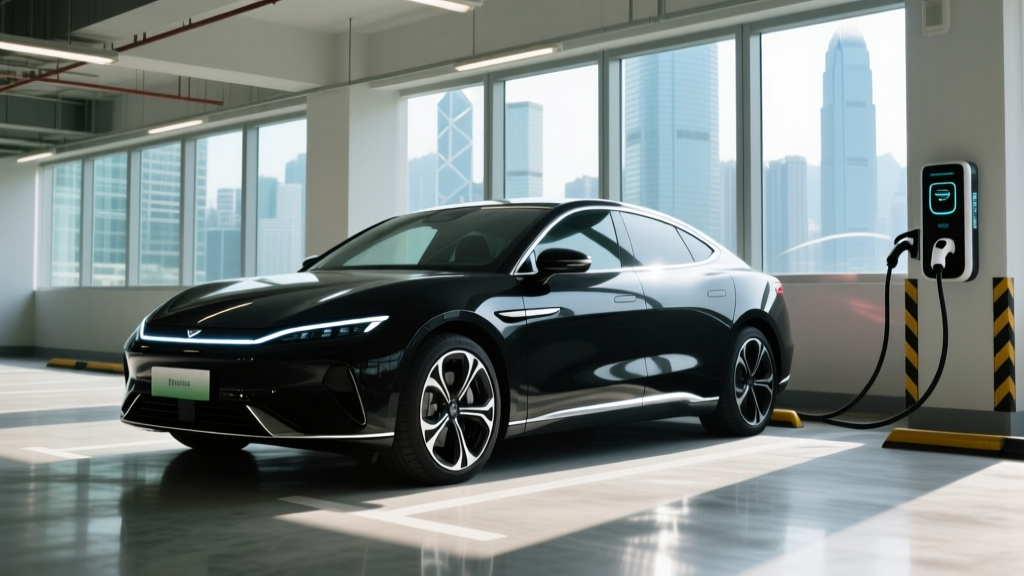
Public charging infrastructure in Hong Kong has expanded significantly — over 7,000 public chargers were available across the territory as of late 2025, including a growing network of DC fast chargers at MTR park-and-ride facilities and shopping centers. But for apartment-dwelling Hong Kong residents (the vast majority), home charging access remains the pivotal ownership question.
The EHSS, administered by the Environment and Ecology Bureau, covers residential carpark owners and management bodies — not individual buyers directly. Here's how it works in practice:
- Subsidy amount: Up to HK$30,000 per parking space for electrical infrastructure upgrades and Level 2 (7 kW single-phase or 22 kW three-phase) charger installation.
- Per-development cap: HK$15 million maximum per residential estate or building.
- Eligibility: Private residential developments with at least 10 parking spaces; application submitted by the owners' corporation or property management company.
- What it covers: Electrical cabling, distribution boards, load-management systems, and the charging unit itself.
If your building's owners' corporation has applied for and received EHSS approval, you can install a personal Level 2 charger in your designated parking space at minimal or zero personal cost. If your building has not participated, the out-of-pocket cost for a compliant Level 2 installation in a Hong Kong residential carpark typically runs HK$25,000–$50,000 depending on cable-run distance and electrical panel capacity.
For buyers without any home-charging option — still a reality in older buildings with no carpark or where EHSS applications have been rejected due to insufficient electrical capacity — public DC fast charging becomes the primary refueling strategy. At Hong Kong's prevailing public DC charging rates (approximately HK$1.6–$2.4 per kWh), energy costs climb to HK$8,000–$12,000 annually for 12,000 km of driving, narrowing the TCO advantage over gas by roughly HK$20,000–$35,000 over five years.
Common Misconceptions About Hong Kong's EV Subsidies
| Myth | Fact |
|---|---|
| "Hong Kong gives you a cash rebate when you buy an EV." | There is no direct cash rebate. The FRT waiver reduces the registration tax you would otherwise pay — it's a tax avoidance, not a subsidy check. |
| "All EVs qualify for the full waiver." | Only EVs priced at or below HK$300,000 get the full waiver. EVs above HK$600,000 get nothing. |
| "The EHSS pays me directly for a home charger." | The EHSS funds the carpark's infrastructure upgrade through the building management, not individual owners. |
| "EVs in Hong Kong have zero running costs." | Electricity isn't free. Home-charged energy costs ~HK$1.0/kWh; public DC charging costs HK$1.6–2.4/kWh. Insurance is also 20–30% pricier. |
| "The waiver applies to used EVs too." | The FRT waiver applies only to first registration of new vehicles. Transferring a used EV does not trigger a new waiver. |
What First-Time EV Buyers in Hong Kong Should Know
Beyond the subsidy mechanics, practical EV ownership in Hong Kong involves several considerations that differ from the US or European experience:
Battery chemistry matters for longevity. Most mass-market EVs popular in Hong Kong — the BYD Atto 3, BYD Dolphin, and the base Tesla Model 3 RWD — use LFP (lithium iron phosphate) batteries. LFP cells tolerate regular 100% charging better than NMC (nickel manganese cobalt) chemistry and show slower capacity degradation over time. In Hong Kong's subtropical climate, where ambient temperatures rarely drop below 10°C, cold-weather range loss is negligible compared to northern markets. However, sustained exposure to 35°C+ summer heat can accelerate degradation slightly; vehicles with active liquid-cooled thermal management (standard on Tesla, BYD, Hyundai/Kia platforms) handle this better than passively cooled packs.
Charging speed reality. The BYD Atto 3 accepts a peak DC charge rate of 80 kW, meaning a 10–80% charge takes approximately 40–45 minutes at a compatible fast charger. The Tesla Model 3 RWD peaks at 170 kW (10–80% in ~25 minutes). The Hyundai Ioniq 5, available in Hong Kong through parallel importers, peaks at 240 kW on 800V architecture (10–80% in ~18 minutes). If you rely on public DC charging, the difference between 45 minutes and 18 minutes per session is significant for weekend trips to Sai Kung or the New Territories.
Typhoon-season flooding risk. Hong Kong's subtropical monsoon climate brings intense rain and localized flooding. While EV battery packs are sealed to IP67 standards (submersion-rated to 1 meter for 30 minutes), wading through flooded streets is not recommended for any vehicle. Insurance claims for water-damaged EV battery packs are complex and may result in total-loss assessments.
Warranty coverage. Most EVs sold officially in Hong Kong carry an 8-year/160,000 km battery warranty (capacity retention threshold typically 70%). Verify whether the warranty is honored by a local distributor or requires mainland China service — this varies by brand and can significantly impact long-term ownership risk.
Decision Framework: Should You Buy an EV in Hong Kong?
Choose an EV if:
- Your target vehicle is priced at or below HK$300,000, maximizing the FRT waiver (e.g., BYD Dolphin, BYD Atto 3, MG4).
- Your residential building has EHSS-approved charging infrastructure, or you have a dedicated parking space with electrical access for a Level 2 charger.
- Your daily driving is under 80 km — covering the vast majority of Hong Kong commutes — meaning nightly home charging keeps you above 30% SoC at all times.
- You plan to keep the vehicle 5+ years, allowing the energy and maintenance savings to compound against the higher insurance premium.
Stick with a hybrid or gas car if:
- You want a vehicle above HK$600,000 (no FRT waiver applies; a PHEV like the Toyota RAV4 Prime may offer partial electric commuting without the full BEV price premium).
- Your building has no carpark, no EHSS eligibility, and your nearest reliable public charger is more than 1 km from home.
- You regularly drive cross-border to mainland China, where charging network compatibility (GB/T standard) and border-crossing logistics add friction that a PHEV's gas engine can mitigate.
- You need a seven-seat MPV for a large family, a segment where EV options in Hong Kong remain limited and priced above the waiver threshold.
How Hong Kong's Policy Compares to Other Markets
Hong Kong's approach — tax avoidance rather than direct subsidy — is distinctive. The US §30D credit provides up to US$7,500 (approximately HK$58,500) as a point-of-sale reduction, but is constrained by MSRP caps, buyer income limits, and battery critical-mineral sourcing requirements enforced by the IRS. Mainland China's national EV purchase subsidy ended in 2023, replaced by a purchase-tax exemption extended through 2027. Norway, often cited as the global EV-policy leader, exempts EVs from VAT (25%) and registration taxes, yielding savings far larger in percentage terms than Hong Kong's FRT waiver.
Hong Kong's policy is effective but narrow: it incentivizes EV adoption primarily for buyers in the HK$200,000–$500,000 price range with home-charging access. Buyers outside that band — whether budget-constrained or luxury-seeking — find less policy support.
Frequently Asked Questions
Is the FRT waiver guaranteed to continue past March 2026?
The Hong Kong government reviews the waiver periodically and has extended it multiple times since its introduction. As of early 2026, the waiver remains in effect through March 31, 2026. Future extensions or modifications depend on budget policy announcements in the annual Budget Speech (typically delivered in late February). Buyers considering an EV should monitor the Environment and Ecology Bureau website for updates.
Do plug-in hybrids (PHEVs) qualify for the FRT waiver?
No. The FRT waiver applies exclusively to battery-electric vehicles (BEVs) and, in some cases, fuel-cell electric vehicles. Plug-in hybrids and conventional hybrids are subject to standard FRT rates based on their retail price.
Can I transfer the FRT waiver if I sell my EV?
No. The waiver applies only at first registration. A subsequent buyer of a used EV pays no new FRT (since the vehicle is already registered), but they also receive no waiver benefit — the price advantage is baked into the used-car market value.
What's the cheapest EV available in Hong Kong in 2026?
The BYD Dolphin and MG4 are among the most affordable new BEVs in the Hong Kong market, with starting prices in the HK$200,000–$260,000 range. Both qualify for the full FRT waiver, bringing effective acquisition costs well below equivalent gas hatchbacks once registration tax is factored in.
How do I check if my building has EHSS approval?
Ask your property management office or owners' corporation. The Environment and Ecology Bureau maintains a list of approved developments. If your building has not applied, the owners' corporation can submit an application — but the process requires majority owner consent and an electrical feasibility assessment, which can take 6–12 months.