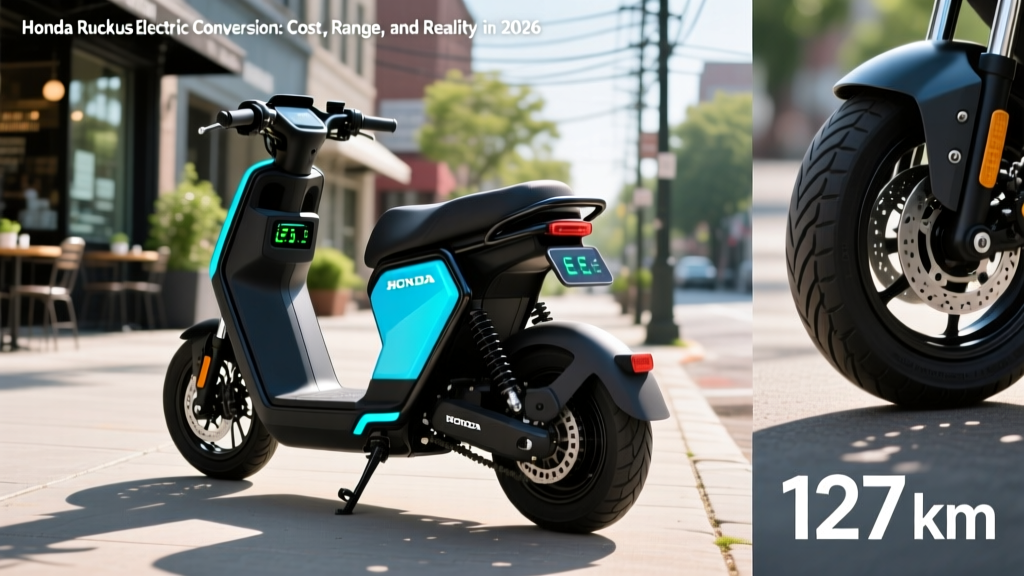
If you own a Honda Ruckus (also known as the Zoomer) and want to go electric, a DIY electric conversion typically costs $1,800 to $4,500 in parts, yields 20 to 45 miles of real-world range depending on battery size, and requires basic mechanical and electrical skills. Most conversions use a hub motor or mid-drive kit paired with a 48V or 72V lithium battery pack. Charging takes 3 to 6 hours on a standard 120V outlet. There is no factory electric Ruckus from Honda as of 2026, so conversion or buying a purpose-built electric scooter are your only paths to an electrified Ruckus experience.
Quick Answer
Cost: $1,800–$4,500 (parts only; professional install adds $500–$1,500)
Range: 20–45 miles (real-world, depends on battery kWh and riding style)
Top speed: 30–45 mph post-conversion (vs. ~38 mph stock gas)
Charge time: 3–6 hours on 120V
Legal status: Varies by state — may require re-registration as an electric motorcycle
Why Convert a Honda Ruckus to Electric?
The Honda Ruckus has a cult following for its rugged, minimalist design and reliable 49cc four-stroke engine. But that engine gets roughly 80–100 MPG and produces only 4.5 horsepower. For riders tired of carburetor maintenance, fuel costs, noise, and emissions — or those who want the instant torque that electric motors deliver — a conversion is appealing.
The Ruckus is also one of the most popular scooter platforms for electric conversion because:
- The frame is simple and spacious, with room under the seat and floorboard for batteries
- The CVT transmission can be retained or removed depending on the motor type
- A large aftermarket community has documented dozens of successful builds
- The scooter's low top speed (under 45 mph) means conversion kits don't need expensive high-power components
Conversion Cost Breakdown: What You'll Actually Spend
Here's a realistic parts and labor breakdown based on common 2024–2026 build configurations using widely available kits from suppliers like Golden Motor, QS Motor, and various e-bike conversion vendors:
| Component | Budget Build (48V) | Premium Build (72V) |
|---|---|---|
| Hub motor or mid-drive kit | $350–$600 | $600–$1,200 |
| Lithium battery pack (LiFePO4 or NMC) | $500–$900 (1.5–2 kWh) | $900–$1,800 (2.5–4 kWh) |
| Motor controller | $80–$150 | $150–$350 |
| Charger (120V) | $60–$120 | $100–$200 |
| Throttle, wiring, connectors, DC-DC converter | $100–$200 | $150–$300 |
| Instrumentation (speedometer, battery gauge) | $40–$80 | $80–$150 |
| Miscellaneous (mounts, fabrication) | $50–$150 | $100–$400 |
| Total parts | $1,180–$2,200 | $2,080–$4,400 |
| Professional installation (optional) | $500–$1,000 | $800–$1,500 |
For context, a used Honda Ruckus in good condition runs $2,500–$4,000 in 2026. So total project cost (scooter + conversion) typically lands between $3,700 and $8,500.
Range and Performance: Real Numbers, Not Marketing
Range is the single biggest variable in a Ruckus electric conversion, and it depends almost entirely on battery capacity (kWh) and your riding habits. Here's what real-world builds report:
| Battery Config | Usable Energy | Estimated Range (city, 25 mph) | Estimated Range (mixed, 35 mph) |
|---|---|---|---|
| 48V 30Ah (LiFePO4) | ~1.2 kWh usable | 20–25 miles | 15–18 miles |
| 48V 50Ah (NMC) | ~2.1 kWh usable | 35–40 miles | 25–30 miles |
| 72V 40Ah (NMC) | ~2.5 kWh usable | 40–45 miles | 30–35 miles |
| 72V 60Ah (NMC) | ~3.8 kWh usable | 55–65 miles | 45–50 miles |
Battery chemistry matters: LiFePO4 (LFP) cells are heavier but last 2,000+ cycles and are thermally stable. NMC cells offer higher energy density (lighter, more range in the same space) but typically deliver 800–1,200 cycles and require more careful thermal management. For a scooter where weight is less critical than in a car, LFP is often the smarter long-term choice.
Performance gains are real. A stock 49cc Ruckus produces ~4.5 HP and tops out around 38 mph. A typical 48V/1500W hub motor conversion delivers the equivalent of ~2 HP but with instant peak torque, meaning acceleration from 0–25 mph feels noticeably quicker than the gas engine. A 72V/3000W setup delivers ~4 HP equivalent with substantially better hill-climbing ability and a top speed of 40–45 mph.
Real-World Range Reality Check
Advertised ranges from kit sellers assume flat terrain, 150-lb rider, 20 mph cruising. Add hills, a passenger, cold weather (below 50°F reduces lithium battery output by 10–20%), or aggressive throttle use, and expect to lose 20–35% from the best-case range figures above.
EV Conversion vs. Gas Ruckus vs. Purpose-Built Electric Scooter
The decision isn't just "convert or don't convert." You're actually choosing between three paths:
| Factor | Gas Ruckus (49cc) | Ruckus EV Conversion | Purpose-Built EV Scooter (e.g., NIU NQi+, Super73) |
|---|---|---|---|
| Total cost (vehicle + powertrain) | $3,000–$4,500 (used/new) | $3,700–$8,500 | $3,500–$7,000 |
| Range | 120–150 mi (2.4-gal tank) | 20–50 mi (battery dependent) | 30–70 mi |
| Top speed | ~38 mph | 30–45 mph | 28–55 mph |
| Energy cost per mile | ~$0.025 (at 90 MPG, $3.50/gal) | ~$0.005 (at $0.15/kWh) | ~$0.005 |
| Annual maintenance | $150–$300 (oil, belt, carb) | $20–$50 (tires, brakes) | $20–$50 |
| Fueling/charging time | 2 min (gas station) | 3–6 hours (120V) | 3–7 hours |
| Reliability / support | Excellent (Honda dealer network) | DIY-dependent | Warranty-backed |
| Resale value | Strong ($2,000–$3,500) | Weak (nicety market) | Moderate |
The gas Ruckus wins on range and simplicity. The conversion wins on customizability and the satisfaction of building something unique. A purpose-built electric scooter wins on warranty, reliability, and not spending weekends troubleshooting a controller wiring harness.
Ownership Realities: Charging, Registration, and Insurance
Home Charging
Most Ruckus conversions charge on a standard 120V household outlet using a dedicated lithium battery charger (typically 3–5 amps). You need access to an outlet near where you park — a garage or covered patio is ideal. If you live in an apartment without ground-floor outlet access, charging becomes a serious logistical problem. There is no public charging infrastructure designed for electric scooters.
Charging cost: A 2.5 kWh battery pack costs roughly $0.38 to fully charge at the US average electricity rate of $0.15/kWh. Over a year of daily 20-mile commutes (5,000 miles), you'd spend approximately $75 in electricity versus $195 in gasoline for the stock Ruckus at 90 MPG.
Registration and Legal Status
This is where many conversion projects hit a wall. After converting a gas Ruckus to electric:
- Your state DMV may require re-registration, as the powertrain type has changed
- Some states classify electric scooters above 1,500W as motorcycles, requiring a motorcycle endorsement, plate, and insurance
- Emissions inspections (where applicable) become irrelevant, but safety inspections may flag non-OEM modifications
- Your VIN remains valid, but the engine number no longer matches Honda's records
Check your state's specific requirements before starting a build. States like California, Texas, and New York have different rules for electric-converted vehicles, and local enforcement varies widely.
Insurance
Most standard scooter insurance policies won't cover a converted vehicle without notification. Expect to pay $150–$400/year for liability coverage on a converted scooter, and comprehensive coverage may be denied or limited due to the non-OEM powertrain.
Tax Credits and Incentives: What You Can (and Can't) Claim
The federal §30D clean vehicle tax credit applies to new qualified plug-in electric vehicles purchased from a manufacturer — not to DIY conversions. You cannot claim the $2,500–$7,500 credit for converting an existing Ruckus.
However, some states and local utilities offer rebates for electric two-wheelers or e-bikes. Check your state energy office and local utility for programs that might cover part of a battery purchase. A few municipalities have offered $200–$500 e-bike/e-scooter incentives, though these typically require purchasing a complete vehicle from an approved vendor, not a conversion.
Federal Tax Credit Eligibility for EV Conversions
- ❌ DIY conversions do NOT qualify for §30D federal tax credit
- ❌ The credit requires a new vehicle with a manufacturer's certificate of origin
- ❌ Battery component purchases alone are not eligible
- ✅ Some state/local e-bike rebate programs may partially apply
- ✅ Commercial conversion businesses selling complete vehicles may qualify if they meet manufacturer certification requirements
Common Misconceptions About Ruckus Electric Conversions
| Myth | Fact |
|---|---|
| "It'll go 100 miles on a charge" | Achieving 100 miles requires a 5+ kWh battery pack that won't physically fit in a Ruckus frame without extensive fabrication. Realistic max is ~50–65 miles with a large 72V pack. |
| "I can use the stock CVT with an electric motor" | Some mid-drive builds retain the CVT, but most hub motor conversions eliminate it entirely. Electric motors don't need a transmission — they produce maximum torque at zero RPM. |
| "Any e-bike kit will work" | E-bike kits rated for bicycles (250–750W) are underpowered for a 200+ lb scooter. You need a kit rated for at least 1,500W continuous / 3,000W peak to get acceptable performance. |
| "It's completely maintenance-free" | You still have tires, brakes, suspension, and steering head bearings to maintain. The battery also needs care — don't store it at 100% or 0% SoC for extended periods, and keep it above freezing when charging. |
| "I'll save thousands vs. buying new" | After adding scooter cost + conversion parts + labor + registration headaches, total cost often equals or exceeds a purpose-built electric scooter that comes with a warranty. |
Decision Framework: Should You Convert?
If-Then Decision Guide
Convert your Ruckus to electric IF:
- You already own a Ruckus and want a fun, educational project
- You have garage space with a 120V outlet for daily charging
- Your daily riding is under 25 miles round-trip
- You're comfortable with basic wiring, mechanical work, and troubleshooting
- You value the uniqueness of a custom build over warranty coverage
- You live in a state with straightforward re-registration for converted vehicles
Buy a purpose-built electric scooter INSTEAD IF:
- You want reliable daily transportation with warranty support
- You don't have mechanical/electrical DIY skills or interest
- You need 40+ miles of guaranteed range year-round
- You want financing options (most lenders won't finance a conversion project)
- Resale value matters to you
Keep your gas Ruckus IF:
- You regularly ride more than 50 miles in a day
- You lack access to convenient home charging
- You live in a state with complicated re-registration rules for conversions
- The scooter is your only transportation and you can't afford downtime during the build
Frequently Asked Questions
How long does a Honda Ruckus electric conversion take?
An experienced DIYer can complete a basic hub motor conversion in a weekend (15–25 hours). A first-time builder should budget 40–60 hours spread over several weekends, including troubleshooting, fabrication, and testing. Mid-drive conversions that retain or adapt the CVT typically take longer.
What's the best motor type for a Ruckus conversion?
A rear hub motor (1,500–3,000W rated) is the simplest option — it replaces the rear wheel and eliminates the need for belts, chains, or the CVT. Mid-drive setups using a QS Motor or Golden Motor unit can work but require more fabrication. Hub motors also provide regenerative braking, which adds 5–10% range back during deceleration.
Can I still carry a passenger after converting?
Yes, but range will drop 25–35% with a passenger. A 48V/2 kWh battery that delivers 30 miles solo might give you only 20 miles with a passenger. Ensure your motor controller is rated for the additional load — running an undersized controller at sustained high current with a passenger will overheat and damage it.
Is an electric Ruckus conversion street-legal?
It depends on your state and the motor's power output. In most states, a 49cc-equivalent electric scooter (under 1,500W or ~2 HP) can be registered as a moped. Above that threshold, it may require motorcycle registration, a motorcycle license endorsement, and motorcycle insurance. Check with your state DMV before purchasing parts.
How long will the conversion battery last before replacement?
An LFP (LiFePO4) battery pack typically lasts 2,000+ charge cycles before dropping to 80% capacity — that's roughly 5–8 years of daily use. NMC packs deliver 800–1,200 cycles, or about 3–5 years of daily use. Replacement cost for a 48V/30Ah pack is approximately $500–$700 in 2026.
Does regenerative braking work on a converted Ruckus?
Yes, if you use a compatible motor controller that supports regen (most modern controllers from suppliers like Kelly, Sabvoton, or Votol do). Regen braking on a scooter is modest — expect to recover about 5–10% of energy during typical stop-and-go city riding. It also reduces wear on your brake pads.
A Honda Ruckus electric conversion is a rewarding project for the right person — someone with mechanical aptitude, realistic range expectations, and a short daily commute. It won't save you money compared to keeping the gas engine running, and it won't match the convenience of a purpose-built electric scooter. But for riders who want instant torque, near-silent operation, and the pride of building their own electric machine, the Ruckus remains one of the best conversion platforms available.