The Honda Prologue arrived as Honda's first dedicated electric SUV built on General Motors' Ultium platform, and it has carved out a solid niche among midsize electric crossovers. But for buyers eyeing the Prologue as a do-it-all family hauler, one question keeps surfacing: what is the Honda Prologue's towing capacity, and is it enough for real-world use? We put the numbers to the test and broke down everything else that matters — range, charging, pricing, and how it stacks up against the Hyundai Ioniq 5 and Ford Mustang Mach-E.
Honda Prologue Towing Capacity: The Numbers
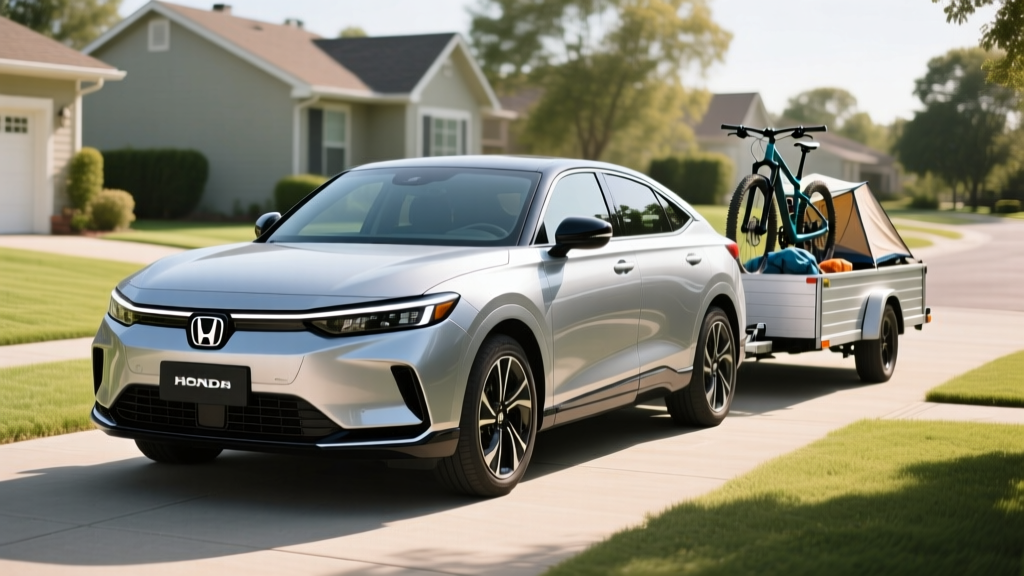
The Honda Prologue carries a maximum towing capacity of 1,500 pounds when properly equipped. This rating applies across all trims (EX, Touring, Elite) and both front-wheel-drive and all-wheel-drive configurations. You'll need the factory-installed towing package, which includes a hitch receiver and wiring harness.
| Specification | Value |
|---|---|
| Max Towing Capacity | 1,500 lbs |
| Hitch Type | Class II (dealer-installed) |
| Payload Capacity | ~970 lbs (FWD), ~950 lbs (AWD) |
| Cargo Volume (behind 2nd row) | 25.2 cu ft |
| Cargo Volume (2nd row folded) | 57.7 cu ft |
| Roof Rail Capacity | 165 lbs (with crossbars) |
What does 1,500 pounds actually get you? A small aluminum utility trailer, a pair of dirt bikes on a lightweight carrier, or a compact pop-up camper fall within range. A loaded 5×8 enclosed trailer or any boat on a single-axle trailer will likely exceed the limit. This is a light-duty towing rating — Honda engineered the Prologue for passenger comfort and efficiency first, not for heavy hauling.
Compared to competitors, the Prologue's towing sits in the middle of the pack. The Hyundai Ioniq 5 is rated at 1,650 lbs (with the optional tow package), while the Ford Mustang Mach-E offers 1,500 lbs on select trims. The Tesla Model Y leads the segment at 3,500 lbs. If towing a mid-size camper or a pair of jet skis is a priority, the Model Y remains the clear segment leader.
Range, Efficiency, and Real-World Expectations
The Prologue is offered with front-wheel drive (FWD) or all-wheel drive (AWD), and EPA range varies by drivetrain and wheel size.
| Trim / Drivetrain | EPA Range | MPGe (combined) | kWh/100 mi |
|---|---|---|---|
| EX FWD (19" wheels) | 296 mi | 99 MPGe | 34 |
| EX AWD (19" wheels) | 281 mi | 95 MPGe | 35 |
| Touring AWD (21" wheels) | 271 mi | 91 MPGe | 37 |
| Elite AWD (21" wheels) | 264 mi | 89 MPGe | 38 |
The Prologue uses a 85 kWh usable lithium-ion battery (NMC chemistry — nickel manganese cobalt) from GM's Ultium platform. NMC chemistry offers higher energy density than LFP (lithium iron phosphate), which helps keep the pack compact, but it requires more careful thermal management and benefits from not being charged to 100% daily for long-term longevity.
Charging Speed: DC Fast and Home Level 2
Charging capability is where the Prologue benefits from its GM underpinnings. The SUV supports both CCS and, via adapter, Tesla's NACS connector for access to the Supercharger network.
| Charging Type | Power | Speed / Time |
|---|---|---|
| DC Fast Charging (peak) | 150 kW (CCS/NACS) | 10-80% in ~32 minutes |
| DC Fast Charging (sustained avg) | ~110 kW | ~65 miles added in 10 min |
| Level 2 Home Charging (240V, 48A) | 11.5 kW | ~29 miles per hour of charging |
| Level 2 Home Charging (240V, 32A) | 7.7 kW | ~20 miles per hour of charging |
| Level 1 (120V outlet) | 1.4 kW | ~3.5 miles per hour |
The Prologue's DC fast-charging curve peaks at 150 kW and holds strong through roughly 50% state of charge before tapering. The 10-80% charge time of approximately 32 minutes is competitive but not class-leading — the Hyundai Ioniq 5 with its 800V architecture can do 10-80% in about 18 minutes at a 350 kW charger. For most Prologue owners charging at home overnight on Level 2, a full charge from 20% takes roughly 6-7 hours at 11.5 kW, which is practical for daily use.
Honda includes a dual-voltage portable charging cord with the Prologue that handles both 120V and 240V outlets, though installing a dedicated 48-amp Level 2 home charger (requiring a 60-amp circuit) is the recommended setup for regular owners. Budget $800-$1,500 for a quality Level 2 unit plus installation by a licensed electrician, assuming your electrical panel has capacity.
Performance and Drivetrain
The Prologue delivers smooth, adequate acceleration that prioritizes comfort over sportiness.
| Spec | FWD | AWD |
|---|---|---|
| Horsepower | 212 hp | 288 hp |
| Torque | 236 lb-ft | 333 lb-ft |
| 0-60 mph | ~7.2 seconds | ~5.9 seconds |
| Drivetrain | Single motor (front) | Dual motor |
| Drive Modes | Normal, Sport, Econ, Snow | Normal, Sport, Econ, Snow |
The AWD model's 288 hp and 5.9-second 0-60 time make it genuinely quick off the line — useful for highway merging and passing. The FWD version's 7.2-second time is perfectly adequate for commuting. Regenerative braking offers adjustable levels via steering-wheel paddles, allowing a near one-pedal driving experience at the strongest setting. The ride quality is composed and quiet, with Honda clearly tuning for comfort over the firm, sporty feel of some rivals.
Interior, Cargo, and Technology
Inside, the Prologue feels like a modern Honda with a few GM-sourced switchgear elements. The cabin is spacious, with genuine midsize-SUV room for five adults.
| Measurement | Value |
|---|---|
| Front Legroom | 41.4 in |
| Rear Legroom | 37.9 in |
| Front Headroom | 39.6 in |
| Rear Headroom | 38.2 in |
| Cargo (rear seats up) | 25.2 cu ft |
| Cargo (rear seats folded) | 57.7 cu ft |
The infotainment system runs on an 11.3-inch touchscreen (standard on all trims) with wireless Apple CarPlay and Android Auto. Google Built-in is available on Touring and Elite trims, giving you native Google Maps, Google Assistant, and Play Store apps. Honda's Honda Sensing suite of driver-assistance features is standard across all trims, including adaptive cruise control, lane-keeping assist, automatic emergency braking, and traffic-sign recognition. This is an SAE Level 2 system — it assists with steering and speed but requires continuous driver attention and is not self-driving.
Notable tech drawbacks: the Prologue lacks a front trunk (frunk), which reduces total cargo utility compared to the Ioniq 5 and Model Y. The center console storage is modest, and the GM-sourced shifter and some interior buttons feel slightly out of place in a Honda cabin. Wireless phone charging is standard on Touring and Elite but absent on the base EX.
Pricing, Trims, and Federal Tax Credit
The Prologue is positioned as a mainstream-priced electric SUV. Here's how the lineup breaks down for the current model year:
| Trim | Drivetrain | MSRP (incl. destination) |
|---|---|---|
| EX | FWD | $48,795 |
| EX | AWD | $50,795 |
| Touring | AWD | $56,295 |
| Elite | AWD | $59,295 |
Does the Honda Prologue Qualify for the Federal EV Tax Credit?
The Prologue is assembled at GM's Spring Hill, Tennessee plant, and its battery sourcing has been structured to meet IRS §30D requirements. As of the current tax year, the Prologue qualifies for the up to $7,500 federal tax credit, available as a point-of-sale transfer to the dealer (reducing your purchase price at signing) or as a credit on your tax return.
| Requirement | Prologue Status |
|---|---|
| MSRP Cap (SUVs: ≤$80,000) | ✅ All trims qualify |
| Buyer Income Cap (MFJ: ≤$300,000 AGI) | ⚠️ Varies by buyer |
| North American Assembly | ✅ Assembled in Tennessee |
| Battery Component Sourcing | ✅ Meets current thresholds |
| Critical Minerals Sourcing | ✅ Meets current thresholds |
Important: Tax credit eligibility depends on your individual income, the specific battery batch in your vehicle, and any rule changes. Always verify current eligibility on fueleconomy.gov and consult a tax professional before relying on the credit for your purchase budget.
Warranty Coverage
Honda backs the Prologue with its standard warranty structure, plus extended coverage for the high-voltage battery:
| Coverage | Term |
|---|---|
| Basic (bumper-to-bumper) | 3 years / 36,000 miles |
| Powertrain | 5 years / 60,000 miles |
| High-Voltage Battery | 8 years / 100,000 miles |
| Battery Capacity Retention | ≥70% of original capacity during warranty term |
| Roadside Assistance | 3 years / 36,000 miles |
The 8-year/100,000-mile battery warranty with a 70% capacity-retention threshold is standard for the segment. Honda's NMC battery chemistry, combined with active thermal management from the Ultium platform, should deliver solid long-term durability. As with all EVs, avoid habitual DC fast charging to 100% and try to keep daily charging between 20-80% for optimal battery health.
Pros, Cons, and Who Should Buy
Pros
- Spacious cabin with generous rear-seat legroom (37.9 in)
- Smooth, quiet ride quality tuned for comfort
- Qualifies for up to $7,500 federal tax credit
- Standard Honda Sensing driver-assist suite on all trims
- NACS adapter compatibility for Tesla Supercharger access
- Competitive starting price in the midsize EV SUV segment
Cons
- Towing limited to 1,500 lbs — below Model Y's 3,500-lb rating
- No front trunk (frunk) for additional cargo
- DC fast-charging speed (150 kW peak) trails Ioniq 5's 800V system
- Some GM-sourced interior components feel out of place
- AWD range drops to 264-281 mi depending on trim and wheels
- Wireless phone charging not standard on base EX trim
Who the Prologue Suits Best
The Honda Prologue is ideal for families and commuters who want a comfortable, spacious electric SUV with strong brand reliability and don't need heavy towing capability. If your towing needs are limited to a small utility trailer, bike rack, or lightweight camper, the 1,500-lb rating is sufficient. If you regularly tow a boat, large camper, or horse trailer, look at the Tesla Model Y or a body-on-frame electric truck instead.
The Prologue also makes sense for Honda loyalists transitioning to electric who value dealer familiarity, Honda Sensing safety tech, and a straightforward ownership experience. Road-trippers should note the 296-mile max range and 32-minute fast-charge times — workable for most routes, but plan charging stops accordingly on longer drives.
How It Compares: Prologue vs. Key Rivals
| Spec | Honda Prologue AWD | Hyundai Ioniq 5 AWD | Ford Mustang Mach-E AWD | Tesla Model Y LR AWD |
|---|---|---|---|---|
| EPA Range | 271-281 mi | 290 mi | 275-312 mi | 310 mi |
| Battery (usable) | 85 kWh | 77.4 kWh | 91 kWh (ext.) | ~75 kWh |
| DC Fast Charge (peak) | 150 kW | 235 kW | 150 kW | 250 kW |
| 10-80% Time | ~32 min | ~18 min | ~36 min | ~25 min |
| 0-60 mph | 5.9 sec | 5.0 sec | 5.1 sec (GT) | 4.8 sec |
| Towing Capacity | 1,500 lbs | 1,650 lbs | 1,500 lbs | 3,500 lbs |
| Cargo (rear up) | 25.2 cu ft | 27.2 cu ft | 29.7 cu ft | 30.2 cu ft |
| Starting MSRP (AWD) | $50,795 | $50,900 | $48,995 | $49,630 |
| Federal Tax Credit | Up to $7,500 | Up to $7,500 | Up to $7,500 | Up to $7,500 |
The Prologue holds its own on price and comfort, but it trails on charging speed, cargo space, and towing. The Ioniq 5 charges significantly faster thanks to its 800V architecture. The Model Y offers the best range, fastest Supercharger access, and double the towing capacity. The Prologue's edge lies in its Honda brand cachet, ride comfort, and straightforward ownership experience at established Honda dealerships.
Frequently Asked Questions
Can the Honda Prologue tow a small camper or boat trailer?
Yes, within its 1,500-pound limit. A lightweight pop-up camper (typically 1,000-1,400 lbs dry) or a small aluminum boat on a single-axle trailer (under 1,200 lbs combined) is feasible. Heavier travel trailers, enclosed car haulers, or larger boats exceed the Prologue's rating. Always confirm the loaded weight of your trailer — cargo, water, and fuel add up quickly.
Does the AWD Prologue tow more than the FWD version?
No. Honda rates both the FWD and AWD Prologue at the same 1,500-pound maximum. AWD provides better traction when starting from a stop on wet or slippery surfaces with a trailer, but it does not increase the rated capacity.
What is the real-world highway range of the Honda Prologue?
The EPA rates the FWD Prologue EX at 296 miles combined, but sustained highway driving at 70-75 mph typically yields 250-265 miles. AWD trims with 21-inch wheels return roughly 235-250 miles in real-world highway conditions. Cold weather (below 30°F) can reduce range by 15-25% depending on cabin heating use and driving style.
How fast does the Prologue charge at home on Level 2?
On a 48-amp Level 2 charger (11.5 kW), the Prologue adds approximately 29 miles of range per hour. A full charge from 20% to 100% takes about 6-7 hours. On a 32-amp circuit (7.7 kW), that drops to roughly 20 miles per hour. Most owners charging overnight will wake to a full battery.
Is the Honda Prologue worth buying over the Tesla Model Y?
It depends on your priorities. The Prologue wins on ride comfort, Honda dealer service familiarity, and a more traditional SUV interior layout. The Model Y wins on range (310 mi), charging speed (250 kW peak), towing (3,500 lbs), cargo space, and Supercharger network access. If towing and road-trip efficiency matter most, the Model Y is the stronger pick. If comfort, brand trust, and a conventional ownership experience matter more, the Prologue is a compelling alternative.
Does the Prologue have a frunk (front trunk)?
No. Unlike the Ioniq 5, Model Y, and Mach-E, the Prologue does not have a front trunk. All cargo space is in the rear (25.2 cu ft with seats up, 57.7 cu ft folded). This is a notable omission for an EV and slightly reduces total utility.