Quick Verdict: A Spacious Two-Row EV SUV With Familiar Honda DNA
The Honda Prologue is Honda's first mass-market electric SUV, built on General Motors' Ultium platform and sharing its bones with the Chevrolet Blazer EV and Cadillac Lyriq. For families researching the Honda Prologue seating capacity, the answer is straightforward: it accommodates five passengers across two rows — no third-row option is available. That two-row layout is deliberate, prioritizing rear-seat legroom and cargo volume over maximum passenger count.
With an EPA-estimated range up to 308 miles, DC fast charging peaking at 155 kW, and a starting MSRP around $47,400 (before incentives), the Prologue targets the midsize electric SUV segment occupied by the Hyundai Ioniq 5, Ford Mustang Mach-E, and Tesla Model Y. It's best suited for families and commuters who value Honda's dealer network, straightforward infotainment, and a comfortable ride over cutting-edge performance or autonomous-driving aspirations.
Honda Prologue Specs at a Glance
| Spec | EX (FWD) | Touring (AWD) |
|---|---|---|
| EPA Range | 308 mi | 283 mi |
| Battery (usable) | 85 kWh, NMC (Ultium) | |
| Motor / Drivetrain | Single motor, FWD | Dual motor, AWD |
| Horsepower | 212 hp | 288 hp |
| Torque | 236 lb-ft | 333 lb-ft |
| 0-60 mph | ~8.0 sec | ~6.2 sec |
| Max DC Fast Charge | 155 kW (CCS1) | |
| 10-80% DCFC Time | ~35 min | |
| Level 2 Home Charge | 11.5 kW (~32 mi/hr) | |
| MPGe (combined) | 101 MPGe | 94 MPGe |
| Efficiency | 33 kWh/100 mi | 36 kWh/100 mi |
| Seating Capacity | 5 passengers (2 rows) | |
| Cargo (rear seats up) | 25.2 cu ft | |
| Cargo (rear seats folded) | 57.7 cu ft | |
| Base MSRP | $47,400 | $57,900 |
| Battery Warranty | 8 yr / 100,000 mi | |
Seating Capacity and Interior Dimensions
The Honda Prologue seats five passengers in a two-row configuration. Honda opted against a third row, which keeps the vehicle's footprint manageable while maximizing comfort for the occupants it does carry. Here's how the interior space breaks down:
- Front headroom: 40.0 inches
- Front legroom: 41.4 inches
- Rear headroom: 38.4 inches
- Rear legroom: 39.4 inches
- Front shoulder room: 59.8 inches
- Rear shoulder room: 58.6 inches
- Rear hip room: 54.0 inches
For context, the Prologue's rear legroom (39.4 inches) edges out the Hyundai Ioniq 5 (39.4 in.) and significantly beats the Tesla Model Y (36.5 in. estimated). Two adults will find the rear seats genuinely comfortable on long drives, and two rear-facing child seats fit without requiring the front seats to slide uncomfortably forward. A middle rear seat exists, but the transmission tunnel — a legacy of the shared GM platform — creates a floor hump that makes the center position best suited for shorter trips or a child in a booster.
If you need three rows, you'll want to look at the Kia EV9 (starting around $56,000) or the Hyundai Ioniq 9. The Prologue competes strictly in the two-row midsize SUV segment.
Cargo Space and Practicality
Behind the second row, the Prologue offers 25.2 cubic feet of cargo space — enough for a week's groceries, two large suitcases, or a double stroller. Fold the 60/40 split rear seats and you get 57.7 cubic feet, which accommodates bulky items like a full-size bicycle (with the front wheel removed) or camping gear for a family of four.
One omission worth noting: the Prologue does not have a frunk (front trunk). The Ultium platform's packaging in this application uses that space for power electronics and HVAC components. Competitors like the Ford Mustang Mach-E (4.7 cu ft frunk) and Hyundai Ioniq 5 (0.85 cu ft) offer small front storage areas for charging cables or a laptop bag. Honda compensates with a deep center console bin and a pass-through under the floating center armrest.
Real-World Range vs. EPA Estimates
EPA Range: 308 miles (EX FWD) / 283 miles (Touring AWD)
Real-World Expectation: Expect 260-280 miles in mixed highway/city driving at 70-75 mph. In freezing temperatures (below 32°F), plan for 210-240 miles — roughly a 20-25% reduction. City-heavy driving with regenerative braking can push closer to or slightly above the EPA figure.
The Prologue's 85 kWh usable battery uses GM's Ultium NMC (nickel manganese cobalt) chemistry, which prioritizes energy density over the cycle-life longevity of LFP (lithium iron phosphate) packs found in some competitors' base trims. The 308-mile EPA figure for the FWD EX trim is competitive, but real-world highway efficiency tells a more nuanced story.
At sustained 70-75 mph speeds, the Prologue AWD Touring consumes roughly 36 kWh per 100 miles (per fueleconomy.gov). That translates to approximately 235-250 miles before you'll want to stop and charge — important for road-trip planning. The FWD EX is more efficient at 33 kWh/100 mi, stretching highway range closer to 270 miles.
Cold weather is the Prologue's kryptonetic. Unlike some competitors, the Prologue lacks a dedicated heat-pump HVAC system (it uses a resistive heater supplemented by a heat pump in some conditions, depending on trim). In sub-freezing testing, range losses of 20-25% are typical. If you live in the Upper Midwest or Northeast and commute more than 80 miles round-trip in winter, factor this into your calculations.
Charging Speed: DC Fast Charging and Home Level 2
Charging capability is where the Prologue is adequate but not class-leading. Here's the full breakdown:
| Charging Level | Power | Speed / Time | Connector |
|---|---|---|---|
| Level 1 (120V outlet) | ~1.4 kW | ~4 mi/hr | J1772 |
| Level 2 (240V home) | 11.5 kW | ~32 mi/hr (9.5 hr full charge) | J1772 |
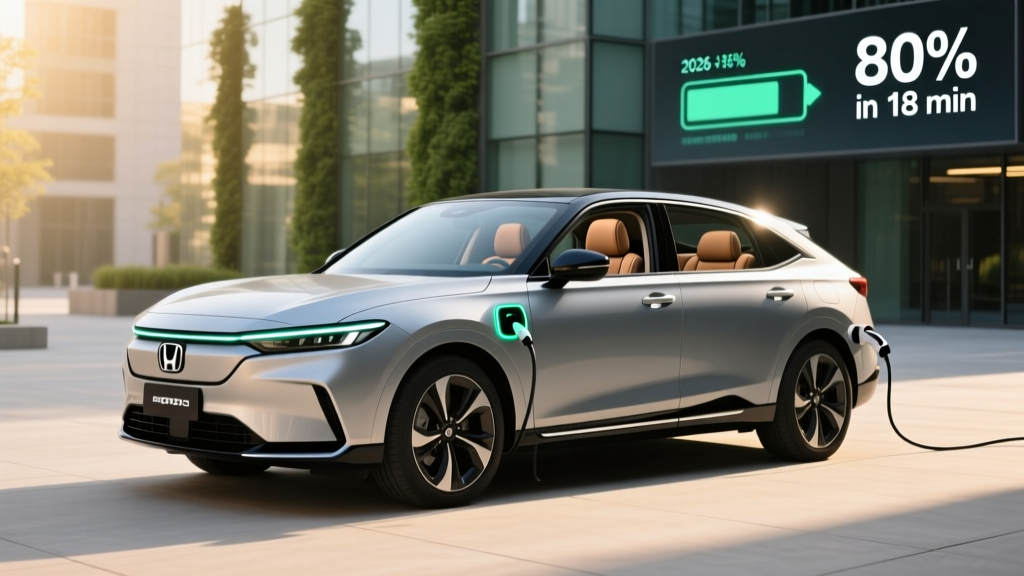
| DC Fast Charge | 155 kW peak | 10-80% in ~35 min | CCS1 |
The Prologue uses a CCS1 connector for DC fast charging. Honda does not currently offer a NACS (Tesla-style) native port, though the included adapter allows access to Tesla Supercharger V3/V4 stalls (which now support CCS via Magic Dock at many locations, or through Honda's included adapter). This is a practical workaround but less seamless than vehicles with native NACS ports like the Ford Mustang Mach-E or Rivian R1S.
At 155 kW peak DC charging, the Prologue adds roughly 65 miles of range in 10 minutes under ideal conditions. The charge curve tapers noticeably above 80% state of charge (SoC), which is standard for NMC batteries but means the 10-80% time of approximately 35 minutes is realistic while 10-90% stretches closer to 50 minutes. For comparison, the Hyundai Ioniq 5 peaks at 240 kW and achieves 10-80% in about 18 minutes on a 350 kW charger.
For home charging, the 11.5 kW onboard charger is a strong point. A 48-amp Level 2 wallbox (hardwired, 60-amp circuit) will replenish the Prologue from empty to full in roughly 9.5 hours — easily enough to recharge overnight on a standard overnight electricity rate. Expect home installation costs of $800-$2,000 for a quality Level 2 charger (ChargePoint Home Flex, Emporia Vue, or Grizzl-E) plus electrician labor, depending on your panel capacity and run distance.
Performance, Ride, and Drivetrain
The Prologue's powertrain options are straightforward:
- EX/EX-L (FWD): Single front motor, 212 hp, 236 lb-ft. 0-60 mph in approximately 8.0 seconds.
- Touring (AWD): Dual motor, 288 hp, 333 lb-ft. 0-60 mph in approximately 6.2 seconds.
The AWD Touring model delivers genuinely brisk acceleration that makes highway merging and passing effortless. The FWD version is adequate for commuting but feels leisurely when fully loaded with passengers and cargo. Neither variant is sporty — the Prologue is tuned for comfort, with a compliant ride that soaks up potholes and expansion joints better than the firmer-sprung Ioniq 5 or Model Y.
Steering is light and precise, typical of Honda, though it lacks the feedback enthusiasts might want. The regenerative braking system offers adjustable levels via steering-wheel paddles, but it doesn't achieve true one-pedal driving at its maximum setting — you'll still need the friction brake for a complete stop. This is a deliberate Honda choice, and some drivers prefer the more aggressive regen of competitors like the Chevrolet Equinox EV.
Pricing, Trims, and Federal Tax Credit Eligibility
The 2026 Honda Prologue is available in three trims:
| Trim | Drivetrain | MSRP | Key Features |
|---|---|---|---|
| EX | FWD | $47,400 | 19" wheels, 11.3" touchscreen, Honda Sensing suite, heated front seats |
| EX-L | AWD | $51,400 | Leather seats, power liftgate, wireless charging, 12-speaker audio |
| Touring | AWD | $57,900 | 21" wheels, panoramic roof, head-up display, Bose premium audio |
Federal EV Tax Credit (§30D) — Current Rules:
- MSRP cap: SUVs must be ≤ $80,000 MSRP. All Prologue trims qualify.
- Buyer income cap: AGI ≤ $150,000 (single), $225,000 (head of household), $300,000 (joint).
- Battery sourcing: Critical minerals and battery components must meet phased-in domestic/free-trade sourcing thresholds. Honda's Ultium battery sourcing has improved since launch, but verify current-year eligibility on IRS.gov before purchase.
- Point-of-sale transfer: Eligible buyers can transfer the credit to the dealer for an immediate price reduction at purchase.
- Maximum credit: Up to $7,500 if both critical-mineral and battery-component requirements are met; $3,750 if only one is satisfied.
Eligibility rules change frequently. Consult a tax professional and verify on IRS.gov before relying on credit amounts for purchase decisions.
With the full $7,500 credit applied, the Prologue EX effectively starts near $39,900 — making it one of the more affordable ways into a new midsize electric SUV with 300+ miles of range. However, the Touring trim at $57,900 (roughly $50,400 after credit) enters territory occupied by well-equipped Hyundai Ioniq 5 Limited models and Tesla Model Y Long Range variants.
Tech, Safety, and Driver Assistance
The Prologue runs Honda's latest infotainment system on an 11.3-inch touchscreen (EX/EX-L) or an upgraded Google Built-in system with native Google Maps and Google Assistant on the Touring trim. Wireless Apple CarPlay and Android Auto are standard across all trims. The system is responsive and logical — a hallmark of Honda's recent interior design — though it lacks the expansive screen real estate of the Hyundai Ioniq 5's dual 12.3-inch displays.
Honda Sensing, the brand's driver-assistance suite, is standard and includes:
- Adaptive cruise control with stop-and-go
- Lane-keeping assist and road-departure mitigation
- Collision mitigation braking
- Blind-spot monitoring with rear cross-traffic alert
- Traffic-sign recognition
SAE Automation Level: Honda Sensing is a Level 2 driver-assistance system per SAE International standards. The driver must remain fully engaged, hands on the wheel, and eyes on the road at all times. This is not autonomous or self-driving capability.
The Prologue does not offer a hands-free highway driving system like GM's Super Cruise (available on the Chevrolet Blazer EV and Cadillac Lyriq, which share the Prologue's platform). This is a missed opportunity given the platform's capability, and it puts the Prologue behind the Ford Mustang Mach-E (BlueCruise) and Hyundai Ioniq 5 (no hands-free, but more advanced lane-centering) in driver-assist sophistication.
Safety ratings are strong. The Prologue earned a 5-star overall rating from NHTSA and is an IIHS Top Safety Pick when equipped with specific headlights, making it one of the safest choices in the segment.
Pros and Cons
Pros
- Comfortable, spacious 5-passenger cabin with generous rear legroom (39.4 in.)
- Strong 308-mile EPA range on FWD EX trim
- Competitive pricing, especially after §30D tax credit
- Honda dealer network and strong resale value reputation
- 11.5 kW Level 2 charging enables fast overnight replenishment
- Top safety ratings (NHTSA 5-star, IIHS Top Safety Pick)
- Smooth, compliant ride quality ideal for families
Cons
- No frunk — a notable omission for an EV
- 155 kW peak DC charging is slower than key competitors (Ioniq 5: 240 kW)
- No hands-free driving assist (Super Cruise not available despite GM platform)
- CCS1 connector requires adapter for Tesla Supercharger access
- Cold-weather range loss of 20-25% is above average for the segment
- FWD base model feels underpowered for the vehicle's weight
- No third-row option for larger families
Who Should Buy the Honda Prologue?
Choose the Honda Prologue if:
- You want a comfortable, safety-focused two-row electric SUV with strong rear-seat space
- You value Honda's dealer network, warranty support, and brand familiarity
- Your daily commute is under 80 miles round-trip and you can charge at home
- You qualify for the §30D tax credit, bringing the EX trim near $40,000
- You prioritize ride comfort over sporty handling or rapid DC charging
Look elsewhere if:
- You need three rows of seating (consider the Kia EV9)
- You take frequent long road trips and want the fastest possible DC charging (Hyundai Ioniq 5 or Kia EV6)
- You want hands-free highway driving (Ford Mustang Mach-E with BlueCruise, or Chevy Blazer EV with Super Cruise)
- You need a frunk for charging cable storage or a front cargo area
- You live in an extremely cold climate and need minimal winter range loss (consider a heat-pump-equipped model like the Ioniq 5)
Frequently Asked Questions
What is the Honda Prologue seating capacity?
The Honda Prologue seats five passengers across two rows. There is no third-row option. Rear-seat legroom is a generous 39.4 inches, making it comfortable for adults on long trips and accommodating two rear-facing child seats.
What is the real-world range of the Honda Prologue?
The EPA rates the FWD Prologue EX at 308 miles and the AWD Touring at 283 miles. In real-world mixed highway driving at 70-75 mph, expect 260-280 miles (EX) or 240-260 miles (Touring). In sub-freezing temperatures, plan for a 20-25% reduction, yielding approximately 210-240 miles for the EX.
How fast does the Honda Prologue charge?
On a DC fast charger, the Prologue peaks at 155 kW and charges from 10-80% in approximately 35 minutes. At home on a Level 2 wallbox (11.5 kW), a full charge takes about 9.5 hours. On a standard 120V outlet (Level 1), expect roughly 4 miles of range per hour of charging.
Does the Honda Prologue qualify for the federal EV tax credit?
The Prologue's MSRP is below the $80,000 SUV cap, so it clears the price threshold. Buyer income limits apply (≤ $150K single, ≤ $300K joint). Battery-sourcing requirements under §30D change annually — verify current eligibility on IRS.gov before purchasing. If eligible, the credit can be up to $7,500, applied at the point of sale.
Is the Honda Prologue worth buying vs. competitors?
The Prologue is competitive on range, space, and safety, and it's a strong value after the tax credit. However, it trails the Hyundai Ioniq 5 in DC charging speed (240 kW vs. 155 kW) and lacks the hands-free driving assist of the Ford Mustang Mach-E (BlueCruise). If comfort, safety, and Honda brand loyalty are your priorities, it's an excellent choice. If fast charging and advanced driver tech matter more, test-drive the Ioniq 5 and Mach-E first.
Does the Honda Prologue have a frunk?
No. The Prologue does not have a front trunk. Cargo capacity is limited to the rear cargo area (25.2 cu ft behind the second row, 57.7 cu ft with seats folded). This is a packaging consequence of the shared GM Ultium platform.
What is the Prologue's battery warranty?
Honda covers the Prologue's high-voltage battery and electric powertrain for 8 years or 100,000 miles, whichever comes first. The battery warranty guarantees a minimum capacity retention threshold (typically 70% of original capacity, though confirm exact terms with your dealer at purchase).