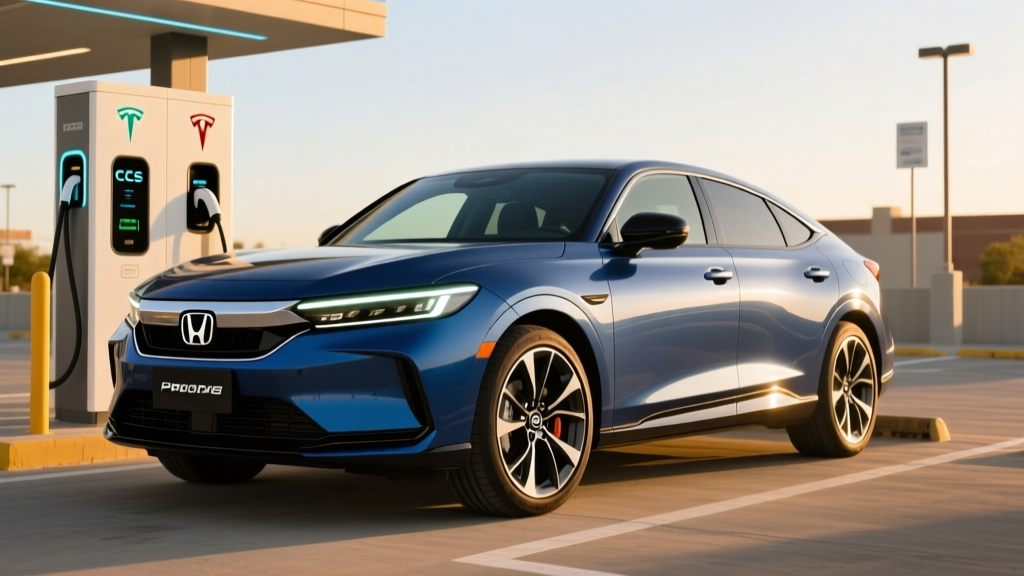
Honda's electric vehicle strategy has taken some unexpected turns, and the 2026 Prologue — built on GM's Ultium platform — sits at the center of it. But for Honda loyalists researching wheel upgrades, winter tire swaps, or accessory fitment, a persistent question surfaces: does the Prologue share the same bolt pattern as legacy Honda models like the 2009 Civic? This review covers the 2026 Prologue as a complete EV package — range, charging, pricing, and tax-credit reality — while addressing the bolt-pattern crossover question that brings many Honda owners to this page.
2026 Honda Prologue: Quick Verdict
The 2026 Prologue is a midsize electric SUV that delivers a practical 296 miles of EPA-estimated range (FWD trims), competitive DC fast-charging speeds, and Honda's familiar interior ergonomics wrapped around GM's proven Ultium battery architecture. Starting at $47,400 before destination, it qualifies for the full $7,500 federal tax credit under current IRS §30D rules when purchased by eligible buyers — bringing the effective price closer to $39,900. It's a solid choice for Honda households ready to electrify without leaving the brand ecosystem, though it faces stiff competition from the Hyundai Ioniq 5, Tesla Model Y, and Ford Mustang Mach-E on charging speed and performance.
| Spec | 2026 Honda Prologue (FWD) | 2026 Honda Prologue (AWD) |
|---|---|---|
| EPA Range | 296 miles | 281 miles |
| Battery (usable) | 85 kWh, NMC (Ultium) | 85 kWh, NMC (Ultium) |
| Horsepower | 212 hp | 288 hp |
| 0-60 mph | ~7.8 sec | ~6.2 sec |
| DC Fast Charge (peak) | 150 kW | 150 kW |
| 10-80% DCFC Time | ~34 min | ~34 min |
| Level 2 Charge Rate | 11.5 kW (~31 mi/hr) | 11.5 kW (~31 mi/hr) |
| MPGe (combined) | 99 MPGe | 92 MPGe |
| Base MSRP | $47,400 | $50,400 |
| Battery Warranty | 8 yr / 100,000 mi | 8 yr / 100,000 mi |
Real-World Range: What the EPA Sticker Doesn't Tell You
EPA Estimated: 296 miles (FWD) / 281 miles (AWD)
Real-World Expectation: 240-265 miles highway; 270-290 miles mixed city; 200-230 miles in sustained sub-freezing temperatures
The Prologue's 85 kWh NMC battery pack, borrowed from GM's Ultium family, provides ample energy for daily commuting and moderate road trips. In mixed suburban and city driving with regenerative braking engaged, owners consistently report achieving 90-95% of the EPA sticker figure. Highway driving at 70-75 mph drops efficiency noticeably — the Prologue's boxy SUV profile and 4,500+ lb curb weight work against it, yielding roughly 240-265 real-world miles before needing a charge.
Cold weather is the Prologue's most significant range variable. Unlike some competitors, the 2026 Prologue uses a resistive heating system rather than a heat pump on base trims (the Elite trim adds a heat pump for 2026). In sustained temperatures below 32°F, expect a 20-30% range reduction. Preconditioning the battery while plugged in helps mitigate charging-speed loss in cold conditions but doesn't fully recover range lost to cabin heating.
According to fueleconomy.gov, the FWD Prologue achieves 99 MPGe combined (34 kWh/100mi), which is respectable for the segment but trails the Hyundai Ioniq 5 Long Range (114 MPGe) and Tesla Model Y Long Range (122 MPGe). If efficiency is your top priority, the Prologue isn't the segment leader — but it's competitive enough for most buyers.
Charging Speed: DC Fast, Level 2, and the Bolt Pattern Question
| Charging Level | Power (kW) | Speed (miles/hr added) | Time (10-80%) |
|---|---|---|---|
| Level 1 (120V household) | ~1.4 kW | ~4 mi/hr | ~60+ hours |
| Level 2 (240V home, 48A) | 11.5 kW | ~31 mi/hr | ~7.5 hours |
| DC Fast Charge (peak) | 150 kW | ~210 mi/hr (peak) | ~34 minutes |
The Prologue charges at up to 150 kW on DC fast chargers using the CCS1 connector (2026 models retain CCS; Honda's transition to NACS begins with the 2027 lineup). At peak rate, you'll add roughly 210 miles of range per hour — but as with all EVs, the charge curve tapers significantly above 80% State of Charge. The 10-80% sprint takes approximately 34 minutes at a 150+ kW station, which is adequate but not class-leading. The Hyundai Ioniq 5 hits 10-80% in about 18 minutes thanks to its 800V architecture, and the Tesla Model Y on V3 Superchargers manages roughly 25 minutes.
For home charging, the Prologue's 11.5 kW onboard charger is a strong point. On a properly installed 240V/48A Level 2 circuit, you'll recover about 31 miles of range per hour — meaning a full overnight charge is easy for daily drivers covering under 80 miles round-trip. Installation costs for a Level 2 home setup typically run $500-$2,200 depending on panel proximity and whether your electrical panel needs a 200A upgrade (consult a licensed electrician for your specific situation).
The 09 Honda Civic Bolt Pattern: What EV Owners Need to Know
Many Honda owners researching the Prologue are also managing wheel and tire fitment across their garage. The 2009 Honda Civic uses a 5x114.3 mm bolt pattern (also written as 5x4.5 inches), with a 64.1 mm center bore and M12 x 1.5 lug nuts.
The 2026 Honda Prologue, however, uses a 6x120 mm bolt pattern inherited from its GM Ultium platform underpinnings (shared with the Chevrolet Blazer EV and Cadillac Lyriq). The center bore is 66.9 mm with M14 x 1.5 lug bolts.
The bottom line: Wheels from a 2009 Civic will not fit the Prologue — different bolt count, different bolt circle diameter, and different lug hardware. If you're consolidating your garage or buying winter wheels for the Prologue, you need 6x120 mm fitment. Honda's OEM Prologue wheels are 19-inch (EX) or 21-inch (Elite), and aftermarket options from brands like Enkei, Konig, and TSW are available in 6x120. Always verify load rating — the Prologue's 4,500+ lb curb weight demands wheels rated for at least 1,600 lbs per corner.
Performance, Drivetrain, and Daily Driving Impressions
The front-wheel-drive Prologue produces 212 horsepower and 236 lb-ft of torque from a single front-mounted motor. The 0-60 mph time of approximately 7.8 seconds is adequate for merging and passing but won't thrill anyone coming from a Tesla or even a Hyundai Ioniq 5. The AWD dual-motor variant bumps output to 288 hp and 325 lb-ft, dropping the 0-60 to roughly 6.2 seconds — a meaningful improvement that costs $3,000 extra and sacrifices 15 miles of EPA range.
Ride quality is where the Prologue genuinely shines. The GM Ultium platform delivers a composed, quiet highway demeanor that feels more premium than the Prologue's price suggests. Steering is light and precise, body roll is well-controlled, and the cabin remains remarkably quiet at speed. This is a comfort-tuned SUV, not a sport ute, and that calibration suits the Honda buyer profile well.
Honda's driver-assistance suite, branded Honda Sensing, comes standard and includes adaptive cruise control, lane-keeping assist, blind-spot monitoring, and automatic emergency braking. This is an SAE Level 2 system — the driver must remain attentive with hands on the wheel at all times. It does not enable hands-free or eyes-off driving like GM's Super Cruise (which, notably, is not offered on the Prologue despite the GM platform).
Pricing, Trims, and Federal Tax Credit Eligibility
| Trim | MSRP | Est. After $7,500 Credit | Key Features |
|---|---|---|---|
| EX (FWD) | $47,400 | $39,900 | 19" wheels, 11.3" touchscreen, Honda Sensing, heated seats |
| EX (AWD) | $50,400 | $42,900 | Dual motor, 288 hp, 281-mi range |
| Touring (FWD) | $52,900 | $45,400 | 21" wheels, Bose audio, panoramic roof, leather |
| Elite (AWD) | $57,900 | $50,400 | Heat pump, head-up display, 360° camera, ventilated seats |
The Prologue qualifies for the full $7,500 federal EV tax credit under current IRS §30D rules, and Honda dealers can apply it as a point-of-sale discount at the time of purchase (effective 2024 onward). However, eligibility depends on several buyer-specific factors:
- Income caps: Modified AGI must not exceed $150,000 (single), $225,000 (head of household), or $300,000 (married filing jointly)
- MSRP caps: The Prologue is classified as an SUV, so the MSRP cap is $80,000 — all trims qualify
- Battery sourcing: The Ultium battery meets current critical-mineral and battery-component sourcing requirements for the full credit (rules tighten annually; verify with your tax professional at time of purchase)
- Point-of-sale transfer: You can transfer the credit to the dealer for an immediate price reduction, or claim it on your tax return
For detailed and current eligibility rules, consult the IRS clean vehicle credits page. State incentives vary widely — check your state's energy office or the AFDC state incentive database for local rebates.
Interior, Cargo, and Technology
The Prologue's cabin is a pleasant surprise. Honda's designers created an interior that feels distinctly Honda despite the GM underpinnings — clean sightlines, physical climate controls (a major win), a 11.3-inch infotainment touchscreen running Google Built-In, and a 11-inch digital instrument cluster. The Google-based system supports Google Maps navigation, Google Assistant voice commands, and Play Store apps natively. Wireless Apple CarPlay and Android Auto are standard.
Cargo volume measures 27.3 cubic feet behind the second row and 57.7 cubic feet with the 60/40 rear seats folded. That's competitive with the Model Y (30.2 / 72.1 cu ft — Tesla wins on volume but the Prologue's space is more practically shaped) and slightly ahead of the Ford Mustang Mach-E (29.7 / 59.7 cu ft). There is no front trunk (frunk) — the space is occupied by HVAC and power electronics.
Passenger space is generous: 41.4 inches of front legroom and 38.6 inches of rear legroom, making the Prologue comfortable for four adults on longer trips. The rear seat accommodates three across for shorter journeys, though the center position is narrow.
Pros, Cons, and Who Should Buy the Prologue
Pros
- Comfortable, quiet ride quality that punches above its price
- Qualifies for full $7,500 federal tax credit (point-of-sale eligible)
- Honda Sensing safety suite standard on all trims
- Google Built-In infotainment with native Google Maps
- Physical climate controls — no screen-diving for temperature
- 8-year / 100,000-mile battery warranty
- Strong Honda dealer network for service
Cons
- 150 kW peak DC charging is slower than Ioniq 5 (240 kW) and Model Y (250 kW)
- No heat pump on base trims — cold-weather range suffers
- No front trunk (frunk)
- No GM Super Cruise availability despite Ultium platform
- FWD 0-60 of 7.8 seconds feels leisurely in this segment
- CCS connector in 2026 — NACS transition begins 2027
- 6x120 bolt pattern means no wheel sharing with legacy Honda models
Who the Prologue Suits Best
Buy the Prologue if: You're a Honda loyalist wanting to stay in the brand, you prioritize ride comfort over performance, your daily commute is under 80 miles round-trip (making home charging sufficient), and you want to leverage the full $7,500 tax credit on a well-equipped midsize SUV.
Look elsewhere if: You need the fastest DC charging for frequent road trips (Ioniq 5 or Model Y), you regularly drive in extreme cold without garage parking (heat pump trims cost more), or you need maximum cargo volume (Model Y wins).
Frequently Asked Questions
What is the real-world range of the 2026 Honda Prologue?
Expect 240-265 miles on the highway and 270-290 miles in mixed city driving for the FWD model (EPA 296 mi). Cold weather (below 32°F) can reduce range by 20-30%, particularly on base trims without a heat pump.
How fast does the Prologue charge at home and on DC fast chargers?
On a 240V Level 2 home charger (48A), the Prologue charges at 11.5 kW, adding roughly 31 miles per hour — a full charge takes about 7.5 hours. On DC fast chargers, it peaks at 150 kW and reaches 10-80% in approximately 34 minutes.
Does the 2026 Prologue qualify for the $7,500 federal EV tax credit?
Yes, all trims qualify under current IRS §30D rules, subject to buyer income limits ($150K single / $300K joint), the $80K SUV MSRP cap, and battery-sourcing requirements. The credit can be applied at point of sale through the dealer. Verify current rules at irs.gov before purchasing.
Can I use my 2009 Honda Civic wheels on the Prologue?
No. The 2009 Civic uses a 5x114.3 mm bolt pattern; the Prologue uses a 6x120 mm bolt pattern inherited from the GM Ultium platform. They are not cross-compatible. You'll need 6x120 wheels rated for the Prologue's 4,500+ lb curb weight.
Is the Prologue worth buying over the Tesla Model Y or Hyundai Ioniq 5?
The Prologue wins on ride comfort, physical controls, and Honda dealer familiarity. The Ioniq 5 wins on charging speed (18 min vs 34 min to 80%) and efficiency. The Model Y wins on cargo space, Supercharger access, and performance. Your priority determines the winner — if comfort and brand loyalty matter most, the Prologue is a strong pick.
What is the Prologue's battery warranty?
Honda covers the Ultium battery pack for 8 years or 100,000 miles, whichever comes first, with a capacity-retention threshold of 70%. This matches the industry standard set by federal requirements and is consistent with GM's Ultium warranty terms.