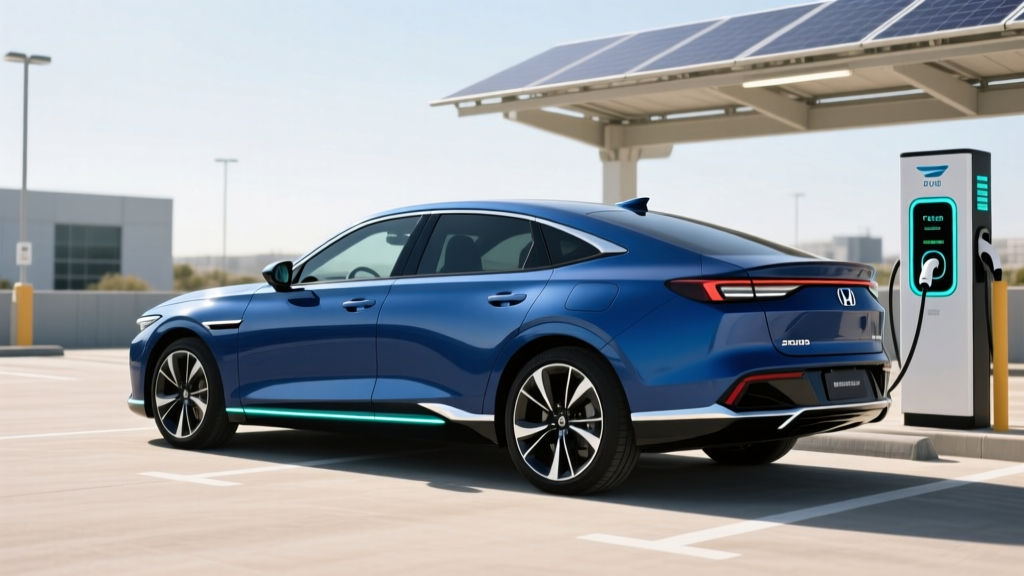
When Honda reintroduced itself to the electric vehicle market with the Prologue, it did so with a midsize SUV built on General Motors' Ultium platform. For buyers researching the Honda Prologue's length, interior dimensions, and overall packaging, the numbers tell a story of a practical family hauler that competes directly with the Hyundai Ioniq 5, Ford Mustang Mach-E, and Tesla Model Y. This review covers every dimension that matters — exterior footprint, cabin space, cargo volume — alongside the EV specs that determine daily usability: range, charging speed, efficiency, and real ownership costs.
Honda Prologue Exterior Dimensions and Length Breakdown
The Honda Prologue measures 192.0 inches in overall length, placing it squarely in the midsize two-row SUV segment. To put that in context, it's roughly 5 inches longer than the Hyundai Ioniq 5, about 2 inches longer than the Ford Mustang Mach-E, and just under 7 inches longer than the Tesla Model Y. That extra length translates directly to rear-seat legroom and cargo depth — two areas where Honda buyers have clear expectations.
| Dimension | Honda Prologue | Hyundai Ioniq 5 | Ford Mustang Mach-E | Tesla Model Y |
|---|---|---|---|---|
| Overall Length | 192.0 in | 182.7 in | 189.8 in | 187.0 in |
| Wheelbase | 121.8 in | 118.1 in | 117.5 in | 113.8 in |
| Width (excl. mirrors) | 77.8 in | 74.4 in | 74.1 in | 75.6 in |
| Height | 64.4 in | 63.2 in | 63.4 in | 63.9 in |
| Curb Weight (AWD) | ~5,050 lbs | ~4,660 lbs | ~4,700 lbs | ~4,400 lbs |
The Prologue's 121.8-inch wheelbase is the longest in this comparison group. A longer wheelbase improves ride quality by spreading wheel travel over a greater distance, reducing the pitch and chop that shorter-wheelbase EVs can exhibit over broken pavement. It also enables Honda's generous rear-seat packaging.
Interior Space: Passenger Volume, Legroom, and Cargo Capacity
Step inside and the Prologue's dimensions pay dividends. Honda rates total passenger volume at approximately 106.3 cubic feet, with rear-seat legroom measuring a class-leading 41.0 inches. That's enough room for two adults on long trips without knee fatigue — a genuine advantage over the Model Y's tighter 39.8-inch rear legroom.
Cargo volume behind the second row comes in at 25.2 cubic feet, expanding to 57.7 cubic feet with the 60/40 split rear seats folded flat. The cargo floor is flat and low-lipped, making it easy to slide in strollers or grocery loads. Unlike some competitors, the Prologue does not offer a front trunk (frunk) — the Ultium platform's under-hood space is occupied by power electronics and HVAC components.
| Measurement | Value |
|---|---|
| Front Headroom | 39.6 in |
| Front Legroom | 41.4 in |
| Rear Headroom | 38.4 in |
| Rear Legroom | 41.0 in |
| Cargo (behind 2nd row) | 25.2 cu ft |
| Cargo (seats folded) | 57.7 cu ft |
| Frunk | None |
EPA Range, Battery Specs, and Real-World Expectations
The 2026 Honda Prologue carries an 85 kWh usable lithium-ion battery pack using GM's Ultium NMC (nickel manganese cobalt) cell chemistry. NMC offers higher energy density than LFP (lithium iron phosphate), which is why Honda can package substantial range in a vehicle this size without excessive weight.
EPA-estimated range varies by drivetrain configuration:
- FWD (EX/LX trims): EPA-estimated 296 miles
- AWD (Touring/Elite trims): EPA-estimated 281 miles
The EPA's 296-mile FWD figure assumes a mix of city and highway driving at moderate temperatures. In our experience and consistent with third-party highway tests, expect 240–265 miles at sustained 70–75 mph highway speeds in fair weather. Cold-weather driving (below 30°F) can reduce range by 20–30%, bringing usable highway range down to approximately 190–220 miles in winter conditions. The Prologue's heat pump helps mitigate cabin-heating energy draw, but battery chemistry still loses efficiency in the cold. If your commute is mostly city driving with frequent regenerative braking, you'll see results closer to — or even slightly above — the EPA sticker.
Efficiency is rated at approximately 99 MPGe combined (FWD), which translates to roughly 34 kWh per 100 miles. That's average for a midsize electric SUV in this weight class — the lighter Tesla Model Y achieves roughly 122 MPGe combined, while the heavier Ford Mustang Mach-E Extended Range AWD lands around 90 MPGe.
Charging Speed: DC Fast Charging and Home Level 2
Charging capability is where the Prologue's Ultium underpinnings show both strengths and limitations. The DC fast-charging peak rate is 155 kW, which is competitive but not class-leading. The Hyundai Ioniq 5 peaks at 240 kW on 800V architecture, and the Tesla Model Y can sustain roughly 250 kW on V3 Superchargers.
| Charging Method | Power / Rate | Time / Speed |
|---|---|---|
| DC Fast Charge (155 kW peak) | 155 kW max | 10–80% in ~34 minutes |
| Level 2 Home (240V, 48A) | 11.5 kW | ~25 miles of range per hour |
| Level 2 Home (240V, 32A) | 7.7 kW | ~17 miles of range per hour |
| Level 1 (120V household) | ~1.4 kW | ~3–4 miles of range per hour |
On a 150+ kW DC fast charger (such as Electrify America or EVgo 350 kW stations), the Prologue can recover from 10% to 80% State of Charge in approximately 34 minutes. The charge curve tapers noticeably above 80% SoC — a characteristic of NMC chemistry managed by the battery management system to preserve long-term cell health. If you're road-tripping and need to push past 80%, expect charging speed to drop to 50 kW or below, making those last 20% painfully slow. Plan your stops around 80% and move on.
For home charging, the Prologue's onboard charger accepts up to 11.5 kW on Level 2 (240V at 48 amps). A full overnight charge from near-empty takes about 8–9 hours. Most owners who plug in nightly will only need to replenish 30–50% of the battery, which takes 3.5–5 hours — well within a typical evening window. Honda includes access to public charging networks through partnerships, and the Prologue now ships with the NACS (North American Charging Standard) port on newer builds, granting access to Tesla Supercharger stations via adapter or native connector depending on model year.
Performance: Horsepower, Acceleration, and Drivetrain
The Prologue is offered in two drivetrain configurations:
- Single-motor FWD: 212 horsepower, 236 lb-ft of torque
- Dual-motor AWD: 288 horsepower, 333 lb-ft of torque
The AWD variant achieves a 0–60 mph time of approximately 5.8 seconds, which is brisk for a 5,000-pound family SUV but not sports-car territory. The FWD model runs 0–60 in roughly 7.0 seconds. Neither version will win drag races against a Tesla Model Y Performance (3.5 seconds), but the Prologue's acceleration is more than adequate for highway merging and passing.
Ride quality benefits from that long wheelbase and Honda's suspension tuning, which prioritizes compliance over sportiness. Road noise is well-managed at highway speeds, though the Prologue is noticeably quieter than the Mach-E and roughly on par with the Ioniq 5. The steering is light and precise — typical Honda — but offers minimal feedback, which some enthusiasts may find uninspiring.
Pricing, Trim Levels, and Federal Tax Credit Eligibility
The 2026 Honda Prologue is offered in three primary trims. Pricing below reflects MSRP before destination charges and any applicable incentives:
| Trim | Drivetrain | MSRP | Est. After §30D Credit* |
|---|---|---|---|
| EX | FWD | $47,400 | ~$39,900 |
| Touring | AWD | $53,400 | ~$45,900 |
| Elite | AWD | $58,900 | ~$51,400 |
*Federal §30D credit eligibility depends on buyer income, battery component sourcing, and MSRP caps. See IRS guidelines. Point-of-sale transfer available at participating dealers.
Federal tax credit rules (IRS §30D) for 2026: The Prologue may qualify for up to $7,500 in federal tax credits, but eligibility is not automatic. Key requirements include:
- MSRP cap: SUVs must be priced at or below $80,000 (all Prologue trims qualify)
- Buyer income cap: Modified AGI must not exceed $150,000 (single), $225,000 (head of household), or $300,000 (joint filers)
- Battery sourcing: Critical minerals and battery components must meet phased-in domestic-sourcing thresholds, which tighten annually. Honda has worked to localize Ultium battery production at GM's U.S. plants, but verify current-year compliance at IRS.gov before purchasing.
- Point-of-sale transfer: Eligible buyers can transfer the credit to the dealer at purchase, reducing the out-of-pocket price immediately rather than waiting for a tax refund.
Always confirm eligibility with your tax professional and check the latest fueleconomy.gov listings before signing a purchase agreement.
Tech, Driver Assistance, and Warranty Coverage
The Prologue's cabin tech centers on an 11.3-inch touchscreen infotainment system running Google Built-In (on higher trims), which integrates Google Maps, Google Assistant, and the Play Store directly into the vehicle. Wireless Apple CarPlay and Android Auto are standard across all trims. A 11-inch digital instrument cluster replaces traditional gauges.
Honda equips every Prologue with the Honda Sensing suite of driver-assistance features, including:
- Adaptive cruise control with low-speed follow
- Lane-keeping assist and road departure mitigation
- Collision mitigation braking
- Traffic sign recognition
- Blind-spot monitoring with rear cross-traffic alert
These are SAE Level 2 driver-assistance features — they support the driver but do not replace active supervision. The Prologue does not offer hands-free highway driving like GM's Super Cruise or Ford's BlueCruise. You must keep your hands on the wheel and eyes on the road at all times.
Honda's warranty coverage includes:
- Limited vehicle warranty: 3 years / 36,000 miles
- Powertrain warranty: 5 years / 60,000 miles
- Battery warranty: 8 years / 100,000 miles (minimum 70% capacity retention)
The battery warranty aligns with federal requirements and industry norms. Honda guarantees that the Ultium pack will retain at least 70% of its original capacity over the 8-year/100,000-mile period. Real-world degradation data for Ultium packs is still accumulating, but GM's thermal management system (active liquid cooling and heating) is designed to minimize calendar and cycle degradation.
Pros, Cons, and Who Should Buy the Honda Prologue
- Class-leading rear legroom (41.0 in) and strong cargo volume
- Comfortable, compliant ride quality from long wheelbase
- Competitive EPA range (296 mi FWD) for the segment
- Google Built-In infotainment with native navigation
- Honda Sensing ADAS standard on all trims
- Eligible for up to $7,500 federal tax credit (verify sourcing rules)
- DC fast charging peaks at 155 kW — slower than Ioniq 5 and Model Y
- No front trunk (frunk) for additional storage
- AWD range drops to 281 mi EPA
- Higher curb weight (~5,050 lbs AWD) reduces efficiency
- No hands-free driving feature (Super Cruise/BlueCruise unavailable)
- Elite trim approaches $59K before incentives
Who the Prologue suits best: Families who prioritize rear-seat comfort and cargo practicality over charging speed and sporty dynamics. The Prologue is an excellent daily commuter and school-run vehicle with enough range for weekend trips within a 200-mile radius. Road trippers who regularly drive 300+ miles between stops may find the 155 kW charging peak adds 10–15 extra minutes per stop compared to faster-charging rivals. If you have reliable home Level 2 charging and your daily driving stays under 80 miles, the Prologue's charging speed becomes largely irrelevant — you'll wake up with a full battery every morning regardless.
Frequently Asked Questions
What is the real-world range of the Honda Prologue?
The EPA rates the FWD Prologue at 296 miles and AWD at 281 miles. In real-world highway driving at 70–75 mph, expect 240–265 miles (FWD) in moderate temperatures. Cold weather (below 30°F) can reduce range by 20–30%, yielding roughly 190–220 highway miles. City driving with regenerative braking often matches or slightly exceeds the EPA estimate.
How fast does the Honda Prologue charge at home and on DC fast chargers?
On a DC fast charger, the Prologue peaks at 155 kW and charges from 10% to 80% in approximately 34 minutes. At home on a 48-amp Level 2 charger (240V), it adds roughly 25 miles of range per hour, completing a full charge overnight in 8–9 hours. A 32-amp Level 2 circuit adds about 17 miles per hour.
Does the Honda Prologue qualify for the $7,500 federal EV tax credit?
The Prologue may qualify for up to $7,500 under IRS §30D, subject to buyer income limits ($150K single / $300K joint), the $80K SUV MSRP cap (all trims pass), and battery critical-mineral sourcing requirements that tighten annually. Verify current eligibility at IRS.gov and with your tax professional. Point-of-sale transfer is available at participating dealerships.
Is the Honda Prologue worth buying over the Hyundai Ioniq 5 or Tesla Model Y?
The Prologue wins on rear-seat legroom and ride comfort. The Ioniq 5 wins on DC charging speed (240 kW, 10–80% in ~18 minutes). The Model Y wins on efficiency (122 MPGe), Supercharger network access, and cargo versatility (including a frunk). If passenger comfort and Honda's dealer network matter most, the Prologue is a strong pick. If fast road-trip charging is your priority, the Ioniq 5 or Model Y may serve you better.
What is the Honda Prologue's overall length and will it fit in a standard garage?
The Prologue is 192.0 inches (16.0 feet) long. Most standard single-car garages are 20–24 feet deep, so the Prologue fits comfortably with room to walk around it. Its 77.8-inch width (excluding mirrors) also fits within a standard garage bay width. If you have a compact or older garage, measure your depth before purchasing — the Prologue's length is on the larger side for the segment.
Does the Prologue have a frunk (front trunk)?
No. The Prologue does not offer a front trunk. The space under the hood is occupied by power electronics, the onboard charger, and HVAC components. All cargo must go in the rear cargo area (25.2 cu ft behind the second row, 57.7 cu ft with seats folded).