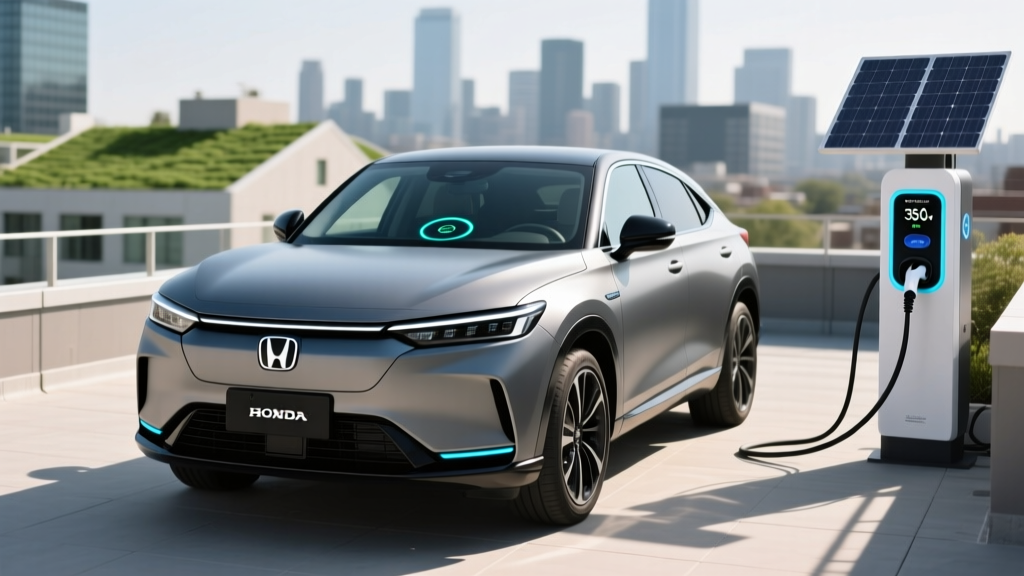
The Honda Prologue occupies a strange space in the EV market: it's a midsize electric SUV built on General Motors' Ultium platform, sold through Honda dealers, and frequently one of the most aggressively leased vehicles in the segment. For 2026, the Prologue continues to attract buyers who want Honda's dealership network and reputation for reliability wrapped around GM's battery and motor hardware. But does the math actually work, especially when the lease-vs-buy decision hinges on a $7,500 federal incentive that behaves very differently depending on how you acquire the vehicle?
We've spent time with the Prologue in real-world driving, at DC fast chargers, and deep in the spec sheets to give you the numbers that matter — not the brochure highlights. Here's what you need to know before signing anything.
Honda Prologue Specs at a Glance
| Specification | 2026 Honda Prologue (FWD) | 2026 Honda Prologue (AWD) |
|---|---|---|
| EPA Range | 308 miles | 294 miles |
| Battery (Usable) | 85 kWh (NMC lithium-ion) | 85 kWh (NMC lithium-ion) |
| MPGe (City/Hwy/Combined) | 114 / 94 / 104 | 108 / 90 / 99 |
| kWh per 100 Miles | 32 kWh | 34 kWh |
| Horsepower | 212 hp | 288 hp |
| Torque | 236 lb-ft | 333 lb-ft |
| 0–60 mph | ~7.8 sec | ~6.2 sec |
| Max DC Fast Charge | 150 kW | 150 kW |
| 10–80% DC Charge Time | ~35 min | ~35 min |
| Level 2 Home Charging | 11.5 kW (~29 mi/hr) | 11.5 kW (~29 mi/hr) |
| Drivetrain | FWD, single motor | AWD, dual motor |
| Towing Capacity | Not rated | 1,500 lbs |
Real-World Range: What the EPA Sticker Doesn't Tell You
Real-World Expectation: 250–275 miles on highway road trips (70–75 mph); 220–240 miles in freezing weather with cabin heat; 280–300 miles in mild-weather city driving with regenerative braking.
The Prologue's 85 kWh usable battery pack uses NMC (nickel manganese cobalt) chemistry, which prioritizes energy density over the cycle-life longevity of LFP packs. In EPA testing, the FWD Prologue achieves 308 miles — a solid figure for a two-row midsize SUV. But EPA testing uses low average speeds and mild temperatures.
On a 70-mph highway run in 65°F weather, expect roughly 260–275 miles before the low-battery warning. Push speeds to 75–80 mph, and that drops to 240–250 miles. Cold weather (below 30°F) without preconditioning can reduce range by 20–30%, putting real-world winter range around 220 miles for the FWD model. The Prologue does have a battery preconditioning feature for DC fast charging, which helps preserve charge speed in cold conditions, but it does not fully offset the range loss from cabin heating and cold-cell chemistry.
Compared to the Hyundai Ioniq 5 (311 miles EPA, but with a smaller 77.4 kWh battery), the Prologue is slightly less efficient per kWh — you're carrying more weight and a less aerodynamic profile. But 308 miles is enough for most commutes and reasonable road-trip legs between charging stops.
Charging Speed: 150 kW Peak, but Mind the Curve
| Charging Level | Power | Miles Added per Hour | Notes |
|---|---|---|---|
| Level 1 (120V outlet) | ~1.4 kW | ~3–4 mi/hr | Emergency/trickle only |
| Level 2 (240V home) | 11.5 kW | ~29 mi/hr | Full charge in ~8.5 hours |
| DC Fast Charge | Peak 150 kW | ~190 mi in 30 min (ideal) | 10–80% in ~35 min; tapers above 80% |
The Prologue's 150 kW peak DC fast-charge rate is the single biggest compromise of the Ultium platform in this application. Competitors like the Hyundai Ioniq 5 and Kia EV6 peak at 240 kW (with 800V architecture enabling 10–80% in ~18 minutes), and even the Tesla Model Y sustains higher rates on V3 Superchargers.
At a 150 kW station, the Prologue pulls close to peak rate between 10% and roughly 50% state of charge, then tapers progressively. The 10–80% time of approximately 35 minutes is usable for road trips — plan a 30-minute meal or restroom break — but it's noticeably slower than the 18–22 minute stops you'd experience in an Ioniq 5 or EV6 at a 350 kW charger. Above 80%, charging slows dramatically, so don't plan to top off to 100% at a DC station unless you have time to spare (the last 20% can add 25+ minutes).
For home charging, the 11.5 kW onboard charger is a strong point. A full charge from near-empty takes about 8.5 hours on a 48-amp Level 2 circuit, meaning you'll wake up to a full battery every morning with a standard overnight charge. Honda includes a dual-level charge cord with the vehicle that can handle both 120V and 240V outlets, though a dedicated hardwired Level 2 station (like a ChargePoint Home Flex or Emporia Vue) will deliver more reliable results.
Pricing, Trims, and the $7,500 Lease Credit Advantage
This is where the Honda Prologue lease story gets interesting — and where most buyers leave money on the table if they don't understand the rules.
| Trim | Drivetrain | Base MSRP | Est. Lease (w/ $7,500 Credit) | Purchase w/ §30D Credit |
|---|---|---|---|---|
| EX | FWD | $48,795 | ~$349–399/mo* | $41,295 (if eligible) |
| EX | AWD | $50,795 | ~$379–429/mo* | $43,295 (if eligible) |
| Touring | AWD | $58,295 | ~$469–529/mo* | $50,795 (if eligible) |
| Elite | AWD | $61,295 | ~$509–569/mo* | $53,795 (if eligible) |
*Lease estimates vary by dealer, region, credit tier, money factor, and residual. Always confirm with your local Honda dealer.
The lease loophole explained: Under current IRS §30D rules, the $7,500 federal EV tax credit has strict requirements for outright purchases: buyer income caps ($150K single / $300K joint), vehicle MSRP caps ($80K for SUVs), and battery critical-mineral and component sourcing requirements that shift annually. Many EVs lose purchase eligibility as sourcing rules tighten.
However, when a vehicle is leased, the $7,500 commercial clean vehicle credit (§45W) goes to the leasing company (the legal owner), and most automakers — Honda included — pass this savings directly to the lessee as a capitalized-cost reduction. This means the lease credit is typically available regardless of your personal income and without the same battery-sourcing restrictions that apply to purchases. For the Prologue, this $7,500 lease incentive effectively drops the capitalized cost significantly, making monthly payments far more attractive than a comparable purchase loan.
If you buy outright, the Prologue's §30D eligibility depends on the current year's critical-mineral and battery-component sourcing percentages, which have been tightening. Confirm eligibility on the IRS clean vehicle credit page and with your tax professional before assuming you'll receive the full $7,500 on a purchase.
Interior, Cargo, and Daily Livability
The Prologue is a legitimate midsize SUV with space that matches its exterior footprint. Honda quotes the following dimensions:
- Cargo behind rear seats: 25.2 cu ft
- Cargo with rear seats folded: 57.7 cu ft
- Front legroom: 41.4 inches
- Rear legroom: 37.8 inches
- Front headroom: 39.6 inches
These numbers put the Prologue squarely in competition with the Hyundai Ioniq 5 (27.2 / 59.3 cu ft) and slightly behind the Tesla Model Y (30.2 / 72.1 cu ft including the frunk). The Prologue has no front trunk (frunk), which is a missed opportunity given the Ultium platform's packaging potential, and the cargo area is a few cubic feet smaller than key rivals.
Inside, the cabin uses an 11.3-inch touchscreen infotainment display running Google built-in (Google Maps, Google Assistant, and the Play Store). Wireless Apple CarPlay and Android Auto are standard. The digital instrument cluster is an 11-inch display. Build quality is solid — Honda's fit and finish standards show through — but some hard plastics on the lower door panels and center console feel out of step with the $48K+ starting price.
Driver Assistance and Safety Tech
The Prologue comes equipped with Honda Sensing 360+, which includes adaptive cruise control with low-speed follow, lane-keeping assist, lane-centering, blind-spot monitoring, rear cross-traffic braking, and traffic-jam assist. On highway drives, the system is competent but conservative — lane centering can feel tentative on faded lane markings, and the adaptive cruise allows larger following gaps than Tesla's Autopilot or GM's Super Cruise.
Safety ratings are strong. The Prologue earned a 5-star overall rating from NHTSA and performed well in IIHS testing. For family buyers, this is a significant trust factor.
Pros and Cons: The Honest Assessment
Pros
- 308-mile EPA range (FWD) is genuinely road-trip capable
- $7,500 lease incentive widely available, no income cap
- Honda dealership network for service and support
- Strong 5-star NHTSA safety rating
- Google built-in infotainment with wireless CarPlay/Android Auto
- 11.5 kW Level 2 onboard charger fills overnight reliably
- Comfortable ride quality and low cabin noise
- Battery warranty: 8 years / 100,000 miles
Cons
- 150 kW peak DC charge rate is slow for the class (35 min 10–80%)
- No front trunk (frunk) — less cargo versatility than rivals
- No hands-free driving option (Super Cruise not available)
- AWD towing limited to just 1,500 lbs
- Purchase tax credit eligibility uncertain due to sourcing rules
- Rear cargo space slightly smaller than Ioniq 5, Model Y
- Higher starting MSRP than some competitors before incentives
- NMC battery chemistry less durable long-term than LFP
Who Should Lease the Honda Prologue?
- You want a midsize electric SUV from a mainstream brand with a vast dealer network
- Your daily commute is under 100 miles round-trip and you can charge at home
- You value the $7,500 lease credit without worrying about income or sourcing restrictions
- You prioritize safety ratings and family-friendly features over cutting-edge charge speed
- You plan to keep the vehicle 36 months and return it (avoiding long-term battery degradation concerns)
- You take frequent 300+ mile road trips and want 18-minute DC charge stops (consider Ioniq 5 or EV6)
- You want hands-free highway driving (GM's Super Cruise on the Blazer EV or Cadillac Lyriq)
- You need maximum cargo space or a frunk (Tesla Model Y)
- You want LFP battery chemistry for maximum long-term durability (Tesla Model Y RWD, base Model 3)
Warranty and Long-Term Battery Outlook
Honda backs the Prologue with a competitive warranty package:
- Limited vehicle warranty: 3 years / 36,000 miles
- Powertrain warranty: 5 years / 60,000 miles
- Battery warranty: 8 years / 100,000 miles (covers capacity loss below 70% state of health)
The 70% capacity-retention threshold is industry-standard, matching what GM, Hyundai, and most others offer. The 8-year/100,000-mile battery warranty aligns with the minimum required by the EPA for an EV to qualify for certain incentives. For lease customers on a 36-month term, battery degradation is essentially a non-issue — NMC packs typically lose 5–8% capacity in the first three years before stabilizing.
If you're buying and plan to keep the Prologue 8+ years, understand that NMC chemistry generally degrades faster than LFP over thousands of charge cycles. Following best practices — avoiding routine 100% charges, minimizing DC fast-charging sessions, and using preconditioning in cold weather — will help preserve state of health.
Frequently Asked Questions
What is the real-world range of the Honda Prologue?
The EPA rates the FWD Prologue at 308 miles and AWD at 294 miles. In real-world highway driving at 70–75 mph, expect 250–275 miles. In freezing weather, that drops to roughly 220–240 miles. City driving with regenerative braking in mild weather can approach or slightly exceed the EPA figure.
How fast does the Prologue charge at home and on the road?
On a 240V Level 2 home charger, the Prologue charges at 11.5 kW, adding about 29 miles per hour — a full overnight charge takes roughly 8.5 hours. On a DC fast charger, it peaks at 150 kW and charges from 10–80% in approximately 35 minutes. This is slower than the Hyundai Ioniq 5 (240 kW peak, ~18 min) but adequate for planned road-trip stops.
Does the Honda Prologue qualify for the $7,500 federal EV tax credit?
For leases, yes — the $7,500 commercial clean vehicle credit is claimed by the leasing company and typically passed through as a cap-cost reduction, with no personal income cap. For outright purchases, eligibility under §30D depends on current-year battery sourcing rules, buyer income limits ($150K single / $300K joint), and the $80K MSRP cap for SUVs. Always verify on IRS.gov and consult a tax professional.
How much does a Honda Prologue lease cost per month?
With the $7,500 lease incentive applied as a cap-cost reduction, FWD EX leases typically range from $349–$399/month and AWD Touring leases from $469–$529/month, depending on dealer, region, credit tier, and down payment. These figures are significantly more attractive than purchase loan payments at current interest rates.
Is the Honda Prologue worth it vs. the Hyundai Ioniq 5 or Tesla Model Y?
It depends on your priorities. The Prologue wins on dealership familiarity, strong safety ratings, and the straightforward $7,500 lease credit. The Ioniq 5 wins on DC charge speed (240 kW) and cargo space. The Model Y wins on Supercharger network access, cargo volume (with frunk), and available LFP battery longevity. If you value Honda's service network and lease economics above all, the Prologue is a solid choice. If charge speed or cargo versatility matter more, test drive the competitors.
Can I tow with the Honda Prologue?
The AWD Prologue is rated for 1,500 lbs of towing — enough for a small utility trailer or a couple of dirt bikes, but not a camping trailer or boat. The FWD model is not rated for towing. If you need serious tow capacity, look at the Rivian R1S, Ford F-150 Lightning, or Hyundai Ioniq 5 (with the appropriate tow package).
What charging connector does the Prologue use?
The 2026 Prologue uses the NACS (North American Charging Standard) connector, giving it native access to Tesla's Supercharger network without an adapter. This is a significant advantage over CCS-equipped competitors that require adapters for Supercharger access.