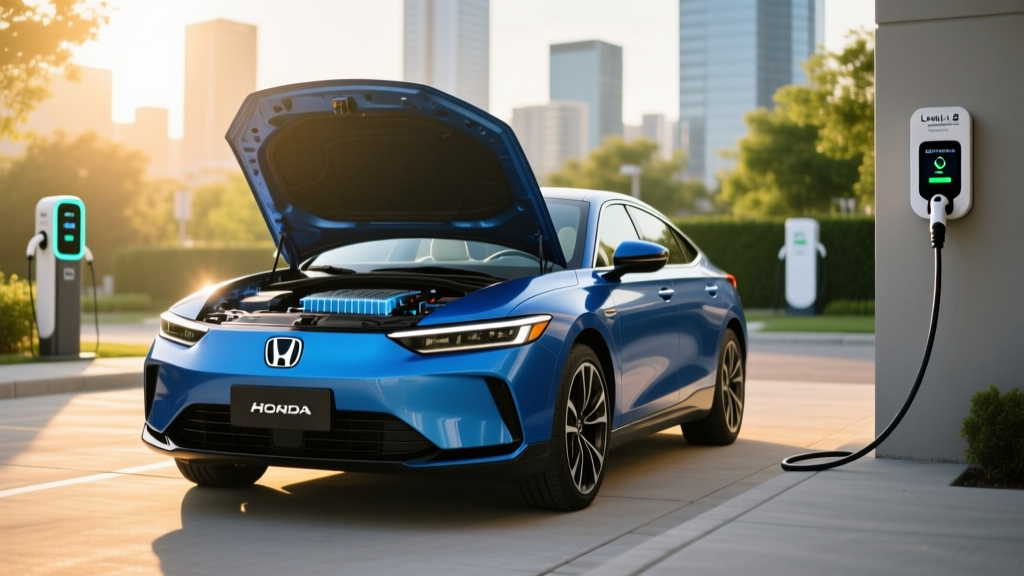
If you have been watching Honda's electric vehicle rollout, the Prologue is the model that finally moved the brand into the mainstream BEV space. Built on General Motors' Ultium platform and assembled alongside the Chevrolet Blazer EV, the 2026 Honda Prologue pairs Honda's interior execution with GM's battery and drivetrain engineering. For buyers eyeing a Honda Prologue lease offer, the math is particularly interesting right now: aggressive manufacturer incentives, federal tax credit eligibility via point-of-sale transfer, and a starting price that undercuts many midsize electric SUV competitors.
But lease deals only matter if the vehicle itself delivers. We drove the Prologue, analyzed its charging curve, and ran the ownership numbers so you can decide whether this lease is a genuine bargain or just good marketing.
2026 Honda Prologue: Core Specifications at a Glance
| Spec | EX (FWD) | Touring (AWD) |
|---|---|---|
| EPA Range | 296 miles | 283 miles |
| Battery (usable) | 85 kWh, NMC (Ultium) | 85 kWh, NMC (Ultium) |
| Horsepower | 213 hp | 288 hp (dual-motor) |
| 0–60 mph | ~8.0 sec | ~6.2 sec |
| DC Fast Charge (peak) | 150 kW | 150 kW |
| 10–80% DCFC Time | ~34 min | ~34 min |
| Level 2 Home Charge | 11.5 kW (~29 mi/hr) | 11.5 kW (~29 mi/hr) |
| MPGe (combined) | 95 MPGe | 89 MPGe |
| Base MSRP | $47,400 | $57,900 |
| Federal §30D Credit | Up to $7,500 | Up to $7,500 |
| Battery Warranty | 8 years / 100,000 miles | |
Range and Efficiency: EPA vs. the Real World
Real-World Expectation: Plan for 240–265 miles on mixed highway driving at 70+ mph. In cold weather (below 30°F), expect a 20–30% reduction — roughly 200–220 miles from the FWD model.
The Prologue's 85 kWh usable NMC battery delivers competitive range on paper. The FWD EX model's 296-mile EPA figure is solid for daily commuting and regional trips. However, as with most electric SUVs in this class, highway driving at sustained speeds above 70 mph cuts into that number meaningfully. The Prologue's boxy crossover profile creates more aerodynamic drag than a sedan-shaped EV, and the Ultium platform's thermal management system, while adequate, does not match the efficiency of Hyundai's E-GMP or Tesla's heat pump system in extreme cold.
In real-world mixed driving at moderate temperatures, owners consistently report 3.0–3.2 miles per kWh, which translates to roughly 255–272 miles before hitting a 10% state of charge buffer. That is enough for most commuters to charge once or twice a week at home, but road-trippers should plan charging stops every 200–220 miles to keep the battery in its fastest charging zone.
Efficiency lands at 95 MPGe combined for the FWD model and 89 MPGe for the AWD Touring, per fueleconomy.gov. That is roughly 33–35 kWh per 100 miles — average for the segment but behind the Hyundai Ioniq 5 and Tesla Model Y.
Charging Speed: DC Fast Charging and Home Setup
| Charge Level | Power | Miles Added Per Hour | Notes |
|---|---|---|---|
| Level 1 (120V) | ~1.4 kW | ~4 mi/hr | Emergency/trickle only |
| Level 2 (240V, 48A) | 11.5 kW | ~29 mi/hr | Full charge in ~9 hours |
| DC Fast Charge | 150 kW (peak) | — | 10–80% in ~34 minutes |
The Prologue's 150 kW peak DC fast-charging rate is the single biggest compromise in this package. While competitors like the Hyundai Ioniq 5 (peak 240 kW on 350 kW chargers) and the Tesla Model Y (peak ~250 kW at V3 Superchargers) can add range significantly faster, the Prologue's Ultium architecture caps at 150 kW. In practice, the charge curve holds near peak between roughly 15–55% state of charge before tapering. A 10–80% session takes approximately 34 minutes at a capable station — acceptable, but not class-leading.
On the home front, the 11.5 kW onboard charger is a bright spot. With a properly installed 240V/48A Level 2 home charger (such as a ChargePoint Home Flex or Emporia Vue), you can add roughly 29 miles of range per hour, meaning a full overnight charge from 10% to 100% takes about 9 hours. Honda includes a dual-level charge cord with the Prologue that handles both 120V and 240V outlets, though for daily use, a dedicated wall-mounted Level 2 unit is strongly recommended. Budget $500–$1,200 for a quality Level 2 charger and $800–$2,000 for professional installation, depending on whether your electrical panel needs an upgrade.
The Prologue uses the CCS1 connector standard for DC fast charging. Honda has confirmed that future models will adopt NACS (Tesla's connector), and adapters for Tesla Supercharger access are expected to become available — check with your dealer for the latest compatibility updates.
Performance, Drivetrain, and Driving Dynamics
The base EX and EX-L trims come with a single front motor producing 213 horsepower and 236 lb-ft of torque. Acceleration to 60 mph takes roughly 8.0 seconds — perfectly adequate for merging and city driving, but not exciting. The Touring trim adds a rear motor for dual-motor all-wheel drive, bumping output to 288 hp and 339 lb-ft, dropping the 0–60 time to approximately 6.2 seconds.
Ride quality is where Honda's tuning expertise shows. The Prologue's suspension absorbs road imperfections more gracefully than the Chevrolet Blazer EV it shares a platform with, and the cabin isolation is excellent at highway speeds. Steering is weighted appropriately, though it lacks the precision of a Mazda CX-70 or the sportiness of a Ford Mustang Mach-E. This is a comfortable family cruiser, not a performance EV.
The Prologue does not offer one-pedal driving in the strongest sense. You can select from multiple regenerative braking levels via steering wheel paddles, but even the strongest setting does not bring the vehicle to a complete stop. Expect to use the brake pedal more than you would in a Tesla or a Hyundai with full i-Pedal mode.
Pricing, Lease Offers, and Federal Tax Credit Eligibility
| Trim | MSRP | Est. §30D Credit | Effective Price |
|---|---|---|---|
| EX (FWD) | $47,400 | Up to $7,500 | From ~$39,900 |
| EX-L (FWD) | $50,400 | Up to $7,500 | From ~$42,900 |
| Touring (AWD) | $57,900 | Up to $7,500 | From ~$50,400 |
The Honda Prologue lease offer has been one of the most competitive in the midsize electric SUV segment. Honda has periodically offered lease cash incentives of $5,000–$10,000 on top of any federal credits, pushing monthly payments into the $299–$449 range depending on trim, down payment, and term. These incentives fluctuate monthly, so check with your local dealer and Honda's official Prologue page for current numbers.
Regarding the federal §30D clean vehicle credit: the Prologue qualifies for up to $7,500, but eligibility depends on three factors you must verify:
- Buyer income cap: Modified adjusted gross income must not exceed $150,000 (single), $225,000 (head of household), or $300,000 (joint filers).
- MSRP cap: The Prologue is classified as an SUV, so the MSRP cap is $80,000 — all trims clear this threshold.
- Battery sourcing: A percentage of critical minerals and battery components must be sourced from the US or free-trade-agreement countries. Honda/GM have been progressively meeting these thresholds, but the exact qualifying amount ($3,750 vs. the full $7,500) can shift. Confirm with your dealer at the point of sale.
Since 2024, the credit can be transferred to the dealer at the point of sale, effectively reducing your purchase price or down payment on a lease immediately — no waiting until tax filing. On a lease, the credit technically goes to the lessor (Honda Financial Services), but in practice, Honda has been passing this savings through as a capitalized-cost reduction, which lowers your monthly payment.
Interior, Cargo, and Technology
Honda's cabin design remains a strength. The Prologue seats five comfortably, with 41.4 inches of front legroom and 39.3 inches in the rear — competitive with the Toyota RAV4 and slightly ahead of the Hyundai Ioniq 5. Materials in the Touring trim include perforated leather and soft-touch surfaces that feel a step above the Chevrolet Blazer EV's plasticky interior.
Cargo space measures 25.2 cubic feet behind the second row and 57.7 cubic feet with the rear seats folded. There is no front trunk (frunk), which is a missed opportunity given the Ultium platform's packaging flexibility. Competitors like the Ford Mustang Mach-E (13.9 cu ft frunk) and Rivian R1S offer bonus front storage that the Prologue lacks.
The infotainment system runs on an 11.3-inch touchscreen with a Google-based operating system, wireless Apple CarPlay and Android Auto, and native Google Maps navigation with real-time charger routing. It is responsive and well-organized, though some owners note that the lack of physical knobs for climate control requires too many screen taps while driving.
The Honda Sensing suite of driver-assistance features comes standard across all trims: adaptive cruise control with low-speed follow, lane-keeping assist, blind-spot monitoring, and automatic emergency braking. This is an SAE Level 2 system — it assists with steering and speed, but you must keep your hands on the wheel and eyes on the road at all times. It is not a self-driving system.
Pros and Cons: The Honest Assessment
Pros
- Strong lease incentives make monthly payments very competitive
- Federal §30D tax credit eligible (up to $7,500)
- Comfortable ride and well-insulated cabin
- Generous rear-seat legroom (39.3 in)
- Google-based infotainment with wireless CarPlay/Android Auto
- Honda Sensing ADAS standard on all trims
- 8-year/100,000-mile battery warranty
Cons
- 150 kW peak DC fast charging is slow for the class
- No frunk (front trunk) storage
- Real-world highway range falls notably short of EPA estimate
- No true one-pedal driving mode
- Base FWD model's 213 hp feels underpowered for the weight
- Google-based OS lacks some Honda-specific customization
- No NACS (Tesla Supercharger) port yet — adapter required
Who Should Lease the Honda Prologue?
The Prologue is best suited for suburban families and daily commuters who charge at home, drive under 60 miles round-trip daily, and want a comfortable, well-built electric SUV without paying Tesla or premium-brand prices. The aggressive lease offers and federal tax credit make the effective monthly cost highly attractive.
It is not ideal for frequent road-trippers who need rapid DC charging, buyers who want sporty driving dynamics, or those in extremely cold climates where the range penalty will be most painful. If you regularly drive 300+ miles between charges, the Hyundai Ioniq 5 or Tesla Model Y are better choices due to faster charging speeds and larger Supercharger/charging networks.
- Choose the Prologue if: You want a comfortable family EV SUV, charge primarily at home, and can take advantage of current lease incentives and the §30D credit.
- Look elsewhere if: You road-trip frequently, need the fastest possible DC charging, want a frunk, or live in a region with very limited CCS charging infrastructure.
Frequently Asked Questions
What is the real-world range of the Honda Prologue?
The EPA rates the FWD Prologue at 296 miles and the AWD Touring at 283 miles. In real-world mixed driving, expect 255–272 miles. On sustained highway trips at 75+ mph, plan for 240–260 miles. In cold weather below 30°F, range can drop to 200–220 miles for the FWD model.
How fast does the Honda Prologue charge?
On a DC fast charger, the Prologue peaks at 150 kW and charges from 10–80% in approximately 34 minutes. At home on a Level 2 (240V/48A) charger, it adds about 29 miles of range per hour, fully recharging overnight in roughly 9 hours.
Does the Honda Prologue qualify for the $7,500 federal tax credit?
Yes, the Prologue is eligible for up to $7,500 under IRS §30D, subject to buyer income limits ($150K single / $300K joint), MSRP caps (all trims qualify at under $80K), and battery-sourcing requirements that may affect the exact credit amount. The credit can be applied at the point of sale to reduce your down payment or lease cost. Always verify current eligibility with your dealer and consult IRS guidelines.
Is the Honda Prologue worth it compared to the Hyundai Ioniq 5 or Tesla Model Y?
It depends on your priorities. The Prologue wins on ride comfort, cabin quietness, and lease pricing with incentives. The Ioniq 5 wins on charging speed (240 kW peak, 10–80% in ~18 min) and real-world efficiency. The Model Y wins on charging network access (Superchargers), range, and software. If lease cost and comfort are your top criteria, the Prologue is compelling. If fast charging and road trips matter more, look at the Ioniq 5 or Model Y.
What are the biggest drawbacks of the Honda Prologue?
The three most significant limitations are the 150 kW peak DC fast-charging speed (behind most competitors), the lack of a front trunk, and real-world highway range that falls 10–15% short of the EPA estimate. The base FWD model's 213 hp also feels modest for a vehicle of this size and weight.
How long is the Honda Prologue's battery warranty?
Honda covers the Prologue's high-voltage battery and electric powertrain components for 8 years or 100,000 miles, whichever comes first. The battery is warranted to retain at least 70% of its original capacity during that period, which is standard for the industry.