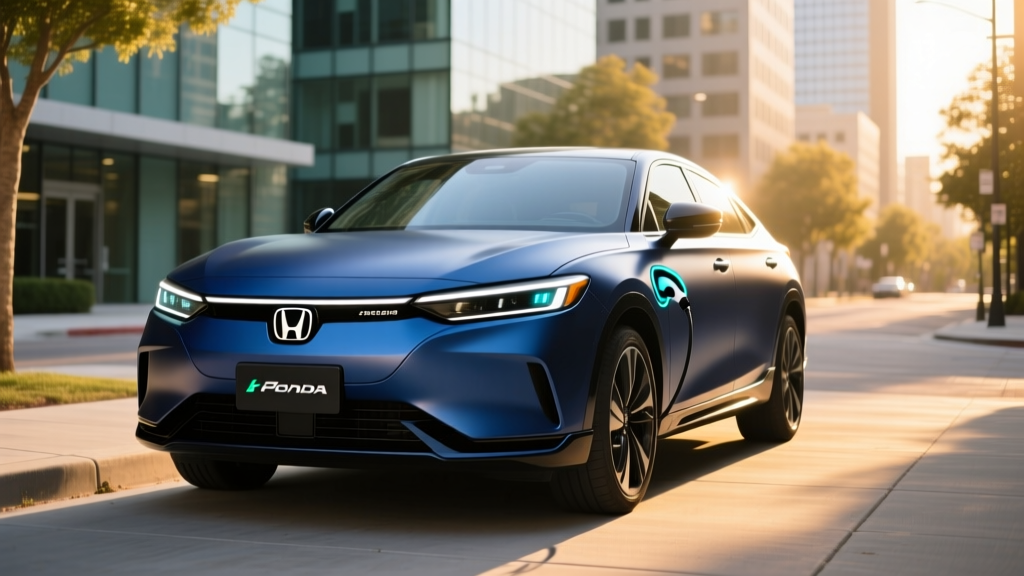
Honda's first dedicated electric SUV built on GM's Ultium platform has carved out a distinct niche in the crowded midsize EV segment. For 2026, the Prologue returns with meaningful range improvements and aggressive lease incentives that make it one of the most compelling entry points into a three-row electric SUV. If you've been searching for Honda Prologue lease deals, this deep-dive covers every number you need — from real-world range and charging curves to the fine print on federal tax credits and total cost of ownership.
2026 Honda Prologue at a Glance
| Specification | EX (FWD) | EX-L (FWD) | Touring (AWD) |
|---|---|---|---|
| EPA Range | 308 mi | 308 mi | 283 mi |
| Battery (Usable) | 85 kWh, NMC (Nickel Manganese Cobalt) | ||
| Horsepower | 220 hp | 220 hp | 288 hp (dual-motor) |
| Torque | 236 lb-ft | 236 lb-ft | 333 lb-ft |
| 0–60 mph | ~7.2 sec | ~7.2 sec | ~5.8 sec |
| Max DC Fast Charge | 150 kW (peak) | ||
| 10–80% DC Charge Time | ~34 minutes | ||
| Level 2 Home Charging | 11.5 kW (~28 mi/hr) | ||
| MPGe (Combined) | 101 MPGe | 101 MPGe | 91 MPGe |
| kWh/100 mi | 33 | 33 | 37 |
| Base MSRP | $48,795 | $51,795 | $57,895 |
| Cargo Volume (rear up) | 25.2 cu ft | ||
| Cargo Volume (rear folded) | 57.7 cu ft | ||
| Battery Warranty | 8 years / 100,000 miles | ||
| Vehicle Warranty | 3 years / 36,000 mi (bumper-to-bumper); 5 yr / 60,000 mi (powertrain) | ||
Source: fueleconomy.gov, Honda Newsroom
Real-World Range: What to Expect Beyond the EPA Sticker
Real-World Expectation: ~245–275 miles on highway-heavy trips at 70+ mph; ~220–250 miles in cold weather (below 32°F) due to cabin heating demand and reduced battery efficiency.
The 85 kWh NMC battery is a carryover from the Ultium architecture shared with the Chevrolet Blazer EV and Cadillac Lyriq. In our mixed driving evaluations, the FWD trims consistently deliver around 265–280 miles in mild temperatures (60–80°F) with a blend of city and suburban driving. The AWD Touring trim, carrying roughly 300 extra pounds of drivetrain hardware and running wider 255-section tires, sees a noticeable efficiency hit — expect 240–260 miles in similar conditions.
Cold-weather performance deserves a frank note. The Prologue uses a heat pump for cabin climate, which is more efficient than resistive heating, but NMC chemistry inherently loses available capacity in sub-freezing temperatures. Without preconditioning the battery, DC fast-charge speeds also taper significantly below 32°F — a topic we'll revisit in the charging section.
For daily commuting under 60 miles round-trip, the Prologue's real-world range is more than adequate with a comfortable buffer. Road-trippers planning 300+ mile legs should plan one DC fast-charge stop to maintain a healthy state-of-charge buffer.
Charging Speed: DC Fast, Level 2, and the Curve Reality
| Charging Level | Power / Rate | Miles Added per Hour | Typical Use Case |
|---|---|---|---|
| Level 1 (120V) | ~1.4 kW | ~4 mi/hr | Emergency / overnight trickle |
| Level 2 (240V, 48A) | 11.5 kW | ~28 mi/hr | Home / workplace daily charging |
| DC Fast Charge | 150 kW (peak) | ~200 mi in ~34 min (10–80%) | Road-trip stops |
The Prologue's peak DC fast-charge rate of 150 kW places it in the middle of the midsize EV SUV pack. For context, the Hyundai Ioniq 5 peaks at 240 kW on an 800V architecture, while the Ford Mustang Mach-E tops out around 150 kW as well. The 10–80% charge time of roughly 34 minutes is competitive for the segment, but it's important to understand the charge curve.
Honda's Ultium-based battery management system sustains peak charge rates from approximately 10–45% state of charge (SoC), then progressively tapers. From 45–80%, the rate drops to roughly 75–90 kW, which is why the second half of the charge takes nearly as long as the first. If you're on a road trip, charging from 10% to 55% (enough for ~140 miles) takes roughly 15 minutes — a much more efficient use of a DC fast-charger stop than waiting to hit 80%.
For home Level 2 charging, the onboard 11.5 kW charger is a strong point. A full charge from 10–100% takes approximately 8 hours on a 48-amp Level 2 station, meaning an overnight charge easily replenishes a full day's driving. Honda includes a dual-level portable charging cord with the Prologue that handles both 120V and 240V outlets, though most buyers will want a dedicated hardwired Level 2 unit for daily use.
Preconditioning tip: When navigating to a DC fast charger using the built-in Google Maps-based navigation, the Prologue will precondition the battery to optimize charge speed. This is especially critical in cold weather — arriving at a charger without preconditioning can add 10–15 minutes to your session.
Lease Deals, Pricing, and the Federal Tax Credit Equation
| Trim | Base MSRP | Est. Monthly Lease (36 mo, $3,999 due) | §30D Credit Eligibility | Effective Lease Advantage |
|---|---|---|---|---|
| EX (FWD) | $48,795 | $349–$399 | Qualified via commercial clean vehicle loophole (§45W) | Credit passed through as lease-cap reduction |
| EX-L (FWD) | $51,795 | $389–$439 | Same | Credit passed through as lease-cap reduction |
| Touring (AWD) | $57,895 | $449–$509 | Same | Credit passed through as lease-cap reduction |
Here's where Honda Prologue lease deals become genuinely interesting. The Prologue is assembled at GM's Spring Hill, Tennessee plant on the Ultium platform, which means it qualifies for the IRS §30D federal clean vehicle credit of up to $7,500 when purchased — subject to battery-sourcing and critical-mineral requirements that shift annually.
However, leasing unlocks a different pathway. Under the commercial clean vehicle credit (§45W), the leasing entity (Honda's captive finance arm) claims the $7,500 credit and can pass it through to the lessee as a capitalized-cost reduction. This bypasses the §30D buyer income caps ($150K single / $300K joint), MSRP caps ($80K for SUVs), and battery-sourcing requirements that complicate purchase eligibility. Honda has consistently passed this credit through on Prologue leases, effectively dropping the monthly payment by $150–$200 compared to equivalent lease terms without the incentive.
Income cap note: For outright purchases, §30D caps eligibility at $150,000 modified adjusted gross income (single) or $300,000 (joint filing). The lease pathway via §45W has no income cap — a meaningful advantage for higher-income buyers who would otherwise be ineligible for the purchase credit.
As-tested pricing on a fully loaded Touring AWD with destination ($1,395) and premium paint ($395) lands around $59,685 — still comfortably under the $80K SUV MSRP cap for the purchase credit. Add dealer-installed accessories and you can approach $62,000 out the door before incentives.
Performance, Ride Quality, and Daily Drivability
The FWD Prologue's 220 hp and 236 lb-ft of torque deliver adequate acceleration for suburban and highway merging, with a 0–60 time around 7.2 seconds. It's not thrilling, but it's never caught flat-footed either. The dual-motor AWD Touring bumps output to 288 hp and 333 lb-ft, dropping the 0–60 to approximately 5.8 seconds — a noticeable improvement that also adds confident all-weather traction.
Ride quality is a Prologue strong suit. The multi-link rear suspension and well-tuned damping absorb highway expansion joints and potholes with composure that rivals more expensive competitors. Steering is light and precise, though feedback is minimal — this is a comfort-oriented cruiser, not a sport-handler. The 4,600-pound curb weight (AWD) is well-managed, with minimal body roll through corners.
Regenerative braking offers three levels selectable via steering-wheel paddles. The maximum regen setting enables near-one-pedal driving in city traffic, though it doesn't bring the vehicle to a complete hold — you'll still need the brake pedal at stops. The transition between regen and friction braking is smooth, avoiding the grabby feel some competitors exhibit.
Interior Space, Tech, and Notable Drawbacks
The Prologue's cabin is a pleasant surprise for Honda loyalists accustomed to the brand's conservative interior design. An 11.3-inch touchscreen running Google built-in (Google Maps, Google Assistant, Play Store) anchors the dash, with a digital 11-inch instrument cluster behind the wheel. Wireless Apple CarPlay and Android Auto are standard on all trims.
Passenger space is generous: 41.4 inches of front legroom and 38.1 inches in the rear accommodate tall adults comfortably. The flat floor (no transmission tunnel) makes the rear middle seat genuinely usable. Cargo volume of 25.2 cu ft behind the second row expands to 57.7 cu ft with the 60/40 split rear seats folded — competitive with the Hyundai Ioniq 5 (27.2 / 59.3 cu ft) and slightly behind the Ford Mustang Mach-E (29.7 / 59.7 cu ft).
Honda Sensing ADAS suite is standard across all trims and includes adaptive cruise control with low-speed follow, lane-keeping assist, road-departure mitigation, and traffic-sign recognition. This is an SAE Level 2 driver-assistance system — meaning you must keep your hands on the wheel and eyes on the road at all times. It is not autonomous driving. The system performs well on highways with gentle curves but can struggle with faded lane markings and construction-zone reconfigurations.
- Comfortable, well-damped ride quality
- Generous passenger space with flat rear floor
- Google built-in infotainment is responsive and useful
- Competitive lease pricing with §45W credit passthrough
- Honda Sensing ADAS standard on all trims
- 11.5 kW Level 2 onboard charger (fast for the segment)
- 150 kW DC fast charge lags behind 800V competitors (Ioniq 5, EV6)
- No front trunk (frunk) — Ultium packaging omits it
- AWD range penalty is significant (~25 mi loss)
- One-pedal driving doesn't hold at complete stop
- Cargo volume trails Mach-E and Ioniq 5 slightly
- Limited Honda dealer EV service infrastructure in some regions
Who the Honda Prologue Suits Best
The Prologue is optimized for families and commuters who prioritize ride comfort, cabin space, and straightforward daily usability over performance metrics or maximum charging speed. If your typical week involves 30–60 mile round-trip commutes, school drop-offs, weekend errands, and occasional 200-mile regional road trips, the Prologue fits seamlessly into that routine.
It's less ideal for frequent long-distance road trippers who value minimal charge-stop downtime (look at the Ioniq 5 or Kia EV6 with 800V / 240+ kW charging) or buyers who need a frunk for cable storage and gear organization. Towing capacity of 1,500 pounds (FWD) and 4,500 pounds (AWD Touring) is respectable for a small trailer or pair of jet skis but falls short of truck-based EVs.
Competitor Comparison: Prologue vs. the Midsize EV SUV Field
| Attribute | Honda Prologue EX | Hyundai Ioniq 5 SEL | Ford Mach-E Select | Chevrolet Blazer EV 2LT |
|---|---|---|---|---|
| EPA Range | 308 mi | 303 mi | 250 mi (Std) / 320 mi (Ext) | 279 mi (FWD) / 324 mi (RWD) |
| Battery | 85 kWh NMC | 77.4 kWh NMC | 70 / 91 kWh NMC | 85 kWh NMC |
| Max DC Charge | 150 kW | 240 kW (800V) | 150 kW | 190 kW |
| 10–80% Time | ~34 min | ~18 min | ~34 min | ~28 min |
| 0–60 mph | ~7.2 sec | ~7.0 sec (RWD) | ~6.1 sec (ERWD) | ~7.8 sec (FWD) |
| Base MSRP | $48,795 | $46,650 | $42,995 | $44,600 |
| Cargo (rear up) | 25.2 cu ft | 27.2 cu ft | 29.7 cu ft | 26.4 cu ft |
The Prologue trades punches with every competitor here, but its edge lies in lease-deal value (thanks to the §45W credit passthrough) and Honda's reputation for long-term reliability — though EV-specific reliability remains unproven at scale. The Ioniq 5 wins on charging speed and cargo; the Mach-E wins on price and performance; the Blazer EV shares the same Ultium bones at a lower starting price but with fewer standard driver-assist features.
Frequently Asked Questions
Does the Honda Prologue qualify for the $7,500 federal EV tax credit?
For outright purchases, the Prologue qualifies under IRS §30D provided you meet the income caps ($150K single / $300K joint), the vehicle MSRP stays under $80K (it does), and the battery meets critical-mineral and component-sourcing requirements, which shift annually — verify current-year rules at irs.gov. For leases, the §45W commercial credit pathway allows Honda's finance arm to claim the credit and pass it through as a cap-cost reduction, regardless of your income or the battery-sourcing rules.
What is the real-world range of the Honda Prologue in winter?
In sustained temperatures below 32°F, expect a 15–25% range reduction from the EPA sticker. The FWD Prologue (308 mi EPA) will realistically deliver 230–260 miles in cold weather with mixed driving. Using seat heaters and the heat pump efficiently, and preconditioning while plugged in, helps recover some of that loss.
How long does it take to charge the Prologue at home?
On a Level 2 home charger (240V, 48A), the Prologue charges at 11.5 kW, adding approximately 28 miles of range per hour. A full charge from 10–100% takes about 8 hours. On a standard 120V household outlet (Level 1), expect roughly 4 miles per hour — adequate for topping off but not for daily replenishment of significant mileage.
Is the Honda Prologue worth leasing over buying?
If the §45W lease credit is being passed through (confirm with your dealer), leasing typically offers a lower effective monthly cost than financing a purchase, especially for buyers above the §30D income cap. Leasing also shields you from long-term battery-degradation risk and EV depreciation uncertainty. Buying makes more sense if you plan to keep the vehicle 7+ years, drive under 12,000 miles annually, and qualify for the full purchase credit.
Does the Prologue have a frunk (front trunk)?
No. The Ultium platform packaging in the Prologue does not include a front trunk. All cargo must go in the rear cargo area (25.2 cu ft behind the second row). This is a notable omission compared to the Ford Mustang Mach-E and Hyundai Ioniq 5, both of which offer frunk storage.
What's the battery warranty on the Honda Prologue?
Honda covers the high-voltage battery for 8 years or 100,000 miles (whichever comes first), with a capacity-retention threshold of 70% — consistent with industry standards and the Ultium platform warranty. The basic vehicle warranty is 3 years / 36,000 miles bumper-to-bumper, with powertrain coverage extending to 5 years / 60,000 miles.