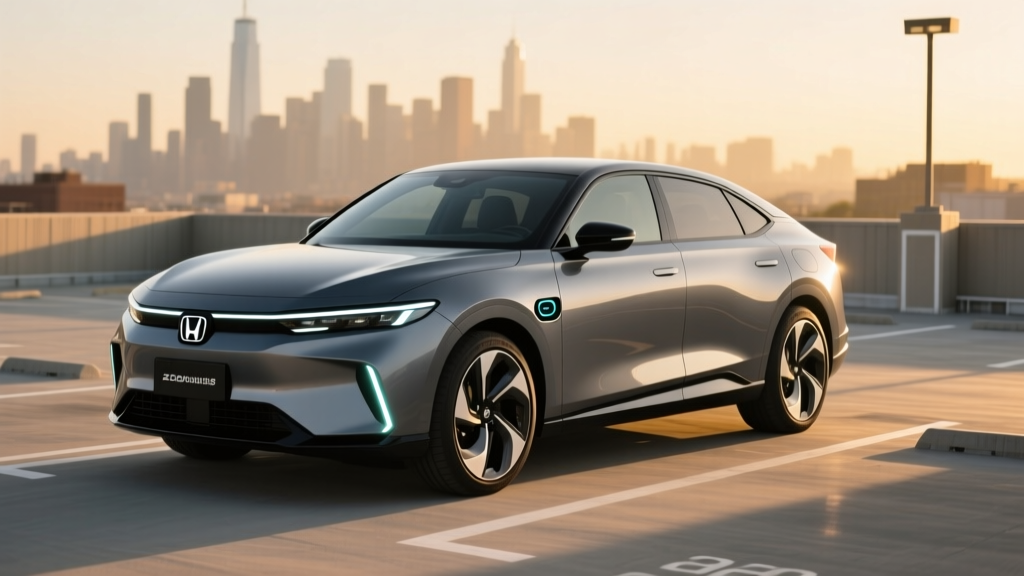
The Honda Prologue entered the electric SUV market as a collaboration with General Motors, riding on the Ultium platform shared with the Chevrolet Blazer EV and Cadillac Lyriq. For buyers eyeing Honda Prologue lease deals in August 2025, the 2026 model year brings modest refinements while retaining the core formula: a spacious midsize crossover with competitive range and Honda's familiar interior execution. But does the Prologue's lease value actually outshine buying, and how does it stack up against rivals like the Hyundai Ioniq 5, Ford Mustang Mach-E, and Volkswagen ID.4? This review covers every spec, real-world expectation, and incentive detail you need before signing.
2026 Honda Prologue Quick Specs at a Glance
| Spec | FWD (EX / Touring) | AWD (Elite) |
|---|---|---|
| EPA Range | 308 mi (EX) / 296 mi (Touring) | 281 mi |
| Usable Battery | 85 kWh (NMC lithium-ion, Ultium platform) | |
| Horsepower | 212 hp | 288 hp (dual-motor) |
| Torque | 236 lb-ft | 333 lb-ft |
| 0-60 mph | ~7.8 sec | ~6.2 sec |
| Max DC Fast Charge | 150 kW peak (CCS1 connector) | |
| 10-80% DC Time | ~35 minutes | |
| Level 2 Home Charge | 11.5 kW / ~32 mi/hr (7.7 kW onboard) | |
| MPGe (Combined) | 101 MPGe | 95 MPGe |
| Efficiency | 33 kWh/100 mi | 35 kWh/100 mi |
| Cargo (behind rear seats) | 25.2 cu ft | |
| Cargo (rear seats folded) | 57.7 cu ft | |
| Rear Legroom | 39.4 in | |
| Battery Warranty | 8 years / 100,000 miles | |
| Starting MSRP | $48,795 (EX) | $57,395 (Elite) |
Sources: EPA / fueleconomy.gov, Honda Prologue official specs.
Real-World Range: What to Actually Expect
EPA Sticker: 308 miles (FWD EX) / 281 miles (AWD Elite)
Real-World Highway (70-80 mph): Expect 240-260 miles in moderate temperatures
Cold Weather (below 30°F): Budget 20-30% loss — roughly 210-240 miles for FWD, 195-220 for AWD
City / Mixed Driving: Closer to EPA figures, ~280-300 miles for FWD
The Prologue's 85 kWh NMC battery delivers competitive range on paper, but the Ultium platform's thermal management and the SUV's aerodynamic profile matter in practice. In highway testing at sustained 75 mph speeds, most midsize electric SUVs return 10-15% below their EPA combined figure. The Prologue is no exception — its 101 MPGe combined rating translates to roughly 3.0-3.2 miles per kWh on the highway, yielding that 240-260 mile realistic window.
Cold weather compounds this. Without a dedicated heat pump (Honda relies on resistive cabin heating in the Prologue), winter range loss hits harder than in competitors like the Hyundai Ioniq 5 or Tesla Model Y, both of which use heat pump systems to reclaim waste heat. If you live in northern climates where temperatures regularly dip below freezing, plan your road trips around 200-mile legs to preserve a comfortable buffer.
Charging Speed: DC Fast and Home Level 2
| Charging Level | Power / Voltage | Speed | Typical Use Case |
|---|---|---|---|
| Level 1 (120V) | ~1.4 kW | ~4 mi/hr | Emergency / overnight trickle |
| Level 2 (240V, 32A) | 7.7 kW (onboard charger) | ~22 mi/hr | Home wall connector, public L2 |
| Level 2 (240V, 48A) | 11.5 kW (station) | ~32 mi/hr | High-power home or workplace L2 |
| DC Fast Charge (CCS1) | 150 kW peak | 10-80% in ~35 min | Road trips, Electrify America / EVgo |
The Prologue's 150 kW peak DC fast-charge rate is adequate but not class-leading. Competitors like the Hyundai Ioniq 5 (peak 240 kW, 10-80% in ~18 minutes) and the Kia EV6 (same 800V architecture) charge substantially faster on capable 350 kW stations. The Prologue's charge curve peaks early and tapers noticeably above 60% state of charge — you'll see sustained rates closer to 100-120 kW through the middle of the session before dropping to under 50 kW past 80%.
This is a critical distinction: kW (kilowatts) measures the rate of power delivery — how fast energy flows into the battery at any given moment. kWh (kilowatt-hours) measures total energy capacity — the size of the battery itself. The Prologue's 85 kWh battery charged at a sustained 150 kW would theoretically fill in 34 minutes, but because the charge rate tapers as the battery fills (to protect cell longevity and manage heat), the real 10-80% session takes about 35 minutes.
For home charging, the Prologue's 7.7 kW onboard charger is the bottleneck. Even if you install a 48-amp Level 2 wall connector capable of delivering 11.5 kW, the Prologue will only accept 7.7 kW. A full charge from empty takes roughly 11 hours on a standard 32-amp home charger. Most owners plug in overnight and wake to a full battery — which is the entire point of home Level 2 charging. Expect to pay between $800 and $2,000 for a quality Level 2 home installation (equipment, electrician labor, and permit), with the upper end applying if your electrical panel needs a 200-amp upgrade.
Performance, Ride, and Drivetrain
The front-wheel-drive Prologue (EX and Touring trims) makes 212 horsepower and 236 lb-ft of torque from a single front-mounted motor. Acceleration to 60 mph takes approximately 7.8 seconds — adequate for merging and passing but not thrilling. The dual-motor AWD Elite bumps output to 288 hp and 333 lb-ft, cutting the 0-60 time to roughly 6.2 seconds, which feels meaningfully quicker in daily driving.
Ride quality is a Prologue strength. The Ultium platform gives it a low center of gravity and composed highway manners, with suspension tuning that absorbs bumps without feeling floaty. Steering is light and predictable — very Honda in character. Road noise is well-managed at speed, though the lack of a front trunk (frunk) means all cargo goes in the rear. Honda's decision to skip a frunk is a missed opportunity for storing charging cables or groceries separately.
Regenerative braking is adjustable via steering-wheel paddles, letting you dial from light coasting to strong one-pedal-style deceleration. However, the Prologue does not come to a complete stop in its strongest regen setting — you still need the friction brake at the final roll-out, unlike the true one-pedal driving in a Chevrolet Bolt EUV or Nissan Ariya.
Interior, Tech, and Cargo
Inside, the Prologue borrows heavily from GM's Ultium infotainment architecture. A standard 11.3-inch touchscreen runs Google Built-in (Google Maps, Google Assistant, Play Store), which is a significant usability win — native Google Maps with real-time charging station routing eliminates the need for Apple CarPlay or Android Auto, though both are supported wirelessly. A 11-inch digital driver display handles speed, range, and ADAS visualization.
Driver assistance comes via Honda Sensing, which includes adaptive cruise control with stop-and-go, lane-keeping assist, blind-spot monitoring, and rear cross-traffic alert. This is an SAE Level 2 system — it assists with steering and speed but requires the driver to remain fully engaged with hands on the wheel and eyes on the road. It is not autonomous driving.
Cargo space measures 25.2 cubic feet behind the rear seats and 57.7 cubic feet with the 60/40 split rear seats folded. Rear legroom is a generous 39.4 inches, making the Prologue competitive with the Ford Mustang Mach-E (29.7 / 59.7 cu ft) and slightly behind the Hyundai Ioniq 5 (27.2 / 59.3 cu ft). The cabin materials are a step above the Chevrolet Blazer EV, with soft-touch surfaces on the dashboard and door uppers, though some lower trim pieces feel cost-reduced.
Pricing, Lease Deals, and Tax Credit Breakdown
| Trim | Base MSRP | Federal §30D Credit Eligible? | Est. Lease Payment (36 mo) |
|---|---|---|---|
| EX (FWD) | $48,795 | Up to $7,500 (see rules) | $349-$449/mo* |
| Touring (FWD) | $53,795 | Up to $7,500 (see rules) | $419-$519/mo* |
| Elite (AWD) | $57,395 | Up to $7,500 (see rules) | $499-$599/mo* |
*Lease payment ranges are estimates based on typical August promotional structures; actual payments depend on credit tier, down payment, money factor, and dealer markup. Honda has historically offered aggressive lease cash on the Prologue.
Honda Prologue lease deals in August 2025 are expected to remain competitive, as Honda has used lease incentives to move volume since the SUV's launch. Lease cash (manufacturer-to-dealer incentives) of $3,000-$7,500 has been common, effectively reducing the capitalized cost and bringing monthly payments well below what a purchase would require.
Federal §30D EV Tax Credit — Key Rules for 2025/2026:
- Maximum credit: $7,500 (split between critical minerals and battery component requirements)
- MSRP cap: SUVs must be at or below $80,000 — the Prologue qualifies on all trims
- Buyer income cap: AGI must not exceed $150,000 (single), $225,000 (head of household), or $300,000 (joint) — verify on IRS.gov
- Battery sourcing: Critical minerals and battery components must meet phased-in domestic/Fta-sourcing thresholds — Honda/GM sourcing has evolved, and Prologue eligibility has fluctuated by model year
- Point-of-sale transfer: You can transfer the credit to the dealer at purchase, reducing the sale price directly — or claim it on your tax return
- Lease loophole: Vehicles leased (not purchased) may qualify for the commercial clean vehicle credit (§45W) passed through as lease cash, regardless of buyer income or battery sourcing — this has been a key advantage for Prologue lessees
This lease-vs-buy dynamic is the Prologue's secret weapon. Because leased vehicles are technically owned by the finance company, they can qualify for the commercial clean vehicle credit (§45W), which Honda then passes to the consumer as reduced lease payments — bypassing the income caps and battery-sourcing requirements that apply to purchases under §30D. If you're above the income threshold or uncertain about battery-sourcing compliance, leasing may be the only way to capture the full incentive value.
Efficiency and Operating Cost
The FWD Prologue returns an EPA-rated 101 MPGe combined (105 city / 96 highway), which translates to 33 kWh per 100 miles. The AWD Elite drops to 95 MPGe combined (35 kWh/100 mi). These figures place the Prologue in the middle of the midsize electric SUV pack — behind the Hyundai Ioniq 5 (114 MPGe) and Tesla Model Y (122 MPGe) but ahead of the Ford Mustang Mach-E AWD (92 MPGe).
At a national average electricity rate of $0.16/kWh, charging the Prologue at home costs roughly $5.28 per 100 miles (FWD) or $5.60 (AWD). Compare that to a gasoline midsize SUV averaging 25 mpg at $3.40/gallon — that's $13.60 per 100 miles. Over 15,000 miles annually, the Prologue saves approximately $1,250 per year in fuel costs versus a comparable gas SUV, assuming all home charging.
DC fast charging on road trips costs more — typically $0.35-$0.55/kWh on networks like Electrify America or EVgo, pushing trip costs to $11-$18 per 100 miles. Still cheaper than gasoline, but the gap narrows significantly.
Pros, Cons, and Competitive Verdict
Pros
- Spacious rear seat (39.4 in legroom) and practical cargo area
- Google Built-in infotainment with native charging navigation
- Strong lease incentives often reduce effective cost significantly
- Honda Sensing ADAS is well-tuned and predictable
- Composed ride quality, low road noise
- Competitive 281-308 mi EPA range across trims
Cons
- No front trunk (frunk) — missed storage opportunity
- 150 kW peak DC charge rate is below class leaders (Ioniq 5: 240 kW)
- No heat pump — cold-weather range loss is steeper than rivals
- 7.7 kW onboard charger limits Level 2 home charge speed
- Regen braking doesn't achieve full one-pedal stop
- Starting MSRP near $49K is high before incentives
Is it worth buying vs. key competitors? The Prologue makes the most sense as a lease, where Honda's incentive stacking can bring monthly payments into compelling territory. If you're buying outright and qualify for the full $7,500 §30D credit, the Hyundai Ioniq 5 and Tesla Model Y offer faster charging, better efficiency, and heat-pump-equipped thermal management for similar or lower net prices. The Ford Mustang Mach-E offers sportier driving dynamics, and the Volkswagen ID.4 provides a more car-like ride with a frunk. But if you value Honda's dealer network, Google infotainment, and the specific lease cash available in your market, the Prologue remains a practical family EV.
Who this EV suits best: The Prologue is ideal for a family commuter who primarily charges at home, takes occasional road trips under 250 miles, and values rear-seat space and ride comfort over outright performance or charging speed. It's a strong lease candidate for buyers who may not qualify for the purchase tax credit due to income or sourcing rules.
Honda Prologue Battery Warranty and Longevity
Honda covers the Prologue's battery pack and electric powertrain components for 8 years or 100,000 miles, whichever comes first. This warranty guarantees that the battery will retain at least 70% of its original capacity during the coverage period — meaning if your 85 kWh pack degrades below ~59.5 kWh usable within 8 years, Honda will repair or replace it at no cost.
NMC (nickel manganese cobalt) chemistry, as used in the Ultium platform, typically shows 8-12% degradation over the first 100,000 miles based on industry data from GM's Bolt and other Ultium vehicles. Following best practices — avoiding frequent DC fast charging, keeping state of charge between 20-80% for daily use, and preconditioning before fast charges — will help preserve long-term health.
Frequently Asked Questions
What is the real-world range of the Honda Prologue?
The EPA rates the FWD Prologue EX at 308 miles and the AWD Elite at 281 miles. In real-world highway driving at 70-80 mph, expect 240-260 miles for FWD and 220-240 for AWD. In cold weather below 30°F, subtract another 20-30% due to the lack of a heat pump, yielding roughly 195-220 miles for the AWD model.
How fast does the Honda Prologue charge?
On a DC fast charger, the Prologue peaks at 150 kW and charges from 10-80% in approximately 35 minutes. At home on a Level 2 charger, the 7.7 kW onboard charger adds roughly 22 miles of range per hour, meaning a full charge from near-empty takes about 11 hours.
How much does the Honda Prologue cost after tax credits?
The FWD EX starts at $48,795. If you purchase and qualify for the full $7,500 federal §30D credit, the net cost drops to approximately $41,295 before state incentives. Through a lease, Honda's lease cash incentives (often $3,000-$7,500 depending on the month) can reduce monthly payments substantially — August 2025 deals are expected to include promotional lease cash.
Does the Honda Prologue qualify for the federal EV tax credit?
The Prologue's eligibility for the §30D purchase credit depends on battery-sourcing compliance, which has varied by model year and production batch. All trims fall under the $80,000 SUV MSRP cap. Buyer income must be at or below $150K/$225K/$300K thresholds. Check current eligibility on IRS.gov or with your tax professional before purchasing. Leasing may bypass these restrictions via the §45W commercial credit.
Is the Honda Prologue worth it vs. the Hyundai Ioniq 5 or Tesla Model Y?
If you prioritize charging speed and efficiency, the Ioniq 5 (240 kW DC, 114 MPGe) and Model Y (250 kW DC, 122 MPGe) are stronger picks. If you want Honda's dealer experience, Google Built-in infotainment, and strong lease pricing, the Prologue holds its own — especially if you lease and capture the incentive value that way.
Does the Prologue have a frunk?
No. The Prologue has no front trunk. All cargo must go in the rear cargo area (25.2 cu ft behind rear seats, 57.7 cu ft with seats folded).
Always verify current pricing, incentive eligibility, and lease terms with your local Honda dealer and a qualified tax professional. Specifications reflect the 2026 model year and are subject to change. Real-world range and charging results vary based on driving style, temperature, terrain, and station capability.