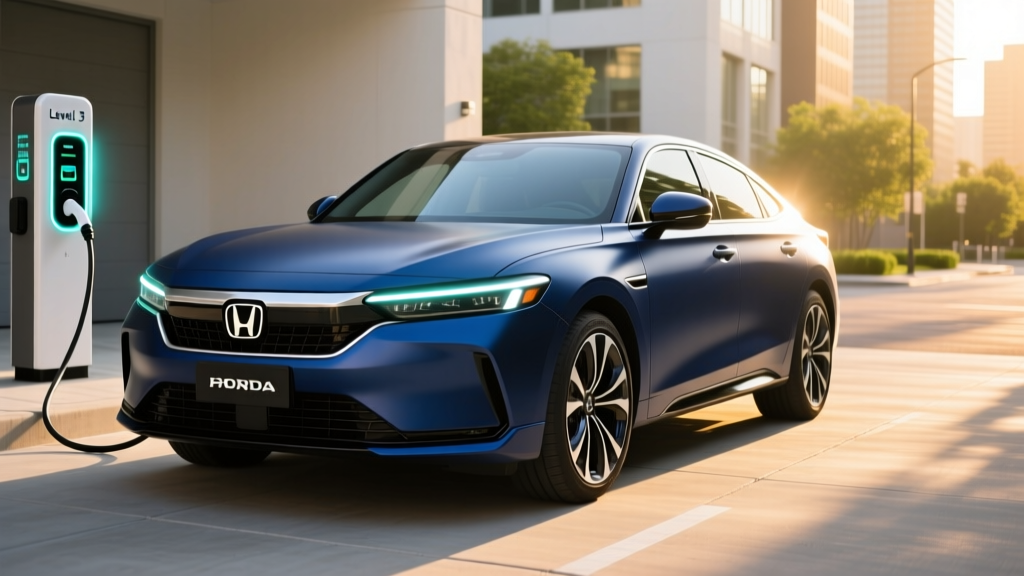
The Honda Prologue entered the market as Honda's first purpose-built electric SUV for North America, riding on General Motors' Ultium platform. For 2026, the Prologue continues to offer three trims — EX, Touring, and Elite — with the dual-motor AWD configuration commanding attention for its 288 horsepower output. If you've been searching for Honda Prologue HP figures and wondering how they translate to real-world driving, charging practicality, and ownership value, this review breaks down every number that matters.
The Prologue occupies a competitive midsize electric SUV segment alongside the Hyundai Ioniq 5, Ford Mustang Mach-E, and Tesla Model Y. Honda's pitch is straightforward: familiar SUV ergonomics, Honda Sensing safety tech, and GM's proven Ultium battery architecture — all wrapped in a package that feels immediately approachable for first-time EV buyers transitioning from a CR-V or Passport.
Honda Prologue HP and Performance Specs
The Prologue's powertrain lineup splits cleanly between front-wheel drive and all-wheel drive. The FWD models (EX and Touring trims) produce 213 horsepower and 236 lb-ft of torque from a single front-mounted motor. Step up to the Elite trim with its dual-motor AWD setup, and output rises to 288 horsepower and 333 lb-ft of torque.
That HP bump matters. The AWD Elite hits 0-60 mph in approximately 5.8 seconds — noticeably quicker than the FWD's 7.8-second run. More importantly, the dual-motor configuration provides confident all-weather traction and better highway passing power when loaded with passengers and cargo.
| Spec | EX (FWD) | Touring (FWD) | Elite (AWD) |
|---|---|---|---|
| Horsepower | 213 hp | 213 hp | 288 hp |
| Torque | 236 lb-ft | 236 lb-ft | 333 lb-ft |
| Drivetrain | FWD | FWD | AWD (dual-motor) |
| 0-60 mph | ~7.8 sec | ~7.8 sec | ~5.8 sec |
| Top Speed | 115 mph | 115 mph | 130 mph |
| Towing Capacity | Not rated | Not rated | Not rated |
One notable omission: Honda does not rate the Prologue for towing. If you need to pull a trailer or camper, the Ford Mustang Mach-E (up to 2,300 lbs with the California Route 1 package) or the Hyundai Ioniq 5 (up to 2,300 lbs) offer that capability. The Prologue is strictly a passenger-focused crossover.
Battery, Range, and Real-World Efficiency
All Prologue trims share the same 85 kWh usable battery pack (91.1 kWh gross) using GM's Ultium pouch-cell architecture with NMC (nickel manganese cobalt) chemistry. NMC offers higher energy density than LFP (lithium iron phosphate), which helps keep the pack size manageable for a midsize SUV footprint, though it requires more careful thermal management for long-term longevity.
FWD (EX/Touring): EPA 296 miles | Real-world highway: ~255-270 miles | Cold weather (below 30°F): ~220-240 miles
AWD (Elite): EPA 281 miles | Real-world highway: ~240-255 miles | Cold weather (below 30°F): ~210-225 miles
The Prologue lacks a heat pump, relying instead on resistive cabin heating. Expect 20-25% range reduction in sustained sub-freezing temperatures — more than EVs equipped with heat pump systems.
Efficiency ratings per fueleconomy.gov show the FWD Prologue achieving 99 MPGe combined (99 city / 99 highway), consuming approximately 34 kWh per 100 miles. The AWD Elite drops to 95 MPGe combined (97 city / 93 highway) at roughly 35 kWh per 100 miles. These figures are competitive but trail the Hyundai Ioniq 5's 114 MPGe combined — a reflection of the Prologue's slightly heavier curb weight and less aerodynamic profile.
| Metric | EX (FWD) | Touring (FWD) | Elite (AWD) |
|---|---|---|---|
| Battery (usable) | 85 kWh NMC | 85 kWh NMC | 85 kWh NMC |
| EPA Range | 296 mi | 296 mi | 281 mi |
| MPGe Combined | 99 | 99 | 95 |
| kWh/100 mi | 34 | 34 | 35 |
| Real-World Highway | ~255-270 mi | ~255-270 mi | ~240-255 mi |
Charging Speed: DC Fast and Home Level 2
The Prologue supports DC fast charging at a peak rate of 150 kW via its CCS1 connector (with a NACS adapter available for Tesla Supercharger access, as Honda has joined the NACS transition). At peak rate, the 10-80% charge takes approximately 35 minutes.
Here's the charging-curve reality: the Prologue sustains near-peak power from roughly 10% to about 55% state of charge, then begins a gradual taper. From 80% to 100%, expect significantly slower speeds — as is typical with NMC chemistry to protect cell health. Plan road-trip stops around the 10-80% window for optimal time efficiency.
| Charging Level | Power / Rate | Time / Speed | Connector |
|---|---|---|---|
| Level 1 (120V household) | ~1.4 kW | ~4 mi/hr of range | J1772 / NACS adapter |
| Level 2 (240V home) | 11.5 kW (48A) | ~28 mi/hr of range; full charge ~9.5 hrs | J1772 / NACS adapter |
| DC Fast Charge | 150 kW peak | 10-80% in ~35 min | CCS1 (NACS adapter for Superchargers) |
For home charging, the Prologue's onboard charger accepts up to 11.5 kW on Level 2 (48 amps). This means a dedicated 60-amp circuit with a hardwired Level 2 station will deliver the best results. Most Prologue owners will recover a full day's driving (30-50 miles) in under two hours of overnight charging. Home installation for a 240V/60A circuit typically runs $800-$2,000 depending on panel proximity and whether your electrical panel needs a 200-amp upgrade.
Honda provides access to public charging networks through partnerships, and the HondaLink app integrates route planning with charging stops. The available NACS adapter opens up Tesla's Supercharger network — a significant advantage for road-trip flexibility in areas where Electrify America or EVgo coverage is sparse.
Pricing, Trims, and Federal Tax Credit Eligibility
The 2026 Honda Prologue starts at $47,400 MSRP for the EX FWD trim, rising to approximately $58,900 for the fully equipped Elite AWD. All trims fall under the IRS §30D federal tax credit MSRP cap of $80,000 for SUVs.
| Trim | MSRP | Drivetrain | Key Features |
|---|---|---|---|
| EX | $47,400 | FWD, 213 hp | 19" wheels, Honda Sensing, 11.3" touchscreen, heated front seats |
| Touring | $51,700 | FWD, 213 hp | 21" wheels, Bose 12-speaker audio, panoramic roof, wireless charging, power liftgate |
| Elite | $58,900 | AWD, 288 hp | Dual-motor AWD, perforated leather, ventilated front seats, heated steering wheel, head-up display |
- Credit amount: Up to $7,500 (split: $3,750 for battery components + $3,750 for critical minerals)
- MSRP cap: $80,000 for SUVs — all Prologue trims qualify
- Buyer income cap: AGI ≤ $150,000 (single), ≤ $225,000 (head of household), ≤ $300,000 (joint)
- Battery sourcing: Must meet critical minerals and battery component requirements per current-year IRS rules — the Ultium platform has progressively improved North American sourcing compliance
- Point-of-sale transfer: Eligible buyers can apply the credit as a down-payment reduction at the dealer
Tax credit eligibility for the Prologue can shift based on battery-sourcing rule updates. Always verify current-year status on the IRS website or with a qualified tax professional before purchasing.
If you qualify for the full $7,500 credit, the effective price of the EX trim drops to roughly $39,900 — putting it squarely in competition with the Ioniq 5 SEL ($44,500 before credits) and the base Tesla Model Y. The Elite AWD at approximately $51,400 after credit remains a premium proposition but undercuts comparably equipped rivals.
Interior, Cargo, and Technology
The Prologue's cabin reflects its GM underpinnings with Honda styling layered on top. The dashboard features an 11.3-inch touchscreen running Google Built-In (with Google Maps, Google Assistant, and Play Store access) on EX and Touring trims, while the Elite adds a 11-inch digital driver display and an available head-up display.
Passenger space is generous for the segment:
- Front legroom: 41.4 inches
- Rear legroom: 39.4 inches
- Cargo behind rear seats: 25.2 cubic feet
- Cargo with rear seats folded: 57.7 cubic feet
That cargo volume is competitive with the Mustang Mach-E (29.7 / 59.7 cu ft) but notably less than the Tesla Model Y (30.2 / 76.2 cu ft) and the Hyundai Ioniq 5 (27.2 / 59.3 cu ft). The Prologue does not offer a front trunk (frunk) — a missed opportunity given the Ultium platform's packaging flexibility in other GM vehicles.
Standard Honda Sensing driver-assistance features include adaptive cruise control with stop-and-go, lane-keeping assist, collision mitigation braking, and traffic sign recognition. This is an SAE Level 2 driver-assist system — meaning the driver must remain fully engaged with hands on the wheel and eyes on the road at all times. It is not autonomous or self-driving. Honda does not currently offer a hands-free highway driving system comparable to GM's Super Cruise or Ford's BlueCruise on the Prologue.
Warranty and Long-Term Ownership
Honda backs the Prologue with its standard new-vehicle warranty plus enhanced EV powertrain coverage:
| Component | Coverage |
|---|---|
| New Vehicle (bumper-to-bumper) | 3 years / 36,000 miles |
| Powertrain | 5 years / 60,000 miles |
| Battery Pack | 8 years / 100,000 miles (retains ≥70% capacity) |
| Corrosion Perforation | 5 years / unlimited miles |
| Roadside Assistance | 3 years / 36,000 miles |
The 8-year/100,000-mile battery warranty with a 70% capacity retention threshold is industry-standard and matches what Hyundai, Ford, and GM offer. For context, Tesla's battery warranty uses the same 70% threshold but extends to 8 years/120,000 miles on the Model Y Long Range. NMC chemistry typically shows 10-15% degradation over 100,000 miles under normal use patterns, meaning most owners should remain well within warranty tolerance.
Insurance costs for the Prologue run approximately 15-25% higher than a comparably priced gas-powered Honda Passport, reflecting the elevated repair costs common to EVs after collision damage. Expect annual premiums in the $1,800-$2,400 range depending on your state and driving record.
Pros, Cons, and Who Should Buy
- 288 hp AWD Elite delivers confident acceleration and all-weather capability
- Familiar Honda ergonomics and dealer network — easy transition for ICE buyers
- Google Built-In infotainment is responsive and well-integrated
- Generous rear-seat legroom (39.4 in) for families
- All trims under the $80K MSRP cap for full federal tax credit eligibility
- NACS adapter unlocks Tesla Supercharger network for road trips
- No heat pump — significant cold-weather range loss (20-25%)
- 150 kW peak DC charging is slower than rivals (Ioniq 5: 240 kW, Model Y: 250 kW)
- No front trunk (frunk) — lost cargo utility
- Not rated for towing
- No hands-free highway driving system (no Super Cruise equivalent)
- Cargo space trails Model Y and Mach-E
Best fit: Families and commuters transitioning from a gas SUV who want a familiar brand, strong dealer support, and daily electric driving without a steep learning curve. The FWD EX at ~$39,900 after tax credit is an excellent value for suburban commuting with 296 miles of EPA range.
Also consider: The AWD Elite if you need all-weather traction and want 288 hp for highway merging and mountain passes. The dual-motor setup is the sweet spot for drivers in snow-belt states.
Look elsewhere if: You need towing capacity, maximum cargo volume, the fastest DC charging for frequent road trips, or hands-free highway driving. The Hyundai Ioniq 5, Ford Mustang Mach-E, or Tesla Model Y better serve those use cases.
Frequently Asked Questions
What is the real-world range of the Honda Prologue?
The FWD Prologue is EPA-rated at 296 miles, but expect roughly 255-270 miles in real-world highway driving at 70+ mph. The AWD Elite (281 EPA) delivers around 240-255 highway miles. In sustained cold weather below 30°F, both versions lose 20-25% of range due to the lack of a heat pump, dropping to approximately 220-240 miles (FWD) or 210-225 miles (AWD).
How fast does the Honda Prologue charge?
On DC fast charging, the Prologue peaks at 150 kW and charges from 10-80% in about 35 minutes. At home on a Level 2 (240V, 48A) station, it accepts 11.5 kW and adds roughly 28 miles of range per hour — enough for a full overnight charge in about 9.5 hours. This is slower than the Hyundai Ioniq 5 (which charges 10-80% in ~18 minutes at 240 kW on an 800V charger).
Does the Honda Prologue qualify for the federal EV tax credit?
The Prologue qualifies for up to $7,500 under IRS §30D, provided the buyer meets income caps (≤$150K single / ≤$300K joint) and the vehicle meets current-year battery component and critical minerals sourcing requirements. All trims are under the $80,000 SUV MSRP cap. The credit can be applied as a point-of-sale reduction at the dealership. Always verify current eligibility on irs.gov before purchasing.
Is the Honda Prologue worth buying vs. the Hyundai Ioniq 5 or Tesla Model Y?
The Prologue makes sense if you prioritize brand familiarity, Honda dealer service access, and straightforward SUV ergonomics. However, the Ioniq 5 offers faster DC charging (240 kW vs. 150 kW), better efficiency (114 MPGe vs. 99), and a heat pump. The Model Y provides more cargo space, access to the native Supercharger network, and optional Autopilot/FSD features. If charging speed and road-trip efficiency are top priorities, the Ioniq 5 or Model Y are stronger choices. If you want a low-stress transition to electric with Honda's dealer network behind you, the Prologue delivers.
How many horsepower does the Honda Prologue have?
The Honda Prologue produces 213 hp in FWD trims (EX and Touring) and 288 hp in the AWD Elite trim with its dual-motor configuration. The Elite's 288 hp and 333 lb-ft of torque deliver a 0-60 mph time of approximately 5.8 seconds.
Does the Honda Prologue have a heat pump?
No. The Prologue uses resistive heating for cabin climate control, which draws more energy from the battery in cold weather compared to a heat pump system. This contributes to the 20-25% range reduction observed in sub-freezing conditions — a meaningful consideration for buyers in northern climates.