Quick Verdict: The Prologue's Tax-Credit Story in 2026
The Honda Prologue occupies a unique space in the midsize electric SUV segment: it's a GM Ultium-platform vehicle wearing a Honda badge, built in the United States, and — critically for buyers — potentially eligible for the full $7,500 federal EV tax credit under IRS §30D. But eligibility isn't automatic. Battery sourcing requirements, MSRP caps, and buyer income limits all factor in, and the rules have tightened since the credit was restructured under the Inflation Reduction Act.
Below, we walk through the 2026 Honda Prologue's real-world range, charging behavior, pricing across all three trims, and exactly what it takes to claim the credit at the point of sale.
| EPA Range | 296 mi (FWD EX) / 283 mi (AWD Touring) |
| Battery | 85 kWh usable, NMC (Ultium) |
| Max DC Charge | 150 kW peak, 10–80% in ~32 min |
| Level 2 Home | 11.5 kW (≈32 mi/hr) |
| 0–60 mph | ~7.2 sec (FWD) / ~5.8 sec (AWD) |
| Horsepower | 220 hp (FWD) / 288 hp (AWD) |
| Efficiency | 107 MPGe combined (FWD) |
| Base MSRP | $48,795 (EX FWD) |
| Battery Warranty | 8 years / 100,000 miles |
Does the Honda Prologue Qualify for the Federal EV Tax Credit?
This is the question driving most Prologue searches, and the answer requires unpacking several layers of IRS §30D rules as they stand in 2026.
The Short Answer
The Honda Prologue can qualify for up to $7,500 in federal tax credit, but only if you meet all the following criteria:
- MSRP Cap: The Prologue is classified as an SUV, so the MSRP cap is $80,000. All current Prologue trims fall below this threshold.
- Buyer Income Limits: Adjusted gross income must not exceed $150,000 (single), $225,000 (head of household), or $300,000 (joint filers).
- Battery Sourcing: At least 40% of critical minerals must be sourced from the U.S. or a free-trade-agreement country, and at least 50% of battery components must be manufactured or assembled in North America. The Prologue is built at GM's Spring Hill, Tennessee plant using Ultium batteries — but the critical-minerals requirement is where eligibility can break down depending on supply-chain shifts.
- Point-of-Sale Transfer: As of 2024, buyers can transfer the credit to the dealer at purchase, receiving it as a down-payment reduction rather than waiting to claim it on their tax return. This option remains available in 2026.
Pricing After the Credit
| Trim | MSRP | Max Credit | Effective Price |
|---|---|---|---|
| EX (FWD) | $48,795 | $7,500 | $41,295 |
| EX (AWD) | $50,795 | $7,500 | $43,295 |
| Touring (AWD) | $55,295 | $7,500 | $47,795 |
| Elite (AWD) | $59,295 | $7,500 | $51,795 |
Destination charges ($1,495) are included in these figures. Note that the $7,500 credit is the maximum — if battery sourcing only partially satisfies the critical-minerals requirement, you may qualify for $3,750 (the half-credit tier). Check the latest fueleconomy.gov tax credit listings for the Prologue's current status.
Real-World Range: What the EPA Sticker Doesn't Tell You
EPA Rated: 296 mi (EX FWD) / 283 mi (AWD trims)
Real-World Highway (70–75 mph): Expect ~240–260 mi
Cold Weather (below 32°F): Expect ~210–240 mi depending on cabin heat usage
Mixed Commuting (city + suburban): ~270–290 mi — regen braking in stop-and-go helps
The Prologue's 85 kWh usable NMC battery delivers solid efficiency for its class, but the EPA's combined-cycle test includes substantial low-speed driving where regenerative braking recovers energy. On a sustained highway run at 75 mph — the scenario that matters for road trips — aerodynamic drag dominates, and the Prologue's boxy SUV profile works against it.
In cold weather, the Prologue uses a resistive heater rather than a heat pump, which draws more from the battery for cabin warmth. Expect 15–25% range reduction in freezing temperatures, more if you're running seat heaters, defrost, and headlights simultaneously. This is a meaningful consideration for buyers in northern states.
The Prologue's efficiency rating of 107 MPGe combined (FWD) translates to roughly 31 kWh per 100 miles — competitive with the Hyundai Ioniq 5 but slightly behind the Tesla Model Y's 122 MPGe.
Charging Speed: DC Fast Charging and Home Level 2
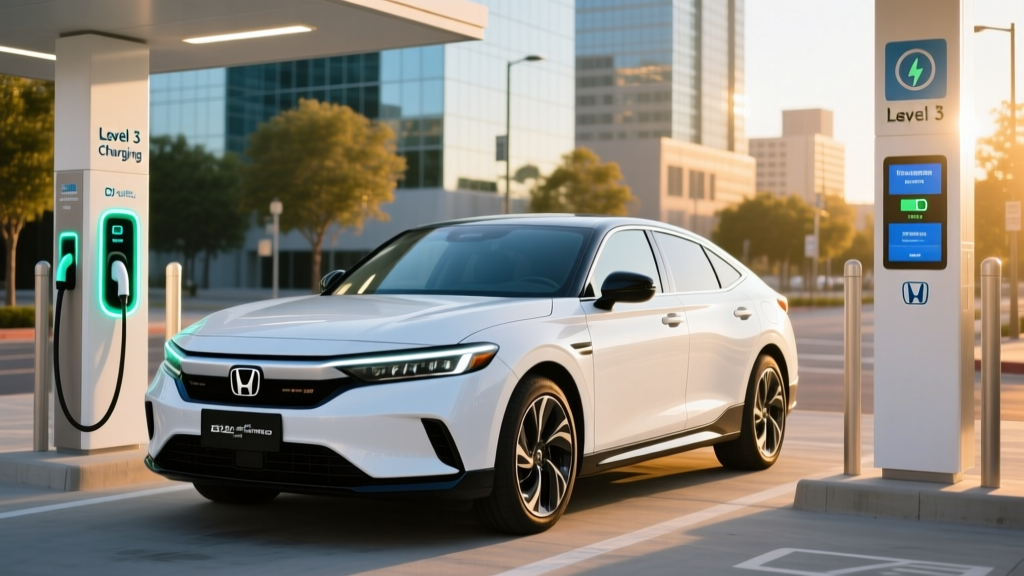
The Prologue supports a peak DC fast-charge rate of 150 kW on CCS-equipped chargers. Honda quotes a 10–80% charge time of approximately 32 minutes under ideal conditions (battery preconditioned, charger capable of sustained output).
Here's the reality of the charging curve: the Prologue peaks near 150 kW only in the 10–30% state-of-charge window. From 30–60%, it sustains roughly 100–120 kW, and above 80%, the rate tapers sharply to protect the battery — often dropping below 40 kW. This means that last 20% can take nearly as long as the first 50%. On road trips, plan your stops around the 10–80% sweet spot and don't bother waiting for a full charge unless you're stopping overnight.
| Charging Level | Power | Miles Added/Hour | Full Charge Time |
|---|---|---|---|
| Level 1 (120V outlet) | 1.4 kW | ~4 mi/hr | ~60+ hours |
| Level 2 (240V home) | 11.5 kW | ~32 mi/hr | ~9 hours |
| DC Fast (150 kW peak) | 150 kW | ~190 mi in 30 min* | 10–80% in ~32 min |
*Peak rate, first 10–30% SoC only. Sustained rate is lower.
For home charging, the Prologue's onboard charger accepts up to 11.5 kW on a Level 2 (240V, 48-amp) circuit. This means a full overnight charge from near-empty in about 9 hours — more than sufficient for daily commuting. You'll need a NEMA 14-50 outlet or a hardwired wall connector installed by a licensed electrician. Budget $800–$2,000 for a professional Level 2 installation depending on your electrical panel's capacity and proximity to the parking spot.
The Prologue uses the CCS1 connector for DC fast charging. Honda has not announced a NACS (Tesla Supercharger) adapter program as of this writing, though GM's broader commitment to NACS may eventually extend to the Prologue. For now, you'll rely on Electrify America, EVgo, ChargePoint, and other CCS networks.
Performance, Interior, and Daily Livability
Powertrain and Driving Dynamics
The front-wheel-drive Prologue EX produces 220 horsepower and 236 lb-ft of torque, reaching 60 mph in roughly 7.2 seconds. That's adequate for merging and passing but not thrilling. The dual-motor AWD variant bumps output to 288 hp and 332 lb-ft, cutting the 0–60 time to approximately 5.8 seconds — a meaningful improvement for highway on-ramps and mountain passes.
Ride quality is a strong suit. The Prologue's GM-sourced suspension is tuned for comfort over sportiness, absorbing potholes and expansion joints with composure. Steering is light and precise, though it lacks the feedback enthusiasts want. The cabin is well-isolated from wind and road noise at highway speeds.
Cargo and Passenger Space
Interior dimensions are competitive for the midsize SUV class:
- Cargo volume: 25.2 cu ft behind the second row, 57.7 cu ft with rear seats folded
- Front legroom: 41.4 inches
- Rear legroom: 38.4 inches
- No front trunk (frunk) — the Ultium platform packaging doesn't allow one, which is a miss versus the Ioniq 5 and Model Y
The rear seat is genuinely comfortable for two adults on longer trips, with decent thigh support and USB-C ports. The flat floor (no transmission tunnel hump) helps the middle-seat passenger.
Tech and Driver Assistance
The Prologue runs an 11.3-inch touchscreen with Google Built-In (Google Maps, Google Assistant, Play Store). It's responsive and logically laid out, though some Honda loyalists miss the brand's previous physical-button approach. Wireless Apple CarPlay and Android Auto are standard on EX and above.
Honda Sensing is standard across all trims and includes adaptive cruise control, lane-keeping assist, automatic emergency braking, and blind-spot monitoring. This is a SAE Level 2 driver-assistance system — it does not drive the car autonomously. You must keep your hands on the wheel and eyes on the road at all times.
Notable tech gaps: no hands-free driving mode (unlike GM's Super Cruise or Ford's BlueCruise), no vehicle-to-load (V2L) capability to power external devices, and the lack of a heat pump reduces cold-weather efficiency.
Warranty and Long-Term Ownership
Honda backs the Prologue with the following warranty coverage:
- Battery: 8 years / 100,000 miles (capacity retention below 70% triggers a claim)
- Powertrain: 5 years / 60,000 miles
- Bumper-to-bumper: 3 years / 36,000 miles
- Roadside assistance: 3 years / 36,000 miles
The battery warranty is competitive but not class-leading — Hyundai offers 10 years/100,000 miles on the Ioniq 5's battery. The 70% capacity-retention threshold is industry standard; if your Prologue's battery degrades below 70% of its original 85 kWh within the warranty period, Honda will repair or replace it.
Long-term battery degradation data for the Ultium platform is still accumulating (the platform launched in 2022), but early evidence from the GMC Hummer EV and Cadillac Lyriq suggests modest degradation of 5–8% over the first 50,000 miles under normal usage patterns.
Pros, Cons, and Who Should Buy the Prologue
- Qualifies for up to $7,500 federal tax credit (verify sourcing status)
- Comfortable ride, spacious rear seat
- Google Built-In infotainment is intuitive
- Built in the USA (Spring Hill, TN)
- Competitive cargo space for the class
- Honda Sensing safety suite is standard
- No frunk (front trunk)
- No heat pump — cold-weather range suffers
- 150 kW peak charge rate trails 200+ kW competitors
- CCS-only (no native NACS / Supercharger access)
- No hands-free highway driving mode
- Starting price near $49K before credit is steep
Who the Prologue Suits Best
Ideal buyer: A suburban commuter or family who values Honda brand trust, wants a comfortable two-row EV SUV for daily driving and occasional road trips, has access to home Level 2 charging, and qualifies for the full federal tax credit. The AWD Touring trim makes sense for buyers in snow-belt states who want the traction and extra power.
Look elsewhere if: You prioritize fast DC charging (the Ioniq 5 peaks at 240 kW), need Supercharger network access (Tesla Model Y), want hands-free highway driving (Ford Mustang Mach-E with BlueCruise), or require a third row (Kia EV9).
How the Prologue Stacks Up Against Key Competitors
| Spec | Honda Prologue AWD | Hyundai Ioniq 5 AWD | Tesla Model Y LR AWD |
|---|---|---|---|
| EPA Range | 283 mi | 290 mi | 311 mi |
| Battery | 85 kWh NMC | 77.4 kWh NMC | ~75 kWh NMC |
| Peak DC Charge | 150 kW | 240 kW | 250 kW |
| 10–80% Time | ~32 min | ~18 min | ~20 min |
| 0–60 mph | 5.8 sec | 5.0 sec | 4.8 sec |
| Cargo (rear seats up) | 25.2 cu ft | 27.2 cu ft | 30.2 cu ft |
| Base AWD MSRP | $50,795 | $50,200 | $49,990 |
| Federal Credit | Up to $7,500* | Up to $7,500* | Up to $7,500* |
*Credit eligibility depends on buyer income, battery sourcing, and current IRS rules. Verify at irs.gov.
The Prologue trails the Ioniq 5 and Model Y in charging speed and cargo space but holds its own in range and comfort. Its strongest competitive advantage is brand loyalty — Honda buyers who trust the nameplate and want a dealer network they know will find the Prologue a lower-friction entry into EV ownership than switching brands.
Frequently Asked Questions
Is the Honda Prologue built by Honda or GM?
The Prologue is built on GM's Ultium platform at the Spring Hill, Tennessee assembly plant — the same facility that produces the Cadillac Lyriq. Honda designed the exterior, interior, and tuned the driving dynamics, but the powertrain, battery, and underlying architecture are General Motors. This partnership is expected to end after the 2027 model year, when Honda transitions to its own dedicated EV platform.
Can I use Tesla Superchargers with the Prologue?
Not natively. The Prologue uses the CCS1 connector. As of 2026, Honda has not announced a NACS adapter or Supercharger access program for the Prologue. You'll charge on Electrify America, EVgo, ChargePoint, and other CCS-compatible networks. If Supercharger access is a priority, consider the Tesla Model Y or a Ford vehicle with Ford's NACS adapter program.
What happens if I don't qualify for the full $7,500 credit?
If the Prologue only meets the battery-component requirement (but not the critical-minerals requirement), you'd receive $3,750 — half the credit. If you exceed the income caps, you receive no credit regardless of the vehicle's eligibility. Some states offer additional rebates or incentives that stack with the federal credit; check your state's energy office or the Alternative Fuels Data Center for local programs.
How does the Prologue handle in snow?
The AWD dual-motor Prologue provides confident traction in light to moderate snow, with 288 hp and electronic traction control. Ground clearance is approximately 8.0 inches, which is adequate for plowed roads but modest for deep accumulation. Pair it with dedicated winter tires for the best cold-weather performance, and precondition the battery while plugged in to preserve range.
Is the Prologue a good first EV?
Yes, with caveats. The Google Built-In infotainment, familiar Honda dealership experience, and standard Honda Sensing suite make the transition from a gas-powered CR-V or Passport relatively painless. The main adjustment will be planning around the 150 kW charge rate on road trips — it's adequate but not leading-edge. Home Level 2 charging is strongly recommended; relying solely on Level 1 (120V) would mean multi-day charge times for a full battery.