Quick Answer: Honda currently offers one all-electric SUV in the U.S.: the Honda Prologue, a midsize crossover built on GM's Ultium platform. For 2026, the Prologue delivers an EPA-estimated 296 miles of range (FWD EX trim), a usable 85 kWh battery, and DC fast charging up to 150 kW. Pricing starts at approximately $48,795 (EX FWD). Honda's upcoming 0 Series SUV (announced for 2027) will bring a ground-up Honda EV architecture. For buyers who need more range or lack reliable home charging, the Honda CR-V Hybrid remains a strong alternative at ~$36,000 with 40 MPG combined.
What Honda EV SUVs Can You Actually Buy?
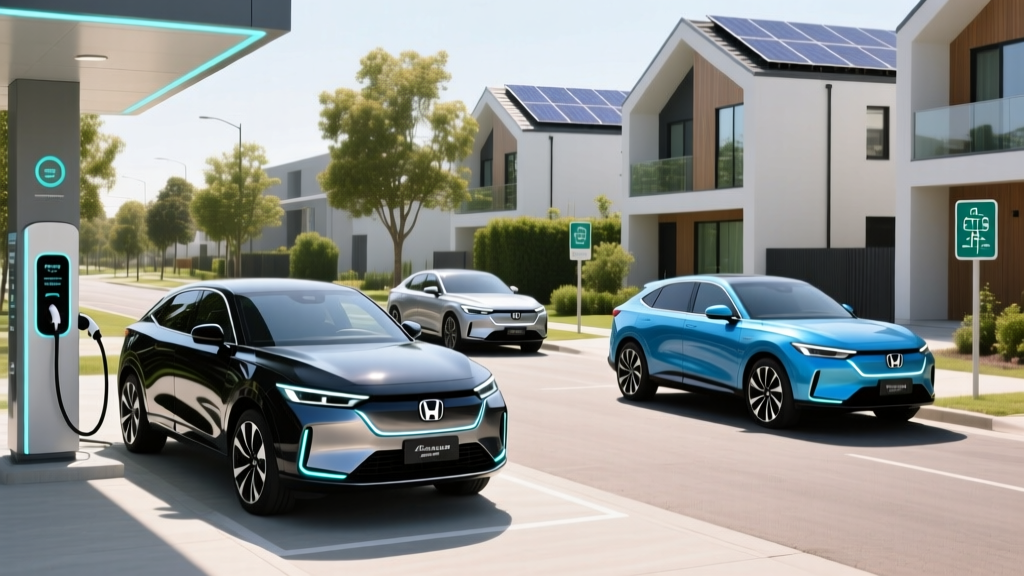
Honda's EV SUV lineup in the U.S. market is currently a single-vehicle story. The Honda Prologue launched for the 2024 model year as a collaborative effort with General Motors, sharing the Ultium battery platform found in the Chevrolet Blazer EV and Cadillac Lyriq. For 2026, Honda carries the Prologue forward with minor trim adjustments but the same core hardware.
Looking ahead, Honda has announced its 0 Series global EV lineup — including a new SUV — built on an entirely new dedicated Honda EV architecture with thinner battery packs and more aerodynamic designs. However, the 0 Series SUV is not expected until 2027 in the U.S., so it is not a vehicle you can buy today.
| Spec | EX (FWD) | Touring (AWD) | Elite (AWD) |
|---|---|---|---|
| MSRP (est.) | $48,795 | $53,295 | $58,495 |
| EPA Range | 296 mi | 281 mi | 273 mi |
| Battery (usable) | 85 kWh, NMC (Ultium) | ||
| Motor / HP | 212 hp (single front motor) | 288 hp (dual motor AWD) | |
| 0–60 mph | ~7.5 sec | ~6.0 sec | |
| Peak DC Fast Charge | 150 kW (CCS) | ||
| 10–80% DC Charge | ~32 minutes | ||
| Level 2 (AC) Charge | 11.5 kW (7.7 kW optional) | ||
| MPGe (combined) | 99 MPGe | 95 MPGe | 93 MPGe |
| Battery Warranty | 8 years / 100,000 miles | ||
Real-World Range Reality: The Prologue's EPA sticker says 296 miles (EX FWD), but expect ~240–260 miles in mixed highway driving at 70 mph. In cold weather (below 32°F), range can drop 20–30%, yielding roughly 190–220 miles. The AWD Touring and Elite trims sacrifice 15–23 miles of EPA range for all-weather traction. Plan your road trips around the lower real-world number — not the sticker.
Prologue Charging: What to Expect at Home and on the Road
The Prologue uses a CCS1 connector for DC fast charging and a J1772 inlet for Level 1/Level 2 AC charging. Honda does not currently use the NACS (Tesla) connector, though adapters are available for Supercharger access through partnerships with various networks.
| Level | Power | Connector | Miles Added per Hour | Typical Use |
|---|---|---|---|---|
| Level 1 | 1.4 kW (120V) | J1772 | ~4 mi/hr | Overnight top-up only |
| Level 2 | 11.5 kW (240V/48A) | J1772 | ~34 mi/hr | Home / workplace daily |
| DC Fast | Peak 150 kW | CCS1 | ~180 mi in 30 min | Road trips |
Charging curve reality: The Prologue peaks at 150 kW only between roughly 10–40% state of charge. Above 60%, the rate tapers significantly — often below 50 kW past 80%. This means a 10–80% charge takes about 32 minutes, but a 10–95% charge can stretch to 55+ minutes. On road trips, plan to charge to 80% and go rather than wait for a full battery.
Home charging setup: A Level 2 home charger (hardwired 48-amp wallbox) will fully recharge the Prologue's 85 kWh battery in roughly 8–9 hours. Installation costs typically range from $500 to $2,500 depending on your electrical panel capacity, distance from panel to garage, and local permit fees. If your home has a 100-amp panel, you may need a $1,500–$3,000 panel upgrade to support a 48-amp circuit — consult a licensed electrician for a site assessment.
Prologue vs. CR-V Hybrid: The Real Cost Comparison
For many Honda SUV shoppers, the more relevant decision isn't "Prologue or competitor" — it's "Prologue or CR-V Hybrid." Here's how the numbers stack up over five years of ownership.
| Cost Factor | Prologue EX (FWD) | CR-V Hybrid Sport-L |
|---|---|---|
| MSRP | $48,795 | $38,500 |
| Federal Tax Credit (§30D) | Up to $7,500 (see eligibility) | $0 (not a BEV) |
| Net Purchase Price | ~$41,295 | $38,500 |
| Fuel/Energy (5 yr, 60k mi) | ~$3,600 (home charging at $0.14/kWh) | ~$7,200 (gas at $3.40/gal, 40 MPG) |
| Maintenance (5 yr) | ~$1,200 | ~$2,800 |
| Insurance (5 yr avg.) | ~$9,500 | ~$7,800 |
| Home Charger Install | ~$1,200 | $0 |
| Est. 5-Year Total | ~$56,795 | ~$56,300 |
Key takeaway: The Prologue's higher sticker price is largely offset by the federal tax credit, dramatically lower fueling costs, and reduced maintenance (no oil changes, fewer brake replacements thanks to regenerative braking). However, EV insurance premiums run 15–25% higher on average. Over five years, the two vehicles land within a few hundred dollars of each other — meaning your decision should hinge on driving patterns and charging access, not total cost alone.
Energy cost note: The $3,600 five-year fueling estimate assumes predominantly Level 2 home charging at the national average residential rate of ~$0.14/kWh. If you rely on public DC fast charging at $0.35–$0.50/kWh, your energy costs could rise to $6,000–$8,500 over five years — erasing much of the fuel savings advantage. This is why home charging access is the single biggest variable in EV ownership economics.
Federal Tax Credit: Does the Prologue Qualify?
The Honda Prologue is assembled in Ramos Arizpe, Mexico, on GM's Ultium platform. Under current IRS §30D rules, eligibility for the up to $7,500 federal tax credit depends on several factors that shift based on battery sourcing and critical-mineral requirements.
- MSRP Cap: SUVs must be under $80,000 — the Prologue qualifies at all trims.
- Buyer Income Cap: Modified AGI must not exceed $150,000 (single), $225,000 (head of household), or $300,000 (joint).
- Battery Component Sourcing: A percentage of battery components must be manufactured or assembled in North America. The Prologue's Ultium battery is produced in the U.S., which has historically satisfied this requirement.
- Critical Minerals: A percentage of critical minerals must be sourced from the U.S. or a free-trade-agreement country. This threshold increases annually and may affect partial or full credit eligibility.
- Point-of-Sale Transfer: Eligible buyers can transfer the credit to the dealer at purchase, reducing the upfront price rather than waiting for a tax refund.
Because sourcing rules tighten each year, verify current eligibility on the IRS qualified vehicles list before purchasing. The credit amount can change mid-year as manufacturers update sourcing documentation. A tax professional can confirm your personal eligibility.
Who Should Buy the Prologue — and Who Should Wait?
Decision Framework: Is the Honda Prologue Right for You?
Buy the Prologue if:
- You have reliable Level 2 home charging (garage or driveway with 240V access)
- Your daily commute is under 80 miles round-trip
- You take road trips fewer than 6–8 times per year and can plan around CCS-equipped DC fast chargers
- You want a midsize EV SUV with Honda branding and GM-proven Ultium battery tech
- You qualify for the §30D federal tax credit, bringing effective price below $42,000
Choose the CR-V Hybrid instead if:
- You live in an apartment or lack access to reliable home/workplace charging
- You frequently drive 300+ mile trips in regions with sparse charging infrastructure
- You live in extreme cold climates where 20–30% winter range loss would be problematic
- You want a lower upfront cost (~$10,000 less) without depending on tax credit eligibility
Wait for the 0 Series SUV if:
- You want a dedicated Honda EV platform (not a rebadged GM product)
- You need 350+ miles of range and faster charging (Honda has targeted 30% better efficiency)
- You can delay your purchase until late 2027
Common Honda EV SUV Misconceptions — Fact-Checked
| Myth | Fact |
|---|---|
| "Honda doesn't make real EVs — they only have hybrids." | The Prologue is a full battery-electric vehicle (BEV) with 296 miles of EPA range, built on GM's Ultium platform. It's a legitimate EV, not a compliance car. |
| "The Prologue is just a rebadged Chevy." | While it shares the Ultium battery and powertrain hardware with the Chevy Blazer EV, Honda tuned the suspension, steering, interior, and software independently. The driving experience and cabin design are distinctly Honda. |
| "EV batteries need replacing every few years." | The Prologue's battery is warrantied for 8 years / 100,000 miles against capacity loss below 70%. Industry data from fueleconomy.gov and long-term fleet studies show most NMC batteries retain 85–90% capacity after 100,000 miles. |
| "I can use Tesla Superchargers with the Prologue." | Not natively. The Prologue uses CCS1. Honda has announced partnerships for Supercharger adapter access, but availability and compatibility vary by network and adapter. Confirm adapter support before relying on it for road trips. |
| "Charging an EV is always cheaper than gas." | Home charging at $0.14/kWh costs roughly $0.04/mile — far cheaper than gas. But public DC fast charging at $0.40+/kWh can cost $0.10–$0.12/mile, approaching the cost of a fuel-efficient hybrid. Your savings depend on where you charge. |
Real-World Ownership: What First-Time Honda EV Buyers Need to Know
If you're coming from a gas Honda and considering the Prologue as your first EV, here are the practical realities that spec sheets don't convey:
Charging access is your #1 priority. Before ordering, confirm you can install a Level 2 charger at home. If you rent or live in a condo, check with your landlord or HOA about EV charging policies. Workplace charging can supplement, but relying on public charging alone is expensive and time-consuming. Use apps like PlugShare or the DOV Alternative Fuels Station Locator to map chargers along your regular routes.
One-pedal driving takes a week to learn. The Prologue offers adjustable regenerative braking via paddle shifters behind the steering wheel. Setting it to the highest regen level enables near one-pedal driving in city traffic — lifting off the accelerator slows the car significantly, often eliminating the need for the brake pedal. Most owners adapt within a few days and prefer it.
Cold weather matters more than you think. If you live in the upper Midwest or Northeast, expect meaningful range reduction in winter. The Prologue uses a liquid-cooled and heated battery pack, which helps, but physics dictates that lithium-ion batteries are less efficient below freezing. Preconditioning the battery while plugged in (using the HondaLink app to warm the cabin and battery before departure) can recover some of that lost range.
Insurance will cost more. EV insurance premiums average 15–25% higher than comparable gas vehicles due to higher repair costs after collisions (battery pack replacement is expensive). Get quotes from your insurer before purchasing to avoid surprises. Some insurers offer EV-specific discounts.
Maintenance is genuinely simpler. No oil changes, no spark plugs, no transmission fluid. Brake pads last significantly longer because regenerative braking handles most deceleration. Expect to replace cabin air filters, wiper blades, tires (EVs are heavier and can wear tires faster), and brake fluid on a normal schedule. Honda's maintenance schedule for the Prologue is notably shorter than for the CR-V.
Frequently Asked Questions
Will Honda make more EV SUVs beyond the Prologue?
Yes. Honda has announced its 0 Series global EV platform, which will include a midsize SUV expected for the 2027 model year in the U.S. Honda also plans a compact EV SUV and additional models through 2030. However, none of these are available to purchase today.
Is the Honda Prologue eligible for the $7,500 federal tax credit in 2026?
The Prologue has qualified for up to $7,500 under §30D in previous years due to its North American-assembled Ultium battery. However, critical-mineral and battery-component sourcing thresholds increase annually. Check the IRS qualified vehicles list for current eligibility before purchasing, and confirm your income falls within the AGI caps.
How long does it take to charge the Prologue at home?
On a Level 2 home charger (11.5 kW), a full charge from empty takes approximately 8–9 hours. Most owners charge from 20–80% overnight, which takes about 4.5 hours. On a standard 120V outlet (Level 1), a full charge takes 60+ hours — Level 1 is only practical for topping up a few miles overnight.
Should I get the Prologue or a Tesla Model Y?
The Model Y offers more range (up to 320 miles EPA), faster DC charging (up to 250 kW), and access to the Supercharger network. The Prologue offers a more traditional Honda interior layout, physical buttons, and Apple CarPlay/Android Auto integration. If charging-network access is your top priority, the Model Y has a clear advantage. If you prefer Honda's ergonomics and dealer experience, the Prologue is competitive at its tax-credit-adjusted price.
Does the Prologue support vehicle-to-home (V2H) or bidirectional charging?
As of the 2026 model year, the Prologue does not support V2H or vehicle-to-load (V2L) functionality. The Ultium platform technically supports bidirectional charging, but Honda has not enabled it in the Prologue. Honda's upcoming 0 Series vehicles are expected to include bidirectional capability.
What's the real highway range of the Honda Prologue?
On the EX FWD trim with an EPA rating of 296 miles, expect approximately 240–260 miles of real-world highway range at 70 mph in moderate temperatures. In cold weather (below 32°F), that drops to roughly 190–220 miles. The AWD Elite trim will deliver about 220–240 miles highway in moderate conditions. These figures are consistent with independent testing data reported by fueleconomy.gov.