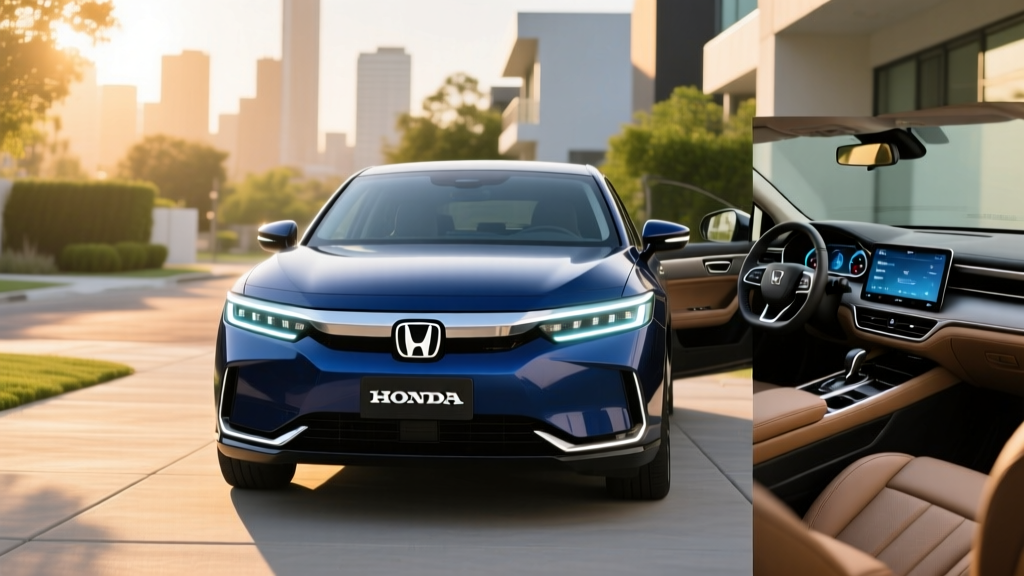
The Honda Prologue occupies a unique space in the midsize electric SUV segment. Built on General Motors' Ultium platform through a Honda-GM partnership, it gives Honda loyalists their first real battery-electric option with a familiar badge. But with the EV market maturing rapidly, the question isn't just whether the Prologue is a competent EV — it's whether buying or leasing makes the most financial sense, especially as federal incentive rules shift. This review covers the 2026 Prologue's real-world range, charging behavior, pricing, and the specific economics of Honda Prologue electric vehicle leasing versus purchasing outright.
Quick Verdict: Who Should Consider the Prologue?
The Prologue works best for suburban families and daily commuters who want a spacious, comfortable electric SUV without the learning curve of a Tesla or the polarizing design of a Hyundai Ioniq 5. Its 308-mile EPA range (FWD), GM-sourced Ultium battery, and Honda Sensing suite make it a competent daily driver. However, its charging speed peaks at 150 kW — adequate but behind the 200+ kW rates of competitors like the Ioniq 5 and Kia EV6. The strongest argument for the Prologue in 2026 may be leasing, where a commercial clean vehicle credit can pass significant savings to the lessee.
Range and Efficiency: EPA Numbers vs. Real-World Driving
Real-World Expectation: ~255–275 miles on mixed highway/city driving; ~220–240 miles in sustained 75+ mph highway travel or cold weather (below 30°F)
| Spec | Prologue EX FWD | Prologue Touring AWD |
|---|---|---|
| Usable Battery Capacity | 85 kWh (NMC) | 85 kWh (NMC) |
| EPA Range | 308 mi | 294 mi |
| EPA Combined MPGe | 95 MPGe | 91 MPGe |
| Energy Consumption | 35 kWh/100 mi | 37 kWh/100 mi |
| Drivetrain | Single-motor FWD | Dual-motor AWD |
| Horsepower | 212 hp | 288 hp |
| 0–60 mph | ~7.8 sec | ~6.2 sec |
The Prologue uses an NMC (nickel manganese cobalt) lithium-ion battery pack supplied by the Ultium Cells joint venture. This chemistry prioritizes energy density over the cycle-life advantages of LFP, which is a reasonable trade-off for a 300+ mile vehicle. Efficiency at 35 kWh/100 mi (FWD) is middle-of-the-pack — the Tesla Model Y achieves around 28 kWh/100 mi, while the Ford Mustang Mach-E sits near 34. In practical terms, expect to spend roughly $0.11–$0.14 per mile on home electricity at national average rates, compared to $0.15–$0.18 per mile for a 25 MPG gas SUV.
Cold-weather impact is real. In sub-freezing conditions, NMC packs lose 20–30% of range due to cabin heating demands and reduced battery chemistry efficiency. The Prologue does include a heat pump (standard on Touring, available on EX), which mitigates some of this loss, but plan for ~220 miles of usable range on a frigid January commute.
Charging Speed: DC Fast Charge and Home Level 2
Charging is where the Prologue reveals its GM-platform DNA — competent but not class-leading. The 85 kWh pack supports a peak DC fast-charge rate of 150 kW, which translates to a 10–80% session in approximately 34 minutes under ideal conditions (battery preconditioned, ambient temperature above 60°F, functional 150+ kW station).
| Charging Level | Power / Rate | Miles Added per Hour | Notes |
|---|---|---|---|
| Level 1 (120V household) | ~1.4 kW | ~4 mi/hr | Emergency/top-up only |
| Level 2 (240V, 48A home) | 11.5 kW | ~33 mi/hr | Full charge in ~8 hours |
| DC Fast Charge | Peak 150 kW | ~210 mi in 30 min | 10–80% in ~34 min; tapers above 80% |
The charge curve matters more than the peak number. Like most Ultium-based vehicles, the Prologue sustains close to its 150 kW peak through roughly 40% State of Charge, then progressively tapers. Expect 80–90 kW average throughput during a typical 10–80% highway stop. That's enough to add roughly 150 miles in 20 minutes — workable for road trips with planned stops, but you'll spend noticeably more time at chargers than an Ioniq 5 owner (which sustains 200+ kW and hits 10–80% in ~18 minutes).
The Prologue ships with a CCS1 connector as standard. Honda has announced NACS adapter availability for Supercharger network access, but confirm adapter compatibility and included-adapter status with your dealer before signing a lease or purchase agreement. For home charging, a 48-amp Level 2 wallbox on a 60-amp circuit delivers the full 11.5 kW onboard charger capacity — budget $800–$1,500 for a quality Level 2 unit (ChargePoint Home Flex, Emporia Vue, or Grizzl-E) plus $500–$2,000 for professional electrician installation depending on panel capacity and run length.
Pricing, Trims, and the Case for Leasing
| Trim | MSRP (2026 est.) | Federal Credit Eligibility | Effective Price with Credit |
|---|---|---|---|
| EX (FWD) | $48,795 | Up to $7,500 (purchase) or $7,500 lease pass-through | ~$41,295 |
| EX (AWD) | $50,795 | Up to $7,500 | ~$43,295 |
| Touring (AWD) | $57,295 | Up to $7,500 (purchase); subject to MSRP cap check | ~$49,795 |
Federal tax credit eligibility for the Prologue depends on how you acquire it. When purchasing, the IRS §30D credit applies — but only if you meet all current requirements: buyer adjusted gross income below $150,000 (single) or $300,000 (joint), vehicle MSRP under $80,000 for SUVs, and the battery meeting critical-mineral and battery-component sourcing thresholds. The Prologue's Ultium battery sourcing has evolved since launch, and Honda dealers should confirm current-year §30D qualification before you commit. The credit can now be transferred to the dealer at point of sale, reducing your purchase price directly.
When leasing, a different mechanism applies. The commercial clean vehicle credit (§45W) goes to the lessor (the leasing company), who can — but is not legally required to — pass the savings to you as a capitalized-cost reduction or lower monthly payment. Honda has historically structured Prologue leases to pass this benefit through, making leasing financially attractive. A typical 36-month lease with the $7,500 credit applied might yield monthly payments $150–$250 lower than an equivalent purchase financing scenario, depending on money factor and residual. However, you won't own the vehicle at lease end, and mileage limits (typically 10,000–12,000 mi/year) apply.
The leasing path also sidesteps the §30D income caps and battery-sourcing requirements entirely — the lessor claims the commercial credit regardless of your personal income level. This makes Honda Prologue electric vehicle leasing particularly attractive for higher-income buyers who would otherwise phase out of the purchase credit.
Interior, Cargo, and Technology
The Prologue's cabin is where Honda's design sensibility shows through the GM underpinnings. A Google Built-in infotainment system runs on an 11.3-inch touchscreen (Touring) or 11-inch (EX), with native Google Maps, Google Assistant, and Play Store apps. Wireless Apple CarPlay and Android Auto are standard across trims. The digital instrument cluster measures 11 inches. Build quality and material choices are solid if not luxurious — think Accord-level, not Acura-level.
Passenger and cargo space are genuine strengths:
- Front legroom: 41.4 inches
- Rear legroom: 37.6 inches
- Cargo behind rear seats: 25.2 cu ft
- Cargo with rear seats folded: 57.7 cu ft
- Front trunk (frunk): Not available — the Ultium platform packaging does not include one
The lack of a frunk is a notable omission compared to the Mustang Mach-E (4.7 cu ft) and Ioniq 5 (0.85 cu ft), though the rear cargo area is competitive. Towing capacity is rated at 1,500 pounds — sufficient for a small utility trailer but not for boat or camper duty.
Driver assistance comes via the Honda Sensing suite, which includes adaptive cruise control with low-speed follow, lane-keeping assist, traffic sign recognition, and blind-spot monitoring. This is SAE Level 2 driver assistance — it requires your hands on the wheel and eyes on the road at all times. It is not autonomous driving. The system is competent for highway cruising but does not offer hands-free operation like GM's Super Cruise or Ford's BlueCruise.
Warranty, Reliability, and Battery Longevity
Honda backs the Prologue with:
- New vehicle limited warranty: 3 years / 36,000 miles
- Powertrain warranty: 5 years / 60,000 miles
- Battery and electric drivetrain warranty: 8 years / 100,000 miles (capacity retention above 70% of original)
The 8-year/100,000-mile battery warranty is industry-standard and matches the federal minimum. Honda's 70% capacity-retention threshold means a battery degrading to 69% of its original 85 kWh (roughly 59 kWh usable) within the warranty window would qualify for repair or replacement. Real-world Ultium degradation data is still accumulating — early reports from GM-platform EVs suggest 5–8% degradation over the first 50,000 miles, which is within normal NMC expectations. Long-term, expect 10–15% degradation over 150,000 miles with typical charging habits (avoiding frequent 100% charges and DC fast-charge exclusivity).
- No hands-free driving — Honda Sensing requires constant supervision
- No frunk for additional cargo storage
- No V2L (vehicle-to-load) or V2H (vehicle-to-home) capability
- 1,500-lb towing limit — not suitable for large trailers
- 150 kW peak charge rate — slower than Ioniq 5, EV6, and Model Y
Prologue vs. the Competition
| Spec | Honda Prologue EX FWD | Hyundai Ioniq 5 SEL RWD | Tesla Model Y LR AWD | Ford Mach-E Select RWD |
|---|---|---|---|---|
| EPA Range | 308 mi | 303 mi | 310 mi | 250 mi (Std Range) / 320 mi (Ext Range) |
| Battery | 85 kWh NMC | 77.4 kWh NMC | ~75 kWh NMC | 70 kWh NMC (Std) / 91 kWh (Ext) |
| Peak DC Charge | 150 kW | 240 kW | 250 kW | 150 kW |
| 10–80% Time | ~34 min | ~18 min | ~25 min | ~35 min |
| 0–60 mph | 7.8 sec | 7.0 sec | 5.0 sec | 6.1 sec |
| Cargo (rear) | 25.2 cu ft | 27.2 cu ft | 30.2 cu ft | 29.7 cu ft |
| Base MSRP | $48,795 | $46,650 | $46,630 | $42,995 |
The Prologue's competitive advantage isn't in any single spec — it's in brand loyalty, dealer network familiarity, and the leasing economics. Honda owners who trust their local dealer and want a no-surprises EV experience will find the Prologue appealing. However, if charging speed is a priority (road-trip-heavy buyers), the Ioniq 5's 240 kW peak and 18-minute 10–80% time are meaningfully better. If cargo space and performance matter most, the Model Y wins both categories. If price is the primary driver, the Mach-E undercuts the Prologue by $5,000+ at base.
Pros, Cons, and Who Should Lease the Prologue
- 308-mile FWD range is competitive for the class
- Spacious cabin with 37.6" rear legroom
- Google Built-in infotainment is responsive and feature-rich
- Honda dealer network provides familiar service experience
- Lease credit pass-through can make monthly payments very competitive
- Heat pump (Touring) improves cold-weather efficiency
- Honda Sensing is a mature, reliable Level 2 ADAS suite
- 150 kW peak charge rate is slower than key competitors
- No frunk — missed cargo opportunity
- No hands-free driving feature (no Super Cruise equivalent)
- No V2L/V2H capability for backup power or camping
- Higher base price than Mach-E and Ioniq 5
- AWD range drops to 294 miles
- 1,500-lb towing capacity limits utility
- You're a current Honda owner who values dealer familiarity and brand trust
- Your daily commute is under 80 miles round-trip and you can charge at home
- You want a spacious family EV without a Tesla or polarizing design
- Leasing economics (with the $7,500 pass-through) make monthly payments attractive vs. purchase
- Your household income exceeds §30D caps, making the lease commercial-credit path more accessible
- You road-trip frequently and need the fastest possible DC charging (choose Ioniq 5 or EV6)
- You need maximum cargo space or towing capacity (choose Model Y or Rivian R1S)
- You want hands-free highway driving (choose GM vehicles with Super Cruise or Ford with BlueCruise)
- Lowest base price is your priority (choose Mach-E or Bolt EUV)
Frequently Asked Questions
What is the real-world range of the Honda Prologue?
The EPA rates the FWD Prologue at 308 miles and AWD at 294 miles. In real-world mixed driving at moderate temperatures, expect 255–275 miles. Sustained highway driving at 75+ mph reduces this to roughly 240–255 miles. In cold weather (below 30°F), plan for 220–240 miles with a heat pump-equipped trim, or 200–220 miles without one.
How fast does the Prologue charge at home and on the road?
At home on a 240V Level 2 charger (48 amps), the Prologue charges at 11.5 kW, adding roughly 33 miles per hour and fully recharging in about 8 hours. On a DC fast charger, it peaks at 150 kW and reaches 10–80% in approximately 34 minutes under ideal conditions, tapering significantly above 80%.
How much does the Honda Prologue cost after tax credits?
The EX FWD starts at approximately $48,795. If you qualify for the full $7,500 federal credit on purchase (meeting income, MSRP, and battery-sourcing requirements), the effective price drops to ~$41,295. On a lease, the lessor claims the commercial credit and may pass it through as a cap-cost reduction — confirm the exact lease structure with your dealer. State and local incentives may stack on top; check your state's EV incentive programs.
Does the Honda Prologue qualify for the $7,500 federal EV tax credit?
For purchases, the Prologue may qualify under IRS §30D if the buyer meets income limits ($150K single / $300K joint AGI), the MSRP is under $80,000 (all Prologue trims qualify as SUVs), and the battery meets current-year critical-mineral and component sourcing requirements. For leases, the commercial clean vehicle credit (§45W) applies to the lessor, and the savings are typically passed to the lessee — without income or sourcing restrictions on the buyer. Always verify current eligibility with your dealer and a tax professional before committing.
Is the Prologue worth leasing over buying?
Leasing often makes financial sense for the Prologue because the commercial credit pass-through sidesteps personal income caps and battery-sourcing uncertainty. You also avoid long-term depreciation risk on a first-generation Honda EV. However, if you drive more than 12,000 miles per year, plan to keep the vehicle 5+ years, or want to modify it, purchasing with the §30D credit (if eligible) may yield better long-term economics. Run both scenarios with your dealer's finance department.
How does the Prologue compare to the Hyundai Ioniq 5 and Tesla Model Y?
The Prologue matches these competitors on range (~300 miles) but trails on DC charging speed (150 kW vs. 240–250 kW) and cargo space. It wins on brand familiarity for Honda loyalists and potentially on lease pricing. The Ioniq 5 is the better road-trip charger; the Model Y offers more cargo room, faster performance, and Supercharger network access; the Prologue offers the most traditional Honda-dealer ownership experience.