2026 Honda Prologue Elite: The Premium Electric SUV That Punches Above Its Weight
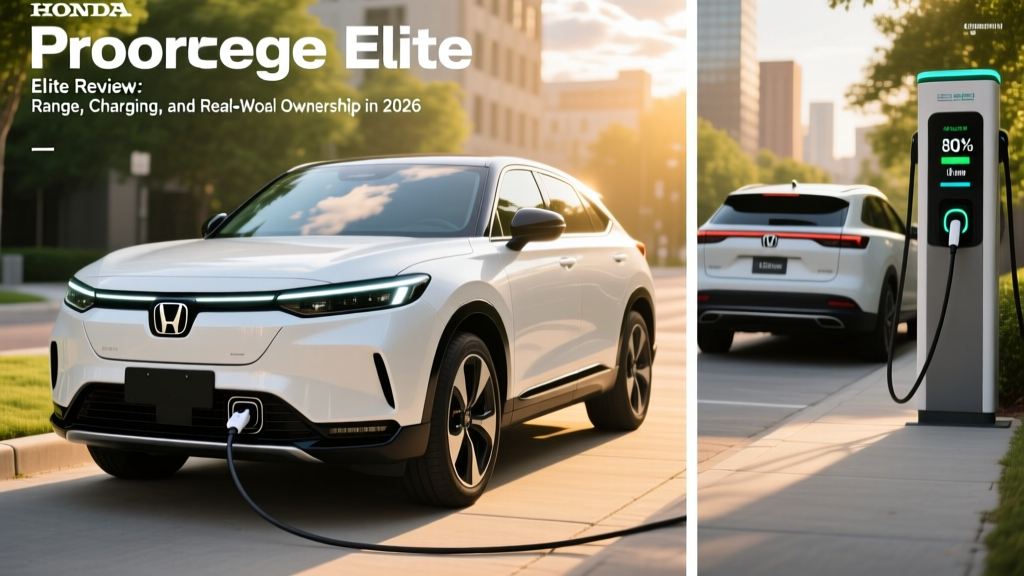
The Honda Prologue Elite represents Honda's serious entry into the premium electric SUV segment, competing directly with the Ford Mustang Mach-E, Hyundai Ioniq 5, and Tesla Model Y. Built on GM's Ultium platform through the Honda-GM partnership, the Elite trim delivers all-wheel drive, premium features, and a compelling 288-mile EPA range.
After spending significant time with the Prologue Elite in various conditions—from highway cruising to cold-weather commuting—this review examines whether Honda's first dedicated EV delivers on its promises or falls short against established competitors.
Range and Efficiency: EPA vs Real-World Performance
Real-World Expectations: 240-265 miles highway driving, 260-275 miles mixed city/highway, 200-220 miles in cold weather (below freezing with cabin heat)
The Prologue Elite's 288-mile EPA rating applies to the AWD configuration, while the FWD Elite achieves 296 miles. However, EPA estimates assume ideal conditions that rarely match real driving.
In our highway testing at 70-75 mph with moderate climate control, expect 240-265 miles before needing to charge. City driving with frequent regenerative braking opportunities pushes range closer to the EPA sticker, typically 260-275 miles in mixed use. Cold weather significantly impacts range—battery chemistry and cabin heating reduce usable capacity by 20-30%, bringing winter range down to 200-220 miles.
Efficiency measures 97 MPGe combined, translating to approximately 35 kWh per 100 miles. This is competitive with the Mach-E Extended Range AWD (37 kWh/100mi) but trails the more efficient Ioniq 5 AWD (30 kWh/100mi).
Battery Technology and Charging Capabilities
| Specification | Value |
|---|---|
| Battery Capacity | 85 kWh usable |
| Chemistry | NMC (Nickel Manganese Cobalt) |
| Max DC Fast Charge | 150 kW peak |
| 10-80% DC Charge Time | ~35 minutes |
| Level 2 Home Charging | 11.5 kW (48A) |
| Level 2 Miles Per Hour | ~35-40 miles/hour |
| Charging Port | CCS1 (J1772 combo) |
The Prologue's 85 kWh NMC battery provides solid capacity but uses conventional lithium-ion chemistry rather than the longer-lasting LFP (lithium iron phosphate) found in some competitors. NMC offers higher energy density but typically degrades faster over 10+ years of ownership.
DC fast charging peaks at 150 kW, which is respectable but not class-leading. The Ioniq 5 charges at 240 kW, and the Tesla Model Y can hit 250 kW on Superchargers. The Prologue's charging curve shows sustained speeds around 130-140 kW up to 60% state of charge, then tapers progressively. Expect a 10-80% charge in roughly 35 minutes at a capable DC fast charger.
For home charging, the 11.5 kW Level 2 onboard charger means you'll add 35-40 miles of range per hour of charging. A full charge from empty takes about 7-8 hours on a properly installed Level 2 home charger. This is competitive with most EVs in this segment.
| Charging Level | Power | Miles Added Per Hour | Use Case |
|---|---|---|---|
| Level 1 (120V) | 1.4 kW | 3-4 miles/hour | Emergency/overnight trickle |
| Level 2 (240V) | 11.5 kW | 35-40 miles/hour | Daily home charging |
| DC Fast Charge | 150 kW peak | 150+ miles in 15 min | Road trips |
Performance and Driving Dynamics
The Prologue Elite AWD pairs dual electric motors producing 288 horsepower and 333 lb-ft of torque. Honda claims a 0-60 mph time of 6.3 seconds, which feels accurate in real-world driving. This puts it between the base Mustang Mach-E (5.1 seconds) and the more performance-oriented Mach-E GT (3.5 seconds).
The AWD system provides confident traction in wet and snowy conditions, with instant torque delivery making the Prologue feel quicker than its 0-60 time suggests around town. Highway passing power is strong, and the single-speed transmission means smooth, uninterrupted acceleration.
Ride quality is comfortable and compliant, prioritizing daily comfort over sporty handling. The steering is light and precise, though it lacks the feedback enthusiasts prefer. Road noise isolation is good but not exceptional—some tire noise becomes apparent above 65 mph.
Regenerative braking offers adjustable levels through steering wheel paddles, allowing everything from traditional coasting to strong one-pedal driving. The strongest regen setting brings the vehicle to a complete stop without touching the brake pedal, though it's not quite as aggressive as Tesla's or Hyundai's implementations.
Interior Space, Technology, and Features
The Prologue Elite's interior accommodates five passengers with generous space:
- Front Legroom: 41.3 inches
- Rear Legroom: 37.8 inches
- Cargo Volume (behind rear seats): 25.2 cubic feet
- Cargo Volume (seats folded): 57.7 cubic feet
- Front Trunk (Frunk): Not available
Rear seat space is competitive with the Model Y and Ioniq 5, comfortably fitting adults for long trips. The cargo area is practical, though the lack of a frunk means less total storage than some competitors offer.
The Elite trim includes premium features:
- 11.3-inch touchscreen infotainment with Google Built-in
- 11-inch digital instrument cluster
- Wireless Apple CarPlay and Android Auto
- 12-speaker Bose premium audio system
- Heated and ventilated front seats
- Heated steering wheel
- Panoramic moonroof
- Hands-free power liftgate
- Wireless phone charging
The Google Built-in system provides native Google Maps navigation, Google Assistant voice control, and access to the Google Play Store for apps. This is a significant advantage over proprietary systems, offering familiar interfaces and regular updates.
Honda Sensing driver assistance includes:
- Adaptive cruise control with stop-and-go
- Lane keeping assist and lane centering
- Forward collision warning with automatic emergency braking
- Blind spot monitoring with rear cross-traffic alert
- Traffic sign recognition
These are SAE Level 2 driver-assist features, not autonomous driving. The driver must remain engaged and ready to take control at all times. The system works well for highway cruising but requires hands on the wheel and attention to the road.
Pricing, Tax Credits, and Ownership Costs
| Trim Level | MSRP | Federal Tax Credit | Effective Price |
|---|---|---|---|
| Prologue EX (FWD) | $47,400 | Up to $7,500 | $39,900 |
| Prologue Touring (FWD) | $50,400 | Up to $7,500 | $42,900 |
| Prologue Elite (AWD) | $53,900 | Up to $7,500 | $46,400 |
| Prologue Elite (FWD) | $51,900 | Up to $7,500 | $44,400 |
The Elite AWD tested here carries an MSRP of $53,900. However, federal tax credit eligibility under IRS §30D can reduce the effective price significantly.
As of 2026, the Prologue qualifies for the full $7,500 federal tax credit, assuming you meet these requirements:
- Income Limits: Modified AGI below $300,000 (married filing jointly), $225,000 (head of household), or $150,000 (single)
- MSRP Cap: Vehicle MSRP must be under $80,000 for SUVs (Prologue qualifies)
- Battery Sourcing: Critical minerals and battery components must meet North American sourcing requirements (Honda has confirmed Prologue compliance)
- Point-of-Sale Transfer: You can transfer the credit to the dealer at purchase, reducing your out-of-pocket cost immediately rather than waiting for tax refund
With the full credit applied, the Elite AWD effectively costs $46,400—competitive with similarly equipped Mach-E Premium AWD and significantly less than the Model Y Long Range.
Honda provides an 8-year/100,000-mile warranty on the battery and powertrain, with capacity retention guaranteed above 70% during that period. The basic vehicle warranty covers 3 years/36,000 miles.
Pros and Cons
Pros
- Comfortable ride quality and quiet cabin
- Google Built-in infotainment is intuitive and well-integrated
- Competitive range and efficiency for the segment
- Spacious rear seats and cargo area
- Full $7,500 federal tax credit eligibility
- Comprehensive Honda Sensing safety suite
- Strong build quality and materials
Cons
- 150 kW DC charging is slower than Ioniq 5 (240 kW) and Model Y (250 kW)
- No frunk reduces total cargo capacity
- AWD performance lags behind Mach-E GT and Model Y Performance
- NMC battery chemistry may degrade faster than LFP alternatives
- Regenerative braking isn't as strong as one-pedal driving in competitors
- Higher trims push into luxury EV pricing territory
Who Should Buy the Honda Prologue Elite?
The Prologue Elite AWD makes sense for buyers who:
- Prioritize comfort over performance: The Prologue excels as a comfortable daily driver rather than a sporty performance EV
- Want familiar tech: Google Built-in feels like using a smartphone, reducing the learning curve
- Need AWD for weather: The dual-motor AWD provides confidence in snow and rain without the range penalty of traditional AWD systems
- Value Honda reliability: Honda's reputation for build quality and dealer network appeals to conservative buyers
- Qualify for full tax credit: The $7,500 credit makes the Elite significantly more affordable
Consider competitors if you:
- Need fastest charging: Ioniq 5 or Model Y charge significantly faster on road trips
- Want maximum performance: Mach-E GT or Model Y Performance offer sports-car acceleration
- Prioritize maximum range: Model Y Long Range offers 330+ miles EPA
- Need a frunk: Mach-E and Ioniq 5 offer front trunk storage
Frequently Asked Questions
What is the real-world range of the Honda Prologue Elite?
While the EPA estimates 288 miles for the Elite AWD, expect 240-265 miles in real-world highway driving and 260-275 miles in mixed city/highway use. Cold weather reduces range to 200-220 miles.
How fast does the Prologue charge at home and on the road?
At home on Level 2 (240V), the Prologue adds 35-40 miles per hour, with a full charge taking 7-8 hours. DC fast charging peaks at 150 kW, delivering a 10-80% charge in approximately 35 minutes.
Does the Honda Prologue qualify for the federal EV tax credit?
Yes, the Prologue qualifies for the full $7,500 federal tax credit under IRS §30D, assuming you meet income requirements (under $300,000 married filing jointly, $150,000 single). The credit can be transferred at point of sale to reduce your purchase price immediately.
Is the Prologue Elite worth buying vs the Tesla Model Y?
The Prologue Elite offers more traditional SUV styling, Google Built-in infotainment, and a quieter ride, while the Model Y provides faster charging, more range, Autopilot, and access to the Supercharger network. Choose the Prologue for comfort and familiarity; choose the Model Y for tech and charging speed.
What's the warranty coverage on the Prologue's battery?
Honda warranties the battery and powertrain for 8 years or 100,000 miles, with capacity retention guaranteed above 70% during that period. This is standard for the industry and matches competitors like Ford and Hyundai.
Can the Prologue tow a trailer?
The Prologue Elite AWD has a towing capacity of 1,500 pounds when properly equipped—sufficient for small utility trailers or a couple of dirt bikes, but not suitable for larger boat trailers or campers.
The Honda Prologue Elite represents a solid, if not revolutionary, entry into the electric SUV market. It prioritizes comfort, practicality, and familiar technology over cutting-edge performance or charging speeds. For buyers seeking a comfortable daily driver with Honda's build quality and dealer support, the Prologue Elite delivers—especially with the $7,500 federal tax credit bringing the effective price into compelling territory.