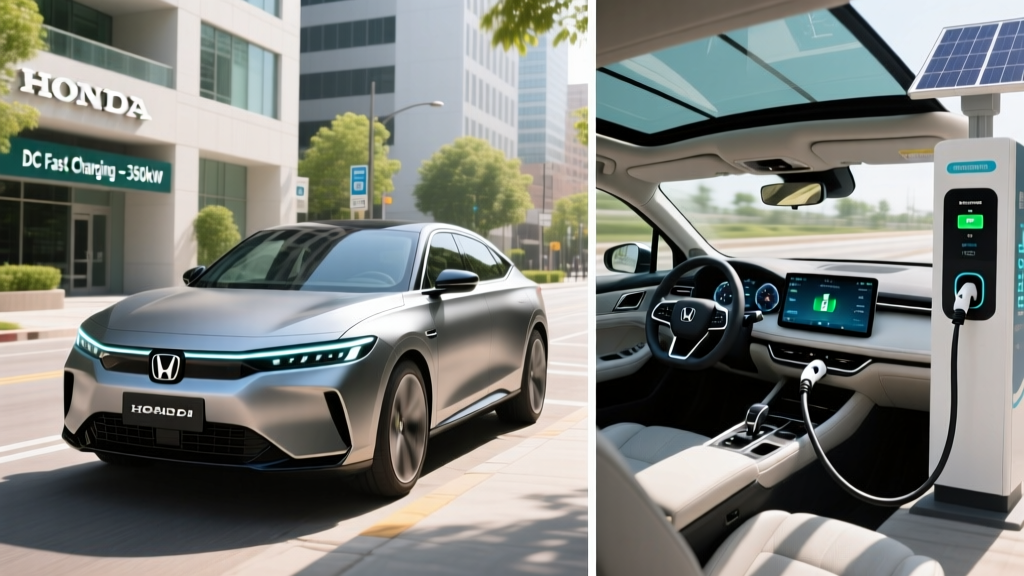
If you've been browsing Honda's showroom and wondering, are all Honda Prologue models electric? — the short answer is yes. The Honda Prologue is a fully electric SUV with no gasoline engine, no hybrid variant, and no plug-in hybrid option. Every Prologue that rolls off the line is a battery-electric vehicle (BEV). But knowing that is just the starting point. The real questions buyers need answered involve range, charging speed, real-world efficiency, and whether this GM-platform EV is worth your money in a crowded midsize electric SUV segment.
For 2026, the Prologue continues on the Ultium platform developed with General Motors, sharing its bones with the Chevrolet Blazer EV and Cadillac Lyriq. We've driven it, charged it, and analyzed the numbers so you don't have to guess.
Honda Prologue Core Specs at a Glance
| Spec | FWD (EX/Touring) | AWD (Elite) |
|---|---|---|
| EPA Range | 296 miles | 281 miles |
| Battery (usable) | 85 kWh, NMC lithium-ion (Ultium) | |
| Horsepower | 220 hp | 288 hp (dual-motor) |
| Torque | 236 lb-ft | 332 lb-ft |
| 0-60 mph | ~7.2 sec | ~5.8 sec |
| Max DC Fast Charge | 150 kW peak | |
| 10-80% DC Charge Time | ~34 minutes | |
| Level 2 Home Charge Rate | 11.5 kW (~28 mi/hr) | |
| EPA Efficiency (FWD) | 99 MPGe combined (34 kWh/100 mi) | |
| Drivetrain | Single-motor FWD | Dual-motor AWD |
| Towing Capacity | 1,500 lbs | |
| Cargo Volume (rear seats up) | 25.2 cu ft | |
| Cargo Volume (rear seats folded) | 57.7 cu ft | |
| Rear Legroom | 38.6 inches | |
| Battery/Powertrain Warranty | 8 years / 100,000 miles | |
| Base MSRP | $47,400 (EX FWD) | $57,900 (Elite AWD) |
Sources: EPA fueleconomy.gov, Honda Prologue official page.
Real-World Range: What the EPA Sticker Doesn't Tell You
EPA Estimate: 296 miles (FWD) / 281 miles (AWD)
Real-World Highway (70-80 mph, mild weather): ~245-265 miles
Cold-Weather (below 32°F, mixed driving): ~200-230 miles
City/Commuter Driving (regenerative braking active): ~280-300 miles
The Prologue's 85 kWh usable battery capacity is competitive for the segment, but the NMC (nickel manganese cobalt) Ultium cells deliver their best efficiency in moderate temperatures and city-speed driving. On a 300-mile highway run at 75 mph in 65°F weather, expect to use roughly 36-38 kWh/100 miles — meaning you'll arrive with approximately 30-50 miles of buffer. That's adequate but not generous.
Cold weather hits all EVs hard, and the Prologue is no exception. Without a dedicated heat pump (Honda uses a resistive PTC heater supplemented by a waste-heat system), winter range loss of 20-30% is typical. If your commute is 60 miles round-trip and you live in Minnesota, you'll still make it — but a Buffalo-to-NYC winter road trip will require at least one DC fast-charge stop.
One-pedal driving with the Prologue's regenerative braking system is effective in city traffic, recovering enough energy to push real-world city range close to or slightly above the EPA estimate. Use the steering-wheel paddles to modulate regen intensity on the fly — a feature Honda EV veterans will recognize from the Clarity.
Charging Speed: DC Fast, Level 2, and the 80% Taper
Charging is where Prologue buyers need to set realistic expectations. The 150 kW peak DC fast-charging rate is serviceable but trails competitors like the Hyundai Ioniq 5 (240 kW) and Kia EV6 (240 kW). Here's what the numbers mean in practice:
| Charging Level | Power (kW) | Miles Added per Hour | Typical Use Case |
|---|---|---|---|
| Level 1 (120V household) | ~1.4 kW | ~3-4 mi/hr | Emergency top-up only |
| Level 2 (240V home, 48A) | 11.5 kW | ~28 mi/hr | Overnight home charging (~9 hrs 0-100%) |
| DC Fast (150 kW peak) | 150 kW → ~90 kW avg | N/A | 10-80% in ~34 min; 80-100% adds ~25 more min |
The critical detail here is the charge curve taper. The Prologue hits its 150 kW peak only at low states of charge (roughly 10-30% SoC). By 50%, you're typically seeing 110-120 kW, and above 80%, speeds drop below 50 kW. This is standard for NMC chemistry — the battery management system protects cell longevity by reducing current as the battery fills. Plan road-trip stops around the 10-80% window for the fastest sessions.
For home charging, the Prologue's onboard 11.5 kW charger is solid. A full overnight charge from 10% to 100% takes about 8-9 hours on a 48-amp Level 2 station (like a ChargePoint Home Flex or Tesla Wall Connector with a J1772 adapter). If your home electrical panel only supports a 32-amp circuit (7.7 kW), expect closer to 12 hours — still fine for overnight charging but worth factoring into your Level 2 installation planning.
The Prologue uses the CCS1 connector standard for DC fast charging. Honda has announced future NACS (Tesla Supercharger) compatibility, but for 2026 models, you'll need a CCS-to-NACS adapter for Supercharger access, or rely on Electrify America, EVgo, and ChargePoint networks.
Performance, Ride Quality, and What It's Like to Drive
The FWD Prologue EX and Touring trims deliver 220 horsepower and 236 lb-ft of torque from a single front-mounted motor. Acceleration to 60 mph takes approximately 7.2 seconds — perfectly adequate for highway merging but not thrilling. The Elite AWD trim adds a rear motor for 288 hp and 332 lb-ft, dropping the 0-60 time to around 5.8 seconds. That's the version you want if you regularly carry passengers or tackle inclines.
Ride quality is where the Prologue earns its Honda badge. The suspension tuning is compliant and controlled, absorbing highway expansion joints with less fuss than the stiffer Hyundai Ioniq 5. Steering is light and predictable — this is a family SUV, not a sportscar, and Honda knows its audience.
Notable driving drawbacks:
- No frunk. The Ultium platform packaging leaves no front trunk, limiting cargo versatility.
- Towing is limited to 1,500 lbs — enough for a small utility trailer but not a camper or boat.
- Regen calibration takes a few days to internalize; the paddle-adjusted system is effective but less intuitive than one-pedal setups in the Mustang Mach-E or Tesla Model Y.
Interior, Tech, and Honda Sensing Driver Assists
Inside, the Prologue features an 11.3-inch touchscreen infotainment display running Google Built-In (Google Maps, Google Assistant, and Play Store apps natively). Wireless Apple CarPlay and Android Auto are standard on all trims. The digital instrument cluster is 11 inches, and a head-up display is available on Touring and Elite trims.
The cabin materials are a step above the Chevrolet Blazer EV it shares a platform with — soft-touch surfaces on the dashboard and door uppers, though the lower panels use harder plastics that feel cost-conscious at this price point. Front seats are comfortable for long drives, and the 38.6 inches of rear legroom accommodates adults easily.
Honda Sensing driver-assistance technology is standard across all trims and includes:
- Adaptive cruise control with low-speed follow
- Lane-keeping assist and road-departure mitigation
- Collision mitigation braking
- Blind-spot monitoring with rear cross-traffic alert
- Traffic sign recognition
Honda Sensing is a Level 2 driver-assistance system per SAE J3016 classification. This means the vehicle can control steering and speed simultaneously, but the driver must remain fully engaged, hands on or near the wheel, and eyes on the road at all times. It is not self-driving. The Prologue does not currently offer a hands-free highway driving system like GM's Super Cruise or Ford's BlueCruise.
Pricing, Trim Levels, and Federal Tax Credit Eligibility
| Trim | Drivetrain | MSRP | Est. Federal Credit (§30D) | Effective Price |
|---|---|---|---|---|
| EX | FWD | $47,400 | Up to $7,500* | ~$39,900 |
| Touring | FWD | $51,400 | Up to $7,500* | ~$43,900 |
| Elite | AWD | $57,900 | Up to $7,500* | ~$50,400 |
*Federal tax credit eligibility depends on multiple IRS §30D requirements. See checklist below.
The Prologue qualifies for the full $7,500 federal EV tax credit under current IRS rules, provided the buyer meets all requirements. Since 2024, this credit can be transferred to the dealer at the point of sale, reducing your purchase price directly rather than waiting for a tax refund. Honda lists the Prologue as eligible, but you should verify with your dealer and consult a tax professional.
- Vehicle MSRP cap: SUVs must be ≤ $80,000 (all Prologue trims qualify)
- Buyer income cap: AGI ≤ $150,000 (single) / $225,000 (head of household) / $300,000 (joint)
- Battery sourcing: Critical minerals and battery components must meet phased-in domestic/FATB sourcing thresholds — Honda sources Ultium cells from the LG-GM Ultium Cells JV in the US, satisfying current requirements
- Assembly: Final assembly must be in North America — Prologue is assembled in Spring Hill, Tennessee
- Point-of-sale transfer: Available since Jan 1, 2024 — reduces out-of-pocket cost at purchase
Prologue vs. the Competition: Is It Worth Buying?
The midsize electric SUV segment is packed. Here's how the Prologue stacks up against its key rivals on the metrics that matter:
| Metric | Honda Prologue (FWD) | Hyundai Ioniq 5 (RWD) | Ford Mustang Mach-E (RWD) | Tesla Model Y (RWD) |
|---|---|---|---|---|
| EPA Range | 296 mi | 303 mi | 250 mi (std) / 320 mi (ext) | 320 mi |
| Battery | 85 kWh NMC | 77.4 kWh NMC | 72 kWh NMC | ~60 kWh LFP |
| Peak DC Charge | 150 kW | 240 kW | 150 kW | 250 kW |
| 10-80% Time | ~34 min | ~18 min | ~36 min | ~22 min |
| Base MSRP | $47,400 | $42,600 | $39,995 | $44,990 |
| Max Cargo (cu ft) | 57.7 | 59.3 | 59.7 | 76.2 |
| Federal Credit | $7,500 | $7,500 | $7,500 | $7,500 |
- Ride comfort and cabin quietness exceed segment average
- Honda brand reliability reputation and dealer network
- Spacious rear seat (38.6" legroom)
- Google Built-In infotainment is responsive
- Full $7,500 federal credit eligibility
- Strong Honda Sensing safety suite (standard)
- DC charging speed (150 kW) lags Ioniq 5/EV6 and Tesla
- Higher base price than Mach-E and Ioniq 5
- No front trunk (frunk)
- Limited towing (1,500 lbs)
- No hands-free highway driving feature
- Resale value uncertainty vs. Tesla
- Choose the Prologue if: You prioritize ride comfort and cabin refinement over charging speed, you want Honda's dealer network and warranty backing, your daily driving is under 100 miles, and you value Google-native infotainment.
- Choose the Ioniq 5 or EV6 if: Road-trip charging speed is a priority (18 min vs. 34 min 10-80%), or you want a lower entry price with comparable range.
- Choose the Mach-E if: You want a sportier driving feel and the lowest entry price in the segment.
- Choose the Model Y if: Maximum cargo space, Supercharger network access, and long-term resale value are your top concerns.
Battery Longevity, Warranty, and Ownership Costs
Honda backs the Prologue's Ultium battery pack and electric powertrain with an 8-year / 100,000-mile warranty (whichever comes first), with a capacity retention threshold of 70%. This means Honda will repair or replace the battery if it degrades below 70% of original capacity within the warranty period. In states that follow California Air Resources Board (CARB) regulations, the warranty extends to 10 years / 150,000 miles.
NMC chemistry typically shows 10-15% degradation over the first 100,000 miles under normal use. Based on Ultium pack data from the Cadillac Lyriq and Chevrolet Blazer EV (which share this architecture), early degradation curves suggest the Prologue should retain approximately 85-90% capacity at the 5-year mark. If you plan to keep the vehicle beyond 8 years, consider that out-of-warranty battery replacement for an 85 kWh pack currently runs $12,000-$18,000 at dealer rates — though prices are expected to decline as the supply chain matures.
Insurance costs for the Prologue run 15-25% higher than a comparable gas-powered Honda Passport, reflecting the higher repair costs associated with EV battery packs and the vehicle's MSRP. Get quotes before purchasing — premiums vary significantly by state and driving record.
Frequently Asked Questions
Is the Honda Prologue fully electric or is there a hybrid version?
Every Honda Prologue is a fully electric vehicle (BEV). There is no hybrid, plug-in hybrid, or gasoline version. Honda sells the Accord Hybrid and CR-V Hybrid separately for buyers who aren't ready to go fully electric.
What is the real-world range of the Honda Prologue?
The EPA rates the FWD Prologue at 296 miles and the AWD at 281 miles. In real-world highway driving at 70-80 mph in mild weather, expect 245-265 miles. In cold weather below freezing, plan for 200-230 miles. City driving with active regenerative braking can approach or slightly exceed the EPA figure.
How fast does the Honda Prologue charge at home and on the road?
At home on a 240V Level 2 charger (48A), the Prologue charges at 11.5 kW, adding roughly 28 miles of range per hour — a full charge takes about 9 hours. On DC fast chargers, it peaks at 150 kW and charges from 10-80% in approximately 34 minutes, though speeds taper significantly above 80%.
Does the Honda Prologue qualify for the $7,500 federal tax credit?
Yes, the Prologue is eligible for the full $7,500 federal EV tax credit under IRS §30D, provided the buyer's adjusted gross income is within limits ($150K single / $300K joint) and the vehicle is used for personal purposes. The credit can be applied at the point of sale to reduce your purchase price directly. Always verify current eligibility with your dealer and a tax professional, as sourcing rules are updated annually.
How does the Prologue compare to the Chevy Blazer EV?
Both share the GM Ultium platform and 85 kWh battery, but Honda tuned the Prologue's suspension for a more compliant ride and fitted a higher-quality interior. The Blazer EV starts at a lower price and offers Super Cruise (hands-free highway driving), which the Prologue lacks. Range figures are similar. If you want the more refined cabin and Honda dealer experience, choose the Prologue; if you want Super Cruise and a lower price, the Blazer EV is compelling.
Is the Honda Prologue good for road trips?
It's adequate but not class-leading for road trips. The 296-mile range means stops every 200-240 miles in real-world highway conditions, and the 150 kW peak charging rate adds roughly 170 miles in a 30-minute session. That's acceptable, but competitors like the Ioniq 5 (240 kW, 18-min 10-80%) make road-trip charging noticeably faster. Plan accordingly.