Quick Answer: Is an Electric Honda SUV Right for You?
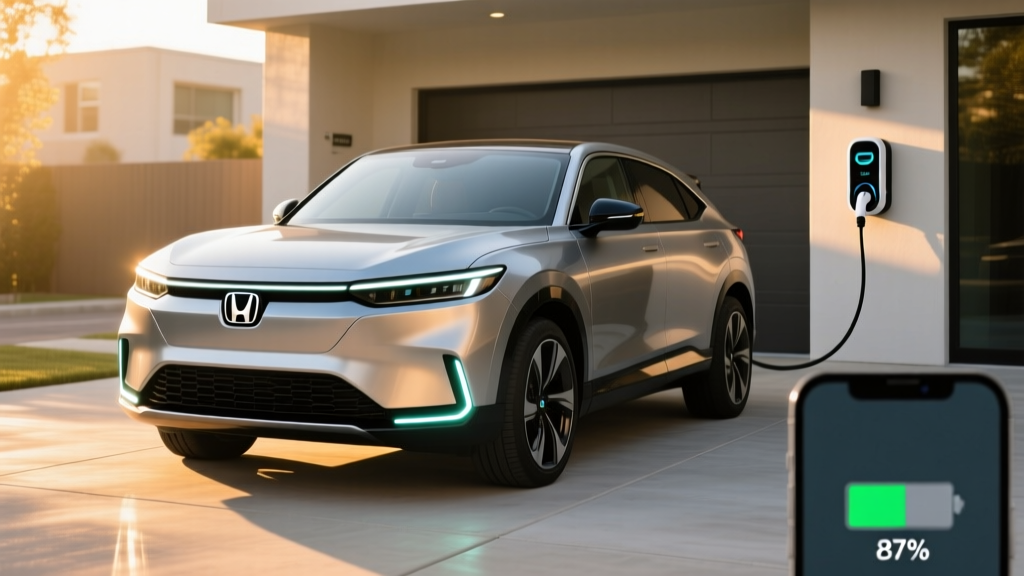
The 2026 Honda Prologue is Honda's only all-electric SUV, offering an EPA-estimated 296 miles of range (FWD Elite trim), 85 kWh usable battery capacity, and DC fast charging up to 150 kW. Starting around $47,400, it qualifies for partial or full federal tax credits depending on your income and the vehicle's battery-sourcing compliance. If you need a three-row family hauler or want to avoid range concerns entirely, the Honda Pilot Hybrid or CR-V Hybrid remain strong alternatives. The Prologue is best for buyers with reliable home Level 2 charging who drive under 250 miles daily and want Honda's dealership network for service.
2026 Honda Prologue: The Electric Honda SUV at a Glance
Honda entered the EV market with the Prologue, built on General Motors' Ultium platform — the same architecture underpinning the Chevrolet Blazer EV and Cadillac Lyriq. For 2026, Honda has refined the software and expanded the trim lineup, but the core hardware remains proven. Here is what the numbers actually look like across trims:
| Spec | EX (FWD) | EX (AWD) | Touring (AWD) | Elite (FWD) | Elite (AWD) |
|---|---|---|---|---|---|
| Base MSRP | $47,400 | $50,400 | $54,400 | $52,900 | $57,900 |
| EPA Range | 296 mi | 281 mi | 281 mi | 296 mi | 273 mi |
| Battery (usable) | 85 kWh, NMC lithium-ion | ||||
| Horsepower | 212 hp | 288 hp | 288 hp | 212 hp | 288 hp |
| 0–60 mph | ~7.6 sec | ~6.0 sec | ~6.0 sec | ~7.6 sec | ~6.0 sec |
| Peak DC Fast Charge | 150 kW | ||||
| 10–80% DC Charge | ~35 minutes | ||||
| Level 2 Charge Rate | 11.5 kW (AC) | ||||
| MPGe (combined) | 95 MPGe | 90 MPGe | 90 MPGe | 95 MPGe | 87 MPGe |
| Cargo (rear seats up) | 25.2 cu ft | ||||
| Battery Warranty | 8 years / 100,000 miles | ||||
Source: EPA fueleconomy.gov, Honda Newsroom. MSRP excludes destination. Range and MPGe figures are EPA estimates; real-world results vary with temperature, speed, and terrain.
Real-World Range: What the EPA Sticker Doesn't Tell You
The 296-mile EPA figure on the FWD Elite is achievable in mild weather at suburban speeds. But real-world conditions shift the math considerably:
- Highway driving at 75 mph: Expect 240–260 miles before needing a charge. Aerodynamic drag dominates at sustained speed, reducing efficiency by roughly 15–18% versus the EPA combined cycle.
- Cold weather (below 32°F): Range drops 20–30%. A 296-mile Prologue may deliver 210–235 miles in freezing conditions, even with the heat pump running. The NMC chemistry is less cold-resilient than LFP alternatives.
- Mixed suburban commute (45–55 mph): This is where the Prologue shines — expect 280–300 miles, sometimes exceeding the EPA number thanks to regenerative braking in stop-and-go traffic.
Prologue Range Reality Check: EPA 296 mi (FWD) / 273 mi (AWD Elite). Plan for 240 mi on highway road trips and 210 mi in deep winter. If your daily round-trip commute exceeds 200 miles, consider whether a mid-trip charge stop fits your routine.
The Prologue's 85 kWh battery is competitive for the class but smaller than the Hyundai Ioniq 5's available 77.4 kWh pack paired with its more efficient 800V architecture. The practical consequence: the Prologue charges more slowly on DC fast chargers than rivals with higher peak rates.
Charging the Prologue: Speed, Cost, and Infrastructure
Understanding charging is the single biggest factor in EV satisfaction. Here is how the Prologue performs across all three charging levels:
| Level | Power (kW) | Miles Added per Hour | Typical Use Case |
|---|---|---|---|
| Level 1 (120V household) | ~1.4 kW | ~4–5 mi/hr | Emergency / overnight top-off only |
| Level 2 (240V home) | 11.5 kW | ~36 mi/hr | Primary daily charging — full charge in ~7.5 hrs |
| DC Fast Charge | Peak 150 kW | ~190 mi in 30 min | Road trips — 10–80% in ~35 min |
The Charging Curve Reality
The Prologue peaks at 150 kW, but like all EVs, it doesn't sustain that rate. The charge curve tapers significantly above 80% State of Charge (SoC). From 10% to 50%, you'll see close to peak speeds. From 80% to 100%, the rate drops to under 30 kW to protect the NMC battery. This is why EV drivers typically charge to 80% on road trips — the last 20% takes nearly as long as the first 60%.
The Prologue uses the CCS1 connector for DC fast charging. Honda has confirmed future models will adopt the NACS (Tesla) connector, but the 2026 Prologue still requires a CCS adapter for Tesla Supercharger access. Honda provides a complimentary adapter program — confirm availability at purchase.
Home Charging Installation: What to Budget
| Component | Low Estimate | High Estimate |
|---|---|---|
| Level 2 charger hardware (40–48A) | $350 | $700 |
| Electrician labor (standard install) | $500 | $1,200 |
| Electrical panel upgrade (if needed) | $1,500 | $3,500 |
| Permit / inspection fees | $100 | $400 |
| Total (no panel upgrade) | $950 | $2,300 |
| Total (with panel upgrade) | $2,450 | $5,800 |
Most Prologue owners will need a dedicated 50-amp or 60-amp circuit. If your home's electrical panel is already near capacity (common in older homes with 100-amp service), a panel upgrade to 200 amps adds significant cost. Get a quote from a licensed electrician before committing to the vehicle. The federal Alternative Fuel Vehicle Refueling Property Credit (IRC §30C) may offset up to $1,000 of home charger installation — check IRS guidelines for eligibility.
Prologue vs. Gas and Hybrid Honda SUVs: The Cost Breakdown
Honda's SUV lineup forces a real decision: the all-electric Prologue, the CR-V Hybrid, or the conventional CR-V/Pilot. Here is how the five-year ownership math compares for a buyer driving 12,000 miles per year:
| Category | 2026 Prologue EX AWD | 2026 CR-V Hybrid AWD | 2026 CR-V Gas AWD |
|---|---|---|---|
| Base MSRP | $50,400 | $38,950 | $35,550 |
| Est. Federal Tax Credit (§30D) | Up to $7,500* | $0 | $0 |
| Effective Purchase Price | ~$42,900 | $38,950 | $35,550 |
| Fuel / Energy (5 yrs) | $3,200–$4,800† | $6,100 | $8,400 |
| Maintenance (5 yrs) | ~$1,200 | ~$2,800 | ~$3,400 |
| Insurance (5 yrs est.) | ~$9,500 | ~$7,800 | ~$7,500 |
| Estimated 5-Year Total | $56,800–$58,400 | $55,650 | $54,850 |
* §30D credit eligibility depends on MSRP caps ($80,000 for SUVs), buyer income limits ($150K single / $300K joint), and battery critical-mineral sourcing. Verify at IRS.gov and confirm with a tax professional. Point-of-sale transfer is available at participating dealers.
† Energy cost range assumes home charging at $0.14/kWh (lower bound) vs. 30% public DC fast charging at $0.40/kWh (upper bound). Gas costs assume $3.50/gallon and EPA-rated MPG.
Key Takeaways from the Numbers
- The Prologue wins on fuel savings: Home charging at national average electricity rates costs roughly $0.05–0.07 per mile versus $0.14 per mile for the gas CR-V. Over 60,000 miles, that's $4,200–$5,200 in savings.
- Insurance erodes some of the savings: EV insurance premiums run 15–25% higher than equivalent gas models due to repair costs and battery replacement risk. Get quotes before buying.
- Maintenance is genuinely cheaper: No oil changes, no transmission fluid, no spark plugs. Brake pads last significantly longer due to regenerative braking. Expect 50–65% lower maintenance costs.
- The tax credit is the swing factor: With the full $7,500 credit, the Prologue's effective price drops to near the CR-V Hybrid. Without it, the premium is harder to justify purely on economics.
Federal Tax Credit Eligibility: What Actually Applies in 2026
§30D New Clean Vehicle Credit Requirements
- Vehicle MSRP cap: SUVs must be under $80,000 — all Prologue trims qualify.
- Buyer income cap: Modified AGI under $150,000 (single), $225,000 (head of household), or $300,000 (married filing jointly).
- Battery sourcing: Increasing percentages of critical minerals and battery components must be sourced from the US or free-trade-agreement countries. This requirement tightens annually — the Prologue's GM-sourced Ultium battery has faced partial compliance challenges. Confirm current-year status at purchase.
- Point-of-sale transfer: You can transfer the credit to the dealer at purchase, reducing your out-of-pocket cost immediately rather than waiting for a tax refund.
- One vehicle per taxpayer per year; VIN must be reported on your tax return.
The critical-mineral sourcing rules have caused several EVs to lose partial or full credit eligibility between model years. Honda's Prologue, sharing the Ultium platform with GM, has maintained partial eligibility in recent years. Always verify the specific VIN's credit status on fueleconomy.gov before signing paperwork.
Common Misconceptions About the Electric Honda SUV
| Myth | Fact |
|---|---|
| "The battery will need replacing in 5 years for $20,000." | NMC batteries in liquid-cooled packs like the Prologue's typically lose 10–15% capacity over 8 years. The 8-year/100,000-mile warranty covers defects and excessive degradation (below 70% capacity). Full replacement is rare and covered if within warranty. |
| "I can charge on any standard outlet and be fine." | Level 1 (120V) adds only ~4 miles per hour — roughly 40 miles overnight. For a 296-mile battery, a full Level 1 charge takes over 60 hours. A Level 2 home charger is practically mandatory for daily use. |
| "EVs are worse in winter." | EVs start instantly in cold weather (no cranking a gas engine), and the Prologue's heat pump is more efficient than resistive heating. However, range does drop 20–30% in sub-freezing temps. Preconditioning the battery while plugged in mitigates both range loss and charging slowdowns. |
| "The Prologue is just a rebadged Chevy." | While the Prologue shares GM's Ultium platform and battery with the Blazer EV, Honda tuned the suspension, steering, interior materials, and software independently. The driving experience and infotainment are distinctly Honda, though some switchgear is shared. |
| "Public charging is unreliable everywhere." | Network reliability varies enormously. Electrify America and EVgo have improved uptime significantly. Tesla Superchargers (with adapter) remain the gold standard at ~99% uptime. Plan road trips around known-reliable stations using PlugShare or A Better Routeplanner. |
Decision Framework: Should You Buy the Prologue?
Choose the Honda Prologue (Electric SUV) If:
- You have access to Level 2 home charging (garage or driveway with a 240V circuit).
- Your daily driving is under 200 miles round-trip, with occasional road trips under 400 miles.
- You qualify for the §30D federal tax credit (check income and sourcing requirements).
- You want Honda's dealer network for service and warranty work.
- You value lower per-mile fuel costs and reduced maintenance over 5+ years.
Choose the CR-V Hybrid Instead If:
- You live in an apartment or lack reliable home charging access.
- You regularly drive more than 300 miles in a single day without time to stop and charge.
- You live in a region with extreme cold (consistent sub-0°F winters) and no garage.
- Your budget is under $40,000 and you cannot absorb the Prologue's higher upfront cost even after tax credits.
- You tow more than 1,500 lbs (the Prologue is not rated for significant towing).
Choose the Pilot Hybrid or Passport If:
- You need three rows of seating — the Prologue seats only five.
- You need over 4,000 lbs of towing capacity.
First-Time EV Buyer Checklist
If the Prologue is your first electric vehicle, here are the practical steps to take before signing:
- Get an electrician quote for Level 2 installation. Do this before visiting the dealer. Know whether your panel can support a 50A/60A circuit or needs upgrading.
- Get insurance quotes. Call your insurer with the Prologue's VIN. EV premiums can be $200–$500/year higher than gas equivalents.
- Verify tax credit eligibility for the specific VIN. Check fueleconomy.gov and confirm with your tax professional. Rules change annually.
- Test the commute. Drive the Prologue on your actual daily route. Note the energy consumption displayed on the dash (kWh/100mi) — multiply your daily miles by that rate to estimate real daily energy use.
- Download charging apps. Install PlugShare, your local utility's EV rate program app, and the HondaLink app. Familiarize yourself with public charger locations along your common routes.
- Understand preconditioning. Set departure times in the HondaLink app so the battery warms to optimal temperature before you drive or fast-charge — especially critical in cold weather.
Frequently Asked Questions
Is the Honda Prologue a good electric SUV for families?
Yes, for families of four or fewer. The Prologue offers 25.2 cu ft of cargo space behind the rear seats (56.1 cu ft with seats folded), a comfortable rear seat with ample legroom, and standard Honda Sensing safety features. It earned strong safety marks from NHTSA. However, it seats only five — families needing a third row should look at the Pilot Hybrid or a three-row EV like the Kia EV9.
How long does the Prologue battery last?
Honda warranties the battery for 8 years or 100,000 miles against defects and capacity loss below 70%. Real-world data from similar Ultium-based EVs suggests 10–15% degradation over the first 8 years under normal use. Many EV batteries outlast the vehicle itself. Avoid frequent DC fast charging above 80% SoC and avoid letting the battery sit at 0% or 100% for extended periods to maximize longevity.
Can I charge the Prologue at Tesla Superchargers?
Not natively — the 2026 Prologue uses a CCS1 connector. However, Honda has offered a complimentary NACS adapter program that allows access to Tesla's Supercharger network (V3 and V4 stalls). Confirm adapter availability and compatibility at your dealer before purchase. With the adapter, you gain access to over 20,000 additional fast-charging stalls nationwide.
What does it cost to charge the Prologue at home?
At the US average residential electricity rate of ~$0.16/kWh, a full 85 kWh charge costs approximately $13.60 and adds roughly 280 real-world miles. That works out to about $0.05 per mile — compared to $0.13–0.15 per mile for the gas CR-V at $3.50/gallon. Over 12,000 miles per year, home charging saves roughly $1,000–$1,200 annually versus gasoline. Time-of-use utility plans can reduce costs further by charging overnight at off-peak rates.
How does the Prologue compare to the Hyundai Ioniq 5 or Tesla Model Y?
The Ioniq 5 offers faster DC charging (800V architecture, 10–80% in ~18 minutes vs. the Prologue's ~35 minutes) and slightly more cargo space. The Model Y has longer range (up to 330 mi EPA), native Supercharger access, and a more mature software ecosystem but limited Honda-style dealer service support. The Prologue's advantage is Honda's familiar ergonomics, strong safety ratings, and a dealer network that many first-time EV buyers find reassuring.
Does the Prologue qualify for the $7,500 federal tax credit?
Eligibility varies by model year and battery sourcing compliance. The Prologue has qualified for partial or full credit in recent years, but critical-mineral sourcing requirements tighten annually. Always verify the specific vehicle's eligibility on fueleconomy.gov and confirm your income falls within §30D limits ($150K single / $300K joint). The credit can be transferred to the dealer at point of sale, reducing your purchase price directly.
Ownership costs, tax credit rules, and electricity rates vary by location and personal circumstances. This guide uses national averages and 2026 model-year data. Consult a licensed electrician for home charging installation and a tax professional for credit eligibility. Always verify current specifications at Honda.com and fueleconomy.gov before purchasing.