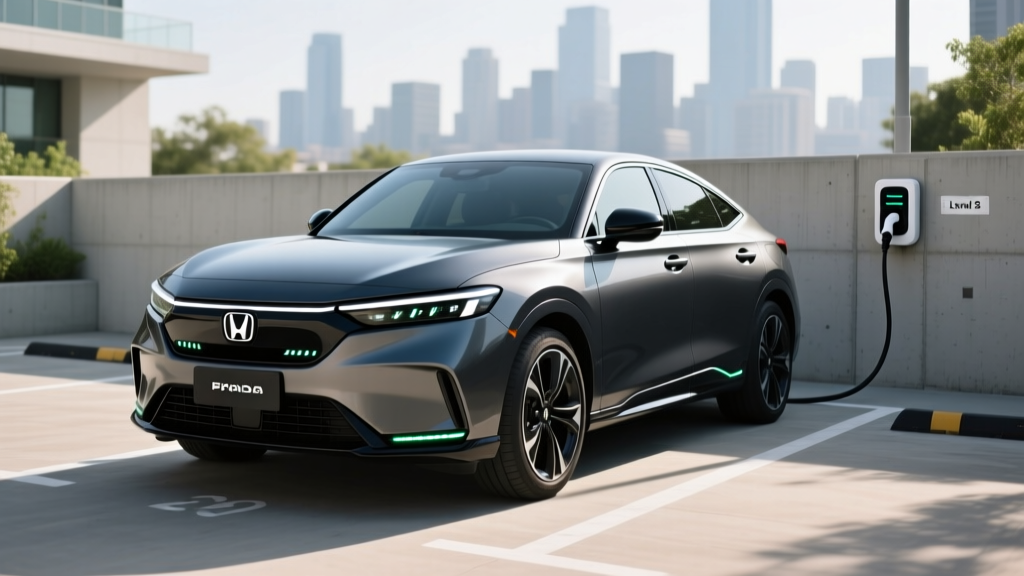
If you have been searching for Honda Prologue deals, timing and trim selection matter more than you might expect. Honda's first mass-market electric SUV, built on General Motors' Ultium platform, has settled into its second full model year for 2026 with meaningful pricing adjustments and a clearer picture of real-world ownership costs. With the federal EV tax credit still in play for qualifying buyers and Honda's aggressive dealer incentives, the Prologue has moved from "interesting experiment" to a legitimate value proposition in the midsize electric SUV segment.
But the sticker price is only part of the equation. Below, we dissect every number that matters — EPA range, real-world efficiency, DC fast-charging curves, home charging costs, and the exact tax-credit mechanics that can drop your effective price by thousands. Whether you are cross-shopping the Hyundai Ioniq 5, Ford Mustang Mach-E, or Tesla Model Y, this guide gives you the data to evaluate a Prologue deal on its merits.
2026 Honda Prologue Pricing: Trims, MSRP, and Effective Cost After Credits
Honda restructured the Prologue lineup for 2026, sharpening its value positioning against rivals that have also seen price cuts. The three-trim strategy remains — EX, EX-L, and Elite — but base prices have been trimmed to stay competitive. Here is the current MSRP breakdown before destination and dealer adjustments:
| Trim | Drivetrain | MSRP | Est. After §30D Credit* |
|---|---|---|---|
| EX (FWD) | Single-motor FWD | $47,400 | $39,900 |
| EX (AWD) | Dual-motor AWD | $49,400 | $41,900 |
| EX-L (FWD) | Single-motor FWD | $50,400 | $42,900 |
| EX-L (AWD) | Dual-motor AWD | $52,400 | $44,900 |
| Elite (AWD only) | Dual-motor AWD | $57,900 | $50,400 |
*Effective price assumes full $7,500 federal tax credit under IRS §30D. Eligibility depends on buyer income, battery sourcing, and MSRP caps. See the tax credit section below for details.
Range and Efficiency: EPA Sticker vs. the Real World
The Prologue's headline range number depends heavily on which trim and drivetrain you choose. The FWD EX maximizes efficiency, while the dual-motor AWD Elite trades range for power and features.
| Trim/Drivetrain | EPA Range | MPGe (City/Hwy/Combined) | kWh/100 mi |
|---|---|---|---|
| EX FWD | 296 mi | 114 / 94 / 104 | 32 |
| EX AWD | 281 mi | 108 / 90 / 99 | 34 |
| EX-L FWD | 296 mi | 114 / 94 / 104 | 32 |
| EX-L AWD | 281 mi | 108 / 90 / 99 | 34 |
| Elite AWD | 270 mi | 103 / 87 / 95 | 35 |
Source: EPA Fueleconomy.gov
Battery Specs: Chemistry, Capacity, and Degradation Outlook
The 2026 Prologue uses General Motors' Ultium battery platform, shared with the Chevrolet Blazer EV and Cadillac Lyriq. Here are the specifics:
- Usable battery capacity: 85 kWh (gross ~89 kWh)
- Chemistry: NMC (nickel-manganese-cobalt) lithium-ion — chosen for its higher energy density versus LFP
- Thermal management: Active liquid cooling and heating
- Warranty: 8 years / 100,000 miles (battery and powertrain), with a capacity retention threshold of 70% over the warranty period
The NMC chemistry gives the Prologue its competitive range in a package that fits a midsize SUV footprint, but it comes with trade-offs. NMC cells are more sensitive to sustained high states of charge than LFP batteries. Honda recommends daily charging to 80–85% and saving 100% charges for road trips. Long-term degradation data for the Ultium platform is still accumulating (the platform launched in 2022), but early indicators from the Lyriq suggest 5–8% capacity loss over the first 50,000 miles, which is within industry norms for NMC packs.
Charging Speed: DC Fast Charging and Home Level 2
Charging speed is where the Prologue's GM underpinnings show their strengths — and one notable limitation. Here is the complete charging profile:
| Charging Level | Power / Rate | Time / Range Added |
|---|---|---|
| Level 1 (120V household) | ~1.4 kW | ~3–4 miles per hour |
| Level 2 (240V, 48A home charger) | 11.5 kW | ~33 miles per hour; full charge in ~8 hrs |
| DC Fast Charge (peak) | 155 kW max | 10–80% in ~33 minutes |
The 155 kW peak DC fast-charging rate is adequate but not class-leading. Competitors like the Hyundai Ioniq 5 (peak 240 kW, 10–80% in ~18 minutes) and Tesla Model Y (peak 250 kW, ~15 minutes) charge significantly faster on compatible stations. In practice, the Prologue sustains roughly 130–150 kW up to about 50% state of charge, then tapers progressively. On a road trip, budget 35–40 minutes for a realistic 10–80% stop including plug-in and authentication time.
For home charging, the Prologue's 11.5 kW onboard AC charger is a genuine strength. With a properly installed 48-amp Level 2 wallbox (requiring a 60-amp dedicated circuit), you will recover a full battery overnight in about 8 hours. This is faster than the Tesla Model Y's 11.5 kW rate and comparable to the best in class. Honda includes a portable dual-voltage charge cord with every Prologue, which can deliver up to 24 amps on a 240V NEMA 14-50 outlet — adequate for overnight charging at roughly 7 kW.
Performance and Drivetrain: What 288 HP Feels Like
| Spec | FWD | AWD (Dual-Motor) |
|---|---|---|
| Horsepower | 212 hp | 288 hp |
| Torque | 236 lb-ft | 333 lb-ft |
| 0–60 mph | ~8.0 sec | ~5.9 sec |
| Top Speed | 115 mph (electronically limited) | 115 mph |
| Towing Capacity | 1,500 lbs | 1,500 lbs |
The AWD dual-motor variant is the one to drive if you care about acceleration. The 5.9-second 0–60 time puts it in the same ballpark as the Ford Mustang Mach-E Select AWD and noticeably quicker than the base Tesla Model Y RWD. The instant torque delivery from the Ultium platform makes the Prologue feel eager around town, even if it won't pin you to the seat like a Model Y Performance.
One area where the Prologue falls short is towing. The 1,500-pound limit is modest — fine for a small utility trailer or a pair of dirt bikes, but not enough for a camper or boat. If towing is a priority, the Ford F-150 Lightning or Rivian R1S are in a different class entirely. Even the Hyundai Ioniq 5 offers a 2,300-pound tow rating with the tow package.
Interior, Cargo, and Technology
The Prologue's cabin borrows heavily from GM's design language (it is, after all, a rebadged Blazer EV underneath), but Honda has applied its own materials and software tuning. Key dimensions:
- Cargo volume (behind rear seats): 25.2 cu ft
- Cargo volume (rear seats folded): 57.7 cu ft
- Front legroom: 41.4 inches
- Rear legroom: 38.5 inches
- Front headroom: 39.6 inches
- Rear headroom: 38.2 inches
Cargo space is competitive with the Ioniq 5 (27.2 / 59.3 cu ft) but trails the Model Y (30.2 / 72.1 cu ft) and Mach-E (29.7 / 59.7 cu ft). The Prologue does not have a front trunk (frunk), which is a missed opportunity given the Ultium platform's packaging flexibility — the Blazer EV also lacks one.
Infotainment: An 11.3-inch touchscreen runs Google Built-In (Google Maps, Google Assistant, and Play Store apps). This is a strong system for EV route planning, as Google Maps natively factors in charging stops and battery state. Wireless Apple CarPlay and Android Auto are standard on all trims.
Driver Assistance: Honda Sensing is standard across the lineup, including adaptive cruise control, lane-keeping assist, automatic emergency braking, and blind-spot monitoring. The Elite trim adds a surround-view camera and a more advanced parking assist system. Importantly, the Prologue's driver-assist suite is SAE Level 2 — it provides steering and speed assistance, but the driver must remain fully engaged and keep hands on the wheel. This is not autonomous driving.
Federal Tax Credit Eligibility: Can You Claim §30D?
The Prologue's eligibility for the $7,500 federal EV tax credit under IRS §30D is one of its strongest selling points — but qualification is not automatic. Here is the checklist based on current IRS rules:
- MSRP cap: The Prologue must be under $80,000 for SUVs (all trims qualify — the Elite at $57,900 is well within the cap).
- Buyer income cap: Modified adjusted gross income (MAGI) must not exceed $150,000 (single), $225,000 (head of household), or $300,000 (joint filers).
- Battery sourcing: A percentage of critical minerals and battery components must be sourced from the US or free-trade-agreement partners. The Ultium platform's North American battery assembly (in Tennessee and Michigan) helps the Prologue meet current thresholds, but the exact credit amount can depend on the specific battery pack and model year. Honda has confirmed the Prologue qualifies for the full $7,500 as of the 2026 model year.
- Point-of-sale transfer: Since 2024, buyers can transfer the credit to the dealer at the point of sale, reducing the purchase price directly rather than waiting to claim it on their tax return. This effectively makes the Prologue's starting price $39,900 for the EX FWD at the dealership.
Source: IRS.gov — Credits for New Clean Vehicles
Prologue vs. Competitors: Where Does It Win?
| Spec | Honda Prologue EX AWD | Hyundai Ioniq 5 SEL AWD | Ford Mach-E Select AWD | Tesla Model Y Long Range |
|---|---|---|---|---|
| Base MSRP | $49,400 | $49,950 | $46,995 | $48,990 |
| EPA Range | 281 mi | 290 mi | 250 mi | 330 mi |
| Battery (usable) | 85 kWh | 77.4 kWh | 70 kWh | 78.1 kWh |
| DC Fast Peak | 155 kW | 240 kW | 150 kW | 250 kW |
| 10–80% Time | ~33 min | ~18 min | ~35 min | ~20 min |
| 0–60 mph | 5.9 sec | 5.1 sec | 5.5 sec | 4.8 sec |
| Cargo (rear up) | 25.2 cu ft | 27.2 cu ft | 29.7 cu ft | 30.2 cu ft |
| §30D Credit | $7,500 | $7,500 | $3,750* | $7,500 |
*Mach-E partial credit reflects current battery-component sourcing; verify at fueleconomy.gov.
The Prologue's advantage is effective price after credits. A $49,400 EX AWD dropping to $41,900 is compelling, especially with Honda's reputation for reliability and the included Electrify America charging. Where it loses ground is charging speed (the Ioniq 5 is meaningfully faster on road trips) and cargo space (the Model Y dominates). If your priority is the lowest cost of entry into a well-equipped AWD electric SUV with strong dealer support, the Prologue's post-credit pricing makes it hard to beat.
✓ Pros
- Full $7,500 §30D credit eligibility
- Strong 11.5 kW Level 2 home charging
- Google Built-In infotainment
- Spacious rear seat (38.5" legroom)
- Honda dealer network and resale value
- Included Electrify America charging
✗ Cons
- No heat pump — cold-weather range suffers
- 155 kW peak DC charging is below class leaders
- No front trunk (frunk)
- Cargo space trails Model Y and Mach-E
- 1,500-lb tow rating is low for the segment
- GM-sourced interior materials feel mid-tier at Elite pricing
Who Should Buy the Honda Prologue?
Choose the Prologue if:
- You want a mainstream-brand electric SUV with a large dealer network and strong resale value.
- You qualify for the full $7,500 federal tax credit and want to apply it at point of sale.
- You charge primarily at home overnight and rarely take road trips exceeding 200 miles one-way.
- You value rear-seat comfort and a smooth, quiet ride over sporty handling.
- You prefer Google Maps native integration for EV route planning.
Look elsewhere if:
- You take frequent long road trips and need the fastest DC charging available (Ioniq 5 or Model Y).
- You live in a cold climate and need maximum winter range (the lack of a heat pump is a real disadvantage).
- Maximum cargo volume or towing capacity is a priority.
- You want a frunk for additional storage.
Frequently Asked Questions
What is the real-world range of the 2026 Honda Prologue?
The EPA rates the FWD Prologue at 296 miles and AWD trims at 270–281 miles. In real-world highway driving at 70 mph, expect 245–265 miles for FWD and 230–250 miles for AWD. In cold weather below freezing, reduce those figures by 20–30%.
How fast does the Prologue charge at home and on the road?
At home on a 240V Level 2 charger (48A), the Prologue charges at 11.5 kW, adding about 33 miles per hour and reaching a full charge in roughly 8 hours. On DC fast chargers, it peaks at 155 kW and charges from 10–80% in approximately 33 minutes.
How much does the Prologue cost after the federal tax credit?
With the full $7,500 §30D credit applied at point of sale, the 2026 Prologue starts at an effective $39,900 for the EX FWD trim. The popular EX-L AWD drops to approximately $44,900. Eligibility depends on buyer income and current IRS sourcing rules.
Does the 2026 Honda Prologue qualify for the $7,500 federal EV tax credit?
Yes — as of the 2026 model year, the Prologue qualifies for the full $7,500 credit, provided the buyer meets income caps ($150K single / $300K joint) and the vehicle's battery sourcing meets current thresholds. The credit can be transferred to the dealer at point of sale. Always verify at IRS.gov before purchasing.
Is the Honda Prologue worth buying over the Tesla Model Y or Hyundai Ioniq 5?
The Prologue wins on effective price (after the $7,500 credit), Honda's dealer network, and home charging speed. The Model Y offers more range (330 mi) and cargo space, while the Ioniq 5 charges significantly faster on road trips. If cost and dealer familiarity are your top priorities, the Prologue is a strong pick. If road-trip charging speed or maximum range matters more, shop the competitors.
What is the Prologue's battery warranty?
Honda covers the Prologue's battery and electric powertrain for 8 years or 100,000 miles, whichever comes first. The warranty guarantees the battery will retain at least 70% of its original capacity during the coverage period.