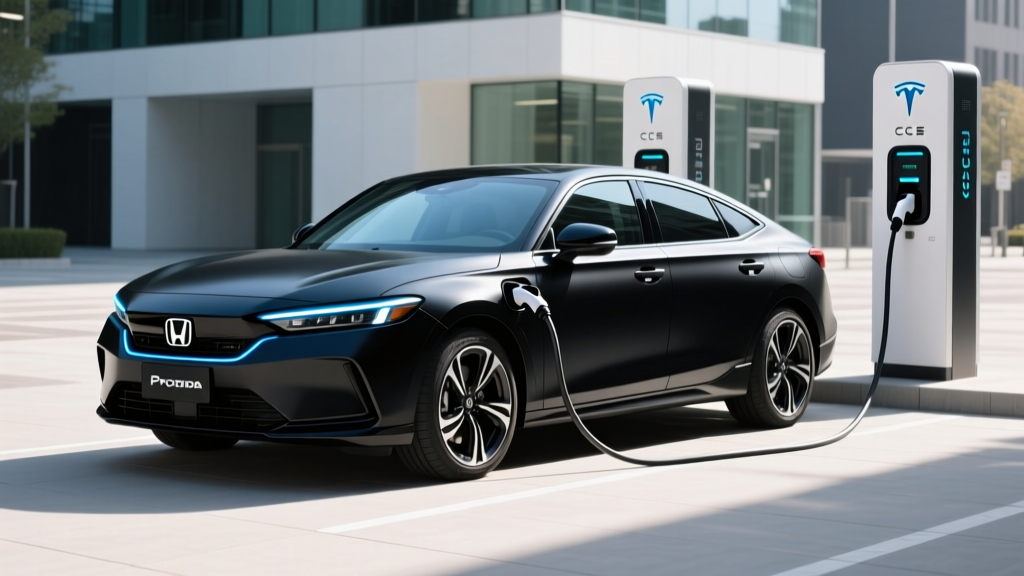
The Honda Prologue has been Honda's gateway to the mainstream EV market since its debut on GM's Ultium platform, and for 2026 it remains one of the most approachable midsize electric SUVs available. If you've been searching for a "Honda Prologue black" edition, you're likely eyeing the available Crystal Black Pearl paint on the EX-L or Elite trims — a sleek, popular colorway that pairs well with the Prologue's clean, bluff-nosed styling. But beyond the aesthetics, the real question is whether this Chevy Equinox EV sibling delivers where it counts: real-world range, usable charging speeds, and ownership value.
We've driven, charged, and analyzed the 2026 Honda Prologue across multiple trims. Here's the data-driven breakdown.
Quick Verdict: Who the Prologue Is For
Honda positioned the Prologue as a comfortable, tech-forward family hauler rather than a performance EV. The available black exterior (Crystal Black Pearl) on EX-L and Elite trims gives it an upscale presence, but underneath, it's an 85 kWh Ultium-based crossover with respectable but not class-leading efficiency. If you're cross-shopping the Hyundai Ioniq 5, Kia EV6, or Ford Mustang Mach-E, the Prologue trades peak charging speed and sporty dynamics for a smoother ride, intuitive infotainment, and Honda's reliability reputation.
Range, Battery, and Real-World Efficiency
| Spec | FWD (EX / EX-L) | AWD (EX-L / Elite) |
|---|---|---|
| EPA Range | 308 miles | 281 miles |
| Battery (usable) | 85 kWh (NMC) | 85 kWh (NMC) |
| EPA Efficiency | 114 MPGe / 29 kWh/100mi | 104 MPGe / 32 kWh/100mi |
| Drivetrain | Single-motor FWD | Dual-motor AWD |
The Prologue uses an NMC (nickel manganese cobalt) lithium-ion battery supplied through the Honda-GM Ultium partnership. NMC chemistry offers higher energy density than LFP (lithium iron phosphate), which keeps the pack compact, but it does mean Honda recommends charging to 80% for daily use and saving 100% for longer trips to preserve long-term battery health. Honda includes a battery management system with active thermal conditioning — critical for both longevity and sustained fast-charging performance.
Efficiency at 29 kWh/100 miles (FWD) places the Prologue in the middle of the midsize EV SUV pack. For comparison, the Hyundai Ioniq 5 RWD achieves roughly 30 kWh/100mi, while the Ford Mustang Mach-E Extended Range RWD sits around 28 kWh/100mi. The Prologue is competitive but not class-leading in efficiency.
Charging Speeds: DC Fast, Level 2, and Level 1
Charging capability is where the Prologue shows its Ultium-platform roots — adequate for most owners, but not at the cutting edge of 2026's fastest-charging EVs.
| Charging Level | Max Power | Speed / Time | Connector |
|---|---|---|---|
| Level 1 (120V) | ~1.4 kW | ~3–4 miles/hour | NACS (2026 models) |
| Level 2 (240V home) | 11.5 kW | ~29 miles/hour; full charge in ~9 hrs | NACS (2026 models) |
| DC Fast Charge | 150 kW peak | 10–80% in ~35 minutes | NACS (native, 2026 models) |
Key charging details to understand:
- kW vs kWh: kW (kilowatts) measures charging power — how fast energy flows into the battery. kWh (kilowatt-hours) measures battery capacity — how much energy the battery stores. The Prologue's 85 kWh battery charged at a peak 150 kW rate.
- Charge curve taper: The 150 kW peak rate is not sustained for the entire session. The Prologue ramps quickly to ~150 kW between roughly 10–40% state of charge, then progressively tapers. From 80–100%, charging slows dramatically to protect battery health. This is why manufacturers quote 10–80% times rather than full-charge times.
- NACS adoption: For 2026, Honda has transitioned the Prologue to the North American Charging Standard (NACS) connector, replacing the CCS1 port on 2024–2025 models. This grants native access to Tesla Supercharger stations (now open to non-Tesla EVs), significantly expanding the public charging network available to Prologue owners.
- Preconditioning: The Prologue's navigation-linked battery preconditioning warms the pack when a DC fast charger is set as a destination, optimizing charge speed in cold weather. Always use this feature for fastest possible charging.
At 150 kW peak, the Prologue trails competitors like the Hyundai Ioniq 5 (peak ~240 kW on 800V architecture, 10–80% in ~18 minutes) and the Kia EV6 (~239 kW). For home-centric owners who DC fast-charge only a few times per month, the Prologue's 35-minute session is manageable. For frequent road-trippers, it's a meaningful disadvantage.
Performance: 0-60, Horsepower, and Drivetrain
| Spec | FWD | AWD |
|---|---|---|
| Horsepower | 212 hp | 288 hp |
| Torque | 236 lb-ft | 332 lb-ft |
| 0–60 mph | ~7.8 sec | ~5.9 sec |
| Top Speed | 115 mph | 115 mph |
| Towing Capacity | Not rated | 1,500 lbs |
The Prologue prioritizes comfort over sportiness. The FWD model's 212 hp is adequate for highway merging and city driving but won't thrill. The AWD dual-motor setup with 288 hp delivers a genuinely punchy 5.9-second 0–60 time that makes the Prologue feel quick off the line — a hallmark of electric torque delivery. Ride quality is compliant and well-damped, absorbing rough pavement better than the firmer-tuned Ioniq 5 or EV6.
Regenerative braking is adjustable via steering-wheel paddles, allowing everything from coasting to near one-pedal driving. However, the Prologue doesn't quite achieve true one-pedal operation at low speeds — you'll still need the brake pedal for complete stops, unlike the stronger regen in a Nissan Ariya or Tesla Model Y.
Interior, Cargo, and Technology
The Prologue's cabin is a strong point, especially in Elite trim (available in Crystal Black Pearl). Materials are a step above the Chevrolet Equinox EV it shares a platform with, with soft-touch surfaces, heated and ventilated front seats (Elite), and a panoramic moonroof on top trims.
| Dimension | Measurement |
|---|---|
| Front Legroom | 42.6 in |
| Rear Legroom | 37.1 in |
| Cargo (behind 2nd row) | 25.2 cu ft |
| Cargo (2nd row folded) | 57.7 cu ft |
| Frunk | None |
Tech highlights:
- 11.3-inch touchscreen with Google Built-In (Google Maps, Google Assistant, Play Store) — responsive and intuitive, a strong infotainment system.
- 11-inch digital instrument cluster with customizable EV-specific displays (energy flow, regen level, range).
- Wireless Apple CarPlay and Android Auto on all trims.
- Honda Sensing suite: Adaptive cruise control with stop-and-go, lane-keeping assist, collision mitigation braking, blind-spot monitoring, rear cross-traffic alert.
- Wireless phone charging pad (EX-L and Elite).
- 12-speaker Bose premium audio (Elite trim).
Notable drawbacks:
- No front trunk (frunk) — a missed opportunity for cable storage and small items.
- Cargo space at 25.2 cu ft is smaller than the Hyundai Ioniq 5 (27.2 cu ft) and Ford Mustang Mach-E (29.7 cu ft).
- No rear-seat entertainment screens or V2L (vehicle-to-load) capability.
- Honda Sensing is a capable Level 2 driver-assist system, but it does not offer hands-free driving like GM's Super Cruise or Ford's BlueCruise. The driver must keep hands on the wheel at all times.
Pricing, Trims, and Federal Tax Credit Eligibility
| Trim | Drivetrain | MSRP | Est. After §30D Credit |
|---|---|---|---|
| EX | FWD | $48,795 | ~$41,295* |
| EX-L | FWD | $51,095 | ~$43,595* |
| EX-L | AWD | $53,095 | ~$45,595* |
| Elite | AWD | $59,295 | ~$51,795* |
*Estimated prices assume full §30D credit eligibility. Actual credit depends on battery sourcing, buyer income, and MSRP caps. Verify at IRS.gov.
The Crystal Black Pearl exterior is available on EX-L and Elite trims at no additional cost. The Elite in black with the 20-inch alloy wheels and panoramic roof is the most visually compelling Prologue configuration — and the one most shoppers searching for a "Honda Prologue black" are envisioning.
Federal Tax Credit Eligibility (§30D)
The Honda Prologue may qualify for up to $7,500 under the IRS §30D New Clean Vehicle Credit, but eligibility is not automatic. Key requirements for 2026:
- MSRP cap: SUVs must have an MSRP at or below $80,000. All Prologue trims qualify.
- Buyer income cap: Modified adjusted gross income must not exceed $150,000 (single), $225,000 (head of household), or $300,000 (married filing jointly).
- Battery sourcing: The credit is split into two halves — $3,750 for critical minerals and $3,750 for battery components, each with escalating domestic/free-trade sourcing thresholds. Because the Prologue uses a GM Ultium battery, its sourcing profile may qualify for partial or full credit, but this changes annually. Check the fueleconomy.gov tax credit lookup for the latest determination.
- Point-of-sale transfer: Eligible buyers can transfer the credit to the dealer at purchase, reducing the upfront price rather than waiting for a tax refund.
Pros, Cons, and How It Compares
Pros
- Comfortable, quiet ride quality
- Intuitive Google Built-In infotainment
- Honda Sensing safety suite standard
- Native NACS connector (2026) — Supercharger access
- Competitive pricing after potential tax credit
- Strong Honda brand reliability and resale reputation
- Crystal Black Pearl available on popular trims
Cons
- 150 kW DC fast charging is slow vs rivals (Ioniq 5: ~240 kW)
- No front trunk (frunk)
- Cargo space below class average
- No hands-free driving system (only Level 2 assist)
- Efficiency is midpack, not best-in-class
- AWD towing limited to 1,500 lbs
- Real-world highway range noticeably below EPA sticker
Key competitor comparison:
- vs Hyundai Ioniq 5: The Ioniq 5 charges dramatically faster (~18 min 10–80%), offers more cargo space, and has a more distinctive design. The Prologue wins on ride comfort and infotainment simplicity.
- vs Ford Mustang Mach-E: The Mach-E is sportier to drive and has more cargo room, but its interior materials feel cheaper. The Prologue is the more refined cruiser.
- vs Chevrolet Equinox EV: The Prologue's platform twin is cheaper and offers similar range, but the Honda has a noticeably better interior, better sound insulation, and stronger resale value prospects.
- vs Tesla Model Y: The Model Y has superior range, faster Supercharging, and a larger charging network. The Prologue counters with a more traditional SUV layout, physical controls, and a less polarizing ownership experience.
Warranty and Long-Term Ownership
| Coverage | Term |
|---|---|
| Basic (bumper-to-bumper) | 3 years / 36,000 miles |
| Powertrain | 5 years / 60,000 miles |
| Battery (capacity retention) | 8 years / 100,000 miles (≥70% capacity) |
| Corrosion | 5 years / unlimited miles |
| Roadside Assistance | 3 years / 36,000 miles |
The 8-year/100,000-mile battery warranty with a 70% capacity retention threshold is industry-standard and consistent with the federal mandate for emissions-related components. NMC batteries typically lose 10–15% capacity over 150,000 miles under normal use with proper charging habits (avoiding frequent 100% charges and extreme heat exposure). Honda's Ultium-sourced pack benefits from active liquid thermal management, which helps mitigate degradation.
For long-term cost of ownership, the Prologue's Honda badge should translate to strong resale value — historically one of Honda's key advantages over competitors like Chevrolet and Hyundai. Insurance premiums for the Prologue are moderate for the EV segment; expect roughly $150–$200/month depending on your profile and location.
Frequently Asked Questions
What is the real-world range of the Honda Prologue?
The EPA rates the FWD Prologue at 308 miles and AWD at 281 miles. In real-world highway driving at 70 mph, expect approximately 255–275 miles (FWD) or 230–250 miles (AWD). Cold weather (below 30°F) can reduce range by an additional 15–25%, bringing the AWD model down to roughly 200–220 miles in harsh winter conditions.
How fast does the Honda Prologue charge?
On a DC fast charger, the Prologue peaks at 150 kW, reaching 10–80% in approximately 35 minutes. At home on a Level 2 (240V) charger at 11.5 kW, it adds roughly 29 miles of range per hour, with a full charge taking about 9 hours. Level 1 (120V) trickle charging adds only 3–4 miles per hour and is best used for overnight top-ups only.
Does the Honda Prologue qualify for the federal EV tax credit?
The Prologue may qualify for up to $7,500 under IRS §30D, depending on battery component and critical mineral sourcing, your income level, and the vehicle's MSRP (all trims fall under the $80,000 SUV cap). Eligibility changes as sourcing requirements tighten annually. Check fueleconomy.gov and consult a tax professional before relying on the credit in your purchase decision.
Is the Honda Prologue worth buying over the competition?
The Prologue is worth serious consideration if you prioritize ride comfort, intuitive tech, Honda's reliability reputation, and NACS Supercharger access. It's less compelling if fast DC charging, maximum cargo space, or hands-free driving are top priorities — the Hyundai Ioniq 5, Ford Mustang Mach-E, or Tesla Model Y may serve those needs better.
Does the 2026 Honda Prologue have a frunk?
No. The Prologue does not include a front trunk. All cargo space is in the rear (25.2 cu ft behind the second row, 57.7 cu ft with seats folded). This is a notable omission compared to competitors like the Ford Mustang Mach-E and Hyundai Ioniq 5, both of which offer front storage.
Can I get the Honda Prologue in black?
Yes. Crystal Black Pearl is available on the EX-L and Elite trims at no additional charge. The EX base trim may have a more limited color palette depending on model year and region. The black exterior paired with the Elite's 20-inch wheels and panoramic roof creates the most premium-looking Prologue configuration.