Quick Verdict: Honda's First EV Is Competent, Not Class-Leading
The 2025 Honda Prologue arrives as Honda's first mass-market battery-electric vehicle, built on General Motors' Ultium platform shared with the Chevrolet Blazer EV and Cadillac Lyriq. It's a midsize two-row SUV that prioritizes comfort, space, and straightforward usability over headline-grabbing performance or cutting-edge battery chemistry. For Honda loyalists transitioning from a CR-V or Passport, the Prologue feels immediately familiar — which is both its greatest strength and its most significant limitation in an increasingly competitive EV segment.
With an EPA-estimated range of up to 296 miles, DC fast charging peaking at 150 kW, and a starting MSRP of $47,400 (before any incentives), the Prologue slots into the thick of the midsize electric SUV market. But does it do enough to justify its price against the Hyundai Ioniq 5, Tesla Model Y, and its platform-mate, the Blazer EV? This review breaks down every spec that matters.
Range, Battery, and Efficiency
The Prologue is offered with two drivetrain configurations, each affecting range differently:
| Specification | FWD (EX/EX-L) | AWD (EX/EX-L/Touring) |
|---|---|---|
| EPA Range | 296 miles | 281 miles (EX/EX-L) / 273 miles (Touring) |
| Battery Capacity (Usable) | 85 kWh (NMC lithium-ion, Ultium platform) | |
| MPGe (City/Hwy/Combined) | 113 / 93 / 103 | 102 / 87 / 95 (Touring: 99 / 84 / 92) |
| Energy Consumption | ~33 kWh/100 mi | ~35-36 kWh/100 mi |
| Drivetrain | Single-motor FWD | Dual-motor AWD |
| Horsepower | 212 hp | 288 hp |
| Torque | 236 lb-ft | 333 lb-ft |
| 0-60 mph | ~7.6 sec (est.) | ~6.2 sec (est.) |
The 85 kWh Ultium battery pack uses NMC (nickel manganese cobalt) chemistry — the industry-standard choice for energy density, though it lacks the longer cycle life and cobalt-free sourcing of LFP batteries found in some Tesla and BYD models. Honda has not published detailed long-term degradation projections, but GM's Ultium platform has shown modest degradation in early fleet data, typically retaining 90%+ capacity after 50,000 miles.
Charging Speed: DC Fast, Level 2, and Level 1
Charging capability is where the Prologue shows its GM DNA — competent but not class-leading. The peak DC fast-charge rate is 150 kW, which trails the Hyundai Ioniq 5's 240 kW and the Tesla Model Y's ~250 kW peak.
| Charging Level | Power / Rate | Speed / Time |
|---|---|---|
| Level 1 (120V household) | ~1.4 kW | ~3-4 miles per hour |
| Level 2 (240V home/public) | Up to 11.5 kW (48A) | ~28-30 miles per hour; full charge in ~9.5 hours |
| DC Fast Charge (CCS) | Peak 150 kW | 10-80% in ~34 minutes (est.); 150 miles in ~20 min |
The 10-80% DC fast-charge time of approximately 34 minutes is adequate for road-trip stops but noticeably slower than the Ioniq 5's 18-minute benchmark or the Kia EV6's ~18 minutes on a 350 kW charger. The Prologue's charge curve is relatively flat through 50% SoC before tapering, meaning you won't see sustained 150 kW for the full session — expect an average rate closer to 110-120 kW across the 10-80% window.
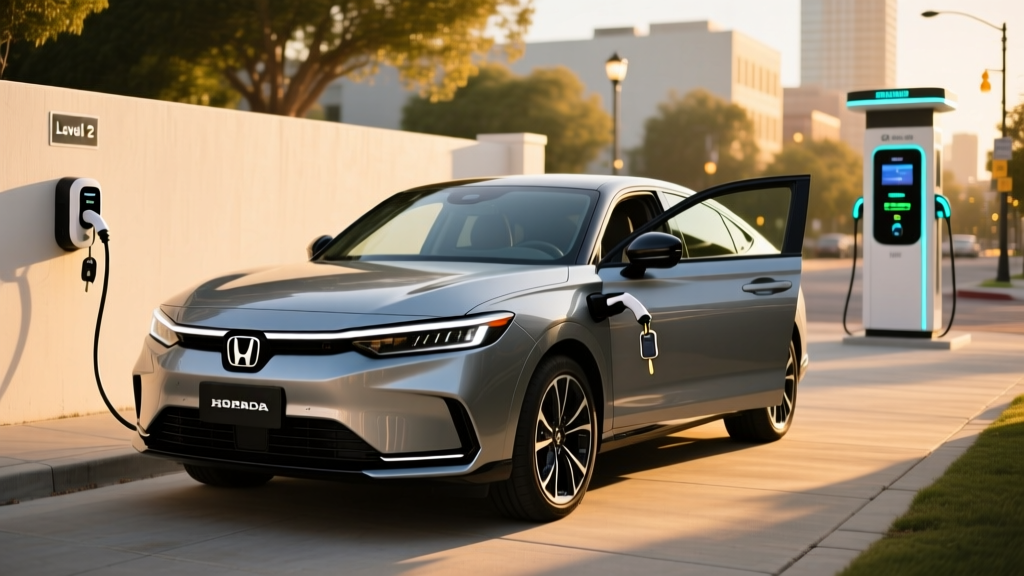
For home charging, the 11.5 kW onboard charger is competitive. On a properly installed 48-amp Level 2 circuit (60-amp breaker), you'll add roughly 30 miles of range per hour of charging, easily replenishing a full day's driving overnight. Honda includes a dual-level charge cord (Level 1/Level 2 capable with a 240V outlet) with the vehicle, though a dedicated wall-mounted Level 2 station is recommended for daily use.
The Prologue uses the CCS1 connector for DC fast charging and J1772 for Level 2 AC. Honda has confirmed that future models will adopt the NACS (Tesla) connector, but the 2025 Prologue does not have native NACS access. Tesla Supercharger access via adapter has not been officially confirmed for the Prologue as of this writing.
Pricing, Trims, and Federal Tax Credit Eligibility
The 2025 Prologue is offered in three trims, with FWD available on the lower two:
| Trim | Drivetrain | MSRP | Est. After §30D Credit* |
|---|---|---|---|
| EX | FWD | $47,400 | ~$39,900 |
| EX | AWD | $50,400 | ~$42,900 |
| EX-L | FWD | $50,100 | ~$42,600 |
| EX-L | AWD | $53,100 | ~$45,600 |
| Touring | AWD only | $57,900 | ~$50,400 |
*Tax credit estimates assume full $7,500 eligibility under IRS §30D. Actual credit depends on individual tax liability, income caps, battery sourcing compliance, and point-of-sale transfer availability. Always verify with a tax professional and the IRS §30D guidelines.
The Prologue's MSRP falls well under the §30D cap of $80,000 for SUVs, so price is not a barrier to credit eligibility. However, buyers must meet adjusted gross income limits: $150,000 (single), $225,000 (head of household), or $300,000 (married filing jointly). The battery's critical-mineral and component sourcing must also meet phased-in thresholds that tighten annually — Honda has not publicly confirmed full compliance for every 2025 Prologue build batch, so verify VIN eligibility on fueleconomy.gov before purchase.
Starting in 2024, the §30D credit can be transferred to the dealer at point of sale as an immediate price reduction, rather than claimed on your tax return. This is a significant cash-flow advantage, but it requires the dealer to be registered with the IRS Energy Credits portal.
Interior, Cargo, and Technology
The Prologue's cabin is where Honda's design philosophy shines — clean, functional, and focused on comfort rather than the minimalist-screen-only approach of Tesla or the bold futurism of Hyundai's E-GMP models.
Passenger space is generous for the midsize segment:
- Front legroom: 41.4 inches
- Rear legroom: 38.6 inches
- Front headroom: 40.0 inches
- Rear headroom: 39.6 inches
Cargo volume is competitive but not best-in-class:
- Behind rear seats: 25.2 cu ft
- Rear seats folded: 57.7 cu ft
- No front trunk (frunk) — the Ultium platform packaging in this configuration does not include one, unlike the Ioniq 5's 2.0 cu ft frunk or the F-150 Lightning's massive front cargo area.
Infotainment centers on an 11.3-inch touchscreen (EX/EX-L) or 11.3-inch display with Google Built-In on the Touring trim. Wireless Apple CarPlay and Android Auto are standard across all trims. The Touring adds a 12.3-inch digital instrument cluster, a head-up display, a 12-speaker Bose audio system, and a panoramic moonroof.
Driver-assistance technology is bundled under Honda's Sensing suite, which includes adaptive cruise control with low-speed follow, lane-keeping assist, lane-departure warning, forward-collision warning, and automatic emergency braking. This is a SAE Level 2 driver-assist system — it does not enable hands-free or self-driving operation. The driver must keep hands on the wheel and remain fully engaged at all times. Unlike GM's Super Cruise (available on the Cadillac Lyriq and some Chevy models), Honda does not offer a hands-free highway driving feature on the Prologue.
Warranty and Long-Term Ownership
Honda backs the Prologue with the following warranty coverage, consistent with industry norms for EV battery protection:
- Battery/Powertrain: 8 years / 100,000 miles (whichever comes first), covering defects and capacity loss below a specified threshold (typically 60-70% retention, though Honda's exact SoH threshold should be confirmed in the owner's manual)
- Limited Vehicle Warranty: 3 years / 36,000 miles
- Roadside Assistance: 3 years / 36,000 miles
The 8-year/100,000-mile battery warranty is standard for the segment and matches federal requirements. However, some competitors offer more generous coverage — Hyundai/Kia provide 10 years/100,000 miles on the battery, and Tesla offers 8 years/120,000 miles on the Model Y.
Who Should Buy the 2025 Honda Prologue?
Choose the Prologue if:
- You're a current Honda owner who values brand familiarity, dealer relationships, and a traditional SUV driving experience
- You need a comfortable, spacious two-row SUV for commuting and family duties with ~250-280 miles of real-world range
- You prefer physical buttons and knobs alongside your touchscreen (climate controls remain accessible)
- You can charge at home with Level 2 and don't rely heavily on DC fast charging for daily use
Look elsewhere if:
- You prioritize the fastest DC charging speeds (Ioniq 5, EV6 charge 10-80% in ~18 min)
- You need a frunk or maximum cargo versatility (Model Y offers 76 cu ft with seats folded)
- You want hands-free highway driving capability (GM Super Cruise on the Lyriq/Blazer EV, or Ford BlueCruise on the Mustang Mach-E)
- You live in a cold climate and want a heat pump for better winter range retention
- Budget is a primary concern — the Ioniq 5 SE starts ~$5,000 lower with comparable range
The Prologue is best understood as a comfortable commuter and family hauler for buyers who want an EV without relearning how to interact with their car. It's not a road-trip champion — the 150 kW charging peak and 34-minute 10-80% time mean longer stops than the fastest-charging rivals. And it's not a technology showcase — no hands-free driving, no frunk, no heat pump on base trims. But for the Honda buyer who wants a smooth, quiet, well-built electric SUV with excellent ride quality and straightforward controls, it delivers.
Pros and Cons at a Glance
- Comfortable, quiet ride quality with well-tuned suspension
- Spacious rear seat with 38.6 inches of legroom
- Intuitive infotainment with wireless CarPlay/Android Auto
- Full Honda Sensing suite standard on all trims
- Competitive EPA range of 296 miles (FWD)
- Familiar Honda ergonomics — minimal learning curve
- Eligible for up to $7,500 federal tax credit (subject to §30D rules)
- DC fast charging peaks at 150 kW — slower than key rivals
- No front trunk (frunk)
- No heat pump on base trims — cold-weather range suffers
- No hands-free driving feature (Sensing is Level 2 only)
- Starting price of $47,400 is high before incentives
- CCS connector only — no native NACS/Supercharger access
- AWD performance (288 hp) trails dual-motor competitors
Frequently Asked Questions
What is the real-world range of the 2025 Honda Prologue?
The EPA estimates 296 miles for the FWD model and 273-281 miles for AWD variants. In real-world highway driving at 70-75 mph, expect approximately 240-260 miles. In cold weather below freezing, range can drop to 190-230 miles due to battery conditioning demands and the lack of a heat pump on lower trims.
How fast does the Prologue charge at home and on the road?
On a 48-amp Level 2 home charger, the Prologue charges at up to 11.5 kW, adding roughly 30 miles of range per hour and fully recharging in about 9.5 hours. On a DC fast charger, it peaks at 150 kW and can go from 10-80% in approximately 34 minutes, adding about 150 miles in 20 minutes under ideal conditions.
Does the 2025 Honda Prologue qualify for the $7,500 federal EV tax credit?
The Prologue's MSRP is below the $80,000 SUV cap, making it potentially eligible. However, buyers must meet IRS income limits ($150K single / $300K married filing jointly), and the vehicle's battery must comply with critical-mineral and component-sourcing requirements that phase in annually. Verify your specific VIN's eligibility on fueleconomy.gov and consult a tax professional. The credit can be transferred at point of sale for an immediate price reduction if the dealer is IRS-registered.
Is the Honda Prologue worth buying over the Hyundai Ioniq 5 or Tesla Model Y?
It depends on your priorities. The Ioniq 5 offers faster DC charging (10-80% in ~18 min), a heat pump, a frunk, and a lower starting price. The Model Y offers more cargo space, Supercharger network access, and available FSD Supervised. The Prologue wins on ride comfort, traditional SUV ergonomics, and Honda brand loyalty. If charging speed and technology are your top priorities, the Ioniq 5 or Model Y are stronger choices. If comfort, familiarity, and dealer support matter most, the Prologue is a solid pick.
Does the Prologue have a frunk (front trunk)?
No. The Ultium platform packaging in the Prologue does not include a front trunk. All cargo space is in the rear, offering 25.2 cu ft behind the second row and 57.7 cu ft with the rear seats folded.
What is the battery warranty on the Honda Prologue?
Honda provides an 8-year/100,000-mile warranty on the battery pack and electric powertrain components, covering defects and significant capacity degradation. This matches the federal minimum and most competitors, though Hyundai/Kia offer 10-year battery coverage.