The 2025 Honda Prologue is Honda's first mass-market battery-electric vehicle, built on General Motors' Ultium platform and sharing its bones with the Chevrolet Blazer EV. While the exterior draws Honda loyalists, it's the Honda Prologue 2025 interior that will ultimately decide whether this midsize electric SUV earns a spot in your garage. We've analyzed every spec, measured the real-world implications of its 85 kWh battery, and broken down exactly what it costs to buy, charge, and own.
Quick Verdict: Who the Prologue Is For
The Prologue targets Honda CR-V and Passport owners ready to go electric without leaving the brand ecosystem. It delivers a genuinely comfortable, well-built cabin with Honda's familiar design language, competitive range, and respectable DC fast-charging speeds. The trade-off? A starting price that pushes into luxury territory and an infotainment system inherited from GM rather than Honda's own. If you want a spacious, comfortable daily-driver EV with strong dealer support and don't need class-leading performance, the Prologue deserves serious consideration.
Range, Battery & Efficiency
The 2025 Prologue is available with front-wheel drive (single motor) or all-wheel drive (dual motor). The FWD model achieves the highest EPA range, while AWD trims sacrifice roughly 10–15 miles for added traction.
| Spec | FWD (EX/EX-L) | AWD (EX-L/Touring) |
|---|---|---|
| EPA Estimated Range | 296 miles | 281 miles |
| Battery Capacity (Usable) | 85 kWh (NMC lithium-ion, Ultium platform) | |
| EPA Efficiency (Combined) | 99 MPGe (34 kWh/100 mi) | 95 MPGe (35 kWh/100 mi) |
| Drivetrain | Single-motor FWD | Dual-motor AWD |
The EPA estimates 296 miles for FWD and 281 miles for AWD. In real-world highway driving at 70–75 mph, expect approximately 245–265 miles from the FWD model and 235–250 miles from the AWD variant. In cold weather (below 30°F), range can drop an additional 20–30%, bringing effective highway range down to roughly 190–215 miles. The Prologue's NMC battery chemistry is energy-dense but more temperature-sensitive than LFP, so preconditioning before DC fast charging in winter is essential for optimal charge speeds.
Charging Speeds: DC Fast, Level 2 & Level 1
Honda equips the Prologue with a maximum DC fast-charge rate of 150 kW on 400-volt architecture. This is competitive with the Hyundai Ioniq 5's base trim but falls short of the 350 kW peak available on the Kia EV9 or the sustained 250 kW of Tesla's Supercharger network. The Prologue uses the CCS1 connector for DC fast charging; Honda has committed to NACS adoption for future models, but the 2025 Prologue ships with CCS.
| Charging Level | Power / Voltage | Speed | Notes |
|---|---|---|---|
| DC Fast Charge (CCS1) | Up to 150 kW / 400V | 10–80% in ~32 minutes | Peak rate sustained to ~50% SoC, then tapers; preconditioning recommended |
| Level 2 (Home/Public AC) | 11.5 kW / 240V, 48A | ~31 miles of range per hour | Full 0–100% in approximately 9 hours |
| Level 1 (Standard 120V) | 1.4 kW / 120V, 12A | ~3–4 miles per hour | Emergency/top-up only; full charge takes 60+ hours |
At home on a 48-amp Level 2 charger (the recommended setup for an 85 kWh battery), the Prologue adds roughly 31 miles of range per hour. A full overnight charge from near-empty takes about 9 hours. For context, a typical daily commute of 40 miles round-trip requires only about 1.5 hours of Level 2 charging — easily handled overnight.
Charging curve reality: The 150 kW peak is not sustained across the full session. Expect maximum draw from roughly 10–50% state of charge (SoC), after which the rate tapers to protect the NMC cells. Charging from 80–100% is significantly slower, as with all EVs. Plan road-trip stops to 10–80% for the fastest pit stops.
2025 Honda Prologue Interior: Space, Tech & Comfort
This is where the search keyword earns its volume — buyers want to know if Honda's first EV interior lives up to the brand's reputation for practicality.
Cabin Layout & Materials
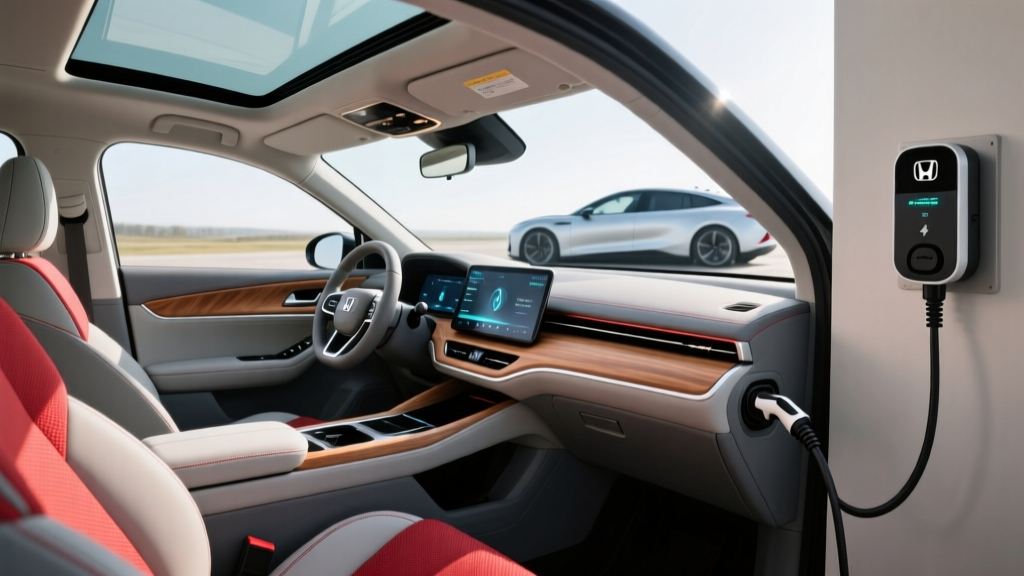
The Prologue's interior borrows heavily from the Chevrolet Blazer EV's architecture but receives Honda-specific styling: a 10-inch digital instrument cluster, an 11.3-inch center touchscreen (on EX-L and Touring; a smaller 7-inch screen on base EX), and Honda's signature push-button gear selector. Soft-touch materials cover the dashboard and upper door panels on EX-L and Touring trims, while the base EX uses more hard plastics. Build quality is solid — panel gaps are tight, and nothing rattles in our experience — but the cabin doesn't quite match the premium feel of a Hyundai Ioniq 5 or Ford Mustang Mach-E at similar price points.
Passenger & Cargo Dimensions
| Dimension | Measurement |
|---|---|
| Front Legroom | 41.4 inches |
| Rear Legroom | 38.6 inches |
| Front Headroom | 40.0 inches |
| Rear Headroom | 38.5 inches |
| Cargo Volume (Behind Rear Seats) | 25.2 cu ft |
| Cargo Volume (Rear Seats Folded) | 57.7 cu ft |
Passenger space is generous — rear-seat legroom beats the CR-V and rivals the Hyundai Ioniq 5. The flat floor (thanks to the Ultium skateboard platform) makes the middle rear seat genuinely usable for adults on shorter trips. Cargo volume at 25.2 cu ft is adequate but trails the Ioniq 5 (27.2 cu ft) and Mach-E (29.7 cu ft). There is no front trunk (frunk), a missed opportunity given the Ultium platform's capability.
Infotainment & Technology
The Prologue runs GM's Google Built-In infotainment system, not Honda's own interface. This means native Google Maps navigation, Google Assistant voice control, and access to the Google Play Store for apps. Wireless Apple CarPlay and Android Auto are standard across all trims. The system is responsive and well-organized, but some Honda loyalists may find the GM-derived interface unfamiliar.
The Honda Sensing suite is standard and includes:
- Adaptive Cruise Control with Low-Speed Follow
- Lane Keeping Assist and Road Departure Mitigation
- Collision Mitigation Braking System
- Traffic Sign Recognition
- Blind Spot Information with Rear Cross Traffic Monitor (EX-L and above)
Important: Honda Sensing is an SAE Level 2 driver-assistance system. It provides steering and acceleration/braking support, but the driver must remain fully engaged at all times. This is not autonomous or "self-driving" capability.
Performance & Driving Dynamics
| Spec | FWD | AWD |
|---|---|---|
| Horsepower | 212 hp | 288 hp |
| Torque | 236 lb-ft | 333 lb-ft |
| 0–60 mph | ~7.8 seconds | ~6.2 seconds |
| Top Speed | 115 mph (electronically limited) | |
| Towing Capacity | 1,500 lbs (when properly equipped) | |
The AWD dual-motor variant delivers a meaningful performance upgrade. The 288 hp and 333 lb-ft of torque provide confident highway merging and passing. Ride quality is a clear strength — the Prologue's suspension tuning prioritizes comfort over sportiness, absorbing road imperfections with a maturity that outclasses the firmer-riding Ioniq 5. Steering is light and precise, if devoid of feedback. This is a cruiser, not a corner-carver, and that's exactly what most midsize SUV buyers want.
The regenerative braking system offers adjustable levels via paddle shifters behind the steering wheel, but it does not provide true one-pedal driving at its strongest setting. You'll still need the friction brakes for complete stops.
Pricing, Trims & Federal Tax Credit
| Trim | Drivetrain | MSRP (incl. destination) | Est. Price After §30D Credit* |
|---|---|---|---|
| EX | FWD | $47,400 | ~$39,900 |
| EX-L | FWD | $49,900 | ~$42,400 |
| EX-L | AWD | $51,900 | ~$44,400 |
| Touring | AWD | $57,400 | ~$49,900 |
*Federal tax credit estimates assume full §30D eligibility. See eligibility checklist below.
Does the 2025 Prologue Qualify for the Federal EV Tax Credit?
The Honda Prologue is assembled at GM's Spring Hill, Tennessee plant, which initially positioned it for the full $7,500 federal tax credit under IRS §30D. However, eligibility depends on several buyer- and vehicle-specific factors that can change year-to-year. Here's the current checklist:
- MSRP Cap: SUVs must have an MSRP at or below $80,000 — all Prologue trims qualify.
- Buyer Income Cap: Adjusted gross income must not exceed $150,000 (single), $225,000 (head of household), or $300,000 (joint filers).
- Battery Sourcing: Critical minerals and battery components must meet phased-in percentage thresholds from U.S. or free-trade-agreement countries. Honda sources Ultium cells from the LG Energy Solution–GM joint venture (Ultium Cells LLC) in Tennessee, which has progressively met sourcing requirements.
- Point-of-Sale Transfer: As of 2024, buyers can transfer the credit to the dealer at purchase, reducing the upfront cost rather than waiting for a tax refund.
- New Vehicle: Must be purchased new (used EVs fall under a separate §25E credit with different rules).
Source: IRS §30D Clean Vehicle Credit. Eligibility rules are subject to change — consult a tax professional and verify current battery-sourcing compliance on the IRS eligible-vehicles list before purchasing.
Warranty & Ownership Costs
| Coverage Type | Term |
|---|---|
| Basic (Bumper-to-Bumper) | 3 years / 36,000 miles |
| Powertrain | 5 years / 60,000 miles |
| Battery & Electric Components | 8 years / 100,000 miles (minimum 70% capacity retention) |
| Corrosion Perforation | 5 years / unlimited miles |
| Roadside Assistance | 3 years / 36,000 miles |
The 8-year/100,000-mile battery warranty is standard for the segment and guarantees at least 70% state of health (SoH) over the coverage period. For context, NMC batteries typically lose 8–12% capacity over the first 100,000 miles under normal use, so the 70% threshold provides a meaningful safety net. Honda also includes 2 years of complimentary DC fast charging at EVgo stations (up to 1,500 kWh or a set dollar amount — confirm with your dealer at purchase).
How It Compares: Prologue vs. Key Rivals
| Spec | Honda Prologue AWD | Hyundai Ioniq 5 AWD | Ford Mach-E Premium AWD |
|---|---|---|---|
| EPA Range | 281 mi | 290 mi | 290 mi |
| Battery | 85 kWh (NMC) | 77.4 kWh (NMC) | 91 kWh (NMC) |
| DC Fast Charge Peak | 150 kW | 235 kW | 150 kW |
| 10–80% DC Time | ~32 min | ~18 min | ~36 min |
| 0–60 mph | 6.2 sec | 5.1 sec | 5.5 sec |
| Cargo (Behind Rear) | 25.2 cu ft | 27.2 cu ft | 29.7 cu ft |
| Starting MSRP (AWD) | $51,900 | $52,600 | $50,995 |
The Ioniq 5's 800-volt architecture gives it a decisive charging-speed advantage (235 kW vs. 150 kW). The Mach-E offers more cargo space and a sportier drive. The Prologue wins on ride comfort, rear-seat space, and Honda's dealer-network reliability. If DC fast-charging speed is your top priority for road trips, the Ioniq 5 is the stronger pick. If you value a smooth ride and Honda brand trust, the Prologue holds its ground.
Pros & Cons
- Spacious, comfortable cabin with excellent rear legroom (38.6 in)
- Composed, quiet ride quality ideal for daily commuting
- Competitive EPA range (up to 296 mi FWD)
- Google Built-In infotainment with native Google Maps
- Qualifies for up to $7,500 federal tax credit (eligibility dependent)
- Strong Honda dealer network for service and support
- Comprehensive Honda Sensing ADAS suite standard
- 150 kW DC fast-charge rate trails 800V rivals (Ioniq 5, EV6)
- No frunk (front trunk) despite skateboard platform
- Cargo space (25.2 cu ft) smaller than key competitors
- GM-derived infotainment may feel unfamiliar to Honda loyalists
- Premium pricing — Touring AWD pushes $57,400
- No true one-pedal driving mode
- CCS1 connector only (no native NACS in 2025)
Who Should Buy the 2025 Honda Prologue?
Choose the Prologue if: You're a current Honda owner who values dealer familiarity, you prioritize ride comfort over sporty handling, your daily commute is under 80 miles round-trip, and you want a well-built midsize EV SUV with strong rear-seat space for family duty.
Look elsewhere if: You take frequent road trips over 300 miles and need the fastest possible DC charging (consider the Ioniq 5 or EV6), you need maximum cargo capacity (the Mach-E or Kia EV9 offer more), or you want a sportier driving experience (the Mach-E GT or Ioniq 5 N deliver more engagement).
Frequently Asked Questions
What is the real-world range of the 2025 Honda Prologue?
The EPA rates the FWD Prologue at 296 miles and AWD at 281 miles. In real-world highway driving at 70–75 mph, expect 245–265 miles (FWD) or 235–250 miles (AWD). Cold weather below 30°F can reduce range an additional 20–30%. City driving with regenerative braking typically yields results closer to the EPA sticker.
How fast does the Prologue charge at home and on the road?
On a Level 2 home charger (11.5 kW, 48A), the Prologue adds about 31 miles of range per hour, with a full charge taking roughly 9 hours. On a DC fast charger, it peaks at 150 kW and charges from 10–80% in approximately 32 minutes. Charge speeds taper significantly above 80% SoC.
How much does the 2025 Prologue cost after the federal tax credit?
With the full $7,500 §30D credit applied, the FWD EX drops from $47,400 to approximately $39,900, and the AWD Touring from $57,400 to about $49,900. Eligibility requires meeting IRS income caps ($150K single / $300K joint), MSRP under $80K (all trims qualify), and battery-sourcing requirements. Verify current eligibility on the IRS Clean Vehicle Credit page before purchasing.
Is the Honda Prologue worth buying over the Hyundai Ioniq 5 or Ford Mach-E?
It depends on your priorities. The Prologue offers the best ride comfort and rear-seat space in the segment, plus Honda's dealer network. The Ioniq 5 charges significantly faster (235 kW vs. 150 kW) and offers more cargo room. The Mach-E provides sportier handling and more cargo volume. If comfort and brand loyalty matter most, the Prologue is competitive. If charging speed or cargo capacity are deal-breakers, test-drive the alternatives.
Does the 2025 Prologue have a frunk?
No. Despite riding on GM's Ultium skateboard platform (which supports a front trunk on some vehicles), Honda opted not to include a frunk in the Prologue. All storage is in the rear cargo area (25.2 cu ft behind the rear seats, 57.7 cu ft with seats folded).
What connector does the Prologue use, and can it charge at Tesla Superchargers?
The 2025 Prologue uses the CCS1 connector for DC fast charging and J1772 for Level 2 AC. It does not natively support Tesla's NACS connector. Honda has announced future models will adopt NACS, but 2025 Prologue owners will need a CCS-to-NACS adapter (once available from Honda or third parties) to access Tesla Superchargers. Honda has also announced plans to provide access to approximately 17,000+ Superchargers via adapter agreements.
Is the Honda Sensing system self-driving?
No. Honda Sensing is an SAE Level 2 driver-assistance system. It provides adaptive cruise control and lane-centering support, but the driver must remain fully attentive, keep hands on the wheel, and be prepared to take over at any moment. It does not offer autonomous or "self-driving" capability.
Sources: EPA Fuel Economy, Honda Prologue Official Specifications, IRS §30D Clean Vehicle Credit.