Quick Verdict: The Prologue EX Is Honda's Practical Electric Crossover
The 2025 Honda Prologue EX arrives as Honda's first mass-market battery-electric vehicle, built on General Motors' Ultium platform in partnership with GM. It's a midsize two-row SUV that targets buyers who want Honda's reputation for reliability wrapped around an electric powertrain. The EX trim sits in the middle of a three-tier lineup (EX, Touring, Elite) and offers the best balance of range, features, and price. With an EPA-estimated 296 miles of range in front-wheel-drive form, competitive DC fast-charging, and a spacious cabin, the Prologue EX makes a credible case for mainstream EV adoption — though it isn't without compromises in charging speed and software polish.
| Spec | Value |
|---|---|
| EPA Range (FWD) | 296 miles |
| EPA Range (AWD) | 281 miles |
| Battery Capacity | 85 kWh usable (NMC lithium-ion, Ultium) |
| Max DC Fast Charge | 150 kW peak |
| 10–80% DC Charge Time | ~32 minutes (estimated) |
| Level 2 Home Charging | 11.5 kW (AC), ~34 miles/hr |
| 0–60 mph (FWD) | ~7.2 seconds |
| 0–60 mph (AWD) | ~6.2 seconds |
| Horsepower (FWD / AWD) | 212 hp / 288 hp |
| Drivetrain | FWD single-motor or AWD dual-motor |
| MPGe (FWD combined) | 95 MPGe |
| Efficiency | 35 kWh/100 mi (FWD) |
| Cargo (behind rear seats) | 25.2 cu ft |
| Cargo (rear seats folded) | 57.7 cu ft |
| Rear Legroom | 39.4 inches |
| Battery Warranty | 8 years / 100,000 miles |
| Base MSRP (EX FWD) | $49,900 (before destination) |
| Destination Charge | $1,395 |
Range and Efficiency: What the EPA Number Doesn't Tell You
The Prologue EX with front-wheel drive carries an EPA-estimated 296 miles of range, while the all-wheel-drive version drops to 281 miles. These are competitive figures for the midsize electric SUV segment, sitting close to the Hyundai Ioniq 5 (303 miles Long Range RWD) and well ahead of the Subaru Solterra (222 miles).
EPA 296 miles (FWD) is the laboratory number. In mixed real-world driving — highway speeds of 70–75 mph, moderate climate control use, and temperatures around 60°F — expect 250–270 miles from a full charge. In sustained cold weather (below 30°F), cabin heating and battery thermal management can reduce usable range by 20–30%, potentially dropping effective range to 200–230 miles. City driving with frequent regenerative braking opportunities will get you closer to the EPA sticker. The Prologue lacks a heat pump (it uses resistive PTC heating), which is a notable efficiency penalty in cold climates compared to competitors like the Ioniq 5 or Tesla Model Y that include heat-pump HVAC systems.
Efficiency comes in at approximately 35 kWh per 100 miles (FWD), which translates to 95 MPGe combined per fueleconomy.gov. That's mid-pack for the segment — the Ioniq 5 achieves 114 MPGe combined, while the Ford Mustang Mach-E Extended Range RWD hits 101 MPGe. The Prologue's heavier curb weight (roughly 4,900 lbs for FWD) and GM Ultium platform tuning prioritize ride comfort over efficiency maximization.
Charging Speed: DC Fast Charging and Home Level 2
Charging is where the Prologue shows both its strengths and its limitations relative to the best-in-class competition.
| Charging Level | Power / Rate | Miles Added per Hour | Notes |
|---|---|---|---|
| Level 1 (120V household) | ~1.4 kW | ~4 mi/hr | Emergency / overnight trickle only |
| Level 2 (240V home, 48A) | 11.5 kW | ~34 mi/hr | Full charge in ~9 hours |
| DC Fast Charge (peak) | 150 kW | ~200+ mi in 30 min | 10–80% in ~32 min; tapers above 80% |
DC fast charging peaks at 150 kW on the Prologue. That's adequate for road trips but falls behind the Hyundai Ioniq 5 and Kia EV6, which can sustain up to 235–240 kW on 800V architecture and achieve 10–80% in roughly 18 minutes. The Prologue's 400V Ultium architecture means a 10–80% session takes approximately 32 minutes under ideal conditions (warm battery, low state of charge at plug-in).
Charging curve taper is worth understanding: peak 150 kW is available roughly between 10–40% state of charge. Beyond 60%, the rate progressively drops. If you're planning road trips, budget for 35–40 minutes at a DC fast charger per stop rather than the optimistic 32-minute figure, especially if the battery isn't preconditioned. The Prologue does support battery preconditioning when you navigate to a charge station in the built-in Google-based infotainment system, which helps reduce charge times in cold weather.
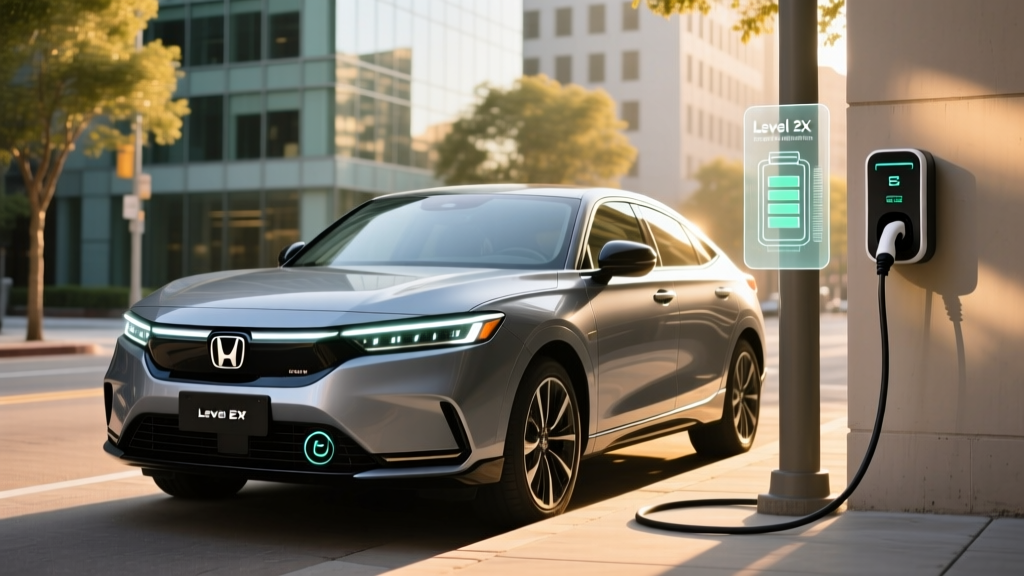
Home Level 2 charging at 11.5 kW (48 amps on a 60-amp circuit) is competitive and will replenish the 85 kWh battery from empty in roughly 9 hours. Honda includes a dual-level charge cord with the vehicle that can plug into a standard 120V outlet (Level 1) or a 240V NEMA 14-50 outlet. For dedicated home charging, a hardwired Level 2 station like the ChargePoint Home Flex or Emporia Level 2 charger is recommended — budget $500–$800 for the unit and $800–$2,000 for professional electrician installation, depending on your panel capacity and run length.
The Prologue uses the standard CCS1 connector for DC fast charging and the J1772 connector for Level 2 AC. Honda has confirmed that future models will adopt the Tesla NACS connector, but the 2025 Prologue ships with CCS. Honda owners currently have access to a complimentary charging credit at Electrify America stations, though specifics vary by promotional period — check with your dealer at purchase.
Performance and Drivetrain: Adequate, Not Thrilling
The Prologue EX is available in two powertrain configurations:
- FWD (single front motor): 212 horsepower, 236 lb-ft of torque. 0–60 mph in approximately 7.2 seconds.
- AWD (dual motor): 288 horsepower, 332 lb-ft of torque. 0–60 mph in approximately 6.2 seconds.
Neither version is a performance EV. The AWD model provides confident highway merging and passing, but the Prologue is tuned for comfort and composure rather than sportiness. The steering is light and numb by enthusiast standards, and the suspension soaks up bumps effectively but allows noticeable body lean through corners. This is a Honda designed for the school run and the interstate commute, not canyon carving — and for its target buyer, that's appropriate.
Regenerative braking is adjustable via paddle shifters behind the steering wheel, offering multiple levels of regen up to near one-pedal driving capability. However, the Prologue does not achieve full one-pedal driving that brings the car to a complete stop and holds it — you'll still need the brake pedal at intersections.
Towing capacity is rated at 1,500 pounds across all trims, which limits the Prologue to light-duty trailer or small boat hauling. If you need serious towing (3,500+ lbs), the Ford F-150 Lightning or Rivian R1S are more appropriate choices.
Interior, Cargo, and Technology
The Prologue's cabin is spacious, with a 116.3-inch wheelbase that translates to generous rear-seat room. Rear legroom measures 39.4 inches, which is competitive with the Hyundai Ioniq 5 and slightly better than the Toyota bZ4X. The seats are comfortable for long drives, and the rear seatbacks recline slightly for added comfort.
Cargo space is 25.2 cubic feet behind the rear seats and 57.7 cubic feet with the 60/40 split rear seats folded. There is no front trunk (frunk) — the space under the hood houses power electronics. A small under-floor storage area in the rear cargo bay holds charging cables.
The infotainment system is an 11.3-inch touchscreen running Google Built-in, which includes native Google Maps navigation, Google Assistant voice control, and access to the Google Play Store for apps. Wireless Apple CarPlay and Android Auto are standard on the EX trim. An 11-inch digital instrument cluster sits ahead of the driver. The system is responsive but not immune to the occasional lag or glitch that has plagued early Ultium-platform vehicles — software updates via OTA (over-the-air) are ongoing.
The EX trim includes Honda Sensing ADAS (Advanced Driver-Assistance Systems), which bundles:
- Adaptive Cruise Control with Low-Speed Follow
- Lane Keeping Assist and Road Departure Mitigation
- Collision Mitigation Braking System
- Traffic Sign Recognition
- Blind Spot Information with Rear Cross Traffic Monitor
These are SAE Level 2 driver-assist features — the driver must remain fully engaged with hands on the wheel and eyes on the road at all times. This is not autonomous or self-driving capability. Honda does not currently offer a hands-free highway driving system on the Prologue comparable to GM's Super Cruise or Ford's BlueCruise.
Pricing, Trims, and Federal Tax Credit
The 2025 Honda Prologue is offered in three trims. Here's the pricing breakdown for the EX and its siblings:
| Trim | Drivetrain | MSRP + Destination | Est. After §30D Credit* |
|---|---|---|---|
| EX | FWD | $51,295 | ~$43,795 |
| EX | AWD | $53,295 | ~$45,795 |
| Touring | AWD | $58,295 | ~$50,795 |
| Elite | AWD | $61,295 | ~$53,795 |
*Estimated price assumes full $7,500 federal §30D tax credit. Actual eligibility depends on buyer income, battery sourcing, and MSRP caps. See IRS.gov for current rules.
Federal tax credit eligibility for the Prologue is a key purchase factor. Under current IRS §30D rules, the Prologue qualifies for up to $7,500 in federal tax credits, subject to several conditions:
- MSRP cap: The Prologue is classified as an SUV, so the MSRP cap is $80,000. All trims clear this threshold.
- Buyer income cap: Adjusted gross income must not exceed $150,000 (single), $225,000 (head of household), or $300,000 (married filing jointly).
- Battery sourcing requirements: The credit is split into two halves ($3,750 each) — one for critical minerals sourcing and one for battery component manufacturing. Because the Prologue is built on GM's Ultium platform with North American battery cell manufacturing, it has historically qualified for the full $7,500, but sourcing rules tighten annually. Verify current-year eligibility on the IRS website or with your tax professional before purchase.
- Point-of-sale transfer: As of 2024, buyers can transfer the credit to the dealer at point of sale, reducing the purchase price directly rather than waiting to claim it on their tax return. Honda dealers should support this option.
Some buyers may also qualify for state or local incentives — these vary widely by jurisdiction. Check your state's energy office or the Alternative Fuels Data Center for applicable programs.
Warranty Coverage
Honda provides the following warranty coverage for the 2025 Prologue:
- Battery: 8 years / 100,000 miles (capacity retention warranty — typically guarantees the battery will retain at least 70% of original capacity)
- Powertrain: 5 years / 60,000 miles
- Limited vehicle warranty: 3 years / 36,000 miles
- Corrosion: 5 years / unlimited miles
The battery warranty is standard for the segment. The Ultium platform is still early in its lifecycle, so long-term degradation data for the Prologue specifically is limited. GM's broader Ultium battery testing and Honda's reputation for durability offer some reassurance, but buyers planning to keep the vehicle 10+ years should monitor state of health via the vehicle's battery management system and follow best practices (avoid routinely charging to 100%, minimize prolonged exposure to extreme heat).
How Does It Compare to Key Competitors?
The Prologue EX competes in a crowded midsize electric SUV segment. Here's how it stacks up against three direct rivals:
| Spec | Honda Prologue EX FWD | Hyundai Ioniq 5 SEL RWD | Ford Mach-E Select RWD | Toyota bZ4X XLE FWD |
|---|---|---|---|---|
| EPA Range | 296 mi | 303 mi | 250 mi | 252 mi |
| Battery | 85 kWh NMC | 77.4 kWh NMC | 70 kWh NMC | 71.4 kWh NMC |
| Peak DC Charge | 150 kW | 235 kW (800V) | 150 kW | 150 kW |
| 10–80% Time | ~32 min | ~18 min | ~35 min | ~30 min |
| 0–60 mph | 7.2 sec | 7.0 sec | 6.3 sec | 7.1 sec |
| MPGe Combined | 95 | 114 | 101 | 114 |
| Cargo (rear up) | 25.2 cu ft | 27.2 cu ft | 29.7 cu ft | 27.7 cu ft |
| Starting MSRP | $51,295 | ~$47,000 | ~$42,000 | ~$44,000 |
The Prologue's advantages are its roomy rear seat, Honda brand cachet, and Google Built-in infotainment. Its disadvantages are a higher starting price than the Ioniq 5 and Mach-E, slower DC charging than the Ioniq 5's 800V architecture, no heat pump, and no frunk. Efficiency (MPGe) trails both the Ioniq 5 and bZ4X.
- Spacious rear seat with 39.4" legroom
- Strong 296-mile EPA range (FWD)
- Google Built-in infotainment with native Maps
- Comfortable, compliant ride quality
- Honda Sensing safety suite standard
- Federal §30D tax credit eligible (up to $7,500)
- Honda reliability reputation
- Higher base price than Ioniq 5, Mach-E, bZ4X
- No heat pump — cold-weather range suffers
- 150 kW peak DC charging trails 800V rivals
- No front trunk (frunk)
- No hands-free highway driving feature
- Only 1,500-lb towing capacity
- Early Ultium software may have refinement issues
Who Should Buy the 2025 Honda Prologue EX?
The Prologue EX is best suited for suburban families and commuters who value Honda's brand trust, need a comfortable two-row SUV with strong rear-seat space, and have reliable home Level 2 charging. It works well for daily commutes of 30–60 miles round-trip with weekend excursions within a 200-mile radius. Road-trippers will find the 150 kW charging adequate but not class-leading — plan for slightly longer stops than Ioniq 5 or Model Y owners.
It's not ideal for buyers who need maximum cargo space (the Mach-E and Ioniq 5 offer more), cutting-edge charging speed, hands-free highway driving, or serious towing capability. If cold-weather efficiency is a top priority, the absence of a heat pump is a meaningful drawback for buyers in northern climates.
- You're a loyal Honda buyer ready to go electric
- Rear-seat passenger comfort is a priority
- You want Google-native infotainment
- Your daily driving is under 80 miles
- Fastest possible DC charging matters (Ioniq 5/EV6)
- You need maximum cargo volume (Mach-E)
- You regularly drive in sub-freezing weather (heat pump competitors)
- Price sensitivity is paramount (Mach-E starts ~$9,000 less)
Frequently Asked Questions
What is the real-world range of the 2025 Honda Prologue EX?
The EPA rates the Prologue EX FWD at 296 miles. In real-world mixed driving at highway speeds, expect approximately 250–270 miles. In cold weather (below 30°F), range can drop to 200–230 miles due to resistive cabin heating and battery thermal demands. The AWD version is EPA-rated at 281 miles.
How fast does the Prologue charge at home and on the road?
At home on a 240V Level 2 charger (11.5 kW), the Prologue adds approximately 34 miles of range per hour, achieving a full charge from empty in about 9 hours. On a DC fast charger, it peaks at 150 kW and charges from 10–80% in approximately 32 minutes under ideal conditions.
How much does the 2025 Honda Prologue EX cost after tax credits?
The Prologue EX FWD starts at $51,295 including destination. If you qualify for the full $7,500 federal §30D tax credit (income limits and battery sourcing requirements apply), the effective price drops to approximately $43,795. Point-of-sale transfer is available, reducing the price at the dealership.
Does the 2025 Honda Prologue qualify for the federal EV tax credit?
Yes, the Prologue is eligible for up to $7,500 under IRS §30D, provided the buyer meets income caps ($150K single / $300K married filing jointly), the vehicle MSRP is under $80,000 (all trims qualify as an SUV), and battery critical-mineral and component sourcing requirements are met. Rules tighten annually — verify at IRS.gov before purchasing.
Is the Honda Prologue worth buying over the Hyundai Ioniq 5 or Ford Mach-E?
It depends on priorities. The Ioniq 5 charges faster (235 kW vs 150 kW), is more efficient (114 vs 95 MPGe), and starts at a lower price. The Mach-E offers more cargo room and a lower entry price. The Prologue wins on rear-seat comfort, Honda brand loyalty, and Google-native infotainment. If charging speed and value are paramount, the Ioniq 5 is the stronger pick. If Honda trust and rear-seat space matter most, the Prologue is a solid choice.
Does the Prologue have a heat pump?
No. The 2025 Prologue uses resistive PTC heating rather than a heat pump. This means cold-weather cabin heating draws more energy from the battery, reducing range more significantly than competitors equipped with heat pumps (such as the Hyundai Ioniq 5, Tesla Model Y, and Ford Mach-E).
What connector does the Honda Prologue use?
The 2025 Prologue uses the CCS1 connector for DC fast charging and the J1772 connector for Level 2 AC charging. Honda has announced plans to adopt the Tesla NACS connector on future models, but the 2025 Prologue ships with CCS.