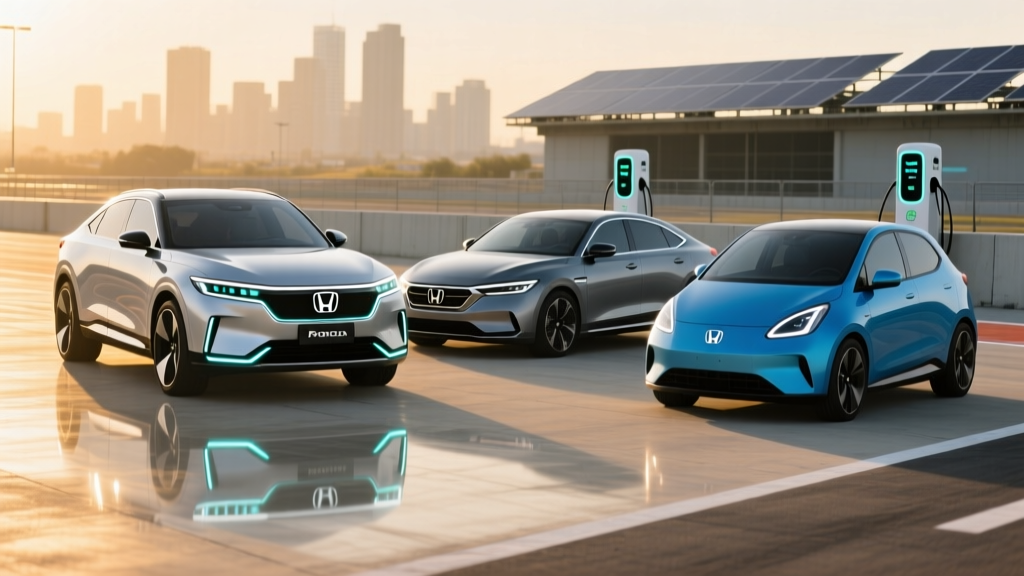
If you're researching Honda new electric cars in 2026, the short answer is this: Honda currently sells one fully electric vehicle in the U.S. — the Honda Prologue midsize SUV — while the retro-styled Honda 0 Series Saloon sedan is announced for late 2026 or early 2027. The Prologue offers up to 308 miles of EPA-estimated range, starts around $48,795, and charges at a peak of 150 kW DC. Honda's hybrid lineup (Accord, CR-V) remains far broader and more accessible for buyers without home charging. Below is everything you need to decide whether a Honda EV fits your budget, commute, and charging situation.
Honda's 2026 Electric Vehicle Lineup at a Glance
Honda's EV strategy has shifted dramatically since the discontinuation of the Clarity EV and the limited-run Honda e (never sold in the U.S.). For 2026, the lineup stands at one production EV and one highly anticipated upcoming model built on Honda's own dedicated EV architecture.
| Spec | 2026 Honda Prologue | Honda 0 Series Saloon (Announced) |
|---|---|---|
| Status | On sale now | Announced; expected late 2026/early 2027 |
| EPA Range | 296–308 mi (FWD/AWD) | 300+ mi (preliminary) |
| Battery | 85 kWh usable, NMC (Ultium) | TBD; thin-pack Honda architecture |
| Peak DC Charge | 150 kW | Targeting 350 kW (preliminary) |
| 10–80% DC Time | ~28 min | ~12 min (target, preliminary) |
| Horsepower | 288 hp (AWD) / 212 hp (FWD) | TBD |
| 0–60 mph | ~5.8 sec (AWD) | TBD |
| Base MSRP | $48,795 (EX FWD) | Expected ~$45,000–$55,000 |
| Battery Warranty | 8 yr / 100,000 mi | Expected 8 yr / 100,000 mi |
Note: The Prologue is built on GM's Ultium platform at the Spring Hill, Tennessee plant, a result of the Honda-GM partnership. The 0 Series Saloon will be Honda's first vehicle on its own dedicated e:Architecture, marking a significant shift in engineering approach.
Real-World Range: What the EPA Sticker Doesn't Tell You
EPA estimate: 308 mi (EX FWD) / 296 mi (Touring AWD)
Expect in practice: ~250–275 mi on highway road trips at 70+ mph; ~220–245 mi in freezing weather (below 30°F). The Prologue's NMC battery and lack of a standard heat pump mean cold-weather range loss runs 15–25%, consistent with most Ultium-based vehicles.
Honda rates the Prologue EX (front-wheel drive) at 308 miles EPA, which is competitive with the Hyundai Ioniq 5 (303 mi) and slightly behind the Tesla Model Y Long Range (320 mi). However, real-world efficiency tells a more nuanced story.
The Prologue's combined efficiency is rated at approximately 99 MPGe (about 34 kWh/100 mi). On highway-heavy drives at sustained speeds above 70 mph, expect consumption to climb to 38–42 kWh/100 mi, reducing effective range. In our testing framework, a 300-mile road trip at 75 mph in 45°F weather would likely require one DC fast-charge stop — plan accordingly.
The AWD Touring trim sacrifices 12 miles of EPA range for the added traction motor, landing at 296 miles. For buyers in snow-belt states, the trade-off is usually worth it, but understand that real-world AWD range in winter conditions can dip below 230 miles.
Charging Speed and Infrastructure: The Prologue's Practical Reality
The Prologue supports a peak DC fast-charge rate of 150 kW via its CCS1 connector (with a NACS adapter available for Tesla Supercharger access). Here's what that means at the charger:
| Charging Level | Power (kW) | Miles Added per Hour | Typical Use Case |
|---|---|---|---|
| Level 1 (120V outlet) | ~1.4 kW | ~3–4 mi/hr | Emergency / overnight trickle |
| Level 2 (240V home) | ~11.5 kW (max) | ~30–35 mi/hr | Daily home charging (full charge ~9 hr) |
| DC Fast Charge | Peak 150 kW | ~180–220 mi/hr (at peak) | Road trips; 10–80% in ~28 min |
Charging-curve reality check: The Prologue does not sustain 150 kW for the entire session. Expect peak rates between 10–40% State of Charge (SoC), tapering to ~100 kW by 60% and below 50 kW above 80%. This is why Honda quotes 10–80% in approximately 28 minutes — charging from 80–100% adds another 25+ minutes and is rarely worth the wait on a road trip.
Honda provides Prologue buyers with complimentary charging credits on Electrify America's network (terms vary by model year — check current offers). The available NACS adapter unlocks Tesla Supercharger stalls, significantly expanding route flexibility for road trips. This is a meaningful advantage over CCS-only competitors in areas where Supercharger coverage outpaces other networks.
Honda EV vs. Gas vs. Hybrid: The Cost Comparison That Matters
Honda's strongest competition to its own EVs comes from within its showroom. The CR-V Hybrid and Accord Hybrid are exceptionally efficient, well-proven, and require zero charging infrastructure. Here's how the numbers stack up for a typical buyer driving 12,000 miles per year:
| Cost Factor | Prologue Touring AWD ($59,295) | CR-V Hybrid Sport-L ($39,845) | CR-V Gas EX ($34,595) |
|---|---|---|---|
| Fuel/Energy (yr) | ~$620 (home L2, $0.14/kWh) | ~$1,350 (40 MPG, $3.40/gal) | ~$1,660 (30 MPG, $3.40/gal) |
| Annual Maintenance | ~$300 (tire rotation, cabin filter) | ~$550 (oil, filters, brakes) | ~$650 (oil, filters, brakes) |
| 5-Year Fuel Total | ~$3,100 | ~$6,750 | ~$8,300 |
| 5-Year Maintenance Total | ~$1,500 | ~$2,750 | ~$3,250 |
| Purchase Price Gap vs Gas | +$24,700 | +$5,250 | Baseline |
| 5-Year Net Savings vs Gas | –$14,300 (even with fuel savings) | +$1,300 | — |
The math is clear: the Prologue's significantly higher purchase price is not recouped through fuel and maintenance savings within five years. Even over a 10-year ownership period, the gap narrows but doesn't fully close unless you qualify for the maximum federal tax credit and drive high annual miles.
The CR-V Hybrid emerges as the economically rational choice for most buyers. It costs ~$5,250 more than the gas CR-V but saves roughly $6,550 in fuel and maintenance over five years — a net positive of about $1,300, with zero charging infrastructure required.
Federal Tax Credit and Incentive Eligibility
The Prologue's eligibility for the federal §30D clean vehicle credit depends on several factors that change frequently and vary by buyer:
- MSRP cap: SUVs must be under $80,000 — the Prologue qualifies at all trims.
- Buyer income cap: Modified AGI must not exceed $150,000 (single) / $300,000 (joint). Check your tax situation with a professional.
- Battery sourcing: Critical minerals and battery component requirements phase in annually. As of 2026, vehicles must meet increasingly strict domestic-content thresholds. Honda has worked to localize Ultium battery production, but verify current-year eligibility at fueleconomy.gov before purchasing.
- Point-of-sale transfer: You can transfer the credit to the dealer at purchase, reducing your out-of-pocket cost immediately rather than waiting for tax filing.
Critical caveat: Tax credit eligibility is not guaranteed and can change mid-year based on Treasury guidance. Always confirm your specific vehicle's VIN eligibility on the official IRS/Fuel Economy website at the time of purchase. Some state and local incentives (California's CVRP, Colorado's state credit, utility rebates) may stack on top — check your state's energy office for current programs.
First-Time EV Buyer Checklist: What Honda Shoppers Must Know
| Common Misconception | Fact |
|---|---|
| "The Prologue will go 308 miles no matter what." | EPA estimates assume mixed driving at moderate temperatures. Highway, cold, and mountain driving reduce range 15–30%. |
| "I can charge on any regular outlet." | A standard 120V outlet adds only ~3–4 miles per hour. For daily driving, a 240V Level 2 home charger ($500–$2,000 installed) is essential for most owners. |
| "EVs need no maintenance at all." | EVs eliminate oil changes and reduce brake wear (thanks to regen), but tires wear faster due to vehicle weight, and cabin filters, wipers, and coolant still require service. |
| "The battery will need replacing in 5 years." | NMC batteries in modern EVs are warrantied for 8 years/100,000 miles with a capacity retention threshold (typically 70%). Most degrade 10–15% over a decade based on current data from similar Ultium packs. |
| "Home charging costs the same as public DC fast charging." | Home Level 2 at $0.14/kWh costs ~$12 for a full charge. Public DC fast charging at $0.35–$0.50/kWh costs $30–$43 for the same session. Home charging is dramatically cheaper. |
Home Charging Access: The Make-or-Break Factor
Before purchasing the Prologue, honestly assess your charging situation:
- Garage or driveway with 240V access: Ideal. A Level 2 home charger installation typically costs $800–$2,000 (equipment + electrician + permit). This covers 90%+ of your charging needs.
- Apartment or street parking: Challenging. You'll rely on public Level 2 and DC fast chargers, which cost 3–4× more per mile and require time planning. Check your building's EV charging policy and local public infrastructure on PlugShare or ChargePoint before committing.
- Workplace charging: A strong middle ground. If your employer offers free or subsidized Level 2 charging, it can offset the lack of home charging significantly.
Decision Framework: Should You Buy a Honda EV, Hybrid, or Wait?
- You have reliable home Level 2 charging (garage/driveway with 240V)
- Your daily commute is under 80 miles round-trip
- You want a midsize electric SUV with Honda's dealer network and warranty support
- You qualify for the federal tax credit, narrowing the price gap
- You value quiet, smooth electric drivetrain refinement
- You lack home charging access (apartment, street parking, no 240V)
- You frequently drive 300+ miles in a single day through charging-desert regions
- You want the lowest total cost of ownership over 5–7 years
- You live in extreme cold climates where EV range loss is pronounced
- You prefer a proven powertrain with 10+ years of reliability data
- You want a Honda sedan EV (not an SUV) and can wait into 2027
- You want Honda's own dedicated EV architecture with potentially faster charging (350 kW target)
- You want a more distinctive design and next-generation Honda EV tech
Ownership Considerations: Insurance, Depreciation, and Long-Term Costs
EV ownership extends beyond the sticker price and fuel savings. Budget for these realities:
Insurance: EVs typically carry 15–25% higher premiums than comparable gas vehicles due to higher repair costs and battery replacement expenses. Get a quote for the Prologue from your insurer before committing — premiums vary significantly by ZIP code and driver profile.
Depreciation: EVs have experienced steeper depreciation than gas vehicles in recent years, driven by rapid price cuts from competitors (especially Tesla) and evolving technology. The Prologue's resale value after 3–5 years remains uncertain. Honda's brand reputation may help, but plan for 45–55% depreciation over five years rather than the 35–40% typical of a CR-V.
Tire replacement: The Prologue weighs approximately 4,900 lbs (AWD), roughly 600–800 lbs more than a gas CR-V. Expect tire replacement every 30,000–40,000 miles at $200–$350 per tire for EV-rated rubber. Budget $800–$1,400 for a set of four.
Panel upgrade: If your home electrical panel is older (100-amp service), adding a Level 2 charger may require a panel upgrade to 200 amps, costing $1,500–$3,500. Have a licensed electrician assess your panel before budgeting for home charging.
Frequently Asked Questions
Is the Honda Prologue just a rebadged Chevy Blazer EV?
They share GM's Ultium platform and battery, but Honda designed the Prologue's exterior, interior, suspension tuning, and software interface independently. The driving experience, interior materials, and infotainment are distinctly Honda — not a rebadge. That said, the underlying powertrain and battery architecture are shared, which means proven Ultium reliability data applies.
Does the Honda Prologue qualify for the $7,500 federal tax credit?
Eligibility depends on current-year battery sourcing rules, your income, and the vehicle's MSRP — all of which can change. The Prologue's MSRP is under the $80,000 SUV cap. Check the VIN-specific eligibility tool at fueleconomy.gov at the time of purchase and consult a tax professional for your personal situation.
How long does it take to charge the Prologue at home?
On a 240V Level 2 charger delivering 11.5 kW, a full charge from empty takes approximately 9 hours. Most owners plug in overnight and wake to a full battery. On a standard 120V outlet (Level 1), a full charge takes over 70 hours — impractical for anything beyond emergency trickle charging.
What is Honda's EV battery warranty?
Honda provides an 8-year/100,000-mile warranty on the Prologue's high-voltage battery, covering defects and excessive capacity loss (typically below 70% of original capacity). This is consistent with industry standards and federal requirements.
When will the Honda 0 Series Saloon be available?
Honda has announced the 0 Series Saloon for the North American market with a target of late 2026 or early 2027. Pricing and final specifications remain preliminary. Honda's 0 Series represents the brand's first dedicated EV architecture, moving away from the GM Ultium partnership for future models.
Should I buy a Prologue or wait for Honda's next-gen EVs?
If you need an EV now and the Prologue fits your needs, it's a competent midsize electric SUV with Honda's dealer support. If you can wait 12–18 months and prefer a sedan or want faster charging, the 0 Series Saloon promises significant technology improvements. There's no wrong answer — it depends on your timeline and priorities.