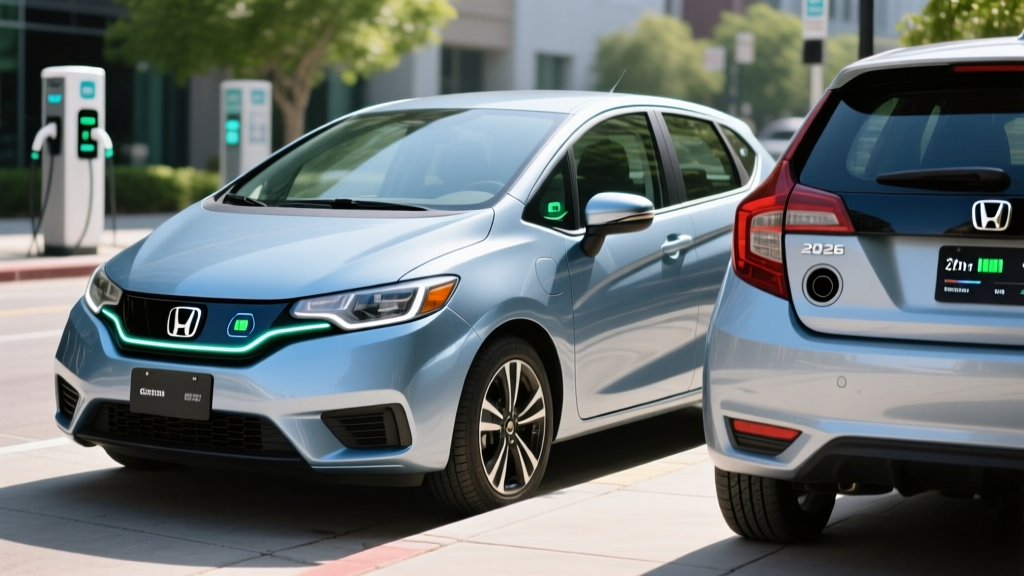
Quick Answer: The Honda Fit EV is a discontinued, lease-only compliance car from 2013–2015 with an EPA-rated 82 miles of range from its 20 kWh battery. In 2026, used examples sell for roughly $6,000–$10,000 depending on battery health and mileage. It makes a functional second car or urban commuter if your daily driving stays under 50 miles round-trip, you can charge at home, and you verify the battery's state of health before purchase. It does not qualify for the federal §30D new EV tax credit, but may be eligible for the up-to-$4,000 used EV credit if income and dealer requirements are met.
Honda never sold the Fit EV at retail in the United States. It was offered exclusively as a three-year lease in California and Oregon from 2013 through 2015, with roughly 1,100 units produced. When leases ended, Honda sold many to former lessees and through auctions, creating a small but real used market. For buyers in 2026 searching for a cheap, compact electric runabout, the Fit EV is worth a serious look — but only with eyes wide open about its limitations.
Range, Battery, and Efficiency: What 82 EPA Miles Really Means
The Fit EV is powered by a 20 kWh lithium-ion battery pack (approximately 17 kWh usable) paired with a 92 kW (123 hp) coaxial electric motor. Honda's engineering prioritized efficiency over capacity, and the result was one of the most efficient EVs of its era.
EPA Range: 82 miles
Real-World Expectation: 60–75 miles in mixed driving; as low as 45–55 miles in sustained cold weather (below 35°F) or at highway speeds above 65 mph.
EPA Efficiency: 118 MPGe combined (29 kWh/100 mi) — per fueleconomy.gov.
That efficiency figure still holds up. The Fit EV consumes less energy per mile than most modern EVs, including the 2026 Nissan Leaf and Chevrolet Bolt EV. The trade-off is range: 82 EPA miles was modest in 2013 and feels restrictive in 2026, when many new EVs exceed 250 miles.
For context, the average American drives roughly 37 miles per day according to FHWA data. The Fit EV covers that comfortably with margin — but a single 50-mile detour, a cold snap, or a heavy right foot can eat that buffer fast. This is a car that rewards planning.
Charging Speed and Connector Reality
The Fit EV charges via a J1772 connector for AC charging. There is no DC fast charging capability — no CCS, no CHAdeMO, no NACS. This is the single biggest ownership constraint and the reason the Fit EV works best as a home-charged commuter.
| Charging Level | Power | Time (Empty to Full) | Miles per Hour |
|---|---|---|---|
| Level 1 (120V outlet) | ~1.2 kW | ~14–16 hours | ~5 mi/hr |
| Level 2 (240V, 30A circuit) | ~6.6 kW (onboard charger max) | ~3 hours | ~22 mi/hr |
| DC Fast Charging | Not supported | N/A | N/A |
The 6.6 kW onboard charger was competitive in 2013. A full charge from empty on a Level 2 home charger takes about three hours — practical for overnight top-ups. On a standard 120V household outlet, expect roughly 5 miles of range per hour of charging, which means a depleted battery needs 14+ hours to refill. Level 1 works for light daily driving (20–30 miles) if you plug in every night, but Level 2 is strongly recommended.
Without DC fast charging, road trips beyond the car's single-charge range are impractical. You cannot pull up to an Electrify America or Tesla Supercharger station and add 100 miles in 20 minutes. This car lives and dies by its home charger.
Used Market Pricing and the Federal Used EV Tax Credit
As of early 2026, Honda Fit EVs typically list between $6,000 and $10,000 on the used market, with variance driven by mileage, cosmetic condition, geographic location, and — most critically — battery state of health (SoH). Low-mileage examples with verified battery health command the top of that range.
Used EV Federal Tax Credit (§25E) — Key Requirements:
- Vehicle sale price must be $25,000 or less (Fit EV qualifies easily)
- Credit equals 30% of sale price, up to a maximum of $4,000
- Buyer adjusted gross income must not exceed $75,000 (single), $112,500 (head of household), or $150,000 (joint)
- Vehicle must be purchased from a licensed dealer (private-party sales do not qualify)
- The vehicle must be at least two model years old (Fit EV qualifies)
- Credit can be transferred to the dealer at point of sale as a price reduction
- Verify current rules at irs.gov — eligibility and sourcing requirements can shift
At a $7,500 purchase price from a qualifying dealer, the 30% calculation yields a $2,250 credit — bringing your effective cost to $5,250 if you meet the income caps. This makes the Fit EV one of the cheapest ways into EV ownership in 2026, provided you accept the range trade-off.
Ownership Costs: Fit EV vs. Gas Honda Fit
The natural comparison is the gasoline Honda Fit, which remained in production through 2020 in the US and is still widely available used. Here's how five-year running costs stack up for a buyer driving 10,000 miles per year.
| Cost Category | Honda Fit EV (2013–2015) | Honda Fit Gas (2015, ~33 MPG combined) |
|---|---|---|
| Purchase Price (typical) | $7,500 | $11,000 |
| Fuel/Energy (5 yrs, 10k mi/yr) | $2,200 (at $0.14/kWh avg) | $5,300 (at $3.50/gal avg) |
| Maintenance (5 yrs) | $800 (brakes, cabin filter, tires) | $2,500 (oil, filters, brakes, spark plugs) |
| Insurance (5 yrs est.) | $4,500 | $4,000 |
| Home Charger Install (one-time) | $500–$1,500 | $0 |
| 5-Year Total | $15,500–$16,500 | $22,800 |
The Fit EV saves roughly $6,000–$7,000 over five years in fuel and maintenance alone, even accounting for a Level 2 charger installation. The gas Fit costs more upfront and burns through fuel and consumables at a much higher rate. EV insurance premiums can run slightly higher, but the gap is narrow on a low-value used vehicle.
Maintenance on the Fit EV is minimal: cabin air filter, wiper blades, brake fluid checks, and tire rotations. The regenerative braking system significantly extends pad life — many owners report original brake pads at 80,000+ miles. There is no engine oil, no transmission fluid to change, no exhaust system to corrode.
Battery Health: The Critical Pre-Purchase Check
Every used EV purchase hinges on battery state of health, and the Fit EV is no exception. After 10–12 years of service, some degradation is guaranteed. The question is how much.
Honda equipped the Fit EV with a Toshiba-built lithium-ion pack using an SCiB (lithium-titanate) chemistry in some components, known for exceptional cycle life and thermal stability. In practice, Fit EV batteries have degraded more slowly than many contemporaries. Owner reports commonly show 85–92% SoH at 80,000–100,000 miles — meaning 68–75 miles of real-world range remains.
Before buying, demand:
- A battery health report from a Honda dealer or an independent EV shop (the car's OBD-II port can be read with tools like LeafSpy-equivalent apps for Honda)
- Documented range at full charge on the dashboard display
- Service records showing any battery-related warranty work
Honda's original battery warranty was 8 years/100,000 miles (10 years/150,000 miles in CARB states like California). In 2026, most Fit EVs have aged out of the time-based coverage, but low-mileage examples in CARB states may still have residual warranty if under 150,000 miles. A replacement battery, if needed, runs approximately $5,000–$8,000 through a Honda dealer — a cost that can exceed the car's value.
Common Misconceptions About the Fit EV
| Myth | Fact |
|---|---|
| "You can buy a new Honda Fit EV." | Honda discontinued the Fit EV after 2015 and never offered it for retail sale. Only used examples are available. |
| "It has DC fast charging." | The Fit EV has no DC fast charge port. Charging is limited to Level 1 and Level 2 AC via J1772. |
| "82 miles of range is unusable." | The average US daily commute is ~37 miles. For a dedicated commuter or second car, 82 miles with home charging is viable — if you plan around cold weather and detours. |
| "The battery will need replacing soon." | Fit EV packs using Toshiba SCiB chemistry have shown strong longevity. Many 10-year-old examples retain 85%+ SoH. Verify before purchase, but assume catastrophic failure is not inevitable. |
| "Any used EV qualifies for the $4,000 tax credit." | The §25E used EV credit has income caps, a $25,000 sale-price cap, and requires purchase from a licensed dealer. Verify eligibility on irs.gov. |
Decision Framework: Is the Honda Fit EV Right for You?
Choose the Honda Fit EV if:
- Your daily round-trip commute is under 50 miles
- You have reliable access to Level 2 home charging (garage or driveway with a 240V circuit)
- You need an affordable second car for errands, school runs, and local commuting
- You live in a mild climate where cold-weather range loss is moderate
- You can verify battery SoH before purchase and are comfortable with 65–75 real-world miles
- You want the lowest possible running costs and minimal maintenance
Look elsewhere if:
- You need a primary vehicle for varied driving patterns, road trips, or long commutes
- You lack home charging access and would rely on public infrastructure (no DC fast charging makes this impractical)
- You live in a region with harsh winters where range could drop below 50 miles
- You need more than 12 cu ft of cargo space (the Fit EV's battery packaging reduces rear cargo volume compared to the gas Fit)
- You want modern driver-assistance features — the Fit EV predates Honda Sensing and offers only basic stability control and airbags
If the Fit EV's range is too limiting but you still want a compact, affordable used EV, consider the 2017–2019 Chevrolet Bolt EV (238 EPA miles, CCS fast charging, used prices around $10,000–$14,000) or the 2018–2020 Nissan Leaf Plus (226 EPA miles, CHAdeMO fast charging). Both cost more upfront but eliminate the range constraint.
Frequently Asked Questions
Can I take a Honda Fit EV on a road trip?
Realistically, no. With 60–75 real-world miles of range and no DC fast charging, any trip beyond a single charge requires an overnight stop with Level 2 access. It's a commuter and errand car, not a road-trip vehicle.
How much does it cost to charge a Fit EV at home?
A full charge from empty uses about 17 kWh of usable energy. At the US average residential electricity rate of roughly $0.16/kWh, a full charge costs about $2.72. If you drive 30 miles daily and charge nightly, expect roughly $1.00–$1.50 per day in electricity — compared to $3.50–$4.50 per day in gasoline for the gas Fit at 33 MPG.
Does the Fit EV qualify for any tax credits in 2026?
Not the new-vehicle §30D credit (the car is discontinued). It may qualify for the §25E used clean vehicle credit — 30% of the sale price up to $4,000 — if purchased from a licensed dealer, the sale price is under $25,000, and your income falls within the caps ($75k single / $150k joint). Confirm current rules at irs.gov and consult a tax professional.
What happens if the battery fails?
A full battery replacement runs $5,000–$8,000 at a Honda dealer, which may total the car given its used value. However, Toshiba SCiB-based packs in the Fit EV have shown strong longevity. Most 10-year-old examples still retain 85%+ capacity. The risk is real but statistically lower than with some contemporaries. Always check SoH before buying.
Is the Fit EV a good first EV?
It can be — if your lifestyle fits the constraints. The low purchase price, cheap home charging, and minimal maintenance make it an excellent introduction to EV ownership. But if you don't have home charging, drive more than 50 miles daily, or need flexibility for longer trips, a used Bolt EV or Leaf with DC fast charging is a better first EV.
Does the Fit EV have a frunk or extra cargo space?
No. The Fit EV retains the gas Fit's front-end layout with no front trunk. The battery pack is mounted low and centrally, which slightly reduces under-floor rear cargo space compared to the gas model. Total cargo volume is approximately 12 cu ft behind the rear seats.