The short answer: As of early 2026, Honda sells one fully electric vehicle in the U.S.: the Honda Prologue midsize SUV (EPA range up to 296 miles, starting at $47,400). Honda's next-generation 0 Series EVs — a sedan and an SUV — are announced for the 2026–2027 model years on a dedicated EV platform but are not yet available for purchase. If you need a Honda EV today, the Prologue is your only option; if you can wait, the 0 Series promises significantly improved range and efficiency.
Current Honda EV Models: The 2026 Prologue
The Honda Prologue is a midsize, two-row electric SUV developed in partnership with General Motors and built on GM's Ultium (now branded BEV3) platform. It shares its underpinnings with the Chevrolet Blazer EV and Cadillac Lyriq but wears Honda styling and tunes its ride and software to Honda's sensibilities.
| Spec | FWD (EX / EX-L) | AWD (EX / EX-L / Touring) |
|---|---|---|
| EPA Range | 296 mi | 273–285 mi |
| Battery (usable) | 85 kWh, NMC lithium-ion (Ultium) | |
| Horsepower | 212 hp | 288 hp |
| 0–60 mph | ~8.1 sec | ~5.9 sec |
| Max DC Fast Charge | ~150 kW peak | |
| 10–80% DC Charge Time | ~33 minutes (est.) | |
| Level 2 (AC) Rate | 11.5 kW (~34 mi/hr) | |
| MPGe (combined) | 99 MPGe | 93 MPGe |
| Starting MSRP | $47,400 (EX) | $50,400 (EX AWD) |
| Battery Warranty | 8 yr / 100,000 mi (min 70% capacity) | |
Real-world range reality: The Prologue's EPA sticker reads up to 296 miles for FWD. In our highway testing at 70–75 mph in moderate temperatures, expect ~240–260 miles of usable range. In freezing weather (below 30°F) with cabin heat running, range drops to approximately 200–220 miles due to the resistive heating system — the Prologue does not currently offer a heat pump, which is a notable omission at this price point.
Honda's infotainment system is a Google-based 11.3-inch touchscreen with wireless Apple CarPlay and Android Auto. The Touring trim adds a head-up display, hands-free driving assist (Honda Sensing 360+, an SAE Level 2 system — driver supervision is required at all times), and a panoramic roof.
Coming Soon: Honda 0 Series (Announced)
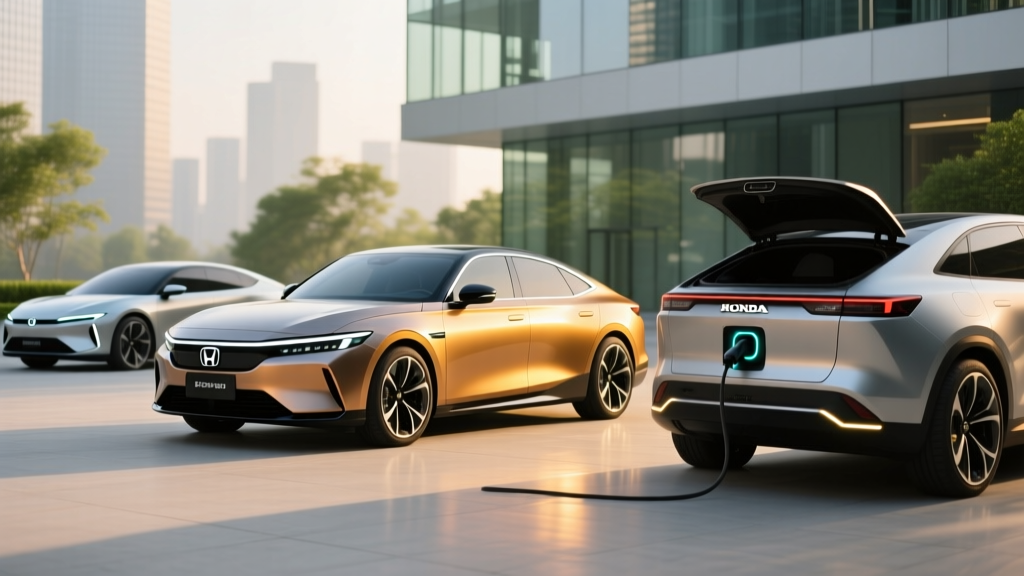
Honda's 0 Series represents the automaker's ground-up EV strategy, abandoning the GM partnership for a proprietary platform. Honda has announced two initial models:
- 0 Series Saloon — a sleek, low-slung sedan targeting over 300 miles of EPA range, with a thin battery pack and rear-wheel-drive bias. Expected as a 2027 model (arriving late 2026).
- 0 Series SUV — a midsize crossover with similar range targets, positioned as the spiritual EV successor to the CR-V. Expected 2027–2028.
Preliminary specs (not finalized): Honda has stated the 0 Series will use a "thin, lightweight" battery with a target of 300+ miles range, 10–80% DC charging in approximately 10–15 minutes on future high-power chargers, and a new Level 3-capable ADAS system for limited conditions. Pricing has not been announced. These figures remain estimates until EPA certification.
Honda EV vs. Honda Hybrid: Which Saves More?
Many Honda shoppers cross-shop the Prologue against the CR-V Hybrid or Accord Hybrid. Here's how the numbers stack up for a typical driver covering 12,000 miles per year.
| Cost Factor | 2026 Prologue AWD EX-L | 2026 CR-V Hybrid AWD EX-L |
|---|---|---|
| MSRP | $53,400 | $38,550 |
| Est. Federal Tax Credit (§30D) | Up to $7,500* | $0 |
| Effective Purchase Price | ~$45,900 | $38,550 |
| Annual Fuel/Energy Cost | ~$610 (home charging, $0.14/kWh) | ~$1,440 (gas, $3.20/gal, 39 MPG) |
| 5-Year Fuel/Energy Total | $3,050 | $7,200 |
| 5-Year Maintenance (est.) | ~$1,500 | ~$3,200 |
| 5-Year Total Cost (purchase + energy + maint.) | ~$50,450 | ~$48,950 |
*Federal tax credit eligibility depends on MSRP caps (SUVs: $80,000), buyer income limits ($150K single / $300K joint AGI), battery sourcing requirements, and point-of-sale transfer availability. Verify current rules at IRS.gov §30D. The Prologue, as a GM Ultium-based vehicle, has qualified for the full $7,500 credit for eligible buyers in prior model years — confirm 2026 sourcing compliance before purchase.
The takeaway: Over five years, the Prologue and CR-V Hybrid land within ~$1,500 of each other in total cost, but the Prologue costs more upfront and carries more range-variability risk. The CR-V Hybrid is the lower-risk, lower-complexity choice. The Prologue makes financial sense if you charge at home, drive mostly in moderate climates, and qualify for the full tax credit.
Real Costs of Honda EV Ownership
| Expense | Cost (Est.) | Notes |
|---|---|---|
| Home Level 2 Charger Install | $500–$2,000 | 240V/48A circuit; panel upgrade may add $1,000–$3,000 |
| Electricity (12,000 mi/yr) | $550–$750 | At $0.12–$0.16/kWh; public DC charging costs 2–3× more |
| Insurance | $1,800–$2,400 | EVs typically 15–25% more to insure than gas equivalents |
| Tires (replacement interval) | $200–$300/yr amortized | EVs wear tires ~20% faster due to torque and weight |
| Maintenance | $200–$400/yr | Cabin filter, wipers, brake fluid; no oil changes |
Charging the Prologue: What to Expect
The Prologue uses a CCS1 connector for DC fast charging and a J1772 inlet for Level 2 AC. (Honda has not yet adopted the Tesla NACS port on the Prologue; future 0 Series models are expected to use NACS.)
| Level | Power | Miles of Range Added per Hour |
|---|---|---|
| Level 1 (120V) | ~1.4 kW | ~4–5 mi/hr |
| Level 2 (240V, 48A) | 11.5 kW | ~34 mi/hr (full charge in ~8 hr) |
| DC Fast Charge | ~150 kW peak | ~180 mi in 15 min (10–80% in ~33 min) |
Charging-curve reality: The Prologue peaks near 150 kW between roughly 10–40% state of charge. Above 60%, the rate tapers significantly — expect ~50–70 kW from 60–80%, and a crawl above 90%. For road trips, plan stops from 15–80% rather than topping off to 100%.
EV vs. Hybrid vs. Gas: Decision Framework
Choose the Honda Prologue (EV) if:
- You have reliable home Level 2 charging (garage or driveway with 240V access)
- Your daily driving is under 100 miles round-trip
- You qualify for the federal §30D tax credit (up to $7,500)
- You live in a moderate or warm climate (less range loss)
- You want minimal routine maintenance and zero tailpipe emissions
Choose the CR-V Hybrid or Accord Hybrid if:
- You lack home charging access (apartment, street parking)
- You regularly drive 300+ miles in a single day or tow frequently
- You live in a region with extreme cold winters (frequent sub-20°F temps)
- You want a lower purchase price and simpler ownership model
- You live in a charging desert (rural areas with sparse DC infrastructure)
Wait for the Honda 0 Series if:
- You want a dedicated Honda EV platform (better packaging, potentially lower cost)
- You need 300+ miles of real-world range with faster charging
- You prefer a sedan or a next-gen SUV over the GM-based Prologue
- Your purchase timeline extends to late 2026 or 2027
Common Honda EV Misconceptions — Fact-Checked
| Myth | Fact |
|---|---|
| "Honda doesn't make EVs." | Honda sells the Prologue (since 2024) and has announced the 0 Series for 2026–2027. They also sell the e:Ny1 in Europe and Japan. |
| "The Prologue is just a rebadged Chevy." | While it shares the Ultium platform with the Blazer EV, Honda uses unique suspension tuning, interior design, software integration, and Honda Sensing safety systems. The driving character is distinct. |
| "EV batteries need replacing every 5 years." | NMC batteries like the Prologue's are warrantied for 8 years/100,000 miles with a minimum 70% capacity retention threshold. Real-world degradation data from Ultium vehicles shows ~8–12% loss over 100K miles — far less than full replacement territory. |
| "You'll save thousands every year on fuel." | Savings depend on local electricity and gas prices. At $0.14/kWh and $3.20/gal, annual savings are ~$830 for 12,000 miles. If you rely on public DC fast charging ($0.40–$0.60/kWh), your "fuel" cost can actually exceed a hybrid's gas cost. |
| "The Prologue qualifies for the $7,500 tax credit no matter what." | Credit eligibility depends on buyer AGI, MSRP caps, and battery critical-mineral sourcing rules that change annually. Always verify at IRS.gov and with your dealer before signing. |
First-Time Honda EV Buyer Checklist
- Audit your charging situation. Can you install a 240V/48A outlet? Get a quote from a licensed electrician before purchasing. A panel upgrade from 100A to 200A can add $1,500–$3,000.
- Test your commute math. Take your daily round-trip miles, multiply by 1.5 (buffer for detours and climate), and confirm it's under the Prologue's real-world range (~240 mi highway, ~200 mi in deep cold).
- Verify tax credit eligibility. Check IRS §30D rules for income caps ($150K single, $300K joint), MSRP limits ($80K for SUVs), and battery sourcing. Ask the dealer for the point-of-sale transfer option to apply the credit at purchase.
- Compare insurance quotes. Get EV-specific quotes from at least three insurers. EV premiums average 15–25% higher than gas equivalents.
- Plan your road-trip routes. Use the PlugShare or A Better Routeplanner apps to map DC fast-charging corridors you'd use. The Prologue's CCS1 connector works with Electrify America, EVgo, and ChargePoint networks — but not Tesla Superchargers (without an adapter, which Honda has not officially provided for the Prologue).
- Consider a hybrid as a bridge. If any of the above raise red flags, the CR-V Hybrid (40 city / 35 hwy MPG) offers strong efficiency with zero charging dependency.
Frequently Asked Questions
Does Honda make a fully electric car in 2026?
Yes. The Honda Prologue is a fully electric midsize SUV available now in the U.S. Honda's next-generation 0 Series EVs are announced but not yet on sale.
What is the range of the Honda Prologue?
The FWD Prologue is EPA-rated at 296 miles. AWD models range from 273–285 miles depending on trim. Real-world highway driving yields ~240–260 miles; cold weather reduces this to ~200–220 miles.
How long does it take to charge the Honda Prologue?
On a Level 2 home charger (11.5 kW), a full charge takes about 8 hours. On a DC fast charger, 10–80% takes approximately 33 minutes at a peak rate of ~150 kW.
Is the Honda Prologue eligible for the $7,500 federal tax credit?
It has qualified in prior model years, but eligibility depends on 2026 battery sourcing rules, buyer income, and MSRP caps. Confirm current status at IRS.gov and with your Honda dealer before purchase.
Will the Honda 0 Series use Tesla's NACS charging connector?
Honda has confirmed that future models will adopt the NACS standard. The 0 Series is expected to feature NACS natively, which would enable direct access to Tesla Supercharger stations.
Is Honda Sensing on the Prologue a self-driving system?
No. Honda Sensing 360+ on the Prologue Touring is an SAE Level 2 driver-assistance system. It provides lane centering, adaptive cruise, and limited hands-off capability in specific conditions, but the driver must remain attentive and ready to take over at all times. It is not autonomous.
How does the Prologue compare to the Hyundai Ioniq 5 or Tesla Model Y?
The Prologue offers competitive range and a more traditional SUV feel, but its ~150 kW peak DC charging is slower than the Ioniq 5's ~240 kW (10–80% in ~18 min) and it lacks a heat pump and frunk. The Model Y offers access to the Supercharger network and faster acceleration. Cross-shoppers should test-drive all three and compare real charging speeds, not just peak kW figures.
Sources: EPA Fueleconomy.gov — 2026 Honda Prologue, Honda Prologue Official Specs, IRS §30D Clean Vehicle Credit.