Quick Answer: Honda's EV Lineup in 2026
Honda currently sells one fully electric vehicle in the U.S.: the Prologue SUV (EPA range up to 308 miles, starting at $47,400). A second model, the Honda Saloon sedan, is expected to arrive for the 2027 model year with a target range exceeding 300 miles. If you're researching a Honda EV electric car today, the Prologue is your only showroom option — and whether it makes financial sense depends heavily on your charging access, local electricity rates, and federal/state incentive eligibility.
The Honda Prologue: Current Specs at a Glance
The Prologue is built on General Motors' Ultium platform, making it a mechanical cousin to the Chevrolet Blazer EV and Cadillac Lyriq. Here's what the numbers look like for the 2026 model year:
| Spec | Prologue FWD | Prologue AWD | Prologue Elite AWD |
|---|---|---|---|
| EPA Range | 308 mi | 296 mi | 283 mi |
| Battery (usable) | 85 kWh, NMC (Ultium) | ||
| Horsepower | 220 hp | 288 hp | |
| 0-60 mph | ~7.8 sec | ~6.2 sec | |
| DC Fast Charge Peak | 150 kW (CCS) | ||
| 10-80% DC Charge | ~35 minutes | ||
| Level 2 Charge Rate | 11.5 kW (7.7 kW std) | ||
| MPGe (combined) | 99 MPGe | 95 MPGe | 90 MPGe |
| Starting MSRP | $47,400 | $50,400 | $57,400 |
| Battery/Powertrain Warranty | 8 years / 100,000 miles | ||
Source: fueleconomy.gov — verify exact trim-year data as EPA posts updates.
Upcoming: The Honda Saloon and Future EV Plans
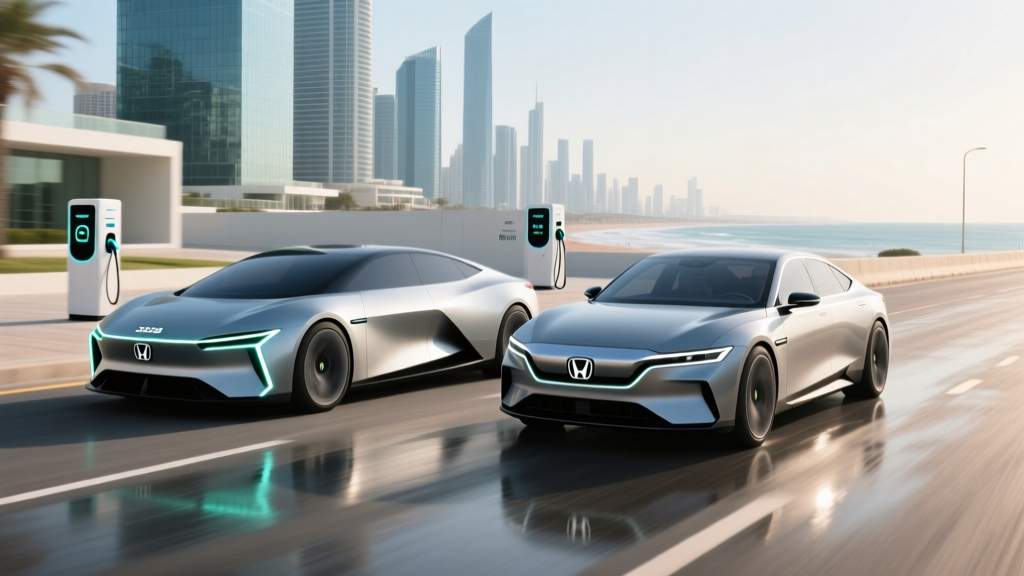
Honda has confirmed a new dedicated EV architecture — called the Honda e:Architecture — that will underpin future models. The first product on this platform is the Honda Saloon, a midsize sedan previewed as a concept and expected to reach U.S. dealerships for the 2027 model year (likely late 2026 calendar availability).
Key announced/preliminary details:
- Target range: Over 300 miles EPA (exact figure TBD)
- Platform: Honda e:Architecture (not GM Ultium)
- Connector: Expected NACS (Tesla Supercharger compatible)
- Positioning: Midsize sedan slotting between Civic and Accord in spirit, EV-only
Honda has also signaled a compact SUV and additional models on this platform through 2030. Until the Saloon arrives, however, the Prologue remains Honda's sole electric offering.
Honda EV vs. Gas vs. Hybrid: A Cost Comparison
The real question for most shoppers isn't whether Honda makes an EV — it's whether the Prologue beats a CR-V Hybrid or a gas CR-V over five years of ownership. Let's run the numbers.
| Cost Factor (5-Year) | Prologue Elite AWD | CR-V Hybrid AWD | CR-V Gas AWD |
|---|---|---|---|
| Base MSRP | $57,400 | $38,500 | $35,400 |
| Est. Federal Tax Credit (§30D) | Up to $7,500* | $0 (hybrid ineligible) | $0 |
| Effective Purchase Price | ~$49,900 | $38,500 | $35,400 |
| Fuel/Energy (15k mi/yr) | ~$3,750** | ~$7,500 | ~$9,750 |
| Maintenance (5 yr) | ~$1,500 | ~$3,200 | ~$3,800 |
| Insurance (est. avg) | ~$11,000 | ~$8,500 | ~$8,000 |
| 5-Year Total (purchase+fuel+maint+ins) | ~$66,150 | ~$57,700 | ~$56,950 |
* §30D credit eligibility depends on MSRP caps, buyer income, battery sourcing, and point-of-sale transfer. Check current rules at IRS.gov.
** Based on $0.15/kWh home charging. Public DC fast charging at $0.35-$0.48/kWh would raise EV energy costs significantly.
The Prologue narrows the gap with the CR-V Hybrid primarily through the federal tax credit and lower fuel/maintenance costs. Without the credit — or if you rely heavily on expensive public charging — the CR-V Hybrid wins on pure economics while still delivering 40 MPG combined.
Charging the Honda Prologue: What You Need to Know
The Prologue uses the CCS1 connector for DC fast charging and J1772 for Level 2 AC charging. This is important because Honda has committed to transitioning to the NACS (Tesla) connector on future models, but the current Prologue does not have native NACS.
| Charging Level | Power | Miles Added Per Hour | Typical Use Case |
|---|---|---|---|
| Level 1 (120V) | ~1.4 kW | ~4 mi/hr | Emergency / overnight trickle |
| Level 2 (240V, 32A) | 7.7 kW | ~25 mi/hr | Home daily charging (standard) |
| Level 2 (240V, 48A) | 11.5 kW | ~37 mi/hr | Home daily charging (upgraded) |
| DC Fast Charge | Peak 150 kW | ~180 mi in 30 min | Road trips / public stations |
Home charging installation for a Level 2 setup typically costs $800-$2,500 depending on your electrical panel capacity and run distance. A 200-amp panel upgrade, if needed, adds $1,500-$3,000. The Prologue's 85 kWh battery means a full Level 2 charge at 7.7 kW takes roughly 11 hours — practical for overnight replenishment but slow if you arrive home nearly empty.
First-Time EV Buyer: 5 Things Honda Shoppers Get Wrong
| Common Misconception | Fact |
|---|---|
| "The Prologue gets 308 miles no matter what." | 308 miles is the FWD trim's EPA estimate under ideal conditions. Highway driving, cold weather, and high HVAC use reduce this by 15-35%. |
| "I'll save $7,500 on taxes automatically." | The §30D credit has income caps ($150K single / $300K joint), MSRP caps ($80K SUVs), and battery-sourcing requirements. Eligibility can change with IRS rule updates. Always verify at IRS.gov and consult a tax professional. |
| "EVs need no maintenance." | EVs eliminate oil changes, spark plugs, and transmission fluid, but still require tire rotations (EVs wear tires faster due to weight and torque), brake fluid checks, cabin air filters, and coolant service. Budget ~$300/year. |
| "I can charge on any Tesla Supercharger." | The Prologue uses CCS1. While some automakers now include NACS adapters for Supercharger access, Honda has not confirmed a universal adapter program for the Prologue. Check Honda's official guidance before planning Tesla-network road trips. |
| "The battery will need replacing in a few years." | Honda warranties the Prologue's battery for 8 years/100,000 miles against capacity loss below ~70%. Industry data shows most NMC batteries retain 85-90% capacity at 100K miles with normal use. Full replacement (rare) runs $12,000-$18,000 out of warranty. |
Decision Framework: Should You Buy the Honda Prologue?
Choose the Honda Prologue if:
- You want an EV from a Honda dealer you already trust, and the midsize SUV form factor fits your family.
- You have reliable Level 2 home charging (garage or driveway with 240V access).
- Your daily commute is under 80 miles round-trip, and road trips are occasional (2-4 per year).
- You qualify for the full or partial §30D federal tax credit, narrowing the price gap with the CR-V Hybrid.
- You value a quieter, smoother ride and don't mind a 283-308 mile practical range.
Choose the CR-V Hybrid instead if:
- You live in an apartment or lack home charging access and your area has limited public DC infrastructure.
- You regularly drive in extreme cold (below 15°F) where EV range loss is most pronounced.
- Your budget is firm below $40,000 and you don't qualify for incentives that bridge the gap.
- You tow or carry heavy loads frequently — the CR-V Hybrid's 1,500-lb tow rating and no range penalty under load is an advantage.
Wait for the Honda Saloon if:
- You prefer a sedan over an SUV and want Honda's own EV platform (expected better efficiency and potentially NACS native charging).
- You're not in a rush — expected availability is late 2026/early 2027 as a 2027 model-year vehicle.
Real-World Ownership: Climate, Commute, and Charging Patterns
The Prologue's NMC Ultium battery performs well in moderate climates, but your specific situation determines whether it thrives or frustrates:
Cold-climate owners (Upper Midwest, Northeast, Mountain West): Expect 20-30% range reduction in sustained sub-freezing temperatures. The Prologue does include a heat pump, which helps cabin efficiency, but battery chemistry itself loses throughput in cold. Preconditioning while plugged in is essential — it warms the battery using grid power rather than battery power. If your commute is 40+ miles each way in Minnesota January, plan as if you have ~210 miles of range.
Warm-climate owners (South, Southwest, Coastal): You'll see EPA or near-EPA range most of the year. Battery degradation in hot climates is a longer-term concern, but the Ultium pack's active thermal management system mitigates this. Garage parking helps.
Apartment dwellers without home charging: This is the hardest scenario for any EV. Relying solely on public DC fast charging at $0.35-$0.48/kWh erases most of the fuel-cost advantage over a hybrid. If your workplace offers Level 2 charging, that helps significantly — but confirm availability before purchasing.
High-mileage commuters (60+ miles/day): The Prologue handles this well if you charge nightly at home. At 15,000 miles/year and $0.15/kWh, your annual energy cost is approximately $675 — versus roughly $1,650 for the CR-V gas at 28 MPG combined and $3.50/gallon. The EV saves roughly $975/year in fuel alone, which recoups the price premium over 5-7 years even without the tax credit.
Frequently Asked Questions
Does Honda make a fully electric car in 2026?
Yes — the Honda Prologue is currently Honda's only fully electric vehicle sold in the U.S. It's a midsize SUV with up to 308 miles of EPA range. The Honda Saloon sedan is expected for the 2027 model year but is not yet available for purchase.
Is the Honda Prologue eligible for the $7,500 federal tax credit?
The Prologue may qualify for up to $7,500 under IRS §30D, but eligibility depends on your income (capped at $150K single / $300K joint filers), the vehicle's MSRP (must be under $80,000 for SUVs), and battery critical-mineral sourcing requirements that update periodically. The credit can now be transferred at the point of sale as a down-payment reduction. Always verify current rules at fueleconomy.gov and consult a tax professional.
How much does it cost to charge a Honda Prologue at home?
A full 0-100% charge of the 85 kWh battery at the U.S. average residential rate of $0.16/kWh costs approximately $13.60. A typical daily replenishment of 30-40 miles (roughly 10-12 kWh) costs $1.60-$1.92 — substantially less than the $4.50-$5.50 that same distance would cost in a gas CR-V at $3.50/gallon.
Can I charge the Honda Prologue at Tesla Superchargers?
Not natively. The Prologue uses the CCS1 connector, while Tesla Superchargers use NACS. Some automakers provide CCS-to-NACS adapters for Supercharger access, but Honda has not universally confirmed this for the Prologue. You can use Electrify America, EVgo, ChargePoint, and other CCS-compatible public networks. Honda's future models on the e:Architecture platform are expected to adopt NACS natively.
How long will the Honda Prologue battery last?
Honda warranties the Ultium battery for 8 years or 100,000 miles against capacity dropping below approximately 70%. Real-world data from similar GM Ultium and industry NMC packs suggests 85-90% capacity retention at 100,000 miles is typical with normal charging habits (avoiding frequent 100% charges and deep discharges). Full battery replacement, while rare, costs an estimated $12,000-$18,000 out of warranty.
How does the Prologue compare to competitors like the Hyundai Ioniq 5 or Tesla Model Y?
The Prologue is competitive on range but trails on charging speed. The Ioniq 5 (up to 305 miles EPA, 240 kW peak charge rate, 10-80% in ~18 min) charges significantly faster. The Tesla Model Y Long Range (310+ miles, NACS native, Supercharger network) benefits from the most reliable public charging infrastructure. The Prologue's advantage is Honda dealer familiarity and a conventional SUV design that appeals to traditional buyers transitioning from gas vehicles. Compare total cost of ownership and charging convenience in your area before deciding.